Difference between revisions of "The Inverse of a Linear Transformation"
| Line 5: | Line 5: | ||
The inverse of an n-by-n matrix can be calculated by creating an n-by-2n matrix which has the original matrix on the left and the identity matrix on the right. Row reduce this matrix and the right half will be the inverse. If the matrix does not row reduce completely (i.e., a row is formed with all zeroes as its entries), it does not have an inverse. | The inverse of an n-by-n matrix can be calculated by creating an n-by-2n matrix which has the original matrix on the left and the identity matrix on the right. Row reduce this matrix and the right half will be the inverse. If the matrix does not row reduce completely (i.e., a row is formed with all zeroes as its entries), it does not have an inverse. | ||
| − | === Example === | + | === Example 1=== |
Let <math> \mathrm{A} = \begin{bmatrix} | Let <math> \mathrm{A} = \begin{bmatrix} | ||
1 & 4 & 4\\ | 1 & 4 & 4\\ | ||
| Line 82: | Line 82: | ||
or right side only. | or right side only. | ||
| − | + | ===Definitions=== | |
| + | Where | ||
<math> \pi:\mathbb{R}^3\to \mathbb{R}^2 </math> is the projection map | <math> \pi:\mathbb{R}^3\to \mathbb{R}^2 </math> is the projection map | ||
| Line 142: | Line 143: | ||
(An example of a function with no inverse on either side | (An example of a function with no inverse on either side | ||
is the zero transformation on <math>\mathbb{R}^2</math>.) | is the zero transformation on <math>\mathbb{R}^2</math>.) | ||
| − | |||
| − | |||
| − | |||
| − | |||
| − | |||
| − | |||
| − | |||
| − | |||
| − | |||
| − | |||
| − | |||
| − | |||
| − | |||
| − | |||
| − | |||
| − | |||
| − | |||
| − | {{ | + | Some functions have a '''two-sided inverse map''', another function that is the inverse of the first, both from the left and from the right. For instance, the map given by <math>\vec{v}\mapsto 2\cdot \vec{v}</math> has the two-sided inverse <math>\vec{v}\mapsto (1/2)\cdot\vec{v}</math>. |
| − | + | In this subsection we will focus on two-sided inverses. The appendix shows that a function has a two-sided inverse if and only if it is both one-to-one and onto. {{anchor|def:inverse function}}The appendix also shows that if a function <math>f</math> has a two-sided inverse then it is unique, and so it is called "the" inverse, and is denoted <math>f^{-1}</math>. So our purpose in this subsection is, where a linear map <math>h</math> has an inverse, to find the relationship between <math>{\rm Rep}_{B,D}(h)</math> and <math>{\rm Rep}_{D,B}(h^{-1})</math>. | |
| + | |||
A matrix <math> G </math> is a '''left inverse matrix''' of the matrix <math> H </math> if <math> GH </math> is the identity matrix. It is a '''right inverse matrix''' if <math> HG </math> is the identity. A matrix <math>H</math> with a two-sided inverse is an '''invertible matrix'''. That two-sided inverse is called '''the inverse matrix''' and is denoted <math> H^{-1} </math>. | A matrix <math> G </math> is a '''left inverse matrix''' of the matrix <math> H </math> if <math> GH </math> is the identity matrix. It is a '''right inverse matrix''' if <math> HG </math> is the identity. A matrix <math>H</math> with a two-sided inverse is an '''invertible matrix'''. That two-sided inverse is called '''the inverse matrix''' and is denoted <math> H^{-1} </math>. | ||
| − | |||
| − | |||
| − | |||
| − | |||
| − | + | Because of the correspondence between linear maps and matrices, statements about map inverses translate into statements about matrix inverses. | |
| − | |||
| − | |||
| − | |||
| − | + | ===Lemmas and Theorems=== | |
| − | + | * If a matrix has both a left inverse and a right inverse then the two are equal. | |
| − | |||
| − | |||
| − | + | * A matrix is invertible if and only if it is nonsingular. | |
| − | + | ** Proof: ''(For both results.)'' Given a matrix <math>H</math>, fix spaces of appropriate dimension for the domain and codomain. Fix bases for these spaces. With respect to these bases, <math>H</math> represents a map <math>h</math>. The statements are true about the map and therefore they are true about the matrix. | |
| − | ''(For both results.)'' Given a matrix <math>H</math>, fix spaces of appropriate dimension for the domain and codomain. Fix bases for these spaces. With respect to these bases, <math>H</math> represents a map <math>h</math>. The statements are true about the map and therefore they are true about the matrix. | ||
| − | |||
| − | + | * A product of invertible matrices is invertible— if <math> G </math> and <math> H </math> are invertible and if <math> GH </math> is defined then <math> GH </math> is invertible and <math> (GH)^{-1}=H^{-1}G^{-1} </math>. | |
| − | + | ** Proof: ''(This is just like the prior proof except that it requires two maps.)'' Fix appropriate spaces and bases and consider the represented maps <math> h </math> and <math> g </math>. Note that <math> h^{-1}g^{-1} </math> is a two-sided map inverse of <math> gh </math> since <math> (h^{-1}g^{-1})(gh) = h^{-1}(\mbox{id})h = h^{-1}h =\mbox{id} </math> and <math> (gh)(h^{-1}g^{-1}) = g(\mbox{id})g^{-1} = gg^{-1} = \mbox{id} </math>. This equality is reflected in the matrices representing the maps, as required. | |
| − | A product of invertible matrices is invertible— if <math> G </math> and <math> H </math> are invertible and if <math> GH </math> is defined then <math> GH </math> is invertible and <math> (GH)^{-1}=H^{-1}G^{-1} </math>. | ||
| − | }} | ||
| − | |||
| − | |||
| − | |||
| − | |||
| − | |||
| − | |||
| − | |||
| − | |||
| − | |||
| − | |||
| − | |||
| − | |||
| − | |||
| − | |||
| − | |||
| − | |||
| − | |||
| − | |||
| − | |||
| − | |||
| − | |||
| − | |||
| − | |||
| − | + | Here is the arrow diagram giving the relationship | |
between map inverses and matrix inverses. | between map inverses and matrix inverses. | ||
It is a special case | It is a special case | ||
| Line 242: | Line 191: | ||
\qquad\qquad (*)</math> | \qquad\qquad (*)</math> | ||
| − | By fixing spaces and bases (e.g., <math>\mathbb{R}^2,\mathbb{R}^2</math> and <math>\mathcal{E}_2,\mathcal{E}_2</math>), | + | By fixing spaces and bases (e.g., <math>\mathbb{R}^2, \mathbb{R}^2 </math> and <math>\mathcal{E}_2,\mathcal{E}_2</math>), |
we take the matrix <math>H</math> to represent some map <math>h</math>. | we take the matrix <math>H</math> to represent some map <math>h</math>. | ||
Then solving the system is the same as | Then solving the system is the same as | ||
| Line 251: | Line 200: | ||
to get <math>{\rm Rep}_{B}(\vec{x})</math>. | to get <math>{\rm Rep}_{B}(\vec{x})</math>. | ||
| − | + | ===Example 2=== | |
| − | |||
We can find a left inverse for the matrix just given | We can find a left inverse for the matrix just given | ||
| Line 297: | Line 245: | ||
=\begin{pmatrix} 5/3 \\ 4/3 \end{pmatrix} | =\begin{pmatrix} 5/3 \\ 4/3 \end{pmatrix} | ||
</math> | </math> | ||
| − | |||
| − | |||
| − | |||
| − | |||
| − | |||
| − | |||
| − | |||
| − | |||
| − | |||
| − | |||
| − | |||
| − | |||
| − | First, once the work of finding an inverse has been done, | + | ====Remark==== |
| − | solving a system with the | + | Why solve systems this way, when Gauss' method takes less arithmetic (this assertion can be made precise by counting the number of arithmetic operations, as computer algorithm designers do)? Beyond its conceptual appeal of fitting into our program of discovering how to represent the various map operations, solving linear systems by using the matrix inverse has at least two advantages. |
| − | same coefficients but different constants is easy and fast: if | + | |
| − | we change the entries on the right of the system (<math>*</math>) | + | First, once the work of finding an inverse has been done, solving a system with the same coefficients but different constants is easy and fast: if we change the entries on the right of the system (<math>*</math>) then we get a related problem |
| − | then we get a related problem | ||
:<math> | :<math> | ||
| Line 376: | Line 311: | ||
usually used to find the inverse matrix. | usually used to find the inverse matrix. | ||
| − | + | * A matrix is invertible if and only if it can be written as the product of elementary reduction matrices. The inverse can be computed by applying to the identity matrix the same row steps, in the same order, as are used to Gauss-Jordan reduce the invertible matrix. | |
| − | + | ** Proof: A matrix <math>H</math> is invertible if and only if it is nonsingular and thus Gauss-Jordan reduces to the identity. This reduction can be done with elementary matrices | |
| − | A matrix is invertible if and only if it can be written as the product of elementary reduction matrices. The inverse can be computed by applying to the identity matrix the same row steps, in the same order, as are used to Gauss-Jordan reduce the invertible matrix. | + | :::<math> R_{r}\cdot R_{r-1}\cdot\dots R_{1}\cdot H=I </math>. |
| − | + | :::This equation gives the two halves of the result. | |
| − | |||
| − | |||
| − | |||
| − | A matrix <math>H</math> is invertible if and only if it is nonsingular and thus | ||
| − | Gauss-Jordan reduces to the identity. | ||
| − | |||
| − | be done with elementary matrices | ||
| − | <math> | ||
| − | This equation gives the two halves of the result. | ||
| − | First, elementary matrices are invertible and their inverses are also | + | :::First, elementary matrices are invertible and their inverses are also elementary. Applying <math>R_r^{-1}</math> to the left of both sides of that equation, then <math>R_{r-1}^{-1}</math>, etc., gives <math>H</math> as the product of elementary matrices <math>H=R_1^{-1}\cdots R_r^{-1}\cdot I</math> (the <math>I</math> is here to cover the trivial <math>r=0</math> case). |
| − | elementary. | ||
| − | Applying <math>R_r^{-1}</math> to the left of both sides of that equation, then | ||
| − | <math>R_{r-1}^{-1}</math>, etc., gives <math>H</math> as the product of | ||
| − | elementary matrices <math>H=R_1^{-1}\cdots R_r^{-1}\cdot I</math> | ||
| − | (the <math>I</math> is here to cover the trivial <math>r=0</math> case). | ||
| − | Second, matrix inverses are unique and so comparison of the above equation with <math>H^{-1}H=I</math> shows that <math>H^{-1}=R_r\cdot R_{r-1}\dots R_1\cdot I</math>. Therefore, applying <math>R_1</math> to the identity, followed by <math>R_2</math>, etc., yields the inverse of <math>H</math>. | + | :::Second, matrix inverses are unique and so comparison of the above equation with <math>H^{-1}H=I</math> shows that <math>H^{-1}=R_r\cdot R_{r-1}\dots R_1\cdot I</math>. Therefore, applying <math>R_1</math> to the identity, followed by <math>R_2</math>, etc., yields the inverse of <math>H</math>. |
| − | |||
| − | + | ===Example 3=== | |
| − | |||
To find the inverse of | To find the inverse of | ||
| Line 451: | Line 370: | ||
\end{pmatrix} | \end{pmatrix} | ||
</math> | </math> | ||
| − | |||
| − | + | ||
| − | + | ===Example 4=== | |
This one happens to start with a row swap. | This one happens to start with a row swap. | ||
| Line 486: | Line 404: | ||
}} | }} | ||
| − | + | ===Example 5=== | |
| − | |||
A non-invertible matrix is detected by the fact that the left half won't | A non-invertible matrix is detected by the fact that the left half won't | ||
reduce to the identity. | reduce to the identity. | ||
| Line 506: | Line 423: | ||
This procedure will find the inverse of a general <math>n \! \times \! n</math> matrix. | This procedure will find the inverse of a general <math>n \! \times \! n</math> matrix. | ||
The <math>2 \! \times \! 2</math> case is handy. | The <math>2 \! \times \! 2</math> case is handy. | ||
| − | |||
| − | |||
| − | |||
| − | |||
| − | |||
| − | |||
| − | |||
| − | |||
| − | |||
| − | |||
| − | |||
| − | |||
| − | |||
| − | |||
| − | |||
| − | |||
| − | |||
| − | |||
| − | |||
| − | |||
| − | |||
| − | |||
| − | |||
| − | |||
| − | |||
| − | |||
| − | |||
| − | |||
| − | |||
| − | |||
| − | |||
| − | |||
| − | |||
| − | |||
| − | |||
| − | |||
| − | |||
| − | |||
| − | |||
| − | |||
| − | |||
| − | |||
| − | |||
| − | |||
| − | |||
| − | |||
| − | |||
| − | |||
| − | |||
Revision as of 13:28, 29 September 2021
Contents
Inverse of an n-by-n matrix
An n-by-n matrix A is the inverse of n-by-n matrix B (and B the inverse of A) if BA = AB = I, where I is an identity matrix.
The inverse of an n-by-n matrix can be calculated by creating an n-by-2n matrix which has the original matrix on the left and the identity matrix on the right. Row reduce this matrix and the right half will be the inverse. If the matrix does not row reduce completely (i.e., a row is formed with all zeroes as its entries), it does not have an inverse.
Example 1
Let
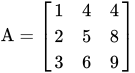
We begin by expanding and partitioning A to include the identity matrix, and then proceed to row reduce A until we reach the identity matrix on the left-hand side.
- Failed to parse (MathML with SVG or PNG fallback (recommended for modern browsers and accessibility tools): Invalid response ("Math extension cannot connect to Restbase.") from server "https://wikimedia.org/api/rest_v1/":): {\displaystyle \begin{bmatrix} 1 & 4 & 4 & \big| & 1 & 0 &0\\ 2 & 5 & 8 & \big| & 0 & 1 &0\\ 3 & 6 & 9 & \big| & 0 & 0 &1 \end{bmatrix} \rightsquigarrow \begin{bmatrix} 1 & 4 & 4 & \big| & 1 & 0 &0\\ 0 & -3 & 0 & \big| & -2 & 1 &0\\ 0 & -6 & -3 & \big| & -3 & 0 &1 \end{bmatrix} \rightsquigarrow \begin{bmatrix} 1 & 4 & 4 & \big| & 1 & 0 &0\\ 0 & 1 & 0 & \big| & 2/3 & -1/3 &0\\ 0 & -6 & -3 & \big| & -3 & 0 &1 \end{bmatrix} \rightsquigarrow }
- Failed to parse (MathML with SVG or PNG fallback (recommended for modern browsers and accessibility tools): Invalid response ("Math extension cannot connect to Restbase.") from server "https://wikimedia.org/api/rest_v1/":): {\displaystyle \begin{bmatrix} 1 & 0 & 4 & \big| & -5/3 & 4/3 &0\\ 0 & 1 & 0 & \big| & 2/3 & -1/3 &0\\ 0 & 0 & -3 & \big| & 1 & -2 &1 \end{bmatrix} \rightsquigarrow \begin{bmatrix} 1 & 0 & 4 & \big| & -5/3 & 4/3 &0\\ 0 & 1 & 0 & \big| & 2/3 & -1/3 &0\\ 0 & 0 & 1 & \big| & -1/3 & 2/3 &-1/3 \end{bmatrix} \rightsquigarrow \begin{bmatrix} 1 & 0 & 0 & \big| & -1/3 & -4/3 &4/3\\ 0 & 1 & 0 & \big| & 2/3 & -1/3 &0\\ 0 & 0 & 1 & \big| & -1/3 & 2/3 &-1/3 \end{bmatrix} }
The matrix Failed to parse (MathML with SVG or PNG fallback (recommended for modern browsers and accessibility tools): Invalid response ("Math extension cannot connect to Restbase.") from server "https://wikimedia.org/api/rest_v1/":): {\displaystyle \mathrm{B} = \begin{bmatrix} -1/3 & -4/3 & 4/3\\ 2/3 & -1/3 & 0\\ -1/3 & 2/3 & -1/3 \end{bmatrix} }
is then the inverse of the original matrix A.
Inverse of a Linear Transformation
We now consider how to represent the inverse of a linear map. We start by recalling some facts about function inverses. Some functions have no inverse, or have an inverse on the left side or right side only.
Definitions
Where Failed to parse (MathML with SVG or PNG fallback (recommended for modern browsers and accessibility tools): Invalid response ("Math extension cannot connect to Restbase.") from server "https://wikimedia.org/api/rest_v1/":): {\displaystyle \pi:\mathbb{R}^3\to \mathbb{R}^2 } is the projection map
- Failed to parse (MathML with SVG or PNG fallback (recommended for modern browsers and accessibility tools): Invalid response ("Math extension cannot connect to Restbase.") from server "https://wikimedia.org/api/rest_v1/":): {\displaystyle \begin{pmatrix} x \\ y \\ z \end{pmatrix} \mapsto \begin{pmatrix} x \\ y \end{pmatrix} }
and Failed to parse (MathML with SVG or PNG fallback (recommended for modern browsers and accessibility tools): Invalid response ("Math extension cannot connect to Restbase.") from server "https://wikimedia.org/api/rest_v1/":): {\displaystyle \eta:\mathbb{R}^2\to \mathbb{R}^3 } is the embedding
- Failed to parse (MathML with SVG or PNG fallback (recommended for modern browsers and accessibility tools): Invalid response ("Math extension cannot connect to Restbase.") from server "https://wikimedia.org/api/rest_v1/":): {\displaystyle \begin{pmatrix} x \\ y \end{pmatrix} \mapsto \begin{pmatrix} x \\ y \\ 0 \end{pmatrix} }
the composition Failed to parse (MathML with SVG or PNG fallback (recommended for modern browsers and accessibility tools): Invalid response ("Math extension cannot connect to Restbase.") from server "https://wikimedia.org/api/rest_v1/":): {\displaystyle \pi\circ \eta} is the identity map on Failed to parse (MathML with SVG or PNG fallback (recommended for modern browsers and accessibility tools): Invalid response ("Math extension cannot connect to Restbase.") from server "https://wikimedia.org/api/rest_v1/":): {\displaystyle \mathbb{R}^2} .
- Failed to parse (MathML with SVG or PNG fallback (recommended for modern browsers and accessibility tools): Invalid response ("Math extension cannot connect to Restbase.") from server "https://wikimedia.org/api/rest_v1/":): {\displaystyle \begin{pmatrix} x \\ y \end{pmatrix} \stackrel{\eta}{\longmapsto} \begin{pmatrix} x \\ y \\ 0 \end{pmatrix} \stackrel{\pi}{\longmapsto} \begin{pmatrix} x \\ y \end{pmatrix} }
We say Failed to parse (MathML with SVG or PNG fallback (recommended for modern browsers and accessibility tools): Invalid response ("Math extension cannot connect to Restbase.") from server "https://wikimedia.org/api/rest_v1/":): {\displaystyle \pi} is a left inverse map of Failed to parse (MathML with SVG or PNG fallback (recommended for modern browsers and accessibility tools): Invalid response ("Math extension cannot connect to Restbase.") from server "https://wikimedia.org/api/rest_v1/":): {\displaystyle \eta} or, what is the same thing, that Failed to parse (MathML with SVG or PNG fallback (recommended for modern browsers and accessibility tools): Invalid response ("Math extension cannot connect to Restbase.") from server "https://wikimedia.org/api/rest_v1/":): {\displaystyle \eta} is a right inverse map of Failed to parse (MathML with SVG or PNG fallback (recommended for modern browsers and accessibility tools): Invalid response ("Math extension cannot connect to Restbase.") from server "https://wikimedia.org/api/rest_v1/":): {\displaystyle \pi} . However, composition in the other order Failed to parse (MathML with SVG or PNG fallback (recommended for modern browsers and accessibility tools): Invalid response ("Math extension cannot connect to Restbase.") from server "https://wikimedia.org/api/rest_v1/":): {\displaystyle \eta\circ \pi} doesn't give the identity map— here is a vector that is not sent to itself under Failed to parse (MathML with SVG or PNG fallback (recommended for modern browsers and accessibility tools): Invalid response ("Math extension cannot connect to Restbase.") from server "https://wikimedia.org/api/rest_v1/":): {\displaystyle \eta\circ \pi} .
- Failed to parse (MathML with SVG or PNG fallback (recommended for modern browsers and accessibility tools): Invalid response ("Math extension cannot connect to Restbase.") from server "https://wikimedia.org/api/rest_v1/":): {\displaystyle \begin{pmatrix} 0 \\ 0 \\ 1 \end{pmatrix} \stackrel{\pi}{\longmapsto} \begin{pmatrix} 0 \\ 0 \end{pmatrix} \stackrel{\eta}{\longmapsto} \begin{pmatrix} 0 \\ 0 \\ 0 \end{pmatrix} }
In fact, the projection Failed to parse (MathML with SVG or PNG fallback (recommended for modern browsers and accessibility tools): Invalid response ("Math extension cannot connect to Restbase.") from server "https://wikimedia.org/api/rest_v1/":): {\displaystyle \pi} has no left inverse at all. For, if Failed to parse (MathML with SVG or PNG fallback (recommended for modern browsers and accessibility tools): Invalid response ("Math extension cannot connect to Restbase.") from server "https://wikimedia.org/api/rest_v1/":): {\displaystyle f} were to be a left inverse of Failed to parse (MathML with SVG or PNG fallback (recommended for modern browsers and accessibility tools): Invalid response ("Math extension cannot connect to Restbase.") from server "https://wikimedia.org/api/rest_v1/":): {\displaystyle \pi} then we would have
- Failed to parse (MathML with SVG or PNG fallback (recommended for modern browsers and accessibility tools): Invalid response ("Math extension cannot connect to Restbase.") from server "https://wikimedia.org/api/rest_v1/":): {\displaystyle \begin{pmatrix} x \\ y \\ z \end{pmatrix} \stackrel{\pi}{\longmapsto} \begin{pmatrix} x \\ y \end{pmatrix} \stackrel{f}{\longmapsto} \begin{pmatrix} x \\ y \\ z \end{pmatrix} }
for all of the infinitely many Failed to parse (MathML with SVG or PNG fallback (recommended for modern browsers and accessibility tools): Invalid response ("Math extension cannot connect to Restbase.") from server "https://wikimedia.org/api/rest_v1/":): {\displaystyle z} 's. But no function Failed to parse (MathML with SVG or PNG fallback (recommended for modern browsers and accessibility tools): Invalid response ("Math extension cannot connect to Restbase.") from server "https://wikimedia.org/api/rest_v1/":): {\displaystyle f} can send a single argument to more than one value.
(An example of a function with no inverse on either side is the zero transformation on Failed to parse (MathML with SVG or PNG fallback (recommended for modern browsers and accessibility tools): Invalid response ("Math extension cannot connect to Restbase.") from server "https://wikimedia.org/api/rest_v1/":): {\displaystyle \mathbb{R}^2} .)
Some functions have a two-sided inverse map, another function that is the inverse of the first, both from the left and from the right. For instance, the map given by Failed to parse (MathML with SVG or PNG fallback (recommended for modern browsers and accessibility tools): Invalid response ("Math extension cannot connect to Restbase.") from server "https://wikimedia.org/api/rest_v1/":): {\displaystyle \vec{v}\mapsto 2\cdot \vec{v}} has the two-sided inverse Failed to parse (MathML with SVG or PNG fallback (recommended for modern browsers and accessibility tools): Invalid response ("Math extension cannot connect to Restbase.") from server "https://wikimedia.org/api/rest_v1/":): {\displaystyle \vec{v}\mapsto (1/2)\cdot\vec{v}} . In this subsection we will focus on two-sided inverses. The appendix shows that a function has a two-sided inverse if and only if it is both one-to-one and onto. Template:AnchorThe appendix also shows that if a function Failed to parse (MathML with SVG or PNG fallback (recommended for modern browsers and accessibility tools): Invalid response ("Math extension cannot connect to Restbase.") from server "https://wikimedia.org/api/rest_v1/":): {\displaystyle f} has a two-sided inverse then it is unique, and so it is called "the" inverse, and is denoted Failed to parse (MathML with SVG or PNG fallback (recommended for modern browsers and accessibility tools): Invalid response ("Math extension cannot connect to Restbase.") from server "https://wikimedia.org/api/rest_v1/":): {\displaystyle f^{-1}} . So our purpose in this subsection is, where a linear map Failed to parse (MathML with SVG or PNG fallback (recommended for modern browsers and accessibility tools): Invalid response ("Math extension cannot connect to Restbase.") from server "https://wikimedia.org/api/rest_v1/":): {\displaystyle h} has an inverse, to find the relationship between Failed to parse (MathML with SVG or PNG fallback (recommended for modern browsers and accessibility tools): Invalid response ("Math extension cannot connect to Restbase.") from server "https://wikimedia.org/api/rest_v1/":): {\displaystyle {\rm Rep}_{B,D}(h)} and Failed to parse (MathML with SVG or PNG fallback (recommended for modern browsers and accessibility tools): Invalid response ("Math extension cannot connect to Restbase.") from server "https://wikimedia.org/api/rest_v1/":): {\displaystyle {\rm Rep}_{D,B}(h^{-1})} .
A matrix Failed to parse (MathML with SVG or PNG fallback (recommended for modern browsers and accessibility tools): Invalid response ("Math extension cannot connect to Restbase.") from server "https://wikimedia.org/api/rest_v1/":): {\displaystyle G } is a left inverse matrix of the matrix Failed to parse (MathML with SVG or PNG fallback (recommended for modern browsers and accessibility tools): Invalid response ("Math extension cannot connect to Restbase.") from server "https://wikimedia.org/api/rest_v1/":): {\displaystyle H } if Failed to parse (MathML with SVG or PNG fallback (recommended for modern browsers and accessibility tools): Invalid response ("Math extension cannot connect to Restbase.") from server "https://wikimedia.org/api/rest_v1/":): {\displaystyle GH } is the identity matrix. It is a right inverse matrix if Failed to parse (MathML with SVG or PNG fallback (recommended for modern browsers and accessibility tools): Invalid response ("Math extension cannot connect to Restbase.") from server "https://wikimedia.org/api/rest_v1/":): {\displaystyle HG } is the identity. A matrix Failed to parse (MathML with SVG or PNG fallback (recommended for modern browsers and accessibility tools): Invalid response ("Math extension cannot connect to Restbase.") from server "https://wikimedia.org/api/rest_v1/":): {\displaystyle H} with a two-sided inverse is an invertible matrix. That two-sided inverse is called the inverse matrix and is denoted Failed to parse (MathML with SVG or PNG fallback (recommended for modern browsers and accessibility tools): Invalid response ("Math extension cannot connect to Restbase.") from server "https://wikimedia.org/api/rest_v1/":): {\displaystyle H^{-1} } .
Because of the correspondence between linear maps and matrices, statements about map inverses translate into statements about matrix inverses.
Lemmas and Theorems
- If a matrix has both a left inverse and a right inverse then the two are equal.
- A matrix is invertible if and only if it is nonsingular.
- Proof: (For both results.) Given a matrix Failed to parse (MathML with SVG or PNG fallback (recommended for modern browsers and accessibility tools): Invalid response ("Math extension cannot connect to Restbase.") from server "https://wikimedia.org/api/rest_v1/":): {\displaystyle H} , fix spaces of appropriate dimension for the domain and codomain. Fix bases for these spaces. With respect to these bases, Failed to parse (MathML with SVG or PNG fallback (recommended for modern browsers and accessibility tools): Invalid response ("Math extension cannot connect to Restbase.") from server "https://wikimedia.org/api/rest_v1/":): {\displaystyle H} represents a map Failed to parse (MathML with SVG or PNG fallback (recommended for modern browsers and accessibility tools): Invalid response ("Math extension cannot connect to Restbase.") from server "https://wikimedia.org/api/rest_v1/":): {\displaystyle h} . The statements are true about the map and therefore they are true about the matrix.
- A product of invertible matrices is invertible— if Failed to parse (MathML with SVG or PNG fallback (recommended for modern browsers and accessibility tools): Invalid response ("Math extension cannot connect to Restbase.") from server "https://wikimedia.org/api/rest_v1/":): {\displaystyle G }
and Failed to parse (MathML with SVG or PNG fallback (recommended for modern browsers and accessibility tools): Invalid response ("Math extension cannot connect to Restbase.") from server "https://wikimedia.org/api/rest_v1/":): {\displaystyle H }
are invertible and if Failed to parse (MathML with SVG or PNG fallback (recommended for modern browsers and accessibility tools): Invalid response ("Math extension cannot connect to Restbase.") from server "https://wikimedia.org/api/rest_v1/":): {\displaystyle GH }
is defined then Failed to parse (MathML with SVG or PNG fallback (recommended for modern browsers and accessibility tools): Invalid response ("Math extension cannot connect to Restbase.") from server "https://wikimedia.org/api/rest_v1/":): {\displaystyle GH }
is invertible and Failed to parse (MathML with SVG or PNG fallback (recommended for modern browsers and accessibility tools): Invalid response ("Math extension cannot connect to Restbase.") from server "https://wikimedia.org/api/rest_v1/":): {\displaystyle (GH)^{-1}=H^{-1}G^{-1} }
.
- Proof: (This is just like the prior proof except that it requires two maps.) Fix appropriate spaces and bases and consider the represented maps Failed to parse (MathML with SVG or PNG fallback (recommended for modern browsers and accessibility tools): Invalid response ("Math extension cannot connect to Restbase.") from server "https://wikimedia.org/api/rest_v1/":): {\displaystyle h } and Failed to parse (MathML with SVG or PNG fallback (recommended for modern browsers and accessibility tools): Invalid response ("Math extension cannot connect to Restbase.") from server "https://wikimedia.org/api/rest_v1/":): {\displaystyle g } . Note that Failed to parse (MathML with SVG or PNG fallback (recommended for modern browsers and accessibility tools): Invalid response ("Math extension cannot connect to Restbase.") from server "https://wikimedia.org/api/rest_v1/":): {\displaystyle h^{-1}g^{-1} } is a two-sided map inverse of Failed to parse (MathML with SVG or PNG fallback (recommended for modern browsers and accessibility tools): Invalid response ("Math extension cannot connect to Restbase.") from server "https://wikimedia.org/api/rest_v1/":): {\displaystyle gh } since and . This equality is reflected in the matrices representing the maps, as required.


Here is the arrow diagram giving the relationship
between map inverses and matrix inverses.
It is a special case
of the diagram for function composition and matrix multiplication.

Beyond its place in our general program of seeing how to represent map operations, another reason for our interest in inverses comes from solving linear systems. A linear system is equivalent to a matrix equation, as here.
- Failed to parse (MathML with SVG or PNG fallback (recommended for modern browsers and accessibility tools): Invalid response ("Math extension cannot connect to Restbase.") from server "https://wikimedia.org/api/rest_v1/":): {\displaystyle \begin{array}{*{2}{rc}r} x_1 &+ &x_2 &= &3 \\ 2x_1 &- &x_2 &= &2 \end{array} \quad\Longleftrightarrow\quad \begin{pmatrix} 1 &1 \\ 2 &-1 \end{pmatrix} \begin{pmatrix} x_1 \\ x_2 \end{pmatrix} = \begin{pmatrix} 3 \\ 2 \end{pmatrix} \qquad\qquad (*)}
By fixing spaces and bases (e.g., Failed to parse (MathML with SVG or PNG fallback (recommended for modern browsers and accessibility tools): Invalid response ("Math extension cannot connect to Restbase.") from server "https://wikimedia.org/api/rest_v1/":): {\displaystyle \mathbb{R}^2, \mathbb{R}^2 } and Failed to parse (MathML with SVG or PNG fallback (recommended for modern browsers and accessibility tools): Invalid response ("Math extension cannot connect to Restbase.") from server "https://wikimedia.org/api/rest_v1/":): {\displaystyle \mathcal{E}_2,\mathcal{E}_2} ), we take the matrix Failed to parse (MathML with SVG or PNG fallback (recommended for modern browsers and accessibility tools): Invalid response ("Math extension cannot connect to Restbase.") from server "https://wikimedia.org/api/rest_v1/":): {\displaystyle H} to represent some map Failed to parse (MathML with SVG or PNG fallback (recommended for modern browsers and accessibility tools): Invalid response ("Math extension cannot connect to Restbase.") from server "https://wikimedia.org/api/rest_v1/":): {\displaystyle h} . Then solving the system is the same as asking: what domain vector Failed to parse (MathML with SVG or PNG fallback (recommended for modern browsers and accessibility tools): Invalid response ("Math extension cannot connect to Restbase.") from server "https://wikimedia.org/api/rest_v1/":): {\displaystyle \vec{x}} is mapped by Failed to parse (MathML with SVG or PNG fallback (recommended for modern browsers and accessibility tools): Invalid response ("Math extension cannot connect to Restbase.") from server "https://wikimedia.org/api/rest_v1/":): {\displaystyle h} to the result Failed to parse (MathML with SVG or PNG fallback (recommended for modern browsers and accessibility tools): Invalid response ("Math extension cannot connect to Restbase.") from server "https://wikimedia.org/api/rest_v1/":): {\displaystyle \vec{d}\,} ? If we could invert Failed to parse (MathML with SVG or PNG fallback (recommended for modern browsers and accessibility tools): Invalid response ("Math extension cannot connect to Restbase.") from server "https://wikimedia.org/api/rest_v1/":): {\displaystyle h} then we could solve the system by multiplying Failed to parse (MathML with SVG or PNG fallback (recommended for modern browsers and accessibility tools): Invalid response ("Math extension cannot connect to Restbase.") from server "https://wikimedia.org/api/rest_v1/":): {\displaystyle {\rm Rep}_{D,B}(h^{-1})\cdot{\rm Rep}_{D}(\vec{d})} to get Failed to parse (MathML with SVG or PNG fallback (recommended for modern browsers and accessibility tools): Invalid response ("Math extension cannot connect to Restbase.") from server "https://wikimedia.org/api/rest_v1/":): {\displaystyle {\rm Rep}_{B}(\vec{x})} .
Example 2
We can find a left inverse for the matrix just given
- Failed to parse (MathML with SVG or PNG fallback (recommended for modern browsers and accessibility tools): Invalid response ("Math extension cannot connect to Restbase.") from server "https://wikimedia.org/api/rest_v1/":): {\displaystyle \begin{pmatrix} m &n \\ p &q \end{pmatrix} \begin{pmatrix} 1 &1 \\ 2 &-1 \end{pmatrix} = \begin{pmatrix} 1 &0 \\ 0 &1 \end{pmatrix} }
by using Gauss' method to solve the resulting linear system.
- Failed to parse (MathML with SVG or PNG fallback (recommended for modern browsers and accessibility tools): Invalid response ("Math extension cannot connect to Restbase.") from server "https://wikimedia.org/api/rest_v1/":): {\displaystyle \begin{array}{*{4}{rc}r} m &+ &2n & & & & &= &1 \\ m &- &n & & & & &= &0 \\ & & & &p &+ &2q &= &0 \\ & & & &p &- &q &= &1 \end{array} }
Answer: Failed to parse (MathML with SVG or PNG fallback (recommended for modern browsers and accessibility tools): Invalid response ("Math extension cannot connect to Restbase.") from server "https://wikimedia.org/api/rest_v1/":): {\displaystyle m=1/3 } , Failed to parse (MathML with SVG or PNG fallback (recommended for modern browsers and accessibility tools): Invalid response ("Math extension cannot connect to Restbase.") from server "https://wikimedia.org/api/rest_v1/":): {\displaystyle n=1/3 } , Failed to parse (MathML with SVG or PNG fallback (recommended for modern browsers and accessibility tools): Invalid response ("Math extension cannot connect to Restbase.") from server "https://wikimedia.org/api/rest_v1/":): {\displaystyle p=2/3 } , and Failed to parse (MathML with SVG or PNG fallback (recommended for modern browsers and accessibility tools): Invalid response ("Math extension cannot connect to Restbase.") from server "https://wikimedia.org/api/rest_v1/":): {\displaystyle q=-1/3 } . This matrix is actually the two-sided inverse of Failed to parse (MathML with SVG or PNG fallback (recommended for modern browsers and accessibility tools): Invalid response ("Math extension cannot connect to Restbase.") from server "https://wikimedia.org/api/rest_v1/":): {\displaystyle H} , as can easily be checked. With it we can solve the system (Failed to parse (MathML with SVG or PNG fallback (recommended for modern browsers and accessibility tools): Invalid response ("Math extension cannot connect to Restbase.") from server "https://wikimedia.org/api/rest_v1/":): {\displaystyle *} ) above by applying the inverse.
- Failed to parse (MathML with SVG or PNG fallback (recommended for modern browsers and accessibility tools): Invalid response ("Math extension cannot connect to Restbase.") from server "https://wikimedia.org/api/rest_v1/":): {\displaystyle \begin{pmatrix} x \\ y \end{pmatrix} =\begin{pmatrix} 1/3 &1/3 \\ 2/3 &-1/3 \end{pmatrix} \begin{pmatrix} 3 \\ 2 \end{pmatrix} =\begin{pmatrix} 5/3 \\ 4/3 \end{pmatrix} }
Remark
Why solve systems this way, when Gauss' method takes less arithmetic (this assertion can be made precise by counting the number of arithmetic operations, as computer algorithm designers do)? Beyond its conceptual appeal of fitting into our program of discovering how to represent the various map operations, solving linear systems by using the matrix inverse has at least two advantages.
First, once the work of finding an inverse has been done, solving a system with the same coefficients but different constants is easy and fast: if we change the entries on the right of the system (Failed to parse (MathML with SVG or PNG fallback (recommended for modern browsers and accessibility tools): Invalid response ("Math extension cannot connect to Restbase.") from server "https://wikimedia.org/api/rest_v1/":): {\displaystyle *} ) then we get a related problem
- Failed to parse (MathML with SVG or PNG fallback (recommended for modern browsers and accessibility tools): Invalid response ("Math extension cannot connect to Restbase.") from server "https://wikimedia.org/api/rest_v1/":): {\displaystyle \begin{pmatrix} 1 &1 \\ 2 &-1 \end{pmatrix} \begin{pmatrix} x \\ y \end{pmatrix} = \begin{pmatrix} 5 \\ 1 \end{pmatrix} }
with a related solution method.
- Failed to parse (MathML with SVG or PNG fallback (recommended for modern browsers and accessibility tools): Invalid response ("Math extension cannot connect to Restbase.") from server "https://wikimedia.org/api/rest_v1/":): {\displaystyle \begin{pmatrix} x \\ y \end{pmatrix} = \begin{pmatrix} 1/3 &1/3 \\ 2/3 &-1/3 \end{pmatrix} \begin{pmatrix} 5 \\ 1 \end{pmatrix} = \begin{pmatrix} 2 \\ 3 \end{pmatrix} }
In applications, solving many systems having the same matrix of coefficients is common.
Another advantage of inverses is that we can explore a system's sensitivity to changes in the constants. For example, tweaking the Failed to parse (MathML with SVG or PNG fallback (recommended for modern browsers and accessibility tools): Invalid response ("Math extension cannot connect to Restbase.") from server "https://wikimedia.org/api/rest_v1/":): {\displaystyle 3} on the right of the system (Failed to parse (MathML with SVG or PNG fallback (recommended for modern browsers and accessibility tools): Invalid response ("Math extension cannot connect to Restbase.") from server "https://wikimedia.org/api/rest_v1/":): {\displaystyle *} ) to
- Failed to parse (MathML with SVG or PNG fallback (recommended for modern browsers and accessibility tools): Invalid response ("Math extension cannot connect to Restbase.") from server "https://wikimedia.org/api/rest_v1/":): {\displaystyle \begin{pmatrix} 1 &1 \\ 2 &-1 \end{pmatrix} \begin{pmatrix} x_1 \\ x_2 \end{pmatrix} = \begin{pmatrix} 3.01 \\ 2 \end{pmatrix} }
can be solved with the inverse.
- Failed to parse (MathML with SVG or PNG fallback (recommended for modern browsers and accessibility tools): Invalid response ("Math extension cannot connect to Restbase.") from server "https://wikimedia.org/api/rest_v1/":): {\displaystyle \begin{pmatrix} 1/3 &1/3 \\ 2/3 &-1/3 \end{pmatrix} \begin{pmatrix} 3.01 \\ 2 \end{pmatrix} = \begin{pmatrix} (1/3)(3.01)+(1/3)(2) \\ (2/3)(3.01)-(1/3)(2) \end{pmatrix} }
to show that Failed to parse (MathML with SVG or PNG fallback (recommended for modern browsers and accessibility tools): Invalid response ("Math extension cannot connect to Restbase.") from server "https://wikimedia.org/api/rest_v1/":): {\displaystyle x_1 } changes by Failed to parse (MathML with SVG or PNG fallback (recommended for modern browsers and accessibility tools): Invalid response ("Math extension cannot connect to Restbase.") from server "https://wikimedia.org/api/rest_v1/":): {\displaystyle 1/3 } of the tweak while Failed to parse (MathML with SVG or PNG fallback (recommended for modern browsers and accessibility tools): Invalid response ("Math extension cannot connect to Restbase.") from server "https://wikimedia.org/api/rest_v1/":): {\displaystyle x_2 } moves by Failed to parse (MathML with SVG or PNG fallback (recommended for modern browsers and accessibility tools): Invalid response ("Math extension cannot connect to Restbase.") from server "https://wikimedia.org/api/rest_v1/":): {\displaystyle 2/3 } of that tweak. This sort of analysis is used, for example, to decide how accurately data must be specified in a linear model to ensure that the solution has a desired accuracy. }}
We finish by describing the computational procedure usually used to find the inverse matrix.
- A matrix is invertible if and only if it can be written as the product of elementary reduction matrices. The inverse can be computed by applying to the identity matrix the same row steps, in the same order, as are used to Gauss-Jordan reduce the invertible matrix.
- Proof: A matrix Failed to parse (MathML with SVG or PNG fallback (recommended for modern browsers and accessibility tools): Invalid response ("Math extension cannot connect to Restbase.") from server "https://wikimedia.org/api/rest_v1/":): {\displaystyle H} is invertible if and only if it is nonsingular and thus Gauss-Jordan reduces to the identity. This reduction can be done with elementary matrices
- Failed to parse (MathML with SVG or PNG fallback (recommended for modern browsers and accessibility tools): Invalid response ("Math extension cannot connect to Restbase.") from server "https://wikimedia.org/api/rest_v1/":): {\displaystyle R_{r}\cdot R_{r-1}\cdot\dots R_{1}\cdot H=I } .
- This equation gives the two halves of the result.
- First, elementary matrices are invertible and their inverses are also elementary. Applying Failed to parse (MathML with SVG or PNG fallback (recommended for modern browsers and accessibility tools): Invalid response ("Math extension cannot connect to Restbase.") from server "https://wikimedia.org/api/rest_v1/":): {\displaystyle R_r^{-1}} to the left of both sides of that equation, then Failed to parse (MathML with SVG or PNG fallback (recommended for modern browsers and accessibility tools): Invalid response ("Math extension cannot connect to Restbase.") from server "https://wikimedia.org/api/rest_v1/":): {\displaystyle R_{r-1}^{-1}} , etc., gives Failed to parse (MathML with SVG or PNG fallback (recommended for modern browsers and accessibility tools): Invalid response ("Math extension cannot connect to Restbase.") from server "https://wikimedia.org/api/rest_v1/":): {\displaystyle H} as the product of elementary matrices Failed to parse (MathML with SVG or PNG fallback (recommended for modern browsers and accessibility tools): Invalid response ("Math extension cannot connect to Restbase.") from server "https://wikimedia.org/api/rest_v1/":): {\displaystyle H=R_1^{-1}\cdots R_r^{-1}\cdot I} (the Failed to parse (MathML with SVG or PNG fallback (recommended for modern browsers and accessibility tools): Invalid response ("Math extension cannot connect to Restbase.") from server "https://wikimedia.org/api/rest_v1/":): {\displaystyle I} is here to cover the trivial Failed to parse (MathML with SVG or PNG fallback (recommended for modern browsers and accessibility tools): Invalid response ("Math extension cannot connect to Restbase.") from server "https://wikimedia.org/api/rest_v1/":): {\displaystyle r=0} case).
- Second, matrix inverses are unique and so comparison of the above equation with Failed to parse (MathML with SVG or PNG fallback (recommended for modern browsers and accessibility tools): Invalid response ("Math extension cannot connect to Restbase.") from server "https://wikimedia.org/api/rest_v1/":): {\displaystyle H^{-1}H=I} shows that Failed to parse (MathML with SVG or PNG fallback (recommended for modern browsers and accessibility tools): Invalid response ("Math extension cannot connect to Restbase.") from server "https://wikimedia.org/api/rest_v1/":): {\displaystyle H^{-1}=R_r\cdot R_{r-1}\dots R_1\cdot I} . Therefore, applying Failed to parse (MathML with SVG or PNG fallback (recommended for modern browsers and accessibility tools): Invalid response ("Math extension cannot connect to Restbase.") from server "https://wikimedia.org/api/rest_v1/":): {\displaystyle R_1} to the identity, followed by Failed to parse (MathML with SVG or PNG fallback (recommended for modern browsers and accessibility tools): Invalid response ("Math extension cannot connect to Restbase.") from server "https://wikimedia.org/api/rest_v1/":): {\displaystyle R_2} , etc., yields the inverse of Failed to parse (MathML with SVG or PNG fallback (recommended for modern browsers and accessibility tools): Invalid response ("Math extension cannot connect to Restbase.") from server "https://wikimedia.org/api/rest_v1/":): {\displaystyle H} .
Example 3
To find the inverse of
- Failed to parse (MathML with SVG or PNG fallback (recommended for modern browsers and accessibility tools): Invalid response ("Math extension cannot connect to Restbase.") from server "https://wikimedia.org/api/rest_v1/":): {\displaystyle \begin{pmatrix} 1 &1 \\ 2 &-1 \end{pmatrix} }
we do Gauss-Jordan reduction, meanwhile performing the same operations on the identity. For clerical convenience we write the matrix and the identity side-by-side, and do the reduction steps together.
- Failed to parse (MathML with SVG or PNG fallback (recommended for modern browsers and accessibility tools): Invalid response ("Math extension cannot connect to Restbase.") from server "https://wikimedia.org/api/rest_v1/":): {\displaystyle \begin{array}{rcl} \left(\begin{array}{cc|cc} 1 &1 &1 &0 \\ 2 &-1 &0 &1 \end{array}\right) &\xrightarrow[]{-2\rho_1+\rho_2} &\left(\begin{array}{cc|cc} 1 &1 &1 &0 \\ 0 &-3 &-2 &1 \end{array}\right) \\ &\xrightarrow[]{-1/3\rho_2} &\left(\begin{array}{cc|cc} 1 &1 &1 &0 \\ 0 &1 &2/3 &-1/3 \end{array}\right) \\ &\xrightarrow[]{-\rho_2+\rho_1} &\left(\begin{array}{cc|cc} 1 &0 &1/3 &1/3 \\ 0 &1 &2/3 &-1/3 \end{array}\right) \end{array} }
This calculation has found the inverse.
- Failed to parse (MathML with SVG or PNG fallback (recommended for modern browsers and accessibility tools): Invalid response ("Math extension cannot connect to Restbase.") from server "https://wikimedia.org/api/rest_v1/":): {\displaystyle \begin{pmatrix} 1 &1 \\ 2 &-1 \end{pmatrix}^{-1} = \begin{pmatrix} 1/3 &1/3 \\ 2/3 &-1/3 \end{pmatrix} }
Example 4
This one happens to start with a row swap.
- Failed to parse (MathML with SVG or PNG fallback (recommended for modern browsers and accessibility tools): Invalid response ("Math extension cannot connect to Restbase.") from server "https://wikimedia.org/api/rest_v1/":): {\displaystyle \begin{array}{rcl} \left(\begin{array}{ccc|ccc} 0 &3 &-1 &1 &0 &0 \\ 1 &0 &1 &0 &1 &0 \\ 1 &-1 &0 &0 &0 &1 \end{array}\right) &\xrightarrow[]{\rho_1\leftrightarrow\rho_2} & \left(\begin{array}{ccc|ccc} 1 &0 &1 &0 &1 &0 \\ 0 &3 &-1 &1 &0 &0 \\ 1 &-1 &0 &0 &0 &1 \end{array}\right) \\ &\xrightarrow[]{-\rho_1+\rho_3} & \left(\begin{array}{ccc|ccc} 1 &0 &1 &0 &1 &0 \\ 0 &3 &-1 &1 &0 &0 \\ 0 &-1 &-1 &0 &-1 &1 \end{array}\right) \\ &\vdots \\ &\xrightarrow[]{} & \left(\begin{array}{ccc|ccc} 1 &0 &0 &1/4 &1/4 &3/4 \\ 0 &1 &0 &1/4 &1/4 &-1/4 \\ 0 &0 &1 &-1/4 &3/4 &-3/4 \end{array}\right) \end{array} }
}}
Example 5
A non-invertible matrix is detected by the fact that the left half won't reduce to the identity.
![{\displaystyle \left({\begin{array}{cc|cc}1&1&1&0\\2&2&0&1\end{array}}\right){\xrightarrow[{}]{-2\rho _{1}+\rho _{2}}}\left({\begin{array}{cc|cc}1&1&1&0\\0&0&-2&1\end{array}}\right)}](https://wikimedia.org/api/rest_v1/media/math/render/svg/920de8987fe84b9cf78efce1afd5cec95aea5d22)
}}
This procedure will find the inverse of a general Failed to parse (MathML with SVG or PNG fallback (recommended for modern browsers and accessibility tools): Invalid response ("Math extension cannot connect to Restbase.") from server "https://wikimedia.org/api/rest_v1/":): {\displaystyle n \! \times \! n} matrix. The Failed to parse (MathML with SVG or PNG fallback (recommended for modern browsers and accessibility tools): Invalid response ("Math extension cannot connect to Restbase.") from server "https://wikimedia.org/api/rest_v1/":): {\displaystyle 2 \! \times \! 2} case is handy.

