Difference between revisions of "Factoring Polynomials"
| Line 1: | Line 1: | ||
| + | ==Useful Formulas== | ||
| + | Computing factors of polynomials requires knowledge of different formulas | ||
| + | and some experience to find out which formula to be applied. Below, we give | ||
| + | some important formulas: | ||
| + | |||
| + | <math>{x^2-y^2=(x+y)(x-y)}</math> | ||
| + | |||
| + | <math>{x^2+2xy+y^2=(x+y)^2}</math> | ||
| + | |||
| + | <math>{x^2-2xy+y^2=(x-y)^2}</math> | ||
| + | |||
| + | <math>{x^3-y^3=(x-y)(x^2+xy+y^2)}</math> | ||
| + | |||
| + | <math>{x^3+y^3=(x+y)(x^2-xy+y^2)}</math> | ||
| + | |||
| + | <math>{a^3+b^3+c^3-3abc=(a+b+c)(a^2+b^2+c^2-ab-ac-bc)}</math> | ||
| + | |||
| + | ==Methods== | ||
| + | Given the expression <math>x^2+3x+2</math> , one may ask "what are the values of <math>x</math> that make this expression 0?" If we factor we obtain | ||
| + | <center><math>x^2+3x+2=(x+2)(x+1)</math></center> . | ||
| + | If <math>x=-1,-2</math> , then one of the factors on the right becomes zero. Therefore, the whole must be zero. So, by factoring we have discovered the values of <math>x</math> that render the expression zero. These values are termed "roots." In general, given a quadratic polynomial <math>px^2+qx+r</math> that factors as | ||
| + | <center><math>px^2+qx+r=(ax+c)(bx+d)</math></center> | ||
| + | then we have that <math>x=-\frac{c}{a}</math> and <math>x=-\frac{d}{b}</math> are roots of the original polynomial. | ||
| + | |||
| + | A special case to be on the look out for is the difference of two squares, <math>a^2-b^2</math> . In this case, we are always able to factor as | ||
| + | <center><math>a^2-b^2=(a+b)(a-b)</math></center>For example, consider <math>4x^2-9</math> . On initial inspection we would see that both <math>4x^2</math> and <math>9</math> are squares of <math>2x</math> and <math>3</math>, respectively. Applying the previous rule we have | ||
| + | <center><math>4x^2-9=(2x+3)(2x-3)</math></center> | ||
| + | |||
| + | === The AC method === | ||
| + | |||
| + | There is a way of simplifying the process of factoring using the AC method. Suppose that a quadratic polynomial has a formula of | ||
| + | |||
| + | <center><math>ax^2+bx+c</math></center> | ||
| + | |||
| + | If there are numbers <math>r</math> and <math>q</math> that satisfy both | ||
| + | |||
| + | <center><math>r\cdot q=ac</math> and <math>r+q=b</math></center> | ||
| + | |||
| + | Then, we can rewrite the polynomial as | ||
| + | |||
| + | <center><math>ax^2+bx+c=ax^2 + rx + qx + c</math></center> | ||
| + | |||
| + | and factor out a common term from <math>(ax^2 + rx)</math> and <math>(qx + c)</math> to factor the polynomial. | ||
| + | |||
| + | |||
| + | For example, take the polynomial <math> 2x^2 + 7x - 15 </math>. | ||
| + | |||
| + | <math> ac = 2(-15) = -30</math>. <math> 10(-3) = -30 = ac </math> and <math> 10 + (-3) = 7 = b</math>, so we can rewrite the polynomial as <math> 2x^2 + 10x - 3x - 15 </math>. From here, we can factor <math> 2x </math> from the first two terms, and <math> -3 </math> from the last two, which gives us <math> 2x(x + 5) + (-3)(x + 5) = (2x - 3)(x + 5) </math>. Thus, the factored form of <math> 2x^2 + 7x - 15 </math> is <math> (2x - 3)(x + 5) </math>. Note that if we reverse the order of <math>10x</math> and <math>-3x</math>, we get <math> 2x^2 -3x + 10x - 15 = x(2x - 3) + 5(2x - 3) = (x + 5)(2x - 3)</math>, which is the same factored form that we got previously. Thus, the order of <math>rx</math> and <math>qx</math> should not matter when using the AC method to factor a quadratic polynomial. | ||
| + | |||
| + | === The quadratic formula === | ||
| + | Given any quadratic equation <math>ax^2+bx+c=0\ ,\ a\ne0</math>, all solutions of the equation are given by the quadratic formula:</br> | ||
| + | :<math>x=\frac{-b \pm \sqrt{b^2 - 4ac} }{2a}</math>}}Note that the value of <math>b^2-4ac</math> will affect the number of ''real'' solutions of the equation. | ||
| + | {| class="wikitable" style="margin: 0 auto;" | ||
| + | !If | ||
| + | !Then | ||
| + | |- | ||
| + | |<math>b^2-4ac>0</math> | ||
| + | |There are two real solutions for the equation | ||
| + | |- | ||
| + | |<math>b^2-4ac=0</math> | ||
| + | |There are only one real solutions for the equation | ||
| + | |- | ||
| + | |<math>b^2-4ac<0</math> | ||
| + | |There are no real solutions for the equation | ||
| + | |} | ||
| + | |||
| + | ==Example Problems== | ||
| + | EXAMPLE 1: Find all the roots of <math>4x^2+7x-2</math> | ||
| + | : Finding the roots is equivalent to solving the equation <math>4x^2+7x-2=0</math> . Applying the quadratic formula with <math>a=4\ ,\ b=7\ ,\ c=-2</math> , we have:</br> | ||
| + | :: <math>x=\frac{-7\pm\sqrt{7^2-4(4)(-2)}}{2(4)}</math> | ||
| + | |||
| + | :: <math>x=\frac{-7\pm\sqrt{49+32}}{8}</math> | ||
| + | |||
| + | :: <math>x=\frac{-7\pm\sqrt{81}}{8}</math> | ||
| + | |||
| + | :: <math>x=\frac{-7\pm9}{8}</math> | ||
| + | |||
| + | :: <math>x=\frac{2}{8}\ ,\ x=\frac{-16}{8}</math> | ||
| + | |||
| + | :: <math>x=\frac{1}{4}\ ,\ x=-2</math> | ||
| + | |||
| + | : The quadratic formula can also help with factoring, as the next example demonstrates. | ||
| + | |||
| + | EXAMPLE 2: Factor the polynomial <math>4x^2+7x-2</math> | ||
| + | : We already know from the previous example that the polynomial has roots <math>x=\frac{1}{4}</math> and <math>x=-2</math> . Our factorization will take the form <br/> <math>C(x+2)\left(x-\tfrac{1}{4}\right)</math><br/>. | ||
| + | : All we have to do is set this expression equal to our polynomial and solve for the unknown constant C:</br> | ||
| + | :: <math>C(x+2)\left(x-\tfrac{1}{4}\right)=4x^2+7x-2</math> | ||
| + | |||
| + | :: <math>C\left(x^2+\left(-\tfrac{1}{4}+2\right)x-\tfrac{2}{4}\right)=4x^2+7x-2</math> | ||
| + | |||
| + | :: <math>C\left(x^2+\tfrac{7}{4}x-\tfrac{1}{2}\right)=4x^2+7x-2</math> | ||
| + | |||
| + | : You can see that <math>C=4</math> solves the equation. So the factorization is</br> | ||
| + | :: <math>4x^2+7x-2=4(x+2)\left(x-\tfrac{1}{4}\right)=(x+2)(4x-1)</math> | ||
| + | |||
| + | EXAMPLE 3: Factor the polynomial <math> 6x^2 + 7x + 2 </math>. | ||
| + | : For this problem, let's use the AC method. <math> a = 6 </math>, <math> b = 7 </math>, and <math> c = 2 </math>. So, <math> ac = 6(2) = 12 </math>, and we need to find two numbers whose product equals 12, and whose sum equals 7. Both ac and b are positive, so we are only concerned with the positive factors of 12, which are <math> 1, 2, 3, 4, 6, </math>and <math> 12 </math>. <math> 3(4) = 12 = ac </math> and <math> 3 + 4 = 7 = b </math>, so we can rewrite the polynomial as <math> 6x^2 + 3x + 4x + 2 = (3x)(2x + 1) = 2(2x + 1) = (3x + 2)(2x+1)</math>. | ||
| + | |||
| + | |||
==Resources== | ==Resources== | ||
* [https://tutorial.math.lamar.edu/classes/alg/factoring.aspx Factoring Polynomials with Example Problems], Paul's Online Notes | * [https://tutorial.math.lamar.edu/classes/alg/factoring.aspx Factoring Polynomials with Example Problems], Paul's Online Notes | ||
Revision as of 10:12, 30 September 2021
Contents
Useful Formulas
Computing factors of polynomials requires knowledge of different formulas and some experience to find out which formula to be applied. Below, we give some important formulas:
Failed to parse (MathML with SVG or PNG fallback (recommended for modern browsers and accessibility tools): Invalid response ("Math extension cannot connect to Restbase.") from server "https://wikimedia.org/api/rest_v1/":): {\displaystyle {x^2-y^2=(x+y)(x-y)}}
Failed to parse (MathML with SVG or PNG fallback (recommended for modern browsers and accessibility tools): Invalid response ("Math extension cannot connect to Restbase.") from server "https://wikimedia.org/api/rest_v1/":): {\displaystyle {x^2+2xy+y^2=(x+y)^2}}
Failed to parse (MathML with SVG or PNG fallback (recommended for modern browsers and accessibility tools): Invalid response ("Math extension cannot connect to Restbase.") from server "https://wikimedia.org/api/rest_v1/":): {\displaystyle {x^2-2xy+y^2=(x-y)^2}}
Failed to parse (MathML with SVG or PNG fallback (recommended for modern browsers and accessibility tools): Invalid response ("Math extension cannot connect to Restbase.") from server "https://wikimedia.org/api/rest_v1/":): {\displaystyle {x^3-y^3=(x-y)(x^2+xy+y^2)}}
Failed to parse (MathML with SVG or PNG fallback (recommended for modern browsers and accessibility tools): Invalid response ("Math extension cannot connect to Restbase.") from server "https://wikimedia.org/api/rest_v1/":): {\displaystyle {x^3+y^3=(x+y)(x^2-xy+y^2)}}
Failed to parse (MathML with SVG or PNG fallback (recommended for modern browsers and accessibility tools): Invalid response ("Math extension cannot connect to Restbase.") from server "https://wikimedia.org/api/rest_v1/":): {\displaystyle {a^3+b^3+c^3-3abc=(a+b+c)(a^2+b^2+c^2-ab-ac-bc)}}
Methods
Given the expression Failed to parse (MathML with SVG or PNG fallback (recommended for modern browsers and accessibility tools): Invalid response ("Math extension cannot connect to Restbase.") from server "https://wikimedia.org/api/rest_v1/":): {\displaystyle x^2+3x+2} , one may ask "what are the values of Failed to parse (MathML with SVG or PNG fallback (recommended for modern browsers and accessibility tools): Invalid response ("Math extension cannot connect to Restbase.") from server "https://wikimedia.org/api/rest_v1/":): {\displaystyle x} that make this expression 0?" If we factor we obtain
.
If Failed to parse (MathML with SVG or PNG fallback (recommended for modern browsers and accessibility tools): Invalid response ("Math extension cannot connect to Restbase.") from server "https://wikimedia.org/api/rest_v1/":): {\displaystyle x=-1,-2} , then one of the factors on the right becomes zero. Therefore, the whole must be zero. So, by factoring we have discovered the values of Failed to parse (MathML with SVG or PNG fallback (recommended for modern browsers and accessibility tools): Invalid response ("Math extension cannot connect to Restbase.") from server "https://wikimedia.org/api/rest_v1/":): {\displaystyle x} that render the expression zero. These values are termed "roots." In general, given a quadratic polynomial Failed to parse (MathML with SVG or PNG fallback (recommended for modern browsers and accessibility tools): Invalid response ("Math extension cannot connect to Restbase.") from server "https://wikimedia.org/api/rest_v1/":): {\displaystyle px^2+qx+r} that factors as
then we have that Failed to parse (MathML with SVG or PNG fallback (recommended for modern browsers and accessibility tools): Invalid response ("Math extension cannot connect to Restbase.") from server "https://wikimedia.org/api/rest_v1/":): {\displaystyle x=-\frac{c}{a}} and are roots of the original polynomial.

A special case to be on the look out for is the difference of two squares, Failed to parse (MathML with SVG or PNG fallback (recommended for modern browsers and accessibility tools): Invalid response ("Math extension cannot connect to Restbase.") from server "https://wikimedia.org/api/rest_v1/":): {\displaystyle a^2-b^2} . In this case, we are always able to factor as
For example, consider Failed to parse (MathML with SVG or PNG fallback (recommended for modern browsers and accessibility tools): Invalid response ("Math extension cannot connect to Restbase.") from server "https://wikimedia.org/api/rest_v1/":): {\displaystyle 4x^2-9} . On initial inspection we would see that both Failed to parse (MathML with SVG or PNG fallback (recommended for modern browsers and accessibility tools): Invalid response ("Math extension cannot connect to Restbase.") from server "https://wikimedia.org/api/rest_v1/":): {\displaystyle 4x^2} and Failed to parse (MathML with SVG or PNG fallback (recommended for modern browsers and accessibility tools): Invalid response ("Math extension cannot connect to Restbase.") from server "https://wikimedia.org/api/rest_v1/":): {\displaystyle 9} are squares of Failed to parse (MathML with SVG or PNG fallback (recommended for modern browsers and accessibility tools): Invalid response ("Math extension cannot connect to Restbase.") from server "https://wikimedia.org/api/rest_v1/":): {\displaystyle 2x} and Failed to parse (MathML with SVG or PNG fallback (recommended for modern browsers and accessibility tools): Invalid response ("Math extension cannot connect to Restbase.") from server "https://wikimedia.org/api/rest_v1/":): {\displaystyle 3} , respectively. Applying the previous rule we have
The AC method
There is a way of simplifying the process of factoring using the AC method. Suppose that a quadratic polynomial has a formula of
If there are numbers Failed to parse (MathML with SVG or PNG fallback (recommended for modern browsers and accessibility tools): Invalid response ("Math extension cannot connect to Restbase.") from server "https://wikimedia.org/api/rest_v1/":): {\displaystyle r} and Failed to parse (MathML with SVG or PNG fallback (recommended for modern browsers and accessibility tools): Invalid response ("Math extension cannot connect to Restbase.") from server "https://wikimedia.org/api/rest_v1/":): {\displaystyle q} that satisfy both
Then, we can rewrite the polynomial as
and factor out a common term from Failed to parse (MathML with SVG or PNG fallback (recommended for modern browsers and accessibility tools): Invalid response ("Math extension cannot connect to Restbase.") from server "https://wikimedia.org/api/rest_v1/":): {\displaystyle (ax^2 + rx)} and Failed to parse (MathML with SVG or PNG fallback (recommended for modern browsers and accessibility tools): Invalid response ("Math extension cannot connect to Restbase.") from server "https://wikimedia.org/api/rest_v1/":): {\displaystyle (qx + c)} to factor the polynomial.
For example, take the polynomial Failed to parse (MathML with SVG or PNG fallback (recommended for modern browsers and accessibility tools): Invalid response ("Math extension cannot connect to Restbase.") from server "https://wikimedia.org/api/rest_v1/":): {\displaystyle 2x^2 + 7x - 15 }
.
Failed to parse (MathML with SVG or PNG fallback (recommended for modern browsers and accessibility tools): Invalid response ("Math extension cannot connect to Restbase.") from server "https://wikimedia.org/api/rest_v1/":): {\displaystyle ac = 2(-15) = -30} . Failed to parse (MathML with SVG or PNG fallback (recommended for modern browsers and accessibility tools): Invalid response ("Math extension cannot connect to Restbase.") from server "https://wikimedia.org/api/rest_v1/":): {\displaystyle 10(-3) = -30 = ac } and Failed to parse (MathML with SVG or PNG fallback (recommended for modern browsers and accessibility tools): Invalid response ("Math extension cannot connect to Restbase.") from server "https://wikimedia.org/api/rest_v1/":): {\displaystyle 10 + (-3) = 7 = b} , so we can rewrite the polynomial as Failed to parse (MathML with SVG or PNG fallback (recommended for modern browsers and accessibility tools): Invalid response ("Math extension cannot connect to Restbase.") from server "https://wikimedia.org/api/rest_v1/":): {\displaystyle 2x^2 + 10x - 3x - 15 } . From here, we can factor Failed to parse (MathML with SVG or PNG fallback (recommended for modern browsers and accessibility tools): Invalid response ("Math extension cannot connect to Restbase.") from server "https://wikimedia.org/api/rest_v1/":): {\displaystyle 2x } from the first two terms, and Failed to parse (MathML with SVG or PNG fallback (recommended for modern browsers and accessibility tools): Invalid response ("Math extension cannot connect to Restbase.") from server "https://wikimedia.org/api/rest_v1/":): {\displaystyle -3 } from the last two, which gives us Failed to parse (MathML with SVG or PNG fallback (recommended for modern browsers and accessibility tools): Invalid response ("Math extension cannot connect to Restbase.") from server "https://wikimedia.org/api/rest_v1/":): {\displaystyle 2x(x + 5) + (-3)(x + 5) = (2x - 3)(x + 5) } . Thus, the factored form of Failed to parse (MathML with SVG or PNG fallback (recommended for modern browsers and accessibility tools): Invalid response ("Math extension cannot connect to Restbase.") from server "https://wikimedia.org/api/rest_v1/":): {\displaystyle 2x^2 + 7x - 15 } is Failed to parse (MathML with SVG or PNG fallback (recommended for modern browsers and accessibility tools): Invalid response ("Math extension cannot connect to Restbase.") from server "https://wikimedia.org/api/rest_v1/":): {\displaystyle (2x - 3)(x + 5) } . Note that if we reverse the order of Failed to parse (MathML with SVG or PNG fallback (recommended for modern browsers and accessibility tools): Invalid response ("Math extension cannot connect to Restbase.") from server "https://wikimedia.org/api/rest_v1/":): {\displaystyle 10x} and Failed to parse (MathML with SVG or PNG fallback (recommended for modern browsers and accessibility tools): Invalid response ("Math extension cannot connect to Restbase.") from server "https://wikimedia.org/api/rest_v1/":): {\displaystyle -3x} , we get Failed to parse (MathML with SVG or PNG fallback (recommended for modern browsers and accessibility tools): Invalid response ("Math extension cannot connect to Restbase.") from server "https://wikimedia.org/api/rest_v1/":): {\displaystyle 2x^2 -3x + 10x - 15 = x(2x - 3) + 5(2x - 3) = (x + 5)(2x - 3)} , which is the same factored form that we got previously. Thus, the order of Failed to parse (MathML with SVG or PNG fallback (recommended for modern browsers and accessibility tools): Invalid response ("Math extension cannot connect to Restbase.") from server "https://wikimedia.org/api/rest_v1/":): {\displaystyle rx} and Failed to parse (MathML with SVG or PNG fallback (recommended for modern browsers and accessibility tools): Invalid response ("Math extension cannot connect to Restbase.") from server "https://wikimedia.org/api/rest_v1/":): {\displaystyle qx} should not matter when using the AC method to factor a quadratic polynomial.
The quadratic formula
Given any quadratic equation Failed to parse (MathML with SVG or PNG fallback (recommended for modern browsers and accessibility tools): Invalid response ("Math extension cannot connect to Restbase.") from server "https://wikimedia.org/api/rest_v1/":): {\displaystyle ax^2+bx+c=0\ ,\ a\ne0}
, all solutions of the equation are given by the quadratic formula:
- Failed to parse (MathML with SVG or PNG fallback (recommended for modern browsers and accessibility tools): Invalid response ("Math extension cannot connect to Restbase.") from server "https://wikimedia.org/api/rest_v1/":): {\displaystyle x=\frac{-b \pm \sqrt{b^2 - 4ac} }{2a}} }}Note that the value of Failed to parse (MathML with SVG or PNG fallback (recommended for modern browsers and accessibility tools): Invalid response ("Math extension cannot connect to Restbase.") from server "https://wikimedia.org/api/rest_v1/":): {\displaystyle b^2-4ac} will affect the number of real solutions of the equation.
| If | Then |
|---|---|
| Failed to parse (MathML with SVG or PNG fallback (recommended for modern browsers and accessibility tools): Invalid response ("Math extension cannot connect to Restbase.") from server "https://wikimedia.org/api/rest_v1/":): {\displaystyle b^2-4ac>0} | There are two real solutions for the equation |
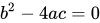
| There are only one real solutions for the equation | |
| Failed to parse (MathML with SVG or PNG fallback (recommended for modern browsers and accessibility tools): Invalid response ("Math extension cannot connect to Restbase.") from server "https://wikimedia.org/api/rest_v1/":): {\displaystyle b^2-4ac<0} | There are no real solutions for the equation |
Example Problems
EXAMPLE 1: Find all the roots of Failed to parse (MathML with SVG or PNG fallback (recommended for modern browsers and accessibility tools): Invalid response ("Math extension cannot connect to Restbase.") from server "https://wikimedia.org/api/rest_v1/":): {\displaystyle 4x^2+7x-2}
- Finding the roots is equivalent to solving the equation Failed to parse (MathML with SVG or PNG fallback (recommended for modern browsers and accessibility tools): Invalid response ("Math extension cannot connect to Restbase.") from server "https://wikimedia.org/api/rest_v1/":): {\displaystyle 4x^2+7x-2=0}
. Applying the quadratic formula with Failed to parse (MathML with SVG or PNG fallback (recommended for modern browsers and accessibility tools): Invalid response ("Math extension cannot connect to Restbase.") from server "https://wikimedia.org/api/rest_v1/":): {\displaystyle a=4\ ,\ b=7\ ,\ c=-2}
, we have:
- Failed to parse (MathML with SVG or PNG fallback (recommended for modern browsers and accessibility tools): Invalid response ("Math extension cannot connect to Restbase.") from server "https://wikimedia.org/api/rest_v1/":): {\displaystyle x=\frac{-7\pm\sqrt{7^2-4(4)(-2)}}{2(4)}}
- Failed to parse (MathML with SVG or PNG fallback (recommended for modern browsers and accessibility tools): Invalid response ("Math extension cannot connect to Restbase.") from server "https://wikimedia.org/api/rest_v1/":): {\displaystyle x=\frac{-7\pm\sqrt{49+32}}{8}}
- Failed to parse (MathML with SVG or PNG fallback (recommended for modern browsers and accessibility tools): Invalid response ("Math extension cannot connect to Restbase.") from server "https://wikimedia.org/api/rest_v1/":): {\displaystyle x=\frac{-7\pm\sqrt{81}}{8}}
- Failed to parse (MathML with SVG or PNG fallback (recommended for modern browsers and accessibility tools): Invalid response ("Math extension cannot connect to Restbase.") from server "https://wikimedia.org/api/rest_v1/":): {\displaystyle x=\frac{-7\pm9}{8}}
- Failed to parse (MathML with SVG or PNG fallback (recommended for modern browsers and accessibility tools): Invalid response ("Math extension cannot connect to Restbase.") from server "https://wikimedia.org/api/rest_v1/":): {\displaystyle x=\frac{2}{8}\ ,\ x=\frac{-16}{8}}
- Failed to parse (MathML with SVG or PNG fallback (recommended for modern browsers and accessibility tools): Invalid response ("Math extension cannot connect to Restbase.") from server "https://wikimedia.org/api/rest_v1/":): {\displaystyle x=\frac{1}{4}\ ,\ x=-2}
- The quadratic formula can also help with factoring, as the next example demonstrates.
EXAMPLE 2: Factor the polynomial Failed to parse (MathML with SVG or PNG fallback (recommended for modern browsers and accessibility tools): Invalid response ("Math extension cannot connect to Restbase.") from server "https://wikimedia.org/api/rest_v1/":): {\displaystyle 4x^2+7x-2}
- We already know from the previous example that the polynomial has roots Failed to parse (MathML with SVG or PNG fallback (recommended for modern browsers and accessibility tools): Invalid response ("Math extension cannot connect to Restbase.") from server "https://wikimedia.org/api/rest_v1/":): {\displaystyle x=\frac{1}{4}}
and Failed to parse (MathML with SVG or PNG fallback (recommended for modern browsers and accessibility tools): Invalid response ("Math extension cannot connect to Restbase.") from server "https://wikimedia.org/api/rest_v1/":): {\displaystyle x=-2}
. Our factorization will take the form
Failed to parse (MathML with SVG or PNG fallback (recommended for modern browsers and accessibility tools): Invalid response ("Math extension cannot connect to Restbase.") from server "https://wikimedia.org/api/rest_v1/":): {\displaystyle C(x+2)\left(x-\tfrac{1}{4}\right)}
. - All we have to do is set this expression equal to our polynomial and solve for the unknown constant C:
- Failed to parse (MathML with SVG or PNG fallback (recommended for modern browsers and accessibility tools): Invalid response ("Math extension cannot connect to Restbase.") from server "https://wikimedia.org/api/rest_v1/":): {\displaystyle C(x+2)\left(x-\tfrac{1}{4}\right)=4x^2+7x-2}
- Failed to parse (MathML with SVG or PNG fallback (recommended for modern browsers and accessibility tools): Invalid response ("Math extension cannot connect to Restbase.") from server "https://wikimedia.org/api/rest_v1/":): {\displaystyle C\left(x^2+\left(-\tfrac{1}{4}+2\right)x-\tfrac{2}{4}\right)=4x^2+7x-2}
- Failed to parse (MathML with SVG or PNG fallback (recommended for modern browsers and accessibility tools): Invalid response ("Math extension cannot connect to Restbase.") from server "https://wikimedia.org/api/rest_v1/":): {\displaystyle C\left(x^2+\tfrac{7}{4}x-\tfrac{1}{2}\right)=4x^2+7x-2}
- You can see that Failed to parse (MathML with SVG or PNG fallback (recommended for modern browsers and accessibility tools): Invalid response ("Math extension cannot connect to Restbase.") from server "https://wikimedia.org/api/rest_v1/":): {\displaystyle C=4}
solves the equation. So the factorization is
- Failed to parse (MathML with SVG or PNG fallback (recommended for modern browsers and accessibility tools): Invalid response ("Math extension cannot connect to Restbase.") from server "https://wikimedia.org/api/rest_v1/":): {\displaystyle 4x^2+7x-2=4(x+2)\left(x-\tfrac{1}{4}\right)=(x+2)(4x-1)}
EXAMPLE 3: Factor the polynomial Failed to parse (MathML with SVG or PNG fallback (recommended for modern browsers and accessibility tools): Invalid response ("Math extension cannot connect to Restbase.") from server "https://wikimedia.org/api/rest_v1/":): {\displaystyle 6x^2 + 7x + 2 } .
- For this problem, let's use the AC method. Failed to parse (MathML with SVG or PNG fallback (recommended for modern browsers and accessibility tools): Invalid response ("Math extension cannot connect to Restbase.") from server "https://wikimedia.org/api/rest_v1/":): {\displaystyle a = 6 } , Failed to parse (MathML with SVG or PNG fallback (recommended for modern browsers and accessibility tools): Invalid response ("Math extension cannot connect to Restbase.") from server "https://wikimedia.org/api/rest_v1/":): {\displaystyle b = 7 } , and Failed to parse (MathML with SVG or PNG fallback (recommended for modern browsers and accessibility tools): Invalid response ("Math extension cannot connect to Restbase.") from server "https://wikimedia.org/api/rest_v1/":): {\displaystyle c = 2 } . So, Failed to parse (MathML with SVG or PNG fallback (recommended for modern browsers and accessibility tools): Invalid response ("Math extension cannot connect to Restbase.") from server "https://wikimedia.org/api/rest_v1/":): {\displaystyle ac = 6(2) = 12 } , and we need to find two numbers whose product equals 12, and whose sum equals 7. Both ac and b are positive, so we are only concerned with the positive factors of 12, which are Failed to parse (MathML with SVG or PNG fallback (recommended for modern browsers and accessibility tools): Invalid response ("Math extension cannot connect to Restbase.") from server "https://wikimedia.org/api/rest_v1/":): {\displaystyle 1, 2, 3, 4, 6, } and Failed to parse (MathML with SVG or PNG fallback (recommended for modern browsers and accessibility tools): Invalid response ("Math extension cannot connect to Restbase.") from server "https://wikimedia.org/api/rest_v1/":): {\displaystyle 12 } . Failed to parse (MathML with SVG or PNG fallback (recommended for modern browsers and accessibility tools): Invalid response ("Math extension cannot connect to Restbase.") from server "https://wikimedia.org/api/rest_v1/":): {\displaystyle 3(4) = 12 = ac } and Failed to parse (MathML with SVG or PNG fallback (recommended for modern browsers and accessibility tools): Invalid response ("Math extension cannot connect to Restbase.") from server "https://wikimedia.org/api/rest_v1/":): {\displaystyle 3 + 4 = 7 = b } , so we can rewrite the polynomial as Failed to parse (MathML with SVG or PNG fallback (recommended for modern browsers and accessibility tools): Invalid response ("Math extension cannot connect to Restbase.") from server "https://wikimedia.org/api/rest_v1/":): {\displaystyle 6x^2 + 3x + 4x + 2 = (3x)(2x + 1) = 2(2x + 1) = (3x + 2)(2x+1)} .
Resources
- Factoring Polynomials with Example Problems, Paul's Online Notes
- Factoring Polynomials, Lumen Learning
- Difference of Squares. Produced by TA Catherine Sporer, UTSA
- 6 Methods of Factoring with Practive Problems, AlgebraLAB
- AC Factoring Method, Texas Wesleyan University

