Difference between revisions of "Arc Length"
| Line 28: | Line 28: | ||
==Resources== | ==Resources== | ||
| + | * [https://en.wikibooks.org/wiki/Calculus/Arc_length Arc Length], WikiBooks: Calculus | ||
* [https://openstax.org/books/calculus-volume-3/pages/3-3-arc-length-and-curvature Arc Length and Curvature], OpenStax | * [https://openstax.org/books/calculus-volume-3/pages/3-3-arc-length-and-curvature Arc Length and Curvature], OpenStax | ||
Revision as of 14:01, 1 October 2021
We can deduce that the length of a curve with parametric equations , should be:


Failed to parse (Conversion error. Server ("https://wikimedia.org/api/rest_") reported: "Cannot get mml. Server problem."): {\displaystyle L=\int _{a}^{b}{\sqrt {{\biggl (}{\frac {dx}{dt}}{\biggr )}^{2}+{\biggl (}{\frac {dy}{dt}}{\biggr )}^{2}}}dt}
Since vector functions are fundamentally parametric equations with directions, we can utilize the formula above into the length of a space curve.
Arc length of a space curve
If the curve has the vector equation Failed to parse (Conversion error. Server ("https://wikimedia.org/api/rest_") reported: "Cannot get mml. Server problem."): {\displaystyle \mathbf {r} (t)=\langle f(t),g(t),h(t)\rangle ,a\leq t\leq b} , or, equivalently, the parametric equations Failed to parse (Conversion error. Server ("https://wikimedia.org/api/rest_") reported: "Cannot get mml. Server problem."): {\displaystyle x=f(t),y=g(t),z=h(t)} , where are continuous, then the length of the curve from Failed to parse (Conversion error. Server ("https://wikimedia.org/api/rest_") reported: "Cannot get mml. Server problem."): {\displaystyle t=a} to Failed to parse (Conversion error. Server ("https://wikimedia.org/api/rest_") reported: "Cannot get mml. Server problem."): {\displaystyle t=b} is:

- Failed to parse (Conversion error. Server ("https://wikimedia.org/api/rest_") reported: "Cannot get mml. Server problem."): {\displaystyle L=\int _{a}^{b}{\sqrt {[f'(t)]^{2}+[g'(t)]^{2}+[h'(t)]^{2}}}dt=\int _{a}^{b}{\sqrt {{\biggl (}{\frac {dx}{dt}}{\biggr )}^{2}+{\biggl (}{\frac {dy}{dt}}{\biggr )}^{2}+{\biggl (}{\frac {dx}{dz}}{\biggr )}^{2}}}dt} }}
For those who prefer simplicity, the formula can be rewritten into:
Failed to parse (Conversion error. Server ("https://wikimedia.org/api/rest_") reported: "Cannot get mml. Server problem."): {\displaystyle L=\int _{a}^{b}|\mathbf {r} '(t)|dt\quad } or Failed to parse (Conversion error. Server ("https://wikimedia.org/api/rest_") reported: "Cannot get mml. Server problem."): {\displaystyle \quad {\frac {dL}{dt}}=|\mathbf {r} '(t)|}
Example Problems
1. Find the circumference of the circle given by the parametric equations Failed to parse (Conversion error. Server ("https://wikimedia.org/api/rest_") reported: "Cannot get mml. Server problem."): {\displaystyle x(t)=R\cos(t),y(t)=R\sin(t)} , with Failed to parse (Conversion error. Server ("https://wikimedia.org/api/rest_") reported: "Cannot get mml. Server problem."): {\displaystyle t\in [0,2\pi ]} .
- Failed to parse (Conversion error. Server ("https://wikimedia.org/api/rest_") reported: "Cannot get mml. Server problem."): {\displaystyle {\begin{aligned}s&=\int \limits _{0}^{2\pi }{\sqrt {\left({\tfrac {d}{dt}}{\big (}R\cos(t){\big )}\right)^{2}+\left({\tfrac {d}{dt}}{\big (}R\sin(t){\big )}\right)^{2}}}dt\\&=\int \limits _{0}^{2\pi }{\sqrt {{\big (}-R\sin(t){\big )}^{2}+{\big (}R\cos(t){\big )}^{2}}}dt\\&=\int \limits _{0}^{2\pi }{\sqrt {R^{2}{\big (}\sin ^{2}(t)+\cos ^{2}(t){\big )}}}dt\\&=\int \limits _{0}^{2\pi }Rdt\\&=R\cdot t{\Big |}_{0}^{2\pi }\\&=\mathbf {2\pi R} \end{aligned}}}
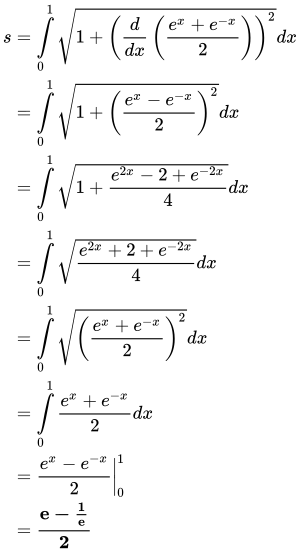
2. Find the length of the curve Failed to parse (Conversion error. Server ("https://wikimedia.org/api/rest_") reported: "Cannot get mml. Server problem."): {\displaystyle y={\frac {e^{x}+e^{-x}}{2}}} from to .


Resources
- Arc Length, WikiBooks: Calculus
- Arc Length and Curvature, OpenStax

