Difference between revisions of "Exponential Functions"
| Line 80: | Line 80: | ||
<math>x = 5\,</math> | <math>x = 5\,</math> | ||
| − | |||
| − | |||
| − | |||
| − | |||
| − | |||
| − | |||
| − | |||
| − | |||
| − | |||
| − | |||
| − | |||
==Resources== | ==Resources== | ||
* [https://mathresearch.utsa.edu/wikiFiles/MAT1053/Exponential%20Functions/MAT1053_M5.1Exponential_Functions.pdf Exponential Functions], Book Chapter | * [https://mathresearch.utsa.edu/wikiFiles/MAT1053/Exponential%20Functions/MAT1053_M5.1Exponential_Functions.pdf Exponential Functions], Book Chapter | ||
* [https://mathresearch.utsa.edu/wikiFiles/MAT1053/Exponential%20Functions/MAT1053_M5.1Exponential_FunctionsGN.pdf Guided Notes] | * [https://mathresearch.utsa.edu/wikiFiles/MAT1053/Exponential%20Functions/MAT1053_M5.1Exponential_FunctionsGN.pdf Guided Notes] | ||
Revision as of 11:57, 4 October 2021
Contents
Operations With Exponential Function
An exponential function is a function where a constant base (b) is raised to a variable.
Multiplication
Firstly, is which is . So when you multiply a base by the same base you add the variables. To clarify, here is an example with numbers:


| 1 | 2 | 4 | 8 | 8 |
| 2 | 4 | 16 | 64 | 64 |


Division
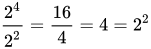
Secondly is . So when a base is divided by the same base you subtract the variables.


Here is an example with numbers: .
Base raised to two powers
Thirdly is which is . So when a base with a variable is raised to a variable you multiply the variables. Here is another example with numbers: (when x = 1) .



Multiple bases
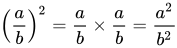
Fourthly when it is the same as . Here is an example with numbers: . There is a similar situation with division: . So when you multiply or divide two different bases raised to the same variable you can multiply or divide them first and then raise them to the variable.



Fractional exponents
The last case is when x is presented as a fraction, you can make a square root function, for example Failed to parse (MathML with SVG or PNG fallback (recommended for modern browsers and accessibility tools): Invalid response ("Math extension cannot connect to Restbase.") from server "https://wikimedia.org/api/rest_v1/":): {\displaystyle b^\frac{1}{x}} becomes Failed to parse (MathML with SVG or PNG fallback (recommended for modern browsers and accessibility tools): Invalid response ("Math extension cannot connect to Restbase.") from server "https://wikimedia.org/api/rest_v1/":): {\displaystyle \pm \sqrt[x] b} . However it is customary to only use the positive root and so Failed to parse (MathML with SVG or PNG fallback (recommended for modern browsers and accessibility tools): Invalid response ("Math extension cannot connect to Restbase.") from server "https://wikimedia.org/api/rest_v1/":): {\displaystyle b^\frac{1}{x}} is defined as Failed to parse (MathML with SVG or PNG fallback (recommended for modern browsers and accessibility tools): Invalid response ("Math extension cannot connect to Restbase.") from server "https://wikimedia.org/api/rest_v1/":): {\displaystyle \sqrt[x] b} . Another similar case is when the fraction has a constant (designated as c) other than 1 in the numerator , for example Failed to parse (MathML with SVG or PNG fallback (recommended for modern browsers and accessibility tools): Invalid response ("Math extension cannot connect to Restbase.") from server "https://wikimedia.org/api/rest_v1/":): {\displaystyle b^ \frac {3}{x} = \left( \sqrt[x] b \right)^3} so Failed to parse (MathML with SVG or PNG fallback (recommended for modern browsers and accessibility tools): Invalid response ("Math extension cannot connect to Restbase.") from server "https://wikimedia.org/api/rest_v1/":): {\displaystyle b^ \frac {c}{x} = \left( \sqrt[x] b \right)^c} .
The Laws of Exponents
The rules that have been suggested above are known as the laws of exponents and can be written as:
- Failed to parse (MathML with SVG or PNG fallback (recommended for modern browsers and accessibility tools): Invalid response ("Math extension cannot connect to Restbase.") from server "https://wikimedia.org/api/rest_v1/":): {\displaystyle b^xb^y = b^{x+y}\,}
- Failed to parse (MathML with SVG or PNG fallback (recommended for modern browsers and accessibility tools): Invalid response ("Math extension cannot connect to Restbase.") from server "https://wikimedia.org/api/rest_v1/":): {\displaystyle \frac{b^x}{b^y} = b^{x-y}}
- Failed to parse (MathML with SVG or PNG fallback (recommended for modern browsers and accessibility tools): Invalid response ("Math extension cannot connect to Restbase.") from server "https://wikimedia.org/api/rest_v1/":): {\displaystyle \left(b^x\right)^y = b^{xy}}
- Failed to parse (MathML with SVG or PNG fallback (recommended for modern browsers and accessibility tools): Invalid response ("Math extension cannot connect to Restbase.") from server "https://wikimedia.org/api/rest_v1/":): {\displaystyle a^n b^n = \left(ab\right)^n\,}
- Failed to parse (MathML with SVG or PNG fallback (recommended for modern browsers and accessibility tools): Invalid response ("Math extension cannot connect to Restbase.") from server "https://wikimedia.org/api/rest_v1/":): {\displaystyle \left(\frac{a}{b}\right)^n = \frac{a^n}{b^n}}
- Failed to parse (MathML with SVG or PNG fallback (recommended for modern browsers and accessibility tools): Invalid response ("Math extension cannot connect to Restbase.") from server "https://wikimedia.org/api/rest_v1/":): {\displaystyle b^{-n}=\frac{1}{b^n}}
- Failed to parse (MathML with SVG or PNG fallback (recommended for modern browsers and accessibility tools): Invalid response ("Math extension cannot connect to Restbase.") from server "https://wikimedia.org/api/rest_v1/":): {\displaystyle b^ \frac {c}{x} = \left( \sqrt[x] b \right)^c} where c is a constant
- Failed to parse (MathML with SVG or PNG fallback (recommended for modern browsers and accessibility tools): Invalid response ("Math extension cannot connect to Restbase.") from server "https://wikimedia.org/api/rest_v1/":): {\displaystyle b^1=b\,}
- Failed to parse (MathML with SVG or PNG fallback (recommended for modern browsers and accessibility tools): Invalid response ("Math extension cannot connect to Restbase.") from server "https://wikimedia.org/api/rest_v1/":): {\displaystyle b^0=1\,}
Graphing an Exponential Function
When you graph an exponential function you use the same methods as with a regular function. There is a graph below that you can look at.

Solving Exponential Equations
In order to solve an exponential equation you need to make sure that all the bases are the same. Then you can remove the base and solve for the variable. Here is an example:
Solve for x. Failed to parse (MathML with SVG or PNG fallback (recommended for modern browsers and accessibility tools): Invalid response ("Math extension cannot connect to Restbase.") from server "https://wikimedia.org/api/rest_v1/":): {\displaystyle 2^{\left(x-1\right)} = 16\,}
Now we convert 16 to a base 2 raised to a number.
Failed to parse (MathML with SVG or PNG fallback (recommended for modern browsers and accessibility tools): Invalid response ("Math extension cannot connect to Restbase.") from server "https://wikimedia.org/api/rest_v1/":): {\displaystyle 2^{\left(x-1\right)} = 2^4\,}
Now we can remove the base. So we have:
Failed to parse (MathML with SVG or PNG fallback (recommended for modern browsers and accessibility tools): Invalid response ("Math extension cannot connect to Restbase.") from server "https://wikimedia.org/api/rest_v1/":): {\displaystyle x-1 = 4\,}
Finally solve for x.
Failed to parse (MathML with SVG or PNG fallback (recommended for modern browsers and accessibility tools): Invalid response ("Math extension cannot connect to Restbase.") from server "https://wikimedia.org/api/rest_v1/":): {\displaystyle x = 5\,}
Resources
- Exponential Functions, Book Chapter
- Guided Notes

