Difference between revisions of "Alternating Series"
(Created page with "<strong>The Alternating Series Test</strong> * [https://www.youtube.com/watch?v=8qhVGeCkgGg The Alternating Series Test] Video by James Sousa, Math is Power 4U * [https://www...") |
|||
| Line 1: | Line 1: | ||
| − | < | + | === Alternating series === |
| + | |||
| + | An ''alternating series'' is any series whose terms alternate in sign — that is, any series for which the product of any two consecutive terms is negative. | ||
| + | |||
| + | Equivalently, an alternating series is one that can be written in the form | ||
| + | :<math>\sum_{n=c}^\infty (-1)^{n+d}\, b_n,</math> | ||
| + | for some fixed integers <math>c</math> and <math>d</math>, and sequence of positive terms <math>b_n</math>. (If the ''n''<sup>th</sup> term of the series is called <math>a_n</math>, as usual, then notice that <math>b_n=|a_n|</math>.) | ||
| + | |||
| + | As with geometric series, we have defined alternating series here in a slightly more general way than is typically done in calculus textbooks. Usually alternating series are either defined quite restrictively as | ||
| + | :<math>\sum_{n=1}^\infty (-1)^{n+1} b_n,</math> | ||
| + | or as being in one of the two forms | ||
| + | :<math>\sum_{n=1}^\infty (-1)^{n} b_n \mbox{ or } \sum_{n=1}^\infty (-1)^{n-1} b_n,</math> | ||
| + | in all cases the <math>b_n</math> being some sequence of positive terms. It is easy to see that these other definitions are special cases of our formula above. | ||
| + | |||
| + | It should be obvious that we could not hope to write a formula for the partial sums of a general alternating series (besides, of course, the definition of partial sums given earlier), but, perhaps surprisingly, we ''can'' say when such a series converges. | ||
| + | |||
| + | An alternating series converges if its terms eventually decrease in magnitude to zero — that is, if | ||
| + | :<math>\lim_{n\to\infty} |a_n| = 0</math> | ||
| + | and | ||
| + | :the sequence <math>\{|a_n|\}</math> is eventually decreasing. | ||
| + | |||
| + | However, if either of these conditions are not satisfied, it does ''not'' mean that the alternating series must diverge. | ||
| + | |||
| + | Note that any geometric series with <math>r<0</math> is alternating. If <math>|r|<1</math>, then the conditions for convergence of an alternating series will be satisfied. This can be proven in the general case, but we will simply illustrate with an example. | ||
| + | |||
| + | ; Example | ||
| + | |||
| + | Consider the series | ||
| + | :<math>\sum_{n=1}^\infty \left(-\frac{1}{2}\right)^{n-1}.</math> | ||
| + | This series can be written in the form | ||
| + | :<math>\sum_{n=1}^\infty (-1)^{n-1} \left(\tfrac{1}{2}\right)^{n-1},</math> | ||
| + | and so matches our definition of an alternating series (<math>c=1</math>, <math>d=-1</math>, and <math>b_n=(\tfrac{1}{2})^{n-1}</math>). | ||
| + | |||
| + | It is obvious that | ||
| + | :<math>\lim_{n\to\infty} |a_n| = \lim_{n\to\infty} \left(\frac{1}{2}\right)^{n-1} = 0</math> | ||
| + | and that | ||
| + | :<math>|a_n|=\left(\frac{1}{2}\right)^{n-1}</math> | ||
| + | is a decreasing sequence, so the series converges (as we knew it must, since it is geometric with <math>|r|<1</math>). | ||
| + | |||
| + | ; Example | ||
| + | |||
| + | Consider the series | ||
| + | :<math>\sum_{n=1}^\infty \frac{(-1)^n}{n}.</math> | ||
| + | This is an alternating version of the harmonic series. Since | ||
| + | :<math>\lim_{n\to\infty} \frac{1}{n} = 0</math> | ||
| + | and | ||
| + | :<math>|a_n|=\frac{1}{n}</math> | ||
| + | is a decreasing sequence of terms, the series converges. | ||
| + | |||
| + | ==== Absolute and conditional convergence ==== | ||
| + | |||
| + | At this point we have considered divergent series whose terms have no limit (the arithmetic series) and divergent series whose terms have a limit of zero (the harmonic series). But every convergent series must have terms that converge to zero. So, does this mean convergent series are "all the same"? Definitely not. There are two kinds of convergence that can be thought of as two "strengths" of convergence: absolute and conditional. The distinction is important because there are things you can do with absolutely convergent series that you cannot do with merely conditionally convergent ones. First, though, some definitions: | ||
| + | * A series <math>\textstyle \sum_{n=c}^{\infty} a_n</math> is said to ''converge absolutely'' (or to ''be absolutely convergent'') if <math>\textstyle \sum_{n=c}^{\infty} |a_n|</math> converges. | ||
| + | * A series <math>\textstyle \sum_{n=c}^{\infty} a_n</math> is said to ''converge conditionally'' (or to ''be conditionally convergent'') if <math>\textstyle \sum_{n=c}^{\infty} |a_n|</math> diverges but <math>\textstyle \sum_{n=c}^{\infty} a_n</math> itself converges. | ||
| + | |||
| + | It should be obvious that this distinction only makes sense for series with a mixture of positive and negative terms. This includes, but is not limited to, alternating series. | ||
| + | |||
| + | ; Example | ||
| + | |||
| + | We have seen that the harmonic series | ||
| + | :<math>\sum_{n=1}^{\infty} \frac{1}{n}</math> | ||
| + | is divergent but its alternating version | ||
| + | :<math>\sum_{n=1}^{\infty} \frac{(-1)^n}{n}</math> | ||
| + | is convergent. Since the first series may be formed by taking the absolute value of the terms in the second series, we see that the second series is conditionally convergent. | ||
| + | |||
| + | ; Example | ||
| + | |||
| + | Consider the series | ||
| + | :<math>\sum_{n=1}^{\infty} \frac{(-1)^n}{n^2}.</math> | ||
| + | This is an alternating series whose terms decrease to zero in magnitude, so it converges. Furthermore, the series formed by the absolute value of the terms | ||
| + | :<math>\sum_{n=1}^{\infty} \frac{1}{n^2}</math> | ||
| + | is a ''p''-series with <math>p=2</math>, so it converges also. Therefore the original alternating series is absolutely convergent. | ||
| + | |||
| + | ==Resources== | ||
| + | ===The Alternating Series Test=== | ||
* [https://www.youtube.com/watch?v=8qhVGeCkgGg The Alternating Series Test] Video by James Sousa, Math is Power 4U | * [https://www.youtube.com/watch?v=8qhVGeCkgGg The Alternating Series Test] Video by James Sousa, Math is Power 4U | ||
| Line 23: | Line 97: | ||
| − | + | ===The Alternating Series Estimation Theorem=== | |
* [https://www.youtube.com/watch?v=oZ3PKvQKffE Find the Error in Using a Partial Sum to Approximate the Sum of an Alternating Series] Video by James Sousa, Math is Power 4U | * [https://www.youtube.com/watch?v=oZ3PKvQKffE Find the Error in Using a Partial Sum to Approximate the Sum of an Alternating Series] Video by James Sousa, Math is Power 4U | ||
| Line 36: | Line 110: | ||
| − | + | ===Absolute Convergence and Conditional Convergence=== | |
* [https://www.youtube.com/watch?v=rEyeRKd3TWo Absolutely and Conditionally Convergent Series] Video by James Sousa, Math is Power 4U | * [https://www.youtube.com/watch?v=rEyeRKd3TWo Absolutely and Conditionally Convergent Series] Video by James Sousa, Math is Power 4U | ||
Revision as of 13:54, 10 October 2021
Contents
Alternating series
An alternating series is any series whose terms alternate in sign — that is, any series for which the product of any two consecutive terms is negative.
Equivalently, an alternating series is one that can be written in the form
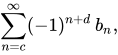
for some fixed integers and , and sequence of positive terms . (If the nth term of the series is called , as usual, then notice that .)


As with geometric series, we have defined alternating series here in a slightly more general way than is typically done in calculus textbooks. Usually alternating series are either defined quite restrictively as
- Failed to parse (MathML with SVG or PNG fallback (recommended for modern browsers and accessibility tools): Invalid response ("Math extension cannot connect to Restbase.") from server "https://wikimedia.org/api/rest_v1/":): {\displaystyle \sum_{n=1}^\infty (-1)^{n+1} b_n,}
or as being in one of the two forms
- Failed to parse (MathML with SVG or PNG fallback (recommended for modern browsers and accessibility tools): Invalid response ("Math extension cannot connect to Restbase.") from server "https://wikimedia.org/api/rest_v1/":): {\displaystyle \sum_{n=1}^\infty (-1)^{n} b_n \mbox{ or } \sum_{n=1}^\infty (-1)^{n-1} b_n,}
in all cases the Failed to parse (MathML with SVG or PNG fallback (recommended for modern browsers and accessibility tools): Invalid response ("Math extension cannot connect to Restbase.") from server "https://wikimedia.org/api/rest_v1/":): {\displaystyle b_n} being some sequence of positive terms. It is easy to see that these other definitions are special cases of our formula above.
It should be obvious that we could not hope to write a formula for the partial sums of a general alternating series (besides, of course, the definition of partial sums given earlier), but, perhaps surprisingly, we can say when such a series converges.
An alternating series converges if its terms eventually decrease in magnitude to zero — that is, if
- Failed to parse (MathML with SVG or PNG fallback (recommended for modern browsers and accessibility tools): Invalid response ("Math extension cannot connect to Restbase.") from server "https://wikimedia.org/api/rest_v1/":): {\displaystyle \lim_{n\to\infty} |a_n| = 0}
and
- the sequence Failed to parse (MathML with SVG or PNG fallback (recommended for modern browsers and accessibility tools): Invalid response ("Math extension cannot connect to Restbase.") from server "https://wikimedia.org/api/rest_v1/":): {\displaystyle \{|a_n|\}} is eventually decreasing.
However, if either of these conditions are not satisfied, it does not mean that the alternating series must diverge.
Note that any geometric series with Failed to parse (MathML with SVG or PNG fallback (recommended for modern browsers and accessibility tools): Invalid response ("Math extension cannot connect to Restbase.") from server "https://wikimedia.org/api/rest_v1/":): {\displaystyle r<0} is alternating. If Failed to parse (MathML with SVG or PNG fallback (recommended for modern browsers and accessibility tools): Invalid response ("Math extension cannot connect to Restbase.") from server "https://wikimedia.org/api/rest_v1/":): {\displaystyle |r|<1} , then the conditions for convergence of an alternating series will be satisfied. This can be proven in the general case, but we will simply illustrate with an example.
- Example
Consider the series
- Failed to parse (MathML with SVG or PNG fallback (recommended for modern browsers and accessibility tools): Invalid response ("Math extension cannot connect to Restbase.") from server "https://wikimedia.org/api/rest_v1/":): {\displaystyle \sum_{n=1}^\infty \left(-\frac{1}{2}\right)^{n-1}.}
This series can be written in the form
- Failed to parse (MathML with SVG or PNG fallback (recommended for modern browsers and accessibility tools): Invalid response ("Math extension cannot connect to Restbase.") from server "https://wikimedia.org/api/rest_v1/":): {\displaystyle \sum_{n=1}^\infty (-1)^{n-1} \left(\tfrac{1}{2}\right)^{n-1},}
and so matches our definition of an alternating series (Failed to parse (MathML with SVG or PNG fallback (recommended for modern browsers and accessibility tools): Invalid response ("Math extension cannot connect to Restbase.") from server "https://wikimedia.org/api/rest_v1/":): {\displaystyle c=1} , Failed to parse (MathML with SVG or PNG fallback (recommended for modern browsers and accessibility tools): Invalid response ("Math extension cannot connect to Restbase.") from server "https://wikimedia.org/api/rest_v1/":): {\displaystyle d=-1} , and Failed to parse (MathML with SVG or PNG fallback (recommended for modern browsers and accessibility tools): Invalid response ("Math extension cannot connect to Restbase.") from server "https://wikimedia.org/api/rest_v1/":): {\displaystyle b_n=(\tfrac{1}{2})^{n-1}} ).
It is obvious that
- Failed to parse (MathML with SVG or PNG fallback (recommended for modern browsers and accessibility tools): Invalid response ("Math extension cannot connect to Restbase.") from server "https://wikimedia.org/api/rest_v1/":): {\displaystyle \lim_{n\to\infty} |a_n| = \lim_{n\to\infty} \left(\frac{1}{2}\right)^{n-1} = 0}
and that
- Failed to parse (MathML with SVG or PNG fallback (recommended for modern browsers and accessibility tools): Invalid response ("Math extension cannot connect to Restbase.") from server "https://wikimedia.org/api/rest_v1/":): {\displaystyle |a_n|=\left(\frac{1}{2}\right)^{n-1}}
is a decreasing sequence, so the series converges (as we knew it must, since it is geometric with Failed to parse (MathML with SVG or PNG fallback (recommended for modern browsers and accessibility tools): Invalid response ("Math extension cannot connect to Restbase.") from server "https://wikimedia.org/api/rest_v1/":): {\displaystyle |r|<1} ).
- Example
Consider the series
- Failed to parse (MathML with SVG or PNG fallback (recommended for modern browsers and accessibility tools): Invalid response ("Math extension cannot connect to Restbase.") from server "https://wikimedia.org/api/rest_v1/":): {\displaystyle \sum_{n=1}^\infty \frac{(-1)^n}{n}.}
This is an alternating version of the harmonic series. Since
- Failed to parse (MathML with SVG or PNG fallback (recommended for modern browsers and accessibility tools): Invalid response ("Math extension cannot connect to Restbase.") from server "https://wikimedia.org/api/rest_v1/":): {\displaystyle \lim_{n\to\infty} \frac{1}{n} = 0}
and
- Failed to parse (MathML with SVG or PNG fallback (recommended for modern browsers and accessibility tools): Invalid response ("Math extension cannot connect to Restbase.") from server "https://wikimedia.org/api/rest_v1/":): {\displaystyle |a_n|=\frac{1}{n}}
is a decreasing sequence of terms, the series converges.
Absolute and conditional convergence
At this point we have considered divergent series whose terms have no limit (the arithmetic series) and divergent series whose terms have a limit of zero (the harmonic series). But every convergent series must have terms that converge to zero. So, does this mean convergent series are "all the same"? Definitely not. There are two kinds of convergence that can be thought of as two "strengths" of convergence: absolute and conditional. The distinction is important because there are things you can do with absolutely convergent series that you cannot do with merely conditionally convergent ones. First, though, some definitions:
- A series Failed to parse (MathML with SVG or PNG fallback (recommended for modern browsers and accessibility tools): Invalid response ("Math extension cannot connect to Restbase.") from server "https://wikimedia.org/api/rest_v1/":): {\displaystyle \textstyle \sum_{n=c}^{\infty} a_n} is said to converge absolutely (or to be absolutely convergent) if Failed to parse (MathML with SVG or PNG fallback (recommended for modern browsers and accessibility tools): Invalid response ("Math extension cannot connect to Restbase.") from server "https://wikimedia.org/api/rest_v1/":): {\displaystyle \textstyle \sum_{n=c}^{\infty} |a_n|} converges.
- A series Failed to parse (MathML with SVG or PNG fallback (recommended for modern browsers and accessibility tools): Invalid response ("Math extension cannot connect to Restbase.") from server "https://wikimedia.org/api/rest_v1/":): {\displaystyle \textstyle \sum_{n=c}^{\infty} a_n} is said to converge conditionally (or to be conditionally convergent) if Failed to parse (MathML with SVG or PNG fallback (recommended for modern browsers and accessibility tools): Invalid response ("Math extension cannot connect to Restbase.") from server "https://wikimedia.org/api/rest_v1/":): {\displaystyle \textstyle \sum_{n=c}^{\infty} |a_n|} diverges but Failed to parse (MathML with SVG or PNG fallback (recommended for modern browsers and accessibility tools): Invalid response ("Math extension cannot connect to Restbase.") from server "https://wikimedia.org/api/rest_v1/":): {\displaystyle \textstyle \sum_{n=c}^{\infty} a_n} itself converges.
It should be obvious that this distinction only makes sense for series with a mixture of positive and negative terms. This includes, but is not limited to, alternating series.
- Example
We have seen that the harmonic series
- Failed to parse (MathML with SVG or PNG fallback (recommended for modern browsers and accessibility tools): Invalid response ("Math extension cannot connect to Restbase.") from server "https://wikimedia.org/api/rest_v1/":): {\displaystyle \sum_{n=1}^{\infty} \frac{1}{n}}
is divergent but its alternating version
- Failed to parse (MathML with SVG or PNG fallback (recommended for modern browsers and accessibility tools): Invalid response ("Math extension cannot connect to Restbase.") from server "https://wikimedia.org/api/rest_v1/":): {\displaystyle \sum_{n=1}^{\infty} \frac{(-1)^n}{n}}
is convergent. Since the first series may be formed by taking the absolute value of the terms in the second series, we see that the second series is conditionally convergent.
- Example
Consider the series
- Failed to parse (MathML with SVG or PNG fallback (recommended for modern browsers and accessibility tools): Invalid response ("Math extension cannot connect to Restbase.") from server "https://wikimedia.org/api/rest_v1/":): {\displaystyle \sum_{n=1}^{\infty} \frac{(-1)^n}{n^2}.}
This is an alternating series whose terms decrease to zero in magnitude, so it converges. Furthermore, the series formed by the absolute value of the terms
- Failed to parse (MathML with SVG or PNG fallback (recommended for modern browsers and accessibility tools): Invalid response ("Math extension cannot connect to Restbase.") from server "https://wikimedia.org/api/rest_v1/":): {\displaystyle \sum_{n=1}^{\infty} \frac{1}{n^2}}
is a p-series with Failed to parse (MathML with SVG or PNG fallback (recommended for modern browsers and accessibility tools): Invalid response ("Math extension cannot connect to Restbase.") from server "https://wikimedia.org/api/rest_v1/":): {\displaystyle p=2} , so it converges also. Therefore the original alternating series is absolutely convergent.
Resources
The Alternating Series Test
- The Alternating Series Test Video by James Sousa, Math is Power 4U
- The Alternating Series Test Video by James Sousa, Math is Power 4U
- Apply the Alternating Series Test Video by James Sousa, Math is Power 4U
- Determine if an Alternating Series Converges or Diverges Video by James Sousa, Math is Power 4U
- Determine if an Alternating Series Converges or Diverges Video by James Sousa, Math is Power 4U
- Ex 1: Determine if a Series and an Alternating Series Converge or Diverge Video by James Sousa, Math is Power 4U
- Ex 2: Determine if a Series and an Alternating Series Converge or Diverge Video by James Sousa, Math is Power 4U
- Alternating Series Video by Patrick JMT
- Alternating Series - Basic Example Video by Patrick JMT
- Two Alternating Series Examples Video by Patrick JMT
- More Alternating Series Examples Video by Patrick JMT
- Alternating Series - Another Example 1 Video by Patrick JMT
- Alternating Series - Another Example 2 Video by Patrick JMT
- Alternating Series - Another Example 3 Video by Patrick JMT
- Alternating Series - Another Example 4 Video by Patrick JMT
- The Alternating Series Test Video by Krista King
- The Alternating Series Test Video by The Organic Chemistry Tutor
The Alternating Series Estimation Theorem
- Find the Error in Using a Partial Sum to Approximate the Sum of an Alternating Series Video by James Sousa, Math is Power 4U
- Number of Terms Needed in a Partial Sum to Approximate the Sum of an Alternating Series with Given Error, Video by James Sousa, Math is Power 4U
- Alternating Series Estimation Theorem Video by Patrick JMT
- Alternating Series Error Estimation Video by Patrick JMT
- Alternating Series Estimation Theorem Video by Krista King
- Alternating Series Estimation Theorem Video by The Organic Chemistry Tutor
Absolute Convergence and Conditional Convergence
- Absolutely and Conditionally Convergent Series Video by James Sousa, Math is Power 4U
- Ex 1: Determine if a Series is Absolutely Convergent, Conditionally Convergent, or Divergent Video by James Sousa, Math is Power 4U
- Ex 2: Determine if a Series is Absolutely Convergent, Conditionally Convergent, or Divergent Video by James Sousa, Math is Power 4U
- Ex 3: Determine if a Series is Absolutely Convergent, Conditionally Convergent, or Divergent Video by James Sousa, Math is Power 4U
- Ex 4: Determine if a Series is Absolutely Convergent, Conditionally Convergent, or Divergent Video by James Sousa, Math is Power 4U
- Absolute Convergence, Conditional Convergence, and Divergence Video by Patrick JMT)
- Absolute Convergence, Conditional Convergence - Another Example 1 Video by Patrick JMT
- Absolute Convergence, Conditional Convergence - Another Example 2 Video by Patrick JMT
- Absolute Convergence, Conditional Convergence - Another Example 3 Video by Patrick JMT
- Absolute and Conditional Convergence Video by Krista King
- Absolute Convergence, Conditional Convergence, and Divergence Video by The Organic Chemistry Tutor

