Difference between revisions of "Solving Equations and Inequalities"
| Line 503: | Line 503: | ||
==Resources and Examples== | ==Resources and Examples== | ||
| − | See also: [Linear Equations] | + | See also: [[Linear Equations]] |
===General Resources=== | ===General Resources=== | ||
* [https://tutorial.math.lamar.edu/classes/alg/Solving.aspx Solving Equations and Inequalities], Paul's Online Notes | * [https://tutorial.math.lamar.edu/classes/alg/Solving.aspx Solving Equations and Inequalities], Paul's Online Notes | ||
| Line 529: | Line 529: | ||
* <math> 6 - y \ge x \implies y - 6 \le -x \implies y \le 6 - x</math> | * <math> 6 - y \ge x \implies y - 6 \le -x \implies y \le 6 - x</math> | ||
* <math> -2x > 24 \implies (-2x)/(-2) < 24/(-2) \implies x < -12 </math> | * <math> -2x > 24 \implies (-2x)/(-2) < 24/(-2) \implies x < -12 </math> | ||
| + | |||
| + | == Licensing == | ||
| + | Content obtained and/or adapted from: | ||
| + | * [https://en.wikibooks.org/wiki/Algebra/Solving_Equations Solving Equations, Wikibooks: Algebra] under a CC BY-SA license | ||
Revision as of 11:31, 21 October 2021
Contents
Introduction to Equations
We've seen that an equation is like a balance. When two quantities are on either side of an equal sign in a mathematical statement, we are saying that the statement is only true under conditions that make the quantities the same. For instance, when we see the statement we now know that we are asking what number can we substitute for in the equation to make this statement true? One way you could work this out is by trying out different values of until you get one that works. This is called guess-and-check. Alternatively you might know the answer intuitively (by thinking What do I need to add to 2 to get 3?).


However, if you have a more complicated problem such as you are likely to have trouble solving this problem intuitively or by guess-and-check. Because of this, mathematicians worked out a technique to solve this type of problem easily. This technique is the fundamental basis of algebra.
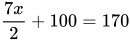
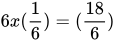
Since the equal sign means that both sides of the equation are the same (Same value, different appearance), and that if you manipulate (using addition, multiplication, etc.) the values on both sides of the equal sign in the same way, then they will still be equal. This is also how a mechanical balance works. As long as you do the same thing to whatever is in both pans they stay level. If we have a value of 3 = in one pan and two things with the value of 2 and 1 in the other pan the balance is level. If we multiply both sides by 5 we get,




Notice how the equality still holds.
Neolithic Algebra
Neolithic Functions Imagine you are the neolithic shepherd. What changes can you make to your bag of rocks?
Possible Answers.
- Addition - When new sheep are added to your flock you would use addition. For instance in the spring you would have a "lamb born" function in which you add a rock to your bag. You might also have a "multiple birth" function in which you invoke the lamb born function once for each lamb born.
- Subtraction - When you decide that a sheep is no longer part of your flock you would use a "remove sheep function" to keep your bag of rocks in balance with your herd. You might do different things with the rock for a missing sheep, a sheep you traded for something you needed, or because it became dinner one night. You might anticipate using these functions to manage your herd. If you know that you need to remove five rocks from your bag in the fall to buy firewood you might examine your bag carefully to know how many times you can invoke the "sheep dinner" function over the summer.
- Multiplication - Imagine you are a shepherd just starting out. If your neighbors had a big enough flock they might promise you a number of sheep per month as payment for watching their flock. For instance if they promised you two sheep a month for tending their flock then you would know that after 1 month you would have two sheep, after two months you would have four sheep, and after an entire year you might have enough sheep to start your own operation.
- Division - It is said that two things are inevitable: death and taxes. Division is the operation we use to make the inevitable fair. When a shepherd died his heirs could use division to divide up his flock fairly. They might use a function that allocated one sheep per heir until the flock was distributed. In what ways could the heirs distribute extra sheep if the flock was not evenly divisible? Similarly, when collecting taxes it is more fair to take a portion of the flock rather than a single amount. The clan leader would be better served taking 1/12th of a flock from each shepherd every year. If the clan leader asked for a specific number of sheep every year they might find that their clan became smaller every year just before tax time as new shepherds took their sheep to a new clan.
Using A Variable
With algebra we use variables to represent things we haven't been able to count. Since we can't count the number the variable represents the number is called an "unknown". The most common variable is denoted . To use a variable we write an expression which we know is true and has on its own on one side of an equals sign and a number on the other side of the equals sign.
Sometimes a variable can represent a set of numbers. In this case the number can be represented with set notation. We generally use a letter that reminds us what the variable represents.
Here are some examples of manipulating equations to get the on its own,
Example 1: How many dollars do I need to see a movie and buy popcorn? If we let equal the dollars that I need to get into the theater, then we could use the variable set to represent a discount admission, a matinee admission, a regular admission, or an Imax admission. If we assume that popcorn costs 3 dollars at all the theaters we will go to then we can write the equation to represent the money we need. We could add an A to both sides to get the equation . Plugging the values for A into this equation we find that .




Example 2: What is the value of in ?

Solution: We can do the same in this case by dividing it by 2 (as is (remember that is the same as 1 because it has implied coefficient of 1)), but again to keep both sides of the equation equal we'll need to divide the other side by 2 as well to get,


Example 3: What is the value of in

Solution: Here we first need to subtract 1 from both sides,


Then we divide both sides by 3 to get,


Although in this case we chose to do the subtraction first and then the division, we could have done it the other way around, doing the division first followed by the subtraction, as follows,
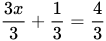


When working problems it often helps to do additions/subtractions first and then multiplication/divisions, as this lets us avoid having to add or subtract fractions. However, both ways are equally valid.
Simplifying Equations
Sometimes you'll come across equations which have a variable on both sides, for instance , where x can be found on both sides of the equation.

We solve this type of equation in much the same way as we've solved the previous problems, but only this time you have to first make sure all of the variables are on the same side. The easiest way to see how to do this is by example:
Example 1: How do you find the value of in the equation, ?
First of all you need to choose which side you want the variable to be on, the left or the right of the equals sign, in this case we'll choose to have the on the left hand side.
To do this we first have to look at where occurs on the right hand side; in this case it only appears in the term . As we don't want on the right hand side we need to get rid of it, and we can do this by subtracting from the right side. Remember that for the equality to still be accurate we need to do the same on the left side as well.

- (subtracting 2x from both sides)
- (simplifying)


Now the equation is in a form which you are familiar with from the last chapter so hopefully you should now be able to solve this problem and get the answer .
Manipulation of Radicals
Let's say that we have a number . The square root of is the number that, if multiplied by itself, equals . Since there are two numbers which satisfy that condition, we usually specify the positive value. For example, the square root of 4 could be 2 (because Failed to parse (MathML with SVG or PNG fallback (recommended for modern browsers and accessibility tools): Invalid response ("Math extension cannot connect to Restbase.") from server "https://wikimedia.org/api/rest_v1/":): {\displaystyle 2 \times 2 = 4} ) or it could be -2 (because ). We use the symbol to indicate the positive square root of .


The cube root of is the number that, if multiplied by itself three times, equals . We use the symbol to indicate the cube root of .
![{\displaystyle {\sqrt[{3}]{x}}}](https://wikimedia.org/api/rest_v1/media/math/render/svg/9a55f866116e7a86823816615dd98fcccde75473)
We use the symbol to indicate the number, which when multiplied times is equal to . Or in symbols: if then .
![{\displaystyle {\sqrt[{n}]{x}}}](https://wikimedia.org/api/rest_v1/media/math/render/svg/7b3ba2638d05cd9ed8dafae7e34986399e48ea99)

![{\displaystyle y={\sqrt[{n}]{x}}}](https://wikimedia.org/api/rest_v1/media/math/render/svg/70c948f50917ced2d3036c8c5edc92ee14a6b43a)

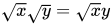
Rules


![{\displaystyle x^{{m} \over {n}}={({\sqrt[{n}]{x}})^{m}}}](https://wikimedia.org/api/rest_v1/media/math/render/svg/153d60200582910105babce7b5685f56e9aee385)
![{\displaystyle {\sqrt[{m}]{\sqrt[{n}]{x}}}={\sqrt[{m\cdot n}]{x}}=x^{1 \over {m\cdot n}}}](https://wikimedia.org/api/rest_v1/media/math/render/svg/933b277d523a19d1571353c3549898cc8907ef91)
Solving for (Variable)
When solving an equation, you usually solve for a specific variable. To do so, you have to get all instances of that variable on one side of the equals sign, and everything else on the other.
Properties of Equality
The equal sign that depicts the fact that both sides of it are equal is a very strange symbol with many properties. It tells you various traits of each side, and it allows you to manipulate each side in specific ways. Here are the different properties of that sign:
| Property Name | Definition | Example |
| Reflexive | a = a | 8=8 |
| Symmetric | If a = b, then b = a | If (3)(2) = 6, then 6 = (3)(2) |
| Transitive | If a = b & b = c, then a = c | If 8 = (4)(2) and (4)(2) = (2)(4), then 8 = (2)(4) |
| Substitution | If a = b, then one can replace a with b or vice versa | If a = b and 1 + a = 3, then 1 + b = 3 |
| Addition | You can add one number to both sides of the equation. |
|
| Subtraction | You can subtract one number from both sides of the equation. |
|
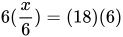
| Multiplication | You can multiply both sides of the equation by a number. |
|
| Division | You can divide both sides of the equation by a number. |
|










Practice Problems
Basic Laws In Algebra
In algebra we are working with the set of real numbers. We talked about the properties of real numbers with respect to mathematical operations in the section Real Numbers. If you don't remember the Commutative Property, the Associative Property, the Distributive Property, and the Identity Property go back to the real numbers section to review them.
There are several basic laws in algebra. Understanding these will help you to manipulate and solve equations, and to understand algebraic relationships.
Proportions or Ratios
Ratios or proportions can be expressed as an equation of fractions
(for example Failed to parse (MathML with SVG or PNG fallback (recommended for modern browsers and accessibility tools): Invalid response ("Math extension cannot connect to Restbase.") from server "https://wikimedia.org/api/rest_v1/":): {\displaystyle \frac {Q}{R} = \frac {S}{T} } ),
or they can be expressed as a relationship Q : R = S : T , (expressed in words “ ‘Q’ is to ‘R’ as ‘S’ is to ‘T’ ”).
Using the words "is to" help us understand the physical relationship between the values, while the fractional representation can help us deal with the mathematical relationship.
For instance in America we know that 3 feet is to 1 yard as 6 feet is to 2 yards, but expressing this as a math equation: Failed to parse (MathML with SVG or PNG fallback (recommended for modern browsers and accessibility tools): Invalid response ("Math extension cannot connect to Restbase.") from server "https://wikimedia.org/api/rest_v1/":): {\displaystyle \frac {3}{1} = \frac {6}{2} = \frac {2*3}{2*1} } helps us see this is true because all we have done is double the original ratio.
Consider the relation 3*4 = 2*6 = 1*12. Does this mean something more than the obvious fact that 12=12=12? How many ways could you package 12 items?
In general, these relationships can be described by a general equation like Failed to parse (MathML with SVG or PNG fallback (recommended for modern browsers and accessibility tools): Invalid response ("Math extension cannot connect to Restbase.") from server "https://wikimedia.org/api/rest_v1/":): {\displaystyle (Q)(T) = (S)(R)}
Dividing each side of the equation by Failed to parse (MathML with SVG or PNG fallback (recommended for modern browsers and accessibility tools): Invalid response ("Math extension cannot connect to Restbase.") from server "https://wikimedia.org/api/rest_v1/":): {\displaystyle (T)(R) } gives
Failed to parse (MathML with SVG or PNG fallback (recommended for modern browsers and accessibility tools): Invalid response ("Math extension cannot connect to Restbase.") from server "https://wikimedia.org/api/rest_v1/":): {\displaystyle \frac{(Q)(T)}{(T)(R)} = \frac{(S)(R)}{(T)(R)} } , which simplifies to Failed to parse (MathML with SVG or PNG fallback (recommended for modern browsers and accessibility tools): Invalid response ("Math extension cannot connect to Restbase.") from server "https://wikimedia.org/api/rest_v1/":): {\displaystyle \frac{(Q)}{(R)} = \frac{(S)}{(T)} }
If we divide by Failed to parse (MathML with SVG or PNG fallback (recommended for modern browsers and accessibility tools): Invalid response ("Math extension cannot connect to Restbase.") from server "https://wikimedia.org/api/rest_v1/":): {\displaystyle (Q)(S)}
instead the results simplify to
Failed to parse (MathML with SVG or PNG fallback (recommended for modern browsers and accessibility tools): Invalid response ("Math extension cannot connect to Restbase.") from server "https://wikimedia.org/api/rest_v1/":): {\displaystyle \frac{(T)}{(S)} = \frac{(R)}{(Q)} }
One needs to be careful since each term also has a proportional relation with the two other variables.
 In our examples all of the following are also valid
 Q : S = R : T ,“ ‘Q’ is to ‘S’ as ‘R’ is to ‘T’ ”.
 R : Q = T : S ,“ ‘R’ is to ‘Q’ as ‘T’ is to ‘S’ ”..
 S : Q = T : R ,“ ‘S’ is to ‘Q’ as ‘T’ is to ‘R’ ”.
 Since 2*6=3*4
 2:3 = 4:6, 2 is to 3 as 4 is to 6, and 2/3 = 4/6.
 4:2 = 6:3, 4 is to 2 as 6 is to 3, and 4/2 = 6/3.
 3:2 = 6:4, 3 is to 2 as 6 is to 4, and 3/2 = 6/4.
 2:4 = 3:6, 2 is to 4 as 3 is to 6, and 2/4 = 3/6.
Solving Equations
Although we have already solved a few equations, we will now discuss the formal idea of solving equations. To solve an equation, you are finding the value of any variables within the equation. To find the value of a variable, you have to manipulate the equation to state Failed to parse (MathML with SVG or PNG fallback (recommended for modern browsers and accessibility tools): Invalid response ("Math extension cannot connect to Restbase.") from server "https://wikimedia.org/api/rest_v1/":): {\displaystyle *insert variable here* = *some number*} . Then you know the value of the variable! You will use the Properties of Equality to manipulate the equation into the desired form.
Practice Problems
Introduction to Inequalities
As opposed to an equation, an inequality is an expression that states that two quantities are unequal or not equivalent to one another. In most cases we use inequalities in real life more than equations (i.e. this shirt costs $2 more than that one).
Given that a and b are real numbers, there are four basic inequalities:
- a < b
- a is "less than" b:
- Example: 2 < 4 ; -3 < 0; etc.
- a > b
- a is "greater than" b:
- Example: -2 > -4 ; 3 > 0 ; etc.
- Failed to parse (MathML with SVG or PNG fallback (recommended for modern browsers and accessibility tools): Invalid response ("Math extension cannot connect to Restbase.") from server "https://wikimedia.org/api/rest_v1/":): {\displaystyle a \le b}
- a is "less than or equal to" b:
- Example: If we know that Failed to parse (MathML with SVG or PNG fallback (recommended for modern browsers and accessibility tools): Invalid response ("Math extension cannot connect to Restbase.") from server "https://wikimedia.org/api/rest_v1/":): {\displaystyle x \le 7} , then we can conclude that x is equal to any value less than 7, including 7 itself.
- Failed to parse (MathML with SVG or PNG fallback (recommended for modern browsers and accessibility tools): Invalid response ("Math extension cannot connect to Restbase.") from server "https://wikimedia.org/api/rest_v1/":): {\displaystyle a \ge b}
- a is "greater than or equal to" b:
- Example: Conversely, if Failed to parse (MathML with SVG or PNG fallback (recommended for modern browsers and accessibility tools): Invalid response ("Math extension cannot connect to Restbase.") from server "https://wikimedia.org/api/rest_v1/":): {\displaystyle x \ge 7} , then x is equal to any value greater than 7, including 7 itself.
Properties of Inequalities
Just as there are four properties of equality, there are also four properties of inequality:
Addition Property of Inequality
If a, b, and c are real numbers such that a > b, then a + c > b + c. Conversely, if a < b, then a + c < b + c.
Subtraction Property of Inequality
If a, b, and c are real numbers such that a > b, then a - c > b - c. Conversely, if a < b, then a - c < b - c.
Multiplication Property of Inequality
If a, b, and c are real numbers such that a > b and c > 0, then ac (or a * c) > bc (or b * c). Conversely, if a < b and c > 0, then ac < bc. (Note that if c = 0, then both sides of the inequality are in fact equal.) We will also review cases where c is less than zero later in the lesson.
Division Property of Inequality
If a, b, and c are real numbers such that a > b, and c > 0, then Failed to parse (MathML with SVG or PNG fallback (recommended for modern browsers and accessibility tools): Invalid response ("Math extension cannot connect to Restbase.") from server "https://wikimedia.org/api/rest_v1/":): {\displaystyle \frac {a}{c} > \frac {b}{c}} . Conversely under the same conditions, if a < b, then Failed to parse (MathML with SVG or PNG fallback (recommended for modern browsers and accessibility tools): Invalid response ("Math extension cannot connect to Restbase.") from server "https://wikimedia.org/api/rest_v1/":): {\displaystyle \frac {a} {c} < \frac {b}{c}} . As with the Multiplication Property, there are special cases that will be discussed later when c < 0.
Note that all four properties also work with inequalities where Failed to parse (MathML with SVG or PNG fallback (recommended for modern browsers and accessibility tools): Invalid response ("Math extension cannot connect to Restbase.") from server "https://wikimedia.org/api/rest_v1/":): {\displaystyle a \le b}
or Failed to parse (MathML with SVG or PNG fallback (recommended for modern browsers and accessibility tools): Invalid response ("Math extension cannot connect to Restbase.") from server "https://wikimedia.org/api/rest_v1/":): {\displaystyle a \ge b}
.
Trichotomy Property
The statements above form the basis of Trichotomy Property:
Given any two real numbers a and b, then only one of the following statements must hold true:
- a < b
- a = b
- a > b
So, if we are given any two unknown real-number values, then any one of the three statements will hold true.
Solving Inequalities
Solving algebraic inequalities is more or less identical to solving algebraic equations. Consider the following example:
Failed to parse (MathML with SVG or PNG fallback (recommended for modern browsers and accessibility tools): Invalid response ("Math extension cannot connect to Restbase.") from server "https://wikimedia.org/api/rest_v1/":): {\displaystyle 2x + 4 \le 3x - 7}
Although it may be an inequality, we can use the Properties of Inequality stated above to solve. Start by subtracting 2x from both sides:
                                Failed to parse (MathML with SVG or PNG fallback (recommended for modern browsers and accessibility tools): Invalid response ("Math extension cannot connect to Restbase.") from server "https://wikimedia.org/api/rest_v1/":): {\displaystyle 2x - 2x + 4 \le 3x - 2x - 7}

                                Failed to parse (MathML with SVG or PNG fallback (recommended for modern browsers and accessibility tools): Invalid response ("Math extension cannot connect to Restbase.") from server "https://wikimedia.org/api/rest_v1/":): {\displaystyle 4 \le x - 7}
Finish by adding 7 to both sides.
                                Failed to parse (MathML with SVG or PNG fallback (recommended for modern browsers and accessibility tools): Invalid response ("Math extension cannot connect to Restbase.") from server "https://wikimedia.org/api/rest_v1/":): {\displaystyle 4 + 7 \le x - 7 + 7}

                                Failed to parse (MathML with SVG or PNG fallback (recommended for modern browsers and accessibility tools): Invalid response ("Math extension cannot connect to Restbase.") from server "https://wikimedia.org/api/rest_v1/":): {\displaystyle 11 \le x}
This can be rewritten as Failed to parse (MathML with SVG or PNG fallback (recommended for modern browsers and accessibility tools): Invalid response ("Math extension cannot connect to Restbase.") from server "https://wikimedia.org/api/rest_v1/":): {\displaystyle x \ge 11} . To check, substitute any value greater than or equal to 11. However, in order to satisfy the Trichotomy Property, we'll substitute three different values: 10, 11, and 12.
| Failed to parse (MathML with SVG or PNG fallback (recommended for modern browsers and accessibility tools): Invalid response ("Math extension cannot connect to Restbase.") from server "https://wikimedia.org/api/rest_v1/":): {\displaystyle 2x + 4 \le 3x - 7} | Failed to parse (MathML with SVG or PNG fallback (recommended for modern browsers and accessibility tools): Invalid response ("Math extension cannot connect to Restbase.") from server "https://wikimedia.org/api/rest_v1/":): {\displaystyle 2x + 4 \le 3x - 7} | Failed to parse (MathML with SVG or PNG fallback (recommended for modern browsers and accessibility tools): Invalid response ("Math extension cannot connect to Restbase.") from server "https://wikimedia.org/api/rest_v1/":): {\displaystyle 2x + 4 \le 3x - 7} |
| Failed to parse (MathML with SVG or PNG fallback (recommended for modern browsers and accessibility tools): Invalid response ("Math extension cannot connect to Restbase.") from server "https://wikimedia.org/api/rest_v1/":): {\displaystyle 2(10) + 4 \le 3(10) - 7} | Failed to parse (MathML with SVG or PNG fallback (recommended for modern browsers and accessibility tools): Invalid response ("Math extension cannot connect to Restbase.") from server "https://wikimedia.org/api/rest_v1/":): {\displaystyle 2(11) + 4 \le 3(11) - 7} | Failed to parse (MathML with SVG or PNG fallback (recommended for modern browsers and accessibility tools): Invalid response ("Math extension cannot connect to Restbase.") from server "https://wikimedia.org/api/rest_v1/":): {\displaystyle 2(12) + 4 \le 3(12) - 7} |
| Failed to parse (MathML with SVG or PNG fallback (recommended for modern browsers and accessibility tools): Invalid response ("Math extension cannot connect to Restbase.") from server "https://wikimedia.org/api/rest_v1/":): {\displaystyle 24 \le 23} | Failed to parse (MathML with SVG or PNG fallback (recommended for modern browsers and accessibility tools): Invalid response ("Math extension cannot connect to Restbase.") from server "https://wikimedia.org/api/rest_v1/":): {\displaystyle 26 \le 26} | Failed to parse (MathML with SVG or PNG fallback (recommended for modern browsers and accessibility tools): Invalid response ("Math extension cannot connect to Restbase.") from server "https://wikimedia.org/api/rest_v1/":): {\displaystyle 28 \le 29} |
Ten is incorrect, whereas eleven and twelve satisfy the solution. Therefore, the solution set - the set of all answers which satisfy the original inequality - is Failed to parse (MathML with SVG or PNG fallback (recommended for modern browsers and accessibility tools): Invalid response ("Math extension cannot connect to Restbase.") from server "https://wikimedia.org/api/rest_v1/":): {\displaystyle x \ge 11} . Written in set notation, the answer is {Failed to parse (MathML with SVG or PNG fallback (recommended for modern browsers and accessibility tools): Invalid response ("Math extension cannot connect to Restbase.") from server "https://wikimedia.org/api/rest_v1/":): {\displaystyle x | x \ge 11} }. This is read as "the set of all x such that x is greater than or equal to 11".
Special Cases - A variable in the denominator
For example, consider the inequality
- Failed to parse (MathML with SVG or PNG fallback (recommended for modern browsers and accessibility tools): Invalid response ("Math extension cannot connect to Restbase.") from server "https://wikimedia.org/api/rest_v1/":): {\displaystyle \frac{2}{x-1}<2\,}
In this case one cannot multiply the right hand side by (x-1) because the value of x is unknown. Since x may be either positive or negative, you can't know whether to leave the inequality sign as <, or reverse it to >. The method for solving this kind of inequality involves four steps:
- Find out when the denominator is equal to 0. In this case it's when Failed to parse (MathML with SVG or PNG fallback (recommended for modern browsers and accessibility tools): Invalid response ("Math extension cannot connect to Restbase.") from server "https://wikimedia.org/api/rest_v1/":): {\displaystyle x=1} .
- Pretend the inequality sign is an = sign and solve it as such: Failed to parse (MathML with SVG or PNG fallback (recommended for modern browsers and accessibility tools): Invalid response ("Math extension cannot connect to Restbase.") from server "https://wikimedia.org/api/rest_v1/":): {\displaystyle \frac{2}{x-1}=2\,} , so Failed to parse (MathML with SVG or PNG fallback (recommended for modern browsers and accessibility tools): Invalid response ("Math extension cannot connect to Restbase.") from server "https://wikimedia.org/api/rest_v1/":): {\displaystyle x=2} .
- Plot the points Failed to parse (MathML with SVG or PNG fallback (recommended for modern browsers and accessibility tools): Invalid response ("Math extension cannot connect to Restbase.") from server "https://wikimedia.org/api/rest_v1/":): {\displaystyle x=1} and Failed to parse (MathML with SVG or PNG fallback (recommended for modern browsers and accessibility tools): Invalid response ("Math extension cannot connect to Restbase.") from server "https://wikimedia.org/api/rest_v1/":): {\displaystyle x=2} on a number line with an unfilled circle because the original equation included < (it would have been a filled circle if the original equation included <= or >=). You now have three regions: Failed to parse (MathML with SVG or PNG fallback (recommended for modern browsers and accessibility tools): Invalid response ("Math extension cannot connect to Restbase.") from server "https://wikimedia.org/api/rest_v1/":): {\displaystyle x<1} , Failed to parse (MathML with SVG or PNG fallback (recommended for modern browsers and accessibility tools): Invalid response ("Math extension cannot connect to Restbase.") from server "https://wikimedia.org/api/rest_v1/":): {\displaystyle 1<x<2} , and Failed to parse (MathML with SVG or PNG fallback (recommended for modern browsers and accessibility tools): Invalid response ("Math extension cannot connect to Restbase.") from server "https://wikimedia.org/api/rest_v1/":): {\displaystyle x>2} .
- Test each region independently. in this case test if the inequality is true for 1<x<2 by picking a point in this region (e.g. x=1.5) and trying it in the original inequation. For x=1.5 the original inequation doesn't hold. So then try for 1>x>2 (e.g. x=3). In this case the original inequation holds, and so the solution for the original inequation is 1>x>2.
Practice Problems
Special Cases
Let us suppose that we were given this inequality to solve:
Failed to parse (MathML with SVG or PNG fallback (recommended for modern browsers and accessibility tools): Invalid response ("Math extension cannot connect to Restbase.") from server "https://wikimedia.org/api/rest_v1/":): {\displaystyle -3x + 8 \ge 26}
Using the same steps as above, start by subtracting 8 from both sides.
                                Failed to parse (MathML with SVG or PNG fallback (recommended for modern browsers and accessibility tools): Invalid response ("Math extension cannot connect to Restbase.") from server "https://wikimedia.org/api/rest_v1/":): {\displaystyle -3x + 8 - 8 \ge 26 - 8}

                                Failed to parse (MathML with SVG or PNG fallback (recommended for modern browsers and accessibility tools): Invalid response ("Math extension cannot connect to Restbase.") from server "https://wikimedia.org/api/rest_v1/":): {\displaystyle -3x \ge 18}
Now divide both sides by -3.
                                Failed to parse (MathML with SVG or PNG fallback (recommended for modern browsers and accessibility tools): Invalid response ("Math extension cannot connect to Restbase.") from server "https://wikimedia.org/api/rest_v1/":): {\displaystyle -3x/-3 \ge 18/-3}

                                Failed to parse (MathML with SVG or PNG fallback (recommended for modern browsers and accessibility tools): Invalid response ("Math extension cannot connect to Restbase.") from server "https://wikimedia.org/api/rest_v1/":): {\displaystyle x \ge -6}
Check this solution by substituting three numbers. We'll use -7, -6, and -5.
| Failed to parse (MathML with SVG or PNG fallback (recommended for modern browsers and accessibility tools): Invalid response ("Math extension cannot connect to Restbase.") from server "https://wikimedia.org/api/rest_v1/":): {\displaystyle -3x + 8 \ge 26} | Failed to parse (MathML with SVG or PNG fallback (recommended for modern browsers and accessibility tools): Invalid response ("Math extension cannot connect to Restbase.") from server "https://wikimedia.org/api/rest_v1/":): {\displaystyle -3x + 8 \ge 26} | |
| Failed to parse (MathML with SVG or PNG fallback (recommended for modern browsers and accessibility tools): Invalid response ("Math extension cannot connect to Restbase.") from server "https://wikimedia.org/api/rest_v1/":): {\displaystyle -3(-7) + 8 \ge 26} | Failed to parse (MathML with SVG or PNG fallback (recommended for modern browsers and accessibility tools): Invalid response ("Math extension cannot connect to Restbase.") from server "https://wikimedia.org/api/rest_v1/":): {\displaystyle -3(-6) + 8 \ge 26} | Failed to parse (MathML with SVG or PNG fallback (recommended for modern browsers and accessibility tools): Invalid response ("Math extension cannot connect to Restbase.") from server "https://wikimedia.org/api/rest_v1/":): {\displaystyle -3(-5) + 8 \ge 26} |
| Failed to parse (MathML with SVG or PNG fallback (recommended for modern browsers and accessibility tools): Invalid response ("Math extension cannot connect to Restbase.") from server "https://wikimedia.org/api/rest_v1/":): {\displaystyle 29 \ge 26} | Failed to parse (MathML with SVG or PNG fallback (recommended for modern browsers and accessibility tools): Invalid response ("Math extension cannot connect to Restbase.") from server "https://wikimedia.org/api/rest_v1/":): {\displaystyle 26 \ge 26} | Failed to parse (MathML with SVG or PNG fallback (recommended for modern browsers and accessibility tools): Invalid response ("Math extension cannot connect to Restbase.") from server "https://wikimedia.org/api/rest_v1/":): {\displaystyle 23 \ge 26} |

Wait, what happened? -7 and -6 satisfy the inequality, yet -7 is non-inclusive in the solution set! And -5, which is greater than -6, does not satisfy the inequality!
This is a special case involved in solving inequalities. Because the coefficient of the x-term was negative, the constant on the other side (26, which became 18 and then -6) switched signs. In order to attain a valid solution if a negative number is divided, we need to switch the sign in order to make sure that the solution set is correct. Thus, Failed to parse (MathML with SVG or PNG fallback (recommended for modern browsers and accessibility tools): Invalid response ("Math extension cannot connect to Restbase.") from server "https://wikimedia.org/api/rest_v1/":): {\displaystyle x \ge -6} becomes Failed to parse (MathML with SVG or PNG fallback (recommended for modern browsers and accessibility tools): Invalid response ("Math extension cannot connect to Restbase.") from server "https://wikimedia.org/api/rest_v1/":): {\displaystyle x \le -6} , or more specifically, {Failed to parse (MathML with SVG or PNG fallback (recommended for modern browsers and accessibility tools): Invalid response ("Math extension cannot connect to Restbase.") from server "https://wikimedia.org/api/rest_v1/":): {\displaystyle x | x \le -6} }.
Practice Problems
Graphing Solutions
Because inequalities have multiple solutions, we need to be able to represent them graphically. In order to do so, we use the number line, depicted below:
                        <--|--|--|--|--|--|--|--|--|--|--|-->
                          -5 -4 -3 -2 -1  0  1  2  3  4  5
There are two ways of graphing solutions; however, each one is unique depending on the nature of the inequality. If, for example, the inequality contains the < or > sign, we use an open circle ("O") and place it on (or above) the corresponding position on the number line, then draw another line either left or right of the solution (based on the sign) to indicate the infinite number of solutions in the set. For example, if we were to graph x < 4:
                        <-----------------------------O
                        <--|--|--|--|--|--|--|--|--|--|--|-->
                          -5 -4 -3 -2 -1  0  1  2  3  4  5
The open circle indicates that 4 is not included in the solution set; however, all values less than 4 satisfy the solution.
If an inequality contains a Failed to parse (MathML with SVG or PNG fallback (recommended for modern browsers and accessibility tools): Invalid response ("Math extension cannot connect to Restbase.") from server "https://wikimedia.org/api/rest_v1/":): {\displaystyle \le} or Failed to parse (MathML with SVG or PNG fallback (recommended for modern browsers and accessibility tools): Invalid response ("Math extension cannot connect to Restbase.") from server "https://wikimedia.org/api/rest_v1/":): {\displaystyle \ge} , then a closed circle (it will be depicted here with a *) is placed on or above the corresponding position on the number line. Hence, the solution Failed to parse (MathML with SVG or PNG fallback (recommended for modern browsers and accessibility tools): Invalid response ("Math extension cannot connect to Restbase.") from server "https://wikimedia.org/api/rest_v1/":): {\displaystyle x \ge -2} is graphed as follows.
                                    *----------------------->
                        <--|--|--|--|--|--|--|--|--|--|--|-->
                          -5 -4 -3 -2 -1  0  1  2  3  4  5
The asterisk (*) indicates that -2 is inclusive in the solution set, as are all values greater than -2.
Practice Problems
Graph the following inequalities on a number line:
1. x > 4
2. Failed to parse (MathML with SVG or PNG fallback (recommended for modern browsers and accessibility tools): Invalid response ("Math extension cannot connect to Restbase.") from server "https://wikimedia.org/api/rest_v1/":): {\displaystyle x \le 1}
3. -1 > x
Solutions
1.
                                                      O----->
                        <--|--|--|--|--|--|--|--|--|--|--|-->
                          -5 -4 -3 -2 -1  0  1  2  3  4  5
2.
                        <--------------------*
                        <--|--|--|--|--|--|--|--|--|--|--|-->
                          -5 -4 -3 -2 -1  0  1  2  3  4  5
(Note that your actual graph should have a closed circle in place of the dot. If in doubt, simply draw a circle and color it black.)
3. Be careful here; you need to rearrange the inequality first before graphing. When rewritten, the inequality becomes x < -1:
                        <--------------O
                        <--|--|--|--|--|--|--|--|--|--|--|-->
                          -5 -4 -3 -2 -1  0  1  2  3  4  5
Lesson Review
An inequality is a statement justifying that two quantities are not equal to each other. There are four cases of inequalities, two of which allow for equality (Failed to parse (MathML with SVG or PNG fallback (recommended for modern browsers and accessibility tools): Invalid response ("Math extension cannot connect to Restbase.") from server "https://wikimedia.org/api/rest_v1/":): {\displaystyle a \le b} and Failed to parse (MathML with SVG or PNG fallback (recommended for modern browsers and accessibility tools): Invalid response ("Math extension cannot connect to Restbase.") from server "https://wikimedia.org/api/rest_v1/":): {\displaystyle a \ge b} ). The four properties of inequality, which are more or less parallel to the properties of equality, can be used to solve simple inequalities. The only exceptions are in multiplication and division, where the signs must be reversed if both sides are multiplied or divided by a negative number. Finally, the solution set of an inequality can be graphed on the number line with either an open circle ("O") or a closed circle ("*"), depending on the original sign used.
Resources and Examples
See also: Linear Equations
General Resources
- Solving Equations and Inequalities, Paul's Online Notes
- Solving Equations and Inequalities, Khan Academy
- Rules for Solving Inequalities, Math Is Fun
Solving Different Types of Equations
- College Algebra from Lumen Learning:
- Solving Absolute Value Equations, Cliff's Notes
Solving Different Types of Inequalities
- Solving Linear Inequalities, patrickJMT on YouTube
- Solving Quadratic Inequalities, patrickJMT on YouTube
- Solving Quadratic Inequalities: More Examples, patrickJMT on YouTube
- Solving Absolute Value Inequalities, patrickJMT on YouTube
- Solving Inequalities with Radicals, University of Michigan Math Prep
NOTE: The same methods for solving equations can be used for solving inequalities. However, multiplying or dividing by a negative number on both sides of an inequality reverses the inequality sign. Examples of this:
- Failed to parse (MathML with SVG or PNG fallback (recommended for modern browsers and accessibility tools): Invalid response ("Math extension cannot connect to Restbase.") from server "https://wikimedia.org/api/rest_v1/":): {\displaystyle -x < 7 \implies (-1)(-x) > (-1)(7) \implies x > -7 }
- Failed to parse (MathML with SVG or PNG fallback (recommended for modern browsers and accessibility tools): Invalid response ("Math extension cannot connect to Restbase.") from server "https://wikimedia.org/api/rest_v1/":): {\displaystyle 6 - y \ge x \implies y - 6 \le -x \implies y \le 6 - x}
- Failed to parse (MathML with SVG or PNG fallback (recommended for modern browsers and accessibility tools): Invalid response ("Math extension cannot connect to Restbase.") from server "https://wikimedia.org/api/rest_v1/":): {\displaystyle -2x > 24 \implies (-2x)/(-2) < 24/(-2) \implies x < -12 }
Licensing
Content obtained and/or adapted from:
- Solving Equations, Wikibooks: Algebra under a CC BY-SA license

