Difference between revisions of "Method of Undetermined Coefficients"
(Created page with "In mathematics, the '''method of undetermined coefficients''' is an approach to finding a particular solution to certain nonhomogeneous ordinary differential equations and...") |
m (Lila moved page Method of Undetermined Coefficients (2nd Order) to Method of Undetermined Coefficients) |
(No difference)
| |
Revision as of 14:37, 26 October 2021
In mathematics, the method of undetermined coefficients is an approach to finding a particular solution to certain nonhomogeneous ordinary differential equations and recurrence relations. It is closely related to the annihilator method, but instead of using a particular kind of differential operator (the annihilator) in order to find the best possible form of the particular solution, a "guess" is made as to the appropriate form, which is then tested by differentiating the resulting equation. For complex equations, the annihilator method or variation of parameters is less time-consuming to perform.
Undetermined coefficients is not as general a method as variation of parameters, since it only works for differential equations that follow certain forms.[1]
Contents
Description of the method
Consider a linear non-homogeneous ordinary differential equation of the form
- where denotes the i-th derivative of , and denotes a function of .
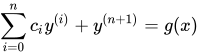


The method of undetermined coefficients provides a straightforward method of obtaining the solution to this ODE when two criteria are met:[2]
- are constants.
- g(x) is a constant, a polynomial function, exponential function , sine or cosine functions or , or finite sums and products of these functions (, constants).


The method consists of finding the general homogeneous solution for the complementary linear homogeneous differential equation

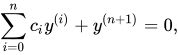
and a particular integral of the linear non-homogeneous ordinary differential equation based on . Then the general solution to the linear non-homogeneous ordinary differential equation would be


If consists of the sum of two functions and we say that is the solution based on and the solution based on . Then, using a superposition principle, we can say that the particular integral is[3]



Typical forms of the particular integral
In order to find the particular integral, we need to 'guess' its form, with some coefficients left as variables to be solved for. This takes the form of the first derivative of the complementary function. Below is a table of some typical functions and the solution to guess for them.
| Function of x | Form for y |
|---|---|
| Failed to parse (MathML with SVG or PNG fallback (recommended for modern browsers and accessibility tools): Invalid response ("Math extension cannot connect to Restbase.") from server "https://wikimedia.org/api/rest_v1/":): {\displaystyle k e^{a x}\!} | Failed to parse (MathML with SVG or PNG fallback (recommended for modern browsers and accessibility tools): Invalid response ("Math extension cannot connect to Restbase.") from server "https://wikimedia.org/api/rest_v1/":): {\displaystyle C e^{a x}\!} |
| Failed to parse (MathML with SVG or PNG fallback (recommended for modern browsers and accessibility tools): Invalid response ("Math extension cannot connect to Restbase.") from server "https://wikimedia.org/api/rest_v1/":): {\displaystyle k x^n,\; n = 0, 1, 2,\ldots\!} |
Failed to parse (MathML with SVG or PNG fallback (recommended for modern browsers and accessibility tools): Invalid response ("Math extension cannot connect to Restbase.") from server "https://wikimedia.org/api/rest_v1/":): {\displaystyle \sum_{i=0}^n K_i x^i \!} |
| Failed to parse (MathML with SVG or PNG fallback (recommended for modern browsers and accessibility tools): Invalid response ("Math extension cannot connect to Restbase.") from server "https://wikimedia.org/api/rest_v1/":): {\displaystyle k \cos(a x) \text{ or } k \sin(a x) \!} |
Failed to parse (MathML with SVG or PNG fallback (recommended for modern browsers and accessibility tools): Invalid response ("Math extension cannot connect to Restbase.") from server "https://wikimedia.org/api/rest_v1/":): {\displaystyle K \cos(a x) + M \sin(a x) \!} |
| Failed to parse (MathML with SVG or PNG fallback (recommended for modern browsers and accessibility tools): Invalid response ("Math extension cannot connect to Restbase.") from server "https://wikimedia.org/api/rest_v1/":): {\displaystyle k e^{a x} \cos(b x) \text{ or } ke^{a x} \sin(b x) \!} |
Failed to parse (MathML with SVG or PNG fallback (recommended for modern browsers and accessibility tools): Invalid response ("Math extension cannot connect to Restbase.") from server "https://wikimedia.org/api/rest_v1/":): {\displaystyle e^{a x} (K \cos(b x) + M \sin(b x)) \!} |
| Failed to parse (MathML with SVG or PNG fallback (recommended for modern browsers and accessibility tools): Invalid response ("Math extension cannot connect to Restbase.") from server "https://wikimedia.org/api/rest_v1/":): {\displaystyle \left(\sum_{i=0}^n k_i x^i\right) \cos(b x) \text{ or }\ \left(\sum_{i=0}^n k_i x^i\right) \sin(b x) \!} |
Failed to parse (MathML with SVG or PNG fallback (recommended for modern browsers and accessibility tools): Invalid response ("Math extension cannot connect to Restbase.") from server "https://wikimedia.org/api/rest_v1/":): {\displaystyle \left(\sum_{i=0}^n Q_i x^i\right) \cos(b x) + \left(\sum_{i=0}^n R_i x^i\right) \sin(b x)} |
| Failed to parse (MathML with SVG or PNG fallback (recommended for modern browsers and accessibility tools): Invalid response ("Math extension cannot connect to Restbase.") from server "https://wikimedia.org/api/rest_v1/":): {\displaystyle \left(\sum_{i=0}^n k_i x^i\right) e^{a x} \cos(b x) \text{ or } \left(\sum_{i=0}^n k_i x^i\right) e^{a x} \sin(b x)\!} |
Failed to parse (MathML with SVG or PNG fallback (recommended for modern browsers and accessibility tools): Invalid response ("Math extension cannot connect to Restbase.") from server "https://wikimedia.org/api/rest_v1/":): {\displaystyle e^{a x} \left(\left(\sum_{i=0}^n Q_i x^i\right) \cos(b x) + \left(\sum_{i=0}^n R_i x^i\right) \sin(b x)\right)} |
If a term in the above particular integral for y appears in the homogeneous solution, it is necessary to multiply by a sufficiently large power of x in order to make the solution independent. If the function of x is a sum of terms in the above table, the particular integral can be guessed using a sum of the corresponding terms for y.[1]
Examples
Example 1
Find a particular integral of the equation
- Failed to parse (MathML with SVG or PNG fallback (recommended for modern browsers and accessibility tools): Invalid response ("Math extension cannot connect to Restbase.") from server "https://wikimedia.org/api/rest_v1/":): {\displaystyle y'' + y = t \cos t. }
The right side t cos t has the form
- Failed to parse (MathML with SVG or PNG fallback (recommended for modern browsers and accessibility tools): Invalid response ("Math extension cannot connect to Restbase.") from server "https://wikimedia.org/api/rest_v1/":): {\displaystyle P_n e^{\alpha t} \cos{\beta t} }
with n = 2, α = 0, and β = 1.
Since α + iβ = i is a simple root of the characteristic equation
- Failed to parse (MathML with SVG or PNG fallback (recommended for modern browsers and accessibility tools): Invalid response ("Math extension cannot connect to Restbase.") from server "https://wikimedia.org/api/rest_v1/":): {\displaystyle \lambda^2 + 1 = 0 }
we should try a particular integral of the form
- Failed to parse (MathML with SVG or PNG fallback (recommended for modern browsers and accessibility tools): Invalid response ("Math extension cannot connect to Restbase.") from server "https://wikimedia.org/api/rest_v1/":): {\displaystyle \begin{align} y_p &= t \left [F_1 (t) e^{\alpha t} \cos{\beta t} + G_1 (t) e^{\alpha t} \sin{\beta t} \right ] \\ &= t \left [F_1 (t) \cos t + G_1 (t) \sin t \right ] \\ &= t \left [ \left (A_0 t + A_1 \right ) \cos t + \left (B_0 t + B_1 \right ) \sin t \right ] \\ &= \left (A_0 t^2 + A_1 t \right ) \cos t + \left (B_0 t^2 + B_1 t \right) \sin t. \end{align}}
Substituting yp into the differential equation, we have the identity
- Failed to parse (MathML with SVG or PNG fallback (recommended for modern browsers and accessibility tools): Invalid response ("Math extension cannot connect to Restbase.") from server "https://wikimedia.org/api/rest_v1/":): {\displaystyle \begin{align} t \cos t &= y_p'' + y_p \\ &= \left [ \left(A_0 t^2 + A_1 t \right ) \cos t + \left (B_0 t^2 + B_1 t \right ) \sin t \right ]'' + \left[\left(A_0 t^2 + A_1 t \right ) \cos t + \left(B_0 t^2 + B_1 t \right ) \sin t \right ] \\ &= \left [2A_0 \cos t + 2 \left (2A_0 t + A_1 \right )(-\sin t) + \left (A_0 t^2 + A_1 t \right )(-\cos t) + 2B_0 \sin t + 2 \left (2B_0 t + B_1 \right ) \cos t + \left (B_0 t^2 + B_1 t \right )(- \sin t) \right ] \\ &\qquad +\left[\left(A_0 t^2 + A_1 t \right ) \cos t + \left(B_0 t^2 + B_1 t \right ) \sin t \right ] \\ &= [4B_0 t + (2A_0 + 2B_1)] \cos t + [-4A_0 t + (-2A_1 + 2B_0)] \sin t. \end{align}}
Comparing both sides, we have
- Failed to parse (MathML with SVG or PNG fallback (recommended for modern browsers and accessibility tools): Invalid response ("Math extension cannot connect to Restbase.") from server "https://wikimedia.org/api/rest_v1/":): {\displaystyle \begin{cases} 1 = 4B_0\\ 0 = 2A_0 + 2B_1 \\ 0 = -4A_0 \\ 0 = -2A_1 + 2B_0 \end{cases}}
which has the solution
- Failed to parse (MathML with SVG or PNG fallback (recommended for modern browsers and accessibility tools): Invalid response ("Math extension cannot connect to Restbase.") from server "https://wikimedia.org/api/rest_v1/":): {\displaystyle A_0 = 0, \quad A_1 = B_0 = \frac{1}{4}, \quad B_1 = 0.}
We then have a particular integral
- Failed to parse (MathML with SVG or PNG fallback (recommended for modern browsers and accessibility tools): Invalid response ("Math extension cannot connect to Restbase.") from server "https://wikimedia.org/api/rest_v1/":): {\displaystyle y_p = \frac {1} {4} t \cos t + \frac {1}{4} t^2 \sin t. }
Example 2
Consider the following linear nonhomogeneous differential equation:
- Failed to parse (MathML with SVG or PNG fallback (recommended for modern browsers and accessibility tools): Invalid response ("Math extension cannot connect to Restbase.") from server "https://wikimedia.org/api/rest_v1/":): {\displaystyle \frac{dy}{dx} = y + e^x.}
This is like the first example above, except that the nonhomogeneous part (Failed to parse (MathML with SVG or PNG fallback (recommended for modern browsers and accessibility tools): Invalid response ("Math extension cannot connect to Restbase.") from server "https://wikimedia.org/api/rest_v1/":): {\displaystyle e^x} ) is not linearly independent to the general solution of the homogeneous part (Failed to parse (MathML with SVG or PNG fallback (recommended for modern browsers and accessibility tools): Invalid response ("Math extension cannot connect to Restbase.") from server "https://wikimedia.org/api/rest_v1/":): {\displaystyle c_1 e^x} ); as a result, we have to multiply our guess by a sufficiently large power of x to make it linearly independent.
Here our guess becomes:
- Failed to parse (MathML with SVG or PNG fallback (recommended for modern browsers and accessibility tools): Invalid response ("Math extension cannot connect to Restbase.") from server "https://wikimedia.org/api/rest_v1/":): {\displaystyle y_p = A x e^x.}
By substituting this function and its derivative into the differential equation, one can solve for A:
- Failed to parse (MathML with SVG or PNG fallback (recommended for modern browsers and accessibility tools): Invalid response ("Math extension cannot connect to Restbase.") from server "https://wikimedia.org/api/rest_v1/":): {\displaystyle \frac{d}{dx} \left( A x e^x \right) = A x e^x + e^x}
- Failed to parse (MathML with SVG or PNG fallback (recommended for modern browsers and accessibility tools): Invalid response ("Math extension cannot connect to Restbase.") from server "https://wikimedia.org/api/rest_v1/":): {\displaystyle A x e^x + A e^x = A x e^x + e^x}
- Failed to parse (MathML with SVG or PNG fallback (recommended for modern browsers and accessibility tools): Invalid response ("Math extension cannot connect to Restbase.") from server "https://wikimedia.org/api/rest_v1/":): {\displaystyle A = 1.}
So, the general solution to this differential equation is:
- Failed to parse (MathML with SVG or PNG fallback (recommended for modern browsers and accessibility tools): Invalid response ("Math extension cannot connect to Restbase.") from server "https://wikimedia.org/api/rest_v1/":): {\displaystyle y = c_1 e^x + xe^x.}
Example 3
Find the general solution of the equation:
- Failed to parse (MathML with SVG or PNG fallback (recommended for modern browsers and accessibility tools): Invalid response ("Math extension cannot connect to Restbase.") from server "https://wikimedia.org/api/rest_v1/":): {\displaystyle \frac{dy}{dt} = t^2 - y}
Failed to parse (MathML with SVG or PNG fallback (recommended for modern browsers and accessibility tools): Invalid response ("Math extension cannot connect to Restbase.") from server "https://wikimedia.org/api/rest_v1/":): {\displaystyle t^2} is a polynomial of degree 2, so we look for a solution using the same form,
- Failed to parse (MathML with SVG or PNG fallback (recommended for modern browsers and accessibility tools): Invalid response ("Math extension cannot connect to Restbase.") from server "https://wikimedia.org/api/rest_v1/":): {\displaystyle y_p = A t^2 + B t + C,}
Plugging this particular function into the original equation yields,
- Failed to parse (MathML with SVG or PNG fallback (recommended for modern browsers and accessibility tools): Invalid response ("Math extension cannot connect to Restbase.") from server "https://wikimedia.org/api/rest_v1/":): {\displaystyle 2 A t + B = t^2 - (A t^2 + B t + C),}
- Failed to parse (MathML with SVG or PNG fallback (recommended for modern browsers and accessibility tools): Invalid response ("Math extension cannot connect to Restbase.") from server "https://wikimedia.org/api/rest_v1/":): {\displaystyle 2 A t + B =(1-A)t^2 -Bt -C, }
- Failed to parse (MathML with SVG or PNG fallback (recommended for modern browsers and accessibility tools): Invalid response ("Math extension cannot connect to Restbase.") from server "https://wikimedia.org/api/rest_v1/":): {\displaystyle (A-1)t^2 + (2A+B)t + (B+C) = 0.}
which gives:
- Failed to parse (MathML with SVG or PNG fallback (recommended for modern browsers and accessibility tools): Invalid response ("Math extension cannot connect to Restbase.") from server "https://wikimedia.org/api/rest_v1/":): {\displaystyle A-1 = 0, \quad 2A+B =0, \quad B+C=0.}
Solving for constants we get:
- Failed to parse (MathML with SVG or PNG fallback (recommended for modern browsers and accessibility tools): Invalid response ("Math extension cannot connect to Restbase.") from server "https://wikimedia.org/api/rest_v1/":): {\displaystyle y_p = t^2 - 2 t + 2}
To solve for the general solution,
- Failed to parse (MathML with SVG or PNG fallback (recommended for modern browsers and accessibility tools): Invalid response ("Math extension cannot connect to Restbase.") from server "https://wikimedia.org/api/rest_v1/":): {\displaystyle y= y_p + y_c}
where Failed to parse (MathML with SVG or PNG fallback (recommended for modern browsers and accessibility tools): Invalid response ("Math extension cannot connect to Restbase.") from server "https://wikimedia.org/api/rest_v1/":): {\displaystyle y_c} is the homogeneous solution Failed to parse (MathML with SVG or PNG fallback (recommended for modern browsers and accessibility tools): Invalid response ("Math extension cannot connect to Restbase.") from server "https://wikimedia.org/api/rest_v1/":): {\displaystyle y_c = c_1 e^{-t}} , therefore, the general solution is:
- Failed to parse (MathML with SVG or PNG fallback (recommended for modern browsers and accessibility tools): Invalid response ("Math extension cannot connect to Restbase.") from server "https://wikimedia.org/api/rest_v1/":): {\displaystyle y= t^2 - 2 t + 2 + c_1 e^{-t}}
Licensing
Content obtained and/or adapted from:
- Method of undetermined coefficients, Wikipedia under a CC BY-SA license

