Difference between revisions of "Integration by Substitution"
| (4 intermediate revisions by the same user not shown) | |||
| Line 49: | Line 49: | ||
|} | |} | ||
| − | + | ===Example 1=== | |
<p><math>\int_{0}^{2} x(x^2+1)^2 \operatorname {d}x</math></p> | <p><math>\int_{0}^{2} x(x^2+1)^2 \operatorname {d}x</math></p> | ||
| Line 55: | Line 55: | ||
<p>Instead of making this a big polynomial we will just use the substitution method.</p> | <p>Instead of making this a big polynomial we will just use the substitution method.</p> | ||
| − | <p>Step 1 </p> | + | <p>'''Step 1'''</p> |
| − | <p>Identify your <i>u</i></p> | + | : <p>Identify your <i>u</i></p> |
| − | <p>Let <math> u = x^2+1</math></p> | + | : <p>Let <math> u = x^2+1</math></p> |
| − | <p>Step 2</p> | + | <p>'''Step 2'''</p> |
| − | <p><br>Identify <math>\operatorname {d}u</math></br></p> | + | : <p><br>Identify <math>\operatorname {d}u</math></br></p> |
| − | <p> <br><math>\operatorname {d}u = 2x\operatorname {d}x</math></br></p> | + | : <p> <br><math>\operatorname {d}u = 2x\operatorname {d}x</math></br></p> |
| − | + | '''Step 3''' | |
| − | <p>Now we plug in our limits of integration to our <i>u</i> to find our new limits of integration</p> | + | : <p>Now we plug in our limits of integration to our <i>u</i> to find our new limits of integration</p> |
| − | <p>When <math> x = 0, u =0^2 + 1 = 1</math></p> | + | : <p>When <math> x = 0, u =0^2 + 1 = 1</math></p> |
| − | <p>and when <math>x = 2, u = 2^2 + 1 = 5</math></p> | + | : <p>and when <math>x = 2, u = 2^2 + 1 = 5</math></p> |
| − | <p>Now our integration problem looks something like this</p> | + | : <p>Now our integration problem looks something like this</p> |
| − | <p><center><math>\frac {1}{2} \int_{0}^{5} (x^2 + 1)^2 (2x)\operatorname {d}x</math></center></p> | + | : <p><center><math>\frac {1}{2} \int_{0}^{5} (x^2 + 1)^2 (2x)\operatorname {d}x</math></center></p> |
| − | + | '''Step 4''' | |
| − | <p>write your new integration problem</p> | + | : <p>write your new integration problem</p> |
| − | <p><br>When we plug in our <i>u</i> it looks like </br></p> | + | : <p><br>When we plug in our <i>u</i> it looks like </br></p> |
<p><center><math>\frac {1}{2} \int_{0}^{5} (u)^2 \operatorname {d}u</math></center></p> | <p><center><math>\frac {1}{2} \int_{0}^{5} (u)^2 \operatorname {d}u</math></center></p> | ||
| − | + | '''Step 5''' | |
| − | <p>Evaluate the Integral</p> | + | : <p>Evaluate the Integral</p> |
| − | <p><center><math>\frac {1}{2} \left[\frac {1}{3} u^3 \right]_{0}^{5}</math></center></p> | + | : <p><center><math>\frac {1}{2} \left[\frac {1}{3} u^3 \right]_{0}^{5}</math></center></p> |
| − | <p><br><center><math>\frac {1}{2} \left[\left(\frac {1}{3} * 5^3 \right) - \left(\frac {1}{3} * 0^3 \right)\right]</math></center></br></p> | + | : <p><br><center><math>\frac {1}{2} \left[\left(\frac {1}{3} * 5^3 \right) - \left(\frac {1}{3} * 0^3 \right)\right]</math></center></br></p> |
| − | <p><br><center><math>\frac {1}{2} \left[\frac {1}{3} * 125 \right]</math></center></br></p> | + | : <p><br><center><math>\frac {1}{2} \left[\frac {1}{3} * 125 \right]</math></center></br></p> |
| − | <p><br><center><math>\frac {1}{2} \left[\frac {125}{3}\right]</math></center></br></p> | + | : <p><br><center><math>\frac {1}{2} \left[\frac {125}{3}\right]</math></center></br></p> |
| − | <p><br><center><math>\frac {125}{6}</math></center></br></p> | + | : <p><br><center><math>\frac {125}{6}</math></center></br></p> |
| − | <p><br>As you can see this all simplified fairly nice. Using substitution will be hard, for most people, at first. Once you get the hang of doing this it should come to you faster and faster each time.</br></p> | + | : <p><br>As you can see this all simplified fairly nice. Using substitution will be hard, for most people, at first. Once you get the hang of doing this it should come to you faster and faster each time.</br></p> |
| − | + | ===Example 2=== | |
| − | < | + | :<math>\int 3x^2(x^3+1)^5dx</math> |
| − | + | we see that <math>3x^2</math> is the derivative of <math>x^3+1</math> . Letting | |
| − | < | + | :<math>u=x^3+1</math> |
| − | < | + | we have |
| + | |||
| + | :<math>\frac{du}{dx}=3x^2</math> | ||
| + | |||
| + | or, in order to apply it to the integral, | ||
| + | |||
| + | :<math>du=3x^2dx</math> | ||
| + | |||
| + | With this we may write | ||
| + | |||
| + | :<math>\int 3x^2(x^3+1)^5dx=\int u^5du=\frac{u^6}{6}+C=\frac{(x^3+1)^6}{6}+C</math> | ||
| + | |||
| + | Note that it was not necessary that we had <i>exactly</i> the derivative of <math>u</math> in our integrand. It would have been sufficient to have any constant multiple of the derivative. | ||
| + | |||
| + | For instance, to treat the integral | ||
| + | |||
| + | :<math>\int x^4\sin(x^5)dx</math> | ||
| + | |||
| + | we may let <math>u=x^5</math> . Then | ||
| + | :<math>du=5x^4dx</math> | ||
| + | and so | ||
| + | :<math>\frac{du}{5}=x^4dx</math> | ||
| + | the right-hand side of which is a factor of our integrand. Thus, | ||
| + | :<math>\int x^4\sin(x^5)dx=\int\frac{\sin(u)}{5}du=-\frac{\cos(u)}{5}+C=-\frac{\cos(x^5)}{5}+C</math> | ||
==Resources== | ==Resources== | ||
| − | [https://www.youtube.com/watch?v=uoCW8S-I9Es Example 1]. Produced by Professor Zachary Sharon, UTSA | + | * [https://en.wikibooks.org/wiki/Calculus/Integration_techniques/Recognizing_Derivatives_and_the_Substitution_Rule Recognizing Derivatives and Substitution Rules], WikiBooks: Calculus |
| + | * [https://en.wikibooks.org/wiki/High_School_Calculus/Integration_by_Substitution Integration by Substitution], WikiBooks: High School Calculus | ||
| + | * [https://www.youtube.com/watch?v=uoCW8S-I9Es Example 1]. Produced by Professor Zachary Sharon, UTSA | ||
| − | [https://www.youtube.com/watch?v=zqMxMtjbaBE Example 2]. Produced by TA Catherine Sporer, UTSA | + | * [https://www.youtube.com/watch?v=zqMxMtjbaBE Example 2]. Produced by TA Catherine Sporer, UTSA |
<strong>Indefinite Integrals Using Substitution</strong> | <strong>Indefinite Integrals Using Substitution</strong> | ||
| Line 153: | Line 178: | ||
* [https://youtu.be/0A2RlnutO8U U-Substitution Integration, Indefinite & Definite Integral] by The Organic Chemistry Tutor | * [https://youtu.be/0A2RlnutO8U U-Substitution Integration, Indefinite & Definite Integral] by The Organic Chemistry Tutor | ||
| + | |||
| + | ==Licensing== | ||
| + | Content obtained and/or adapted from: | ||
| + | * [https://en.wikibooks.org/wiki/Calculus/Integration_techniques/Recognizing_Derivatives_and_the_Substitution_Rule Recognizing Derivatives and Substitution Rules, WikiBooks: Calculus] under a CC BY-SA license | ||
| + | |||
| + | * [https://en.wikibooks.org/wiki/High_School_Calculus/Integration_by_Substitution Integration by Substitution, WikiBooks: High School Calculus] under a CC BY-SA license | ||
Latest revision as of 13:21, 28 October 2021
Integration by Substitution
There is a theorem that will help you with substitution for integration. It is called Change of Variables for Definite Integrals.
what the theorem looks like is this
In order to get Failed to parse (MathML with SVG or PNG fallback (recommended for modern browsers and accessibility tools): Invalid response ("Math extension cannot connect to Restbase.") from server "https://wikimedia.org/api/rest_v1/":): {\displaystyle \alpha}
you must plug a into the function g and to get Failed to parse (MathML with SVG or PNG fallback (recommended for modern browsers and accessibility tools): Invalid response ("Math extension cannot connect to Restbase.") from server "https://wikimedia.org/api/rest_v1/":): {\displaystyle \beta}
you must plug b into the function g.
The tricky part is trying to identify what you want to make your u to be. Some times substitution will not be enough and you will have to use the rules for integration by parts. That will be covered in a different section
Steps
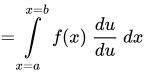
(1) i.e. Failed to parse (MathML with SVG or PNG fallback (recommended for modern browsers and accessibility tools): Invalid response ("Math extension cannot connect to Restbase.") from server "https://wikimedia.org/api/rest_v1/":): {\displaystyle =\int\limits_{x=a}^{x=b}{\left(f(x)\ \frac{dx}{du}\right)\left(\frac{du}{dx}\right)}\ dx} (2) i.e. Failed to parse (MathML with SVG or PNG fallback (recommended for modern browsers and accessibility tools): Invalid response ("Math extension cannot connect to Restbase.") from server "https://wikimedia.org/api/rest_v1/":): {\displaystyle \frac{dx}{du}\cdot\frac{du}{dx}=1} Failed to parse (MathML with SVG or PNG fallback (recommended for modern browsers and accessibility tools): Invalid response ("Math extension cannot connect to Restbase.") from server "https://wikimedia.org/api/rest_v1/":): {\displaystyle =\int\limits_{x=a}^{x=b}\left(f(x)\ \frac{dx}{du}\right)g'(x)\ dx} (3) i.e. Failed to parse (MathML with SVG or PNG fallback (recommended for modern browsers and accessibility tools): Invalid response ("Math extension cannot connect to Restbase.") from server "https://wikimedia.org/api/rest_v1/":): {\displaystyle \frac{du}{dx}=g'(x)} Failed to parse (MathML with SVG or PNG fallback (recommended for modern browsers and accessibility tools): Invalid response ("Math extension cannot connect to Restbase.") from server "https://wikimedia.org/api/rest_v1/":): {\displaystyle =\int\limits_{x=a}^{x=b}h(g(x))g'(x)dx} (4) i.e. Now equate Failed to parse (MathML with SVG or PNG fallback (recommended for modern browsers and accessibility tools): Invalid response ("Math extension cannot connect to Restbase.") from server "https://wikimedia.org/api/rest_v1/":): {\displaystyle \left(f(x)\ \frac{dx}{du}\right)} with Failed to parse (MathML with SVG or PNG fallback (recommended for modern browsers and accessibility tools): Invalid response ("Math extension cannot connect to Restbase.") from server "https://wikimedia.org/api/rest_v1/":): {\displaystyle h(g(x))} Failed to parse (MathML with SVG or PNG fallback (recommended for modern browsers and accessibility tools): Invalid response ("Math extension cannot connect to Restbase.") from server "https://wikimedia.org/api/rest_v1/":): {\displaystyle =\int\limits_{x=a}^{x=b}h(u)g'(x)dx} (5) i.e. Failed to parse (MathML with SVG or PNG fallback (recommended for modern browsers and accessibility tools): Invalid response ("Math extension cannot connect to Restbase.") from server "https://wikimedia.org/api/rest_v1/":): {\displaystyle g(x)=u} Failed to parse (MathML with SVG or PNG fallback (recommended for modern browsers and accessibility tools): Invalid response ("Math extension cannot connect to Restbase.") from server "https://wikimedia.org/api/rest_v1/":): {\displaystyle =\int\limits_{u=g(a)}^{u=g(b)}h(u)du} (6) i.e. Failed to parse (MathML with SVG or PNG fallback (recommended for modern browsers and accessibility tools): Invalid response ("Math extension cannot connect to Restbase.") from server "https://wikimedia.org/api/rest_v1/":): {\displaystyle du=\frac{du}{dx}dx=g'(x)dx} Failed to parse (MathML with SVG or PNG fallback (recommended for modern browsers and accessibility tools): Invalid response ("Math extension cannot connect to Restbase.") from server "https://wikimedia.org/api/rest_v1/":): {\displaystyle =\int\limits_{u=c}^{u=d}h(u)du} (7) i.e. We have achieved our desired result


Example 1
Failed to parse (MathML with SVG or PNG fallback (recommended for modern browsers and accessibility tools): Invalid response ("Math extension cannot connect to Restbase.") from server "https://wikimedia.org/api/rest_v1/":): {\displaystyle \int_{0}^{2} x(x^2+1)^2 \operatorname {d}x}
Instead of making this a big polynomial we will just use the substitution method.
Step 1
Identify your u
Let Failed to parse (MathML with SVG or PNG fallback (recommended for modern browsers and accessibility tools): Invalid response ("Math extension cannot connect to Restbase.") from server "https://wikimedia.org/api/rest_v1/":): {\displaystyle u = x^2+1}
Step 2
Identify Failed to parse (MathML with SVG or PNG fallback (recommended for modern browsers and accessibility tools): Invalid response ("Math extension cannot connect to Restbase.") from server "https://wikimedia.org/api/rest_v1/":): {\displaystyle \operatorname {d}u}
Failed to parse (MathML with SVG or PNG fallback (recommended for modern browsers and accessibility tools): Invalid response ("Math extension cannot connect to Restbase.") from server "https://wikimedia.org/api/rest_v1/":): {\displaystyle \operatorname {d}u = 2x\operatorname {d}x}
Step 3
Now we plug in our limits of integration to our u to find our new limits of integration
When Failed to parse (MathML with SVG or PNG fallback (recommended for modern browsers and accessibility tools): Invalid response ("Math extension cannot connect to Restbase.") from server "https://wikimedia.org/api/rest_v1/":): {\displaystyle x = 0, u =0^2 + 1 = 1}
and when Failed to parse (MathML with SVG or PNG fallback (recommended for modern browsers and accessibility tools): Invalid response ("Math extension cannot connect to Restbase.") from server "https://wikimedia.org/api/rest_v1/":): {\displaystyle x = 2, u = 2^2 + 1 = 5}
Now our integration problem looks something like this
Failed to parse (MathML with SVG or PNG fallback (recommended for modern browsers and accessibility tools): Invalid response ("Math extension cannot connect to Restbase.") from server "https://wikimedia.org/api/rest_v1/":): {\displaystyle \frac {1}{2} \int_{0}^{5} (x^2 + 1)^2 (2x)\operatorname {d}x}
Step 4
write your new integration problem
When we plug in our u it looks like
Step 5
Evaluate the Integral
Failed to parse (MathML with SVG or PNG fallback (recommended for modern browsers and accessibility tools): Invalid response ("Math extension cannot connect to Restbase.") from server "https://wikimedia.org/api/rest_v1/":): {\displaystyle \frac {1}{2} \left[\frac {1}{3} u^3 \right]_{0}^{5}}
Failed to parse (MathML with SVG or PNG fallback (recommended for modern browsers and accessibility tools): Invalid response ("Math extension cannot connect to Restbase.") from server "https://wikimedia.org/api/rest_v1/":): {\displaystyle \frac {1}{2} \left[\left(\frac {1}{3} * 5^3 \right) - \left(\frac {1}{3} * 0^3 \right)\right]}
Failed to parse (MathML with SVG or PNG fallback (recommended for modern browsers and accessibility tools): Invalid response ("Math extension cannot connect to Restbase.") from server "https://wikimedia.org/api/rest_v1/":): {\displaystyle \frac {1}{2} \left[\frac {1}{3} * 125 \right]}
Failed to parse (MathML with SVG or PNG fallback (recommended for modern browsers and accessibility tools): Invalid response ("Math extension cannot connect to Restbase.") from server "https://wikimedia.org/api/rest_v1/":): {\displaystyle \frac {1}{2} \left[\frac {125}{3}\right]}
Failed to parse (MathML with SVG or PNG fallback (recommended for modern browsers and accessibility tools): Invalid response ("Math extension cannot connect to Restbase.") from server "https://wikimedia.org/api/rest_v1/":): {\displaystyle \frac {125}{6}}
As you can see this all simplified fairly nice. Using substitution will be hard, for most people, at first. Once you get the hang of doing this it should come to you faster and faster each time.
Example 2
- Failed to parse (MathML with SVG or PNG fallback (recommended for modern browsers and accessibility tools): Invalid response ("Math extension cannot connect to Restbase.") from server "https://wikimedia.org/api/rest_v1/":): {\displaystyle \int 3x^2(x^3+1)^5dx}
we see that Failed to parse (MathML with SVG or PNG fallback (recommended for modern browsers and accessibility tools): Invalid response ("Math extension cannot connect to Restbase.") from server "https://wikimedia.org/api/rest_v1/":): {\displaystyle 3x^2} is the derivative of Failed to parse (MathML with SVG or PNG fallback (recommended for modern browsers and accessibility tools): Invalid response ("Math extension cannot connect to Restbase.") from server "https://wikimedia.org/api/rest_v1/":): {\displaystyle x^3+1} . Letting
- Failed to parse (MathML with SVG or PNG fallback (recommended for modern browsers and accessibility tools): Invalid response ("Math extension cannot connect to Restbase.") from server "https://wikimedia.org/api/rest_v1/":): {\displaystyle u=x^3+1}
we have
- Failed to parse (MathML with SVG or PNG fallback (recommended for modern browsers and accessibility tools): Invalid response ("Math extension cannot connect to Restbase.") from server "https://wikimedia.org/api/rest_v1/":): {\displaystyle \frac{du}{dx}=3x^2}
or, in order to apply it to the integral,
- Failed to parse (MathML with SVG or PNG fallback (recommended for modern browsers and accessibility tools): Invalid response ("Math extension cannot connect to Restbase.") from server "https://wikimedia.org/api/rest_v1/":): {\displaystyle du=3x^2dx}
With this we may write
- Failed to parse (MathML with SVG or PNG fallback (recommended for modern browsers and accessibility tools): Invalid response ("Math extension cannot connect to Restbase.") from server "https://wikimedia.org/api/rest_v1/":): {\displaystyle \int 3x^2(x^3+1)^5dx=\int u^5du=\frac{u^6}{6}+C=\frac{(x^3+1)^6}{6}+C}
Note that it was not necessary that we had exactly the derivative of Failed to parse (MathML with SVG or PNG fallback (recommended for modern browsers and accessibility tools): Invalid response ("Math extension cannot connect to Restbase.") from server "https://wikimedia.org/api/rest_v1/":): {\displaystyle u} in our integrand. It would have been sufficient to have any constant multiple of the derivative.
For instance, to treat the integral
- Failed to parse (MathML with SVG or PNG fallback (recommended for modern browsers and accessibility tools): Invalid response ("Math extension cannot connect to Restbase.") from server "https://wikimedia.org/api/rest_v1/":): {\displaystyle \int x^4\sin(x^5)dx}
we may let Failed to parse (MathML with SVG or PNG fallback (recommended for modern browsers and accessibility tools): Invalid response ("Math extension cannot connect to Restbase.") from server "https://wikimedia.org/api/rest_v1/":): {\displaystyle u=x^5} . Then
- Failed to parse (MathML with SVG or PNG fallback (recommended for modern browsers and accessibility tools): Invalid response ("Math extension cannot connect to Restbase.") from server "https://wikimedia.org/api/rest_v1/":): {\displaystyle du=5x^4dx}
and so
- Failed to parse (MathML with SVG or PNG fallback (recommended for modern browsers and accessibility tools): Invalid response ("Math extension cannot connect to Restbase.") from server "https://wikimedia.org/api/rest_v1/":): {\displaystyle \frac{du}{5}=x^4dx}
the right-hand side of which is a factor of our integrand. Thus,
- Failed to parse (MathML with SVG or PNG fallback (recommended for modern browsers and accessibility tools): Invalid response ("Math extension cannot connect to Restbase.") from server "https://wikimedia.org/api/rest_v1/":): {\displaystyle \int x^4\sin(x^5)dx=\int\frac{\sin(u)}{5}du=-\frac{\cos(u)}{5}+C=-\frac{\cos(x^5)}{5}+C}
Resources
- Recognizing Derivatives and Substitution Rules, WikiBooks: Calculus
- Integration by Substitution, WikiBooks: High School Calculus
- Example 1. Produced by Professor Zachary Sharon, UTSA
- Example 2. Produced by TA Catherine Sporer, UTSA
Indefinite Integrals Using Substitution
- Indefinite Integration Using Substitution by James Sousa, Math is Power 4U
- Integration by Substitution Part 1 by James Sousa, Math is Power 4U
- Integration by Substitution Part 2 by James Sousa, Math is Power 4U
- Ex 1: Indefinite Integration Using Substitution by James Sousa, Math is Power 4U
- Ex 2: Indefinite Integration Using Substitution by James Sousa, Math is Power 4U
- Ex 3: Indefinite Integration Using Substitution by James Sousa, Math is Power 4U
- Ex 4: Indefinite Integration Using Substitution by James Sousa, Math is Power 4U
- Ex 5: Indefinite Integration Using Substitution by James Sousa, Math is Power 4U
- Ex 6: Indefinite Integration Using Substitution by James Sousa, Math is Power 4U
- Ex 7: Indefinite Integration Using Substitution by James Sousa, Math is Power 4U
- Ex 8: Indefinite Integration Using Substitution by James Sousa, Math is Power 4U
- Ex 9: Indefinite Integration Using Substitution by James Sousa, Math is Power 4U
- Integration using U-Substitution by patrickJMT
- U-Substitution - More Complicated Examples by patrickJMT
- U-Substitution Example 1 by Krista King
- U-Substitution Example 2 by Krista King
- U-Substitution Example 3 by Krista King
- U-Substitution Example 4 by Krista King
- U-Substitution Example 5 by Krista King
- U-Substitution Example 6 by Krista King
- U-Substitution Example 7 by Krista King
- How To Integrate Using U-Substitution by The Organic Chemistry Tutor
Definite Integrals Using Substitution
- Definite Integration Using Subsitution by James Sousa, Math is Power 4U
- Ex 1: Definite Integration Using Substitution - Change Limits of Integration? by James Sousa, Math is Power 4U
- Ex 2: Definite Integration Using Substitution - Change Limits of Integration? by James Sousa, Math is Power 4U
- Ex 1: Definite Integration Using Substitution by James Sousa, Math is Power 4U
- Ex 2: Definite Integration Using Substitution by James Sousa, Math is Power 4U
- Integration by U-Substitution, Definite Integral by patrickJMT
- U-Substitution: When Do I Have to Change the Limits of Integration ? by patrickJMT
- U-Substitution Integration, Indefinite & Definite Integral by The Organic Chemistry Tutor
Licensing
Content obtained and/or adapted from:
- Recognizing Derivatives and Substitution Rules, WikiBooks: Calculus under a CC BY-SA license
- Integration by Substitution, WikiBooks: High School Calculus under a CC BY-SA license

