Difference between revisions of "Integrals Involving Exponential and Logarithmic Functions"
| Line 80: | Line 80: | ||
|} | |} | ||
| − | == | + | === Exponential & Logarithm /integrals === |
| − | |||
| − | + | Regarding the derivatives of exponentials and logarithms, we know that: | |
| − | |||
| − | |||
| − | <math>\ | + | * <math>\dfrac{d}{dx} e^x = e^x</math> |
| + | * <math>\dfrac{d}{dx} \ln x = \frac{1}{x}</math> | ||
| − | + | Reversing these, we get: | |
| − | <math>\ | + | * <math>\int e^x = e^x + c</math> |
| + | * <math>\int \frac{1}{x} = \ln |x|</math> | ||
| − | + | The natural logarithm takes a modulus input so that it can handle negative numbers. | |
| − | + | Note that similar rules apply to any linear expressions that may be composed with these functions: | |
| − | + | * <math>\int e^{ax+b} = \frac{1}{a}e^{ax+b} + c</math> | |
| − | + | * <math>\int \frac{1}{ax+b} = \frac{1}{a}\ln|ax+b|</math> | |
| − | |||
| − | |||
| − | |||
| − | <math>\ | ||
| − | |||
| − | |||
| − | |||
| − | |||
| − | |||
| − | |||
| − | |||
| − | |||
| − | |||
| − | |||
| − | |||
| − | |||
| − | |||
| − | |||
| − | |||
| − | |||
| − | |||
| − | |||
| − | |||
| − | |||
| − | |||
| − | \frac{1}{ | ||
| − | |||
| − | |||
| − | |||
| − | |||
| − | |||
| − | |||
| − | |||
| − | |||
| − | |||
| − | |||
| − | |||
| − | |||
| − | |||
| − | |||
| − | |||
| − | |||
| − | |||
| − | |||
| − | |||
| − | |||
| − | |||
| − | |||
| − | |||
| − | |||
| − | { | ||
| − | |||
| − | |||
| − | |||
| − | |||
| − | |||
| − | |||
| − | |||
| − | |||
| − | |||
| − | |||
| − | |||
| − | |||
| − | |||
==Resources== | ==Resources== | ||
* [https://youtu.be/D9dqdbCgJQM Integrating Exponential Functions By Substitution - Antiderivatives - Calculus] by The Organic Chemistry Tutor | * [https://youtu.be/D9dqdbCgJQM Integrating Exponential Functions By Substitution - Antiderivatives - Calculus] by The Organic Chemistry Tutor | ||
* [https://en.wikibooks.org/wiki/Calculus/Indefinite_integral Indefinite Integral], WikiBooks: Calculus | * [https://en.wikibooks.org/wiki/Calculus/Indefinite_integral Indefinite Integral], WikiBooks: Calculus | ||
Revision as of 13:29, 28 October 2021
Contents
Logarithm Function
We shall first look at the irrational number in order to show its special properties when used with derivatives of exponential and logarithm functions. As mentioned before in the Algebra section, the value of is approximately but it may also be calculated as the Infinite Limit:


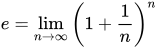
Now we find the derivative of using the formal definition of the derivative:


Let Failed to parse (MathML with SVG or PNG fallback (recommended for modern browsers and accessibility tools): Invalid response ("Math extension cannot connect to Restbase.") from server "https://wikimedia.org/api/rest_v1/":): {\displaystyle n=\frac{x}{h}} . Note that as Failed to parse (MathML with SVG or PNG fallback (recommended for modern browsers and accessibility tools): Invalid response ("Math extension cannot connect to Restbase.") from server "https://wikimedia.org/api/rest_v1/":): {\displaystyle n\to\infty} , we get Failed to parse (MathML with SVG or PNG fallback (recommended for modern browsers and accessibility tools): Invalid response ("Math extension cannot connect to Restbase.") from server "https://wikimedia.org/api/rest_v1/":): {\displaystyle h\to0} . So we can redefine our limit as:
Failed to parse (MathML with SVG or PNG fallback (recommended for modern browsers and accessibility tools): Invalid response ("Math extension cannot connect to Restbase.") from server "https://wikimedia.org/api/rest_v1/":): {\displaystyle \lim_{n\to\infty}\ln\left(1+\frac{1}{n}\right)^\frac{n}{x}=\frac{1}{x}\ln\left(\lim_{n\to\infty}\left(1+\frac{1}{n}\right)^n\right)=\frac{1}{x}\ln(e)=\frac{1}{x}}
Here we could take the natural logarithm outside the limit because it doesn't have anything to do with the limit (we could have chosen not to). We then substituted the value of Failed to parse (MathML with SVG or PNG fallback (recommended for modern browsers and accessibility tools): Invalid response ("Math extension cannot connect to Restbase.") from server "https://wikimedia.org/api/rest_v1/":): {\displaystyle e} .
|
Failed to parse (MathML with SVG or PNG fallback (recommended for modern browsers and accessibility tools): Invalid response ("Math extension cannot connect to Restbase.") from server "https://wikimedia.org/api/rest_v1/":): {\displaystyle \frac{d}{dx}\ln(x)=\frac{1}{x}} |
If we wanted, we could go through that same process again for a generalized base, but it is easier just to use properties of logs and realize that:
- Failed to parse (MathML with SVG or PNG fallback (recommended for modern browsers and accessibility tools): Invalid response ("Math extension cannot connect to Restbase.") from server "https://wikimedia.org/api/rest_v1/":): {\displaystyle \log_a(x)=\frac{\ln(x)}{\ln(a)}}
Since Failed to parse (MathML with SVG or PNG fallback (recommended for modern browsers and accessibility tools): Invalid response ("Math extension cannot connect to Restbase.") from server "https://wikimedia.org/api/rest_v1/":): {\displaystyle \frac{1}{\ln(a)}} is a constant, we can just take it outside of the derivative:
- Failed to parse (MathML with SVG or PNG fallback (recommended for modern browsers and accessibility tools): Invalid response ("Math extension cannot connect to Restbase.") from server "https://wikimedia.org/api/rest_v1/":): {\displaystyle \frac{d}{dx}\log_a(x)=\frac{1}{\ln(a)}\cdot\frac{d}{dx}\ln(x)}
Which leaves us with the generalized form of:
|
Failed to parse (MathML with SVG or PNG fallback (recommended for modern browsers and accessibility tools): Invalid response ("Math extension cannot connect to Restbase.") from server "https://wikimedia.org/api/rest_v1/":): {\displaystyle \frac{d}{dx}\log_a(x)=\frac{1}{\ln(a)x}} |
An alternative approach to derivative of the logarithm refers to the original expression of the logarithm as quadrature of the hyperbola y = 1/x .
Exponential Function
We shall take two different approaches to finding the derivative of Failed to parse (MathML with SVG or PNG fallback (recommended for modern browsers and accessibility tools): Invalid response ("Math extension cannot connect to Restbase.") from server "https://wikimedia.org/api/rest_v1/":): {\displaystyle \ln(e^x)} . The first approach:
- Failed to parse (MathML with SVG or PNG fallback (recommended for modern browsers and accessibility tools): Invalid response ("Math extension cannot connect to Restbase.") from server "https://wikimedia.org/api/rest_v1/":): {\displaystyle \frac{d}{dx}\ln(e^x)=\frac{d}{dx}x=1}
The second approach:
- Failed to parse (MathML with SVG or PNG fallback (recommended for modern browsers and accessibility tools): Invalid response ("Math extension cannot connect to Restbase.") from server "https://wikimedia.org/api/rest_v1/":): {\displaystyle \frac{d}{dx}\ln(e^x)=\frac{1}{e^x}\left(\frac{d}{dx}e^x\right)}
Note that in the second approach we made some use of the chain rule. Thus:
- Failed to parse (MathML with SVG or PNG fallback (recommended for modern browsers and accessibility tools): Invalid response ("Math extension cannot connect to Restbase.") from server "https://wikimedia.org/api/rest_v1/":): {\displaystyle \frac{1}{e^x}\left(\frac{d}{dx}e^x\right)=1}
- Failed to parse (MathML with SVG or PNG fallback (recommended for modern browsers and accessibility tools): Invalid response ("Math extension cannot connect to Restbase.") from server "https://wikimedia.org/api/rest_v1/":): {\displaystyle \frac{d}{dx}e^x=e^x}
so that we have proved the following rule:
|
Failed to parse (MathML with SVG or PNG fallback (recommended for modern browsers and accessibility tools): Invalid response ("Math extension cannot connect to Restbase.") from server "https://wikimedia.org/api/rest_v1/":): {\displaystyle \frac{d}{dx}e^x=e^x} |
Now that we have derived a specific case, let us extend things to the general case. Assuming that Failed to parse (MathML with SVG or PNG fallback (recommended for modern browsers and accessibility tools): Invalid response ("Math extension cannot connect to Restbase.") from server "https://wikimedia.org/api/rest_v1/":): {\displaystyle a} is a positive real constant, we wish to calculate:
- Failed to parse (MathML with SVG or PNG fallback (recommended for modern browsers and accessibility tools): Invalid response ("Math extension cannot connect to Restbase.") from server "https://wikimedia.org/api/rest_v1/":): {\displaystyle \frac{d}{dx}a^x}
One of the oldest tricks in mathematics is to break a problem down into a form that we already know we can handle. Since we have already determined the derivative of Failed to parse (MathML with SVG or PNG fallback (recommended for modern browsers and accessibility tools): Invalid response ("Math extension cannot connect to Restbase.") from server "https://wikimedia.org/api/rest_v1/":): {\displaystyle e^x} , we will attempt to rewrite Failed to parse (MathML with SVG or PNG fallback (recommended for modern browsers and accessibility tools): Invalid response ("Math extension cannot connect to Restbase.") from server "https://wikimedia.org/api/rest_v1/":): {\displaystyle a^x} in that form.
Using that Failed to parse (MathML with SVG or PNG fallback (recommended for modern browsers and accessibility tools): Invalid response ("Math extension cannot connect to Restbase.") from server "https://wikimedia.org/api/rest_v1/":): {\displaystyle e^{\ln(c)}=c} and that Failed to parse (MathML with SVG or PNG fallback (recommended for modern browsers and accessibility tools): Invalid response ("Math extension cannot connect to Restbase.") from server "https://wikimedia.org/api/rest_v1/":): {\displaystyle \ln(a^b)=b\cdot\ln(a)} , we find that:
- Failed to parse (MathML with SVG or PNG fallback (recommended for modern browsers and accessibility tools): Invalid response ("Math extension cannot connect to Restbase.") from server "https://wikimedia.org/api/rest_v1/":): {\displaystyle a^x=e^{\ln(a)x}}
Thus, we simply apply the chain rule:
- Failed to parse (MathML with SVG or PNG fallback (recommended for modern browsers and accessibility tools): Invalid response ("Math extension cannot connect to Restbase.") from server "https://wikimedia.org/api/rest_v1/":): {\displaystyle \frac{d}{dx}e^{\ln(a)x}=e^{\ln(a)x}\cdot\frac{d}{dx}[\ln(a)x]=\ln(a)a^x}
|
Failed to parse (MathML with SVG or PNG fallback (recommended for modern browsers and accessibility tools): Invalid response ("Math extension cannot connect to Restbase.") from server "https://wikimedia.org/api/rest_v1/":): {\displaystyle \frac{d}{dx}a^x=\ln(a)a^x} |
Exponential & Logarithm /integrals
Regarding the derivatives of exponentials and logarithms, we know that:
- Failed to parse (MathML with SVG or PNG fallback (recommended for modern browsers and accessibility tools): Invalid response ("Math extension cannot connect to Restbase.") from server "https://wikimedia.org/api/rest_v1/":): {\displaystyle \dfrac{d}{dx} e^x = e^x}
- Failed to parse (MathML with SVG or PNG fallback (recommended for modern browsers and accessibility tools): Invalid response ("Math extension cannot connect to Restbase.") from server "https://wikimedia.org/api/rest_v1/":): {\displaystyle \dfrac{d}{dx} \ln x = \frac{1}{x}}
Reversing these, we get:
- Failed to parse (MathML with SVG or PNG fallback (recommended for modern browsers and accessibility tools): Invalid response ("Math extension cannot connect to Restbase.") from server "https://wikimedia.org/api/rest_v1/":): {\displaystyle \int e^x = e^x + c}
- Failed to parse (MathML with SVG or PNG fallback (recommended for modern browsers and accessibility tools): Invalid response ("Math extension cannot connect to Restbase.") from server "https://wikimedia.org/api/rest_v1/":): {\displaystyle \int \frac{1}{x} = \ln |x|}
The natural logarithm takes a modulus input so that it can handle negative numbers.
Note that similar rules apply to any linear expressions that may be composed with these functions:
- Failed to parse (MathML with SVG or PNG fallback (recommended for modern browsers and accessibility tools): Invalid response ("Math extension cannot connect to Restbase.") from server "https://wikimedia.org/api/rest_v1/":): {\displaystyle \int e^{ax+b} = \frac{1}{a}e^{ax+b} + c}
- Failed to parse (MathML with SVG or PNG fallback (recommended for modern browsers and accessibility tools): Invalid response ("Math extension cannot connect to Restbase.") from server "https://wikimedia.org/api/rest_v1/":): {\displaystyle \int \frac{1}{ax+b} = \frac{1}{a}\ln|ax+b|}
Resources
- Integrating Exponential Functions By Substitution - Antiderivatives - Calculus by The Organic Chemistry Tutor
- Indefinite Integral, WikiBooks: Calculus

