Difference between revisions of "Uniform Convergence of Series of Functions"
(Created page with "==Pointwise Convergent and Uniformly Convergent Series of Functions== <p>Recall that a sequence of functions <math>(f_n(x))_{n=1}^{\infty}</math> with common domain <math>X</m...") |
|||
| (11 intermediate revisions by the same user not shown) | |||
| Line 1: | Line 1: | ||
| − | |||
<p>Recall that a sequence of functions <math>(f_n(x))_{n=1}^{\infty}</math> with common domain <math>X</math> is said to be pointwise convergent if for all <math>x \in X</math> and for all <math>\varepsilon > 0</math> there exists an <math>N \in \mathbb{N}</math> such that if <math>n \geq N</math> then:</p> | <p>Recall that a sequence of functions <math>(f_n(x))_{n=1}^{\infty}</math> with common domain <math>X</math> is said to be pointwise convergent if for all <math>x \in X</math> and for all <math>\varepsilon > 0</math> there exists an <math>N \in \mathbb{N}</math> such that if <math>n \geq N</math> then:</p> | ||
| Line 8: | Line 7: | ||
<p>We will now extend the concept of pointwise convergence and uniform convergence to series of functions.</p> | <p>We will now extend the concept of pointwise convergence and uniform convergence to series of functions.</p> | ||
| + | <blockquote style="background: white; border: 1px solid black; padding: 1em;"> | ||
<strong>Definition:</strong> Let <math>(f_n(x))_{n=1}^{\infty}</math> be a sequence of functions with common domain <math>X</math>. The corresponding series <math>\displaystyle{\sum_{n=1}^{\infty} f_n(x)}</math> is said to be <strong>Pointwise Convergent</strong> to the sum function <math>f(x)</math> if the corresponding sequence of partial sums <math>(s_n(x))_{n=1}^{\infty}</math> (where <math>\displaystyle{s_n(x) = \sum_{k=1}^n f_n(x) = f_1(x) + f_2(x) + ... + f_n(x)}</math>) is pointwise convergent to <math>f(x)</math>. | <strong>Definition:</strong> Let <math>(f_n(x))_{n=1}^{\infty}</math> be a sequence of functions with common domain <math>X</math>. The corresponding series <math>\displaystyle{\sum_{n=1}^{\infty} f_n(x)}</math> is said to be <strong>Pointwise Convergent</strong> to the sum function <math>f(x)</math> if the corresponding sequence of partial sums <math>(s_n(x))_{n=1}^{\infty}</math> (where <math>\displaystyle{s_n(x) = \sum_{k=1}^n f_n(x) = f_1(x) + f_2(x) + ... + f_n(x)}</math>) is pointwise convergent to <math>f(x)</math>. | ||
| + | </blockquote> | ||
<p>For example, consider the following sequence of functions defined on the interval <math>(-1, 1)</math>:</p> | <p>For example, consider the following sequence of functions defined on the interval <math>(-1, 1)</math>:</p> | ||
| Line 15: | Line 16: | ||
<p>We now that this series converges pointwise for all <math>x \in (0, 1)</math> since the result series <math>\sum_{n=1}^{\infty} x^{n-1}</math> is simply a geometric series to the sum function <math>\displaystyle{f(x) = \frac{1}{1 - x}}</math>.</p> | <p>We now that this series converges pointwise for all <math>x \in (0, 1)</math> since the result series <math>\sum_{n=1}^{\infty} x^{n-1}</math> is simply a geometric series to the sum function <math>\displaystyle{f(x) = \frac{1}{1 - x}}</math>.</p> | ||
| + | <blockquote style="background: white; border: 1px solid black; padding: 1em;"> | ||
<strong>Definition:</strong> Let <math>(f_n(x))_{n=1}^{\infty}</math> be a sequence of functions with common domain <math>X</math>. The corresponding series <math>\displaystyle{\sum_{n=1}^{\infty} f_n(x)}</math> is said to be <strong>Uniformly Convergent</strong> to the sum function <math>f(x)</math> if the corresponding sequence of partial sums is uniformly convergent to <math>f(x)</math>. | <strong>Definition:</strong> Let <math>(f_n(x))_{n=1}^{\infty}</math> be a sequence of functions with common domain <math>X</math>. The corresponding series <math>\displaystyle{\sum_{n=1}^{\infty} f_n(x)}</math> is said to be <strong>Uniformly Convergent</strong> to the sum function <math>f(x)</math> if the corresponding sequence of partial sums is uniformly convergent to <math>f(x)</math>. | ||
| + | </blockquote> | ||
<p>The geometric series given above actually converges uniformly on <math>(-1, 1)</math>, though, showing this with the current definition of uniform convergence of series of functions is laborious. We will soon develop methods to determine whether a series of functions converges uniformly or not without having to brute-force apply the definition for uniform convergence for the sequence of partial sums.</p> | <p>The geometric series given above actually converges uniformly on <math>(-1, 1)</math>, though, showing this with the current definition of uniform convergence of series of functions is laborious. We will soon develop methods to determine whether a series of functions converges uniformly or not without having to brute-force apply the definition for uniform convergence for the sequence of partial sums.</p> | ||
| + | ==Cauchy's Uniform Convergence Criterion for Series of Functions== | ||
| + | <p>If we have a sequence of functions <math>(f_n(x))_{n=1}^{\infty}</math> with common domain <math>X</math> then the corresponding series of functions <math>\displaystyle{\sum_{n=1}^{\infty} f_n(x)}</math> is said to be uniformly convergent if the corresponding sequence of partial sums <math>(s_n(x))_{n=1}^{\infty}</math> is a uniformly convergent sequence of functions.</p> | ||
| + | <p>We will now look at a nice theorem known as Cauchy's uniform convergence criterion for series of functions.</p> | ||
| + | <table class="wiki-content-table"> | ||
| + | |||
| + | <blockquote style="background: white; border: 1px solid black; padding: 1em;"> <strong>Theorem 1:</strong> Let <math>(f_n(x))_{n=1}^{\infty}</math> be a sequence of real-valued functions with common domain <math>X</math>. Then <math>\displaystyle{\sum_{n=1}^{\infty} f_n(x)}</math> is uniformly convergent on <math>X</math> if and only if for all <math>\varepsilon > 0</math> there exists an <math>N \in \mathbb{N}</math> such that if <math>n \geq N</math> and for all <math>x \in X</math> we have that <math>\displaystyle{ \left| \sum_{k=n+1}^{n+p} f_k(x) \right| < \varepsilon}</math> for all <math>p \in \mathbb{N}</math>. | ||
| + | </blockquote> | ||
| + | |||
| + | </table> | ||
| + | <ul> | ||
| + | <li><strong>Proof:</strong> <math>\Rightarrow</math> Suppose that <math>\displaystyle{\sum_{n=1}^{\infty} f_n(x)}</math> is uniformly convergent to some limit function <math>f(x)</math> on <math>X</math>. Let <math>(s_n(x))_{n=1}^{\infty}</math> denote the sequence of partial sums for this series. Then we must have that <math>\displaystyle{\lim_{n \to \infty} s_n(x) = f(x)}</math> uniformly on <math>X</math>. So, for <math>\varepsilon_1 = \frac{\varepsilon}{2}</math> there exists an <math>N \in \mathbb{N}</math> such that if <math>n \geq N</math> and for all <math>x \in X</math> we have that:</li> | ||
| + | |||
| + | </ul> | ||
| + | <math>\begin{align} \quad \left| s_n(x) - f(x) \right| < \varepsilon \end{align}</math> | ||
| + | <ul> | ||
| + | <li>For any <math>p \in \mathbb{N}</math> let <math>m = n + p</math>. Then <math>m \geq N</math> and so:</li> | ||
| + | |||
| + | </ul> | ||
| + | <math>\begin{align} \quad \quad \left| \sum_{k=1}^{m} f_k(x) - \sum_{k=1}^{n} f_k(x) \right| = \left| \sum_{k=1}^{n+p} f_k(x) - \sum_{k=1}^{n} f_k(x) \right| = \left| \sum_{k=n+1}^{n+p} f_k(x) \right| = \left| s_m(x) - s_n(x) \right| \leq \left| s_m(x) - f(x) \right| + \left| f(x) - s_n(x) \right| < \varepsilon_1 + \varepsilon_1 = \frac{\varepsilon}{2} + \frac{\varepsilon}{2} = \varepsilon \end{align}</math> | ||
| + | <ul> | ||
| + | <li><math>\Leftarrow</math> Suppose that for all <math>\varepsilon > 0</math> there exists an <math>N \in \mathbb{N}</math> such that if <math>n \geq N</math> and for all <math>x \in X</math> we have that:</li> | ||
| + | </ul> | ||
| + | |||
| + | <math>\begin{align} \quad \left| \sum_{k=n+1}^{n+p} f_k(x) \right| < \varepsilon \end{align}</math> | ||
| + | <ul> | ||
| + | <li>Let <math>m, n \geq N</math>. Assume without loss of generality that <math>m > n</math> and that <math>m = n + p</math> for some <math>p \in \mathbb{N}</math>. Then from above we see that for all <math>x \in X</math>:</li> | ||
| + | </ul> | ||
| + | |||
| + | <math>\begin{align} \quad \left| s_m(x) - s_n(x) \right| = \left| \sum_{k=1}^{n+p} f_k(x) - \sum_{k=1}^{n} f_k(x) \right| = \left| \sum_{k=n+1}^{n+p} f_k(x) \right| < \varepsilon \end{align}</math> | ||
| + | <ul> | ||
| + | <li>So <math>(s_n(x))_{n=1}^{\infty}</math> converges uniformly by the Cauchy uniform convergence criterion for sequences of functions. So <math>\displaystyle{\sum_{n=1}^{\infty} f_n(x)}</math> converges uniformly on <math>X</math>. <math>\blacksquare</math></li> | ||
| + | |||
| + | </ul> | ||
| + | |||
| + | ==The Weierstrass M-Test for Uniform Convergence of Series of Functions== | ||
| + | <p>Recall that if <math>(f_n(x))_{n=1}^{\infty}</math> is a sequence of real-valued functions with common domain <math>X</math>, then we say that the corresponding series of functions <math>\displaystyle{\sum_{n=1}^{\infty} f_n(x)}</math> is uniformly convergent if the sequence of partial sums <math>(s_n(x))_{n=1}^{\infty}</math> is a uniformly convergent sequence.</p> | ||
| + | <p>We will now look at a very nice and relatively simply test to determine uniform convergence of a series of real-valued functions called the Weierstrass M-test.</p> | ||
| + | |||
| + | <blockquote style="background: white; border: 1px solid black; padding: 1em;"> | ||
| + | <td><strong>Theorem 1:</strong> Let <math>(f_n(x))_{n=1}^{\infty}</math> be a sequence of real-valued functions with common domain <math>X</math>, and let <math>(M_n)_{n=1}^{\infty}</math> be a sequence of nonnegative real numbers such that <math>\left| f_n(x) \right| \leq M_n</math> for each <math>n \in \mathbb{N}</math> and for all <math>x \in X</math>. If <math>\displaystyle{\sum_{n=1}^{\infty} M_n}</math> converges then <math>\displaystyle{\sum_{n=1}^{\infty} f_n(x)}</math> uniformly converges on <math>X</math>.</td> | ||
| + | </blockquote> | ||
| + | <ul> | ||
| + | <li><strong>Proof:</strong> Suppose that there exists a sequence of nonnegative real numbers <math>(M_n)_{n=1}^{\infty}</math> such that for all <math>n \in \mathbb{N}</math> and for all <math>x \in X</math> we have that:</li> | ||
| + | </ul> | ||
| + | |||
| + | <math>\begin{align} \quad \left| f_n(x) \right| \leq M_n \end{align}</math> | ||
| + | <ul> | ||
| + | <li>Furthermore, suppose that <math>\displaystyle{\sum_{n=1}^{\infty} M_n}</math> converges to some <math>M \in \mathbb{R}</math>, <math>M \geq 0</math>. Then we have that for all <math>x \in X</math>:</li> | ||
| + | </ul> | ||
| + | |||
| + | <math>\begin{align} \quad \left| \sum_{n=1}^{\infty} f_n(x) \right| \leq \sum_{n=1}^{\infty} \left| f_n(x) \right| \leq \sum_{n=1}^{\infty} M_n = M \end{align}</math> | ||
| + | <ul> | ||
| + | <li>So the <math>\displaystyle{\sum_{n=1}^{\infty} f_n(x)}</math> converges for each <math>x \in X</math> by the comparison test. <math>\blacksquare</math></li> | ||
| + | </ul> | ||
| + | |||
| + | ===Weierstrass Example=== | ||
| + | The series expansion of the exponential function can be shown to be uniformly convergent on any bounded subset <math>S \subset \C</math> using the Weierstrass M-test. | ||
| + | |||
| + | '''Theorem (Weierstrass M-test).''' ''Let <math>(f_n)</math> be a sequence of functions <math>f_n:E\to \C</math> and let <math>M_n </math> be a sequence of positive real numbers such that <math>|f_n(x)|\le M_n</math> for all <math>x\in E</math> and <math>n=1,2, 3, \ldots</math> If <math display="inline">\sum_n M_n</math> converges, then <math display="inline">\sum_n f_n</math> converges uniformly on <math>E</math>.'' | ||
| + | |||
| + | The complex exponential function can be expressed as the series: | ||
| + | |||
| + | :<math>\sum_{n=0}^{\infty}\frac{z^n}{n!}.</math> | ||
| + | |||
| + | Any bounded subset is a subset of some disc <math>D_R</math> of radius <math>R,</math> centered on the origin in the complex plane. The Weierstrass M-test requires us to find an upper bound <math>M_n</math> on the terms of the series, with <math>M_n</math> independent of the position in the disc: | ||
| + | |||
| + | :<math>\left| \frac{z^n}{n!} \right|\le M_n, \forall z\in D_R.</math> | ||
| + | |||
| + | To do this, we notice | ||
| + | |||
| + | :<math>\left| \frac{z^n}{n!}\right| \le \frac{|z|^n}{n!} \le \frac{R^n}{n!}</math> | ||
| + | |||
| + | and take <math>M_n=\tfrac{R^n}{n!}.</math> | ||
| + | |||
| + | If <math>\sum_{n=0}^{\infty}M_n</math> is convergent, then the M-test asserts that the original series is uniformly convergent. | ||
| + | |||
| + | The ratio test can be used here: | ||
| + | |||
| + | :<math>\lim_{n \to \infty}\frac{M_{n+1}}{M_n}=\lim_{n \to \infty}\frac{R^{n+1}}{R^n}\frac{n!}{(n+1)!}=\lim_{n \to \infty}\frac{R}{n+1}=0</math> | ||
| + | |||
| + | which means the series over <math>M_n</math> is convergent. Thus the original series converges uniformly for all <math>z\in D_R,</math> and since <math>S\subset D_R</math>, the series is also uniformly convergent on <math>S.</math> | ||
==Licensing== | ==Licensing== | ||
Content obtained and/or adapted from: | Content obtained and/or adapted from: | ||
* [http://mathonline.wikidot.com/pointwise-convergent-and-uniformly-convergent-series-of-func Pointwise Convergent and Uniformly Convergent Series of Functions, mathonline.wikidot.com] under a CC BY-SA license | * [http://mathonline.wikidot.com/pointwise-convergent-and-uniformly-convergent-series-of-func Pointwise Convergent and Uniformly Convergent Series of Functions, mathonline.wikidot.com] under a CC BY-SA license | ||
| + | * [https://en.wikipedia.org/wiki/Uniform_convergence Uniform convergence, Wikipedia] under a CC BY-SA license | ||
Latest revision as of 17:08, 28 October 2021
Recall that a sequence of functions with common domain is said to be pointwise convergent if for all and for all there exists an such that if then:



Also recall that a sequence of functions with common domain is said to be uniformly convergent if for all there exists an such that if then for all we have that:
We will now extend the concept of pointwise convergence and uniform convergence to series of functions.
Definition: Let be a sequence of functions with common domain . The corresponding series is said to be Pointwise Convergent to the sum function if the corresponding sequence of partial sums (where ) is pointwise convergent to .



For example, consider the following sequence of functions defined on the interval :


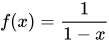
We now that this series converges pointwise for all since the result series is simply a geometric series to the sum function .


Definition: Let be a sequence of functions with common domain . The corresponding series is said to be Uniformly Convergent to the sum function if the corresponding sequence of partial sums is uniformly convergent to .
The geometric series given above actually converges uniformly on , though, showing this with the current definition of uniform convergence of series of functions is laborious. We will soon develop methods to determine whether a series of functions converges uniformly or not without having to brute-force apply the definition for uniform convergence for the sequence of partial sums.
Contents
Cauchy's Uniform Convergence Criterion for Series of Functions
If we have a sequence of functions with common domain then the corresponding series of functions is said to be uniformly convergent if the corresponding sequence of partial sums is a uniformly convergent sequence of functions.
We will now look at a nice theorem known as Cauchy's uniform convergence criterion for series of functions.
Theorem 1: Let be a sequence of real-valued functions with common domain . Then is uniformly convergent on if and only if for all there exists an such that if and for all we have that for all .
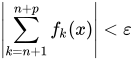

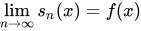
- Proof: Suppose that is uniformly convergent to some limit function on . Let denote the sequence of partial sums for this series. Then we must have that uniformly on . So, for there exists an such that if and for all we have that:



- For any let . Then and so:



- Suppose that for all there exists an such that if and for all we have that:

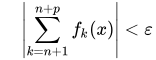
- Let . Assume without loss of generality that and that for some . Then from above we see that for all :



- So converges uniformly by the Cauchy uniform convergence criterion for sequences of functions. So converges uniformly on .

The Weierstrass M-Test for Uniform Convergence of Series of Functions
Recall that if is a sequence of real-valued functions with common domain , then we say that the corresponding series of functions is uniformly convergent if the sequence of partial sums is a uniformly convergent sequence.
We will now look at a very nice and relatively simply test to determine uniform convergence of a series of real-valued functions called the Weierstrass M-test.
Theorem 1: Let be a sequence of real-valued functions with common domain , and let be a sequence of nonnegative real numbers such that for each and for all . If converges then uniformly converges on .

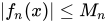


- Proof: Suppose that there exists a sequence of nonnegative real numbers such that for all and for all we have that:

- Furthermore, suppose that converges to some , . Then we have that for all :



- So the Failed to parse (MathML with SVG or PNG fallback (recommended for modern browsers and accessibility tools): Invalid response ("Math extension cannot connect to Restbase.") from server "https://wikimedia.org/api/rest_v1/":): {\displaystyle \displaystyle{\sum_{n=1}^{\infty} f_n(x)}} converges for each by the comparison test.
Weierstrass Example
The series expansion of the exponential function can be shown to be uniformly convergent on any bounded subset using the Weierstrass M-test.

Theorem (Weierstrass M-test). Let Failed to parse (MathML with SVG or PNG fallback (recommended for modern browsers and accessibility tools): Invalid response ("Math extension cannot connect to Restbase.") from server "https://wikimedia.org/api/rest_v1/":): {\displaystyle (f_n)} be a sequence of functions Failed to parse (MathML with SVG or PNG fallback (recommended for modern browsers and accessibility tools): Invalid response ("Math extension cannot connect to Restbase.") from server "https://wikimedia.org/api/rest_v1/":): {\displaystyle f_n:E\to \C} and let Failed to parse (MathML with SVG or PNG fallback (recommended for modern browsers and accessibility tools): Invalid response ("Math extension cannot connect to Restbase.") from server "https://wikimedia.org/api/rest_v1/":): {\displaystyle M_n } be a sequence of positive real numbers such that Failed to parse (MathML with SVG or PNG fallback (recommended for modern browsers and accessibility tools): Invalid response ("Math extension cannot connect to Restbase.") from server "https://wikimedia.org/api/rest_v1/":): {\displaystyle |f_n(x)|\le M_n} for all Failed to parse (MathML with SVG or PNG fallback (recommended for modern browsers and accessibility tools): Invalid response ("Math extension cannot connect to Restbase.") from server "https://wikimedia.org/api/rest_v1/":): {\displaystyle x\in E} and Failed to parse (MathML with SVG or PNG fallback (recommended for modern browsers and accessibility tools): Invalid response ("Math extension cannot connect to Restbase.") from server "https://wikimedia.org/api/rest_v1/":): {\displaystyle n=1,2, 3, \ldots} If Failed to parse (MathML with SVG or PNG fallback (recommended for modern browsers and accessibility tools): Invalid response ("Math extension cannot connect to Restbase.") from server "https://wikimedia.org/api/rest_v1/":): {\textstyle \sum_n M_n} converges, then Failed to parse (MathML with SVG or PNG fallback (recommended for modern browsers and accessibility tools): Invalid response ("Math extension cannot connect to Restbase.") from server "https://wikimedia.org/api/rest_v1/":): {\textstyle \sum_n f_n} converges uniformly on Failed to parse (MathML with SVG or PNG fallback (recommended for modern browsers and accessibility tools): Invalid response ("Math extension cannot connect to Restbase.") from server "https://wikimedia.org/api/rest_v1/":): {\displaystyle E} .
The complex exponential function can be expressed as the series:
- Failed to parse (MathML with SVG or PNG fallback (recommended for modern browsers and accessibility tools): Invalid response ("Math extension cannot connect to Restbase.") from server "https://wikimedia.org/api/rest_v1/":): {\displaystyle \sum_{n=0}^{\infty}\frac{z^n}{n!}.}
Any bounded subset is a subset of some disc Failed to parse (MathML with SVG or PNG fallback (recommended for modern browsers and accessibility tools): Invalid response ("Math extension cannot connect to Restbase.") from server "https://wikimedia.org/api/rest_v1/":): {\displaystyle D_R} of radius Failed to parse (MathML with SVG or PNG fallback (recommended for modern browsers and accessibility tools): Invalid response ("Math extension cannot connect to Restbase.") from server "https://wikimedia.org/api/rest_v1/":): {\displaystyle R,} centered on the origin in the complex plane. The Weierstrass M-test requires us to find an upper bound Failed to parse (MathML with SVG or PNG fallback (recommended for modern browsers and accessibility tools): Invalid response ("Math extension cannot connect to Restbase.") from server "https://wikimedia.org/api/rest_v1/":): {\displaystyle M_n} on the terms of the series, with Failed to parse (MathML with SVG or PNG fallback (recommended for modern browsers and accessibility tools): Invalid response ("Math extension cannot connect to Restbase.") from server "https://wikimedia.org/api/rest_v1/":): {\displaystyle M_n} independent of the position in the disc:
- Failed to parse (MathML with SVG or PNG fallback (recommended for modern browsers and accessibility tools): Invalid response ("Math extension cannot connect to Restbase.") from server "https://wikimedia.org/api/rest_v1/":): {\displaystyle \left| \frac{z^n}{n!} \right|\le M_n, \forall z\in D_R.}
To do this, we notice
- Failed to parse (MathML with SVG or PNG fallback (recommended for modern browsers and accessibility tools): Invalid response ("Math extension cannot connect to Restbase.") from server "https://wikimedia.org/api/rest_v1/":): {\displaystyle \left| \frac{z^n}{n!}\right| \le \frac{|z|^n}{n!} \le \frac{R^n}{n!}}
and take Failed to parse (MathML with SVG or PNG fallback (recommended for modern browsers and accessibility tools): Invalid response ("Math extension cannot connect to Restbase.") from server "https://wikimedia.org/api/rest_v1/":): {\displaystyle M_n=\tfrac{R^n}{n!}.}
If Failed to parse (MathML with SVG or PNG fallback (recommended for modern browsers and accessibility tools): Invalid response ("Math extension cannot connect to Restbase.") from server "https://wikimedia.org/api/rest_v1/":): {\displaystyle \sum_{n=0}^{\infty}M_n} is convergent, then the M-test asserts that the original series is uniformly convergent.
The ratio test can be used here:
- Failed to parse (MathML with SVG or PNG fallback (recommended for modern browsers and accessibility tools): Invalid response ("Math extension cannot connect to Restbase.") from server "https://wikimedia.org/api/rest_v1/":): {\displaystyle \lim_{n \to \infty}\frac{M_{n+1}}{M_n}=\lim_{n \to \infty}\frac{R^{n+1}}{R^n}\frac{n!}{(n+1)!}=\lim_{n \to \infty}\frac{R}{n+1}=0}
which means the series over Failed to parse (MathML with SVG or PNG fallback (recommended for modern browsers and accessibility tools): Invalid response ("Math extension cannot connect to Restbase.") from server "https://wikimedia.org/api/rest_v1/":): {\displaystyle M_n} is convergent. Thus the original series converges uniformly for all Failed to parse (MathML with SVG or PNG fallback (recommended for modern browsers and accessibility tools): Invalid response ("Math extension cannot connect to Restbase.") from server "https://wikimedia.org/api/rest_v1/":): {\displaystyle z\in D_R,} and since Failed to parse (MathML with SVG or PNG fallback (recommended for modern browsers and accessibility tools): Invalid response ("Math extension cannot connect to Restbase.") from server "https://wikimedia.org/api/rest_v1/":): {\displaystyle S\subset D_R} , the series is also uniformly convergent on Failed to parse (MathML with SVG or PNG fallback (recommended for modern browsers and accessibility tools): Invalid response ("Math extension cannot connect to Restbase.") from server "https://wikimedia.org/api/rest_v1/":): {\displaystyle S.}
Licensing
Content obtained and/or adapted from:
- Pointwise Convergent and Uniformly Convergent Series of Functions, mathonline.wikidot.com under a CC BY-SA license
- Uniform convergence, Wikipedia under a CC BY-SA license

