Difference between revisions of "Conservative Vector Fields"
| Line 1: | Line 1: | ||
| + | ===Path Independence=== | ||
| + | If a vector field '''F''' is the gradient of a scalar field ''G'' (i.e. if '''F''' is conservative), that is, | ||
| + | |||
| + | :<math>\mathbf{F} = \nabla G ,</math> | ||
| + | |||
| + | then by the multivariable chain rule, the derivative of the composition of ''G'' and '''r'''(''t'') is | ||
| + | |||
| + | :<math>\frac{dG(\mathbf{r}(t))}{dt} = \nabla G(\mathbf{r}(t)) \cdot \mathbf{r}'(t) = \mathbf{F}(\mathbf{r}(t)) \cdot \mathbf{r}'(t)</math> | ||
| + | |||
| + | which happens to be the integrand for the line integral of '''F''' on '''r'''(''t''). It follows, given a path ''C '', that | ||
| + | |||
| + | :<math>\int_C \mathbf{F}(\mathbf{r})\cdot\,d\mathbf{r} = \int_a^b \mathbf{F}(\mathbf{r}(t))\cdot\mathbf{r}'(t)\,dt = \int_a^b \frac{dG(\mathbf{r}(t))}{dt}\,dt = G(\mathbf{r}(b)) - G(\mathbf{r}(a)).</math> | ||
| + | |||
| + | In other words, the integral of '''F''' over ''C'' depends solely on the values of ''G'' at the points '''r'''(''b'') and '''r'''(''a''), and is thus independent of the path between them. For this reason, a line integral of a conservative vector field is called ''path independent''. | ||
| + | |||
=== Stokes' Theorem === | === Stokes' Theorem === | ||
| Line 86: | Line 101: | ||
* [https://www.youtube.com/watch?v=xVhHow_usMQ The Fundamental Theorem for Line Integrals] Video by Patrick JMT | * [https://www.youtube.com/watch?v=xVhHow_usMQ The Fundamental Theorem for Line Integrals] Video by Patrick JMT | ||
* [https://www.youtube.com/watch?v=hT3YSXQaUHQ Potential Function of a Conservative Vector Field to Evaluate a Line Integral] Video by Krista King | * [https://www.youtube.com/watch?v=hT3YSXQaUHQ Potential Function of a Conservative Vector Field to Evaluate a Line Integral] Video by Krista King | ||
| + | |||
| + | ==Licensing== | ||
| + | Content obtained and/or adapted from: | ||
| + | * [https://en.wikibooks.org/wiki/Calculus/Vector_calculus#Volume,_path,_and_surface_integrals Vector calculus, Wikibooks: Calculus] under a CC BY-SA license | ||
Revision as of 08:10, 3 November 2021
Path Independence
If a vector field F is the gradient of a scalar field G (i.e. if F is conservative), that is,
- Failed to parse (MathML with SVG or PNG fallback (recommended for modern browsers and accessibility tools): Invalid response ("Math extension cannot connect to Restbase.") from server "https://wikimedia.org/api/rest_v1/":): {\displaystyle \mathbf{F} = \nabla G ,}
then by the multivariable chain rule, the derivative of the composition of G and r(t) is

- Failed to parse (MathML with SVG or PNG fallback (recommended for modern browsers and accessibility tools): Invalid response ("Math extension cannot connect to Restbase.") from server "https://wikimedia.org/api/rest_v1/":): {\displaystyle \frac{dG(\mathbf{r}(t))}{dt} = \nabla G(\mathbf{r}(t)) \cdot \mathbf{r}'(t) = \mathbf{F}(\mathbf{r}(t)) \cdot \mathbf{r}'(t)}
which happens to be the integrand for the line integral of F on r(t). It follows, given a path C , that

- Failed to parse (MathML with SVG or PNG fallback (recommended for modern browsers and accessibility tools): Invalid response ("Math extension cannot connect to Restbase.") from server "https://wikimedia.org/api/rest_v1/":): {\displaystyle \int_C \mathbf{F}(\mathbf{r})\cdot\,d\mathbf{r} = \int_a^b \mathbf{F}(\mathbf{r}(t))\cdot\mathbf{r}'(t)\,dt = \int_a^b \frac{dG(\mathbf{r}(t))}{dt}\,dt = G(\mathbf{r}(b)) - G(\mathbf{r}(a)).}
In other words, the integral of F over C depends solely on the values of G at the points r(b) and r(a), and is thus independent of the path between them. For this reason, a line integral of a conservative vector field is called path independent.
Stokes' Theorem
Stokes' Theorem is effectively a generalization of Green's theorem to 3 dimensions, and the "curl" is a generalization of the quantity Failed to parse (MathML with SVG or PNG fallback (recommended for modern browsers and accessibility tools): Invalid response ("Math extension cannot connect to Restbase.") from server "https://wikimedia.org/api/rest_v1/":): {\displaystyle \frac{\partial F_y}{\partial x} - \frac{\partial F_x}{\partial y}} to 3 dimensions. An arbitrary oriented surface Failed to parse (MathML with SVG or PNG fallback (recommended for modern browsers and accessibility tools): Invalid response ("Math extension cannot connect to Restbase.") from server "https://wikimedia.org/api/rest_v1/":): {\displaystyle \sigma} can be articulated into a family of infinitesimal surfaces, some parallel to the xy-plane, others parallel to the zx-plane, and the remainder parallel to the yz-plane. Let Failed to parse (MathML with SVG or PNG fallback (recommended for modern browsers and accessibility tools): Invalid response ("Math extension cannot connect to Restbase.") from server "https://wikimedia.org/api/rest_v1/":): {\displaystyle \mathbf{F}} denote an arbitrary vector field.
Let Failed to parse (MathML with SVG or PNG fallback (recommended for modern browsers and accessibility tools): Invalid response ("Math extension cannot connect to Restbase.") from server "https://wikimedia.org/api/rest_v1/":): {\displaystyle \sigma} be a surface that is parallel to the yz-plane with counter-clockwise oriented boundary Failed to parse (MathML with SVG or PNG fallback (recommended for modern browsers and accessibility tools): Invalid response ("Math extension cannot connect to Restbase.") from server "https://wikimedia.org/api/rest_v1/":): {\displaystyle C} . Green's theorem gives:
Failed to parse (MathML with SVG or PNG fallback (recommended for modern browsers and accessibility tools): Invalid response ("Math extension cannot connect to Restbase.") from server "https://wikimedia.org/api/rest_v1/":): {\displaystyle \int_{\mathbf{q} \in C} \mathbf{F}(\mathbf{q}) \cdot d\mathbf{q} = \iint_{\mathbf{q} \in \sigma}\left(\frac{\partial F_z}{\partial y} - \frac{\partial F_y}{\partial z}\right)(\mathbf{dS} \cdot \mathbf{i}) = \iint_{\mathbf{q} \in \sigma}\left(\left(\frac{\partial F_z}{\partial y} - \frac{\partial F_y}{\partial z}\right)\mathbf{i}\right) \cdot \mathbf{dS}}
Failed to parse (MathML with SVG or PNG fallback (recommended for modern browsers and accessibility tools): Invalid response ("Math extension cannot connect to Restbase.") from server "https://wikimedia.org/api/rest_v1/":): {\displaystyle \mathbf{dS} \cdot \mathbf{i}} is positive if the normal direction to Failed to parse (MathML with SVG or PNG fallback (recommended for modern browsers and accessibility tools): Invalid response ("Math extension cannot connect to Restbase.") from server "https://wikimedia.org/api/rest_v1/":): {\displaystyle \sigma} points in the positive x direction and is negative if otherwise. If the normal direction to Failed to parse (MathML with SVG or PNG fallback (recommended for modern browsers and accessibility tools): Invalid response ("Math extension cannot connect to Restbase.") from server "https://wikimedia.org/api/rest_v1/":): {\displaystyle \sigma} points in the negative x direction, then Failed to parse (MathML with SVG or PNG fallback (recommended for modern browsers and accessibility tools): Invalid response ("Math extension cannot connect to Restbase.") from server "https://wikimedia.org/api/rest_v1/":): {\displaystyle C} is oriented clockwise instead of counter-clockwise in the yz-plane.
Repeating this argument for Failed to parse (MathML with SVG or PNG fallback (recommended for modern browsers and accessibility tools): Invalid response ("Math extension cannot connect to Restbase.") from server "https://wikimedia.org/api/rest_v1/":): {\displaystyle \sigma} being parallel to the zx-plane and xy-plane respectively gives:

Failed to parse (MathML with SVG or PNG fallback (recommended for modern browsers and accessibility tools): Invalid response ("Math extension cannot connect to Restbase.") from server "https://wikimedia.org/api/rest_v1/":): {\displaystyle \int_{\mathbf{q} \in C} \mathbf{F}(\mathbf{q}) \cdot d\mathbf{q} = \iint_{\mathbf{q} \in \sigma}\left(\frac{\partial F_x}{\partial z} - \frac{\partial F_z}{\partial x}\right)(\mathbf{dS} \cdot \mathbf{j}) = \iint_{\mathbf{q} \in \sigma}\left(\left(\frac{\partial F_x}{\partial z} - \frac{\partial F_z}{\partial x}\right)\mathbf{j}\right) \cdot \mathbf{dS}}
and
Failed to parse (MathML with SVG or PNG fallback (recommended for modern browsers and accessibility tools): Invalid response ("Math extension cannot connect to Restbase.") from server "https://wikimedia.org/api/rest_v1/":): {\displaystyle \int_{\mathbf{q} \in C} \mathbf{F}(\mathbf{q}) \cdot d\mathbf{q} = \iint_{\mathbf{q} \in \sigma}\left(\frac{\partial F_y}{\partial x} - \frac{\partial F_x}{\partial y}\right)(\mathbf{dS} \cdot \mathbf{k}) = \iint_{\mathbf{q} \in \sigma}\left(\left(\frac{\partial F_y}{\partial x} - \frac{\partial F_x}{\partial y}\right)\mathbf{k}\right) \cdot \mathbf{dS}}
Treating Failed to parse (MathML with SVG or PNG fallback (recommended for modern browsers and accessibility tools): Invalid response ("Math extension cannot connect to Restbase.") from server "https://wikimedia.org/api/rest_v1/":): {\displaystyle \sigma} as an ensemble of infinitesimal surfaces parallel to the yz-plane, zx-plane, or xy-plane gives:

Failed to parse (MathML with SVG or PNG fallback (recommended for modern browsers and accessibility tools): Invalid response ("Math extension cannot connect to Restbase.") from server "https://wikimedia.org/api/rest_v1/":): {\displaystyle \int_{\mathbf{q} \in C} \mathbf{F}(\mathbf{q}) \cdot d\mathbf{q} = \iint_{\mathbf{q} \in \sigma}\left( \left(\frac{\partial F_z}{\partial y} - \frac{\partial F_y}{\partial z}\right)\mathbf{i} + \left(\frac{\partial F_x}{\partial z} - \frac{\partial F_z}{\partial x}\right)\mathbf{j} + \left(\frac{\partial F_y}{\partial x} - \frac{\partial F_x}{\partial y}\right)\mathbf{k} \right) \cdot \mathbf{dS} }
This is Stokes' theorem, and Failed to parse (MathML with SVG or PNG fallback (recommended for modern browsers and accessibility tools): Invalid response ("Math extension cannot connect to Restbase.") from server "https://wikimedia.org/api/rest_v1/":): {\displaystyle \nabla \times \mathbf{F} = \left(\frac{\partial F_z}{\partial y} - \frac{\partial F_y}{\partial z}\right)\mathbf{i} + \left(\frac{\partial F_x}{\partial z} - \frac{\partial F_z}{\partial x}\right)\mathbf{j} + \left(\frac{\partial F_y}{\partial x} - \frac{\partial F_x}{\partial y}\right)\mathbf{k}} is the "curl" of Failed to parse (MathML with SVG or PNG fallback (recommended for modern browsers and accessibility tools): Invalid response ("Math extension cannot connect to Restbase.") from server "https://wikimedia.org/api/rest_v1/":): {\displaystyle \mathbf{F}} which generalizes the "circulation density" to 3 dimensions.

The direction of Failed to parse (MathML with SVG or PNG fallback (recommended for modern browsers and accessibility tools): Invalid response ("Math extension cannot connect to Restbase.") from server "https://wikimedia.org/api/rest_v1/":): {\displaystyle \nabla \times \mathbf{F}} at Failed to parse (MathML with SVG or PNG fallback (recommended for modern browsers and accessibility tools): Invalid response ("Math extension cannot connect to Restbase.") from server "https://wikimedia.org/api/rest_v1/":): {\displaystyle \mathbf{q}} is effectively an "axis of rotation" around which the counterclockwise circulation density in a plane whose normal is parallel to Failed to parse (MathML with SVG or PNG fallback (recommended for modern browsers and accessibility tools): Invalid response ("Math extension cannot connect to Restbase.") from server "https://wikimedia.org/api/rest_v1/":): {\displaystyle \nabla \times \mathbf{F}} is Failed to parse (MathML with SVG or PNG fallback (recommended for modern browsers and accessibility tools): Invalid response ("Math extension cannot connect to Restbase.") from server "https://wikimedia.org/api/rest_v1/":): {\displaystyle |\nabla \times \mathbf{F}|} . Out of all planes that pass through Failed to parse (MathML with SVG or PNG fallback (recommended for modern browsers and accessibility tools): Invalid response ("Math extension cannot connect to Restbase.") from server "https://wikimedia.org/api/rest_v1/":): {\displaystyle \mathbf{q}} , the plane whose normal is parallel to Failed to parse (MathML with SVG or PNG fallback (recommended for modern browsers and accessibility tools): Invalid response ("Math extension cannot connect to Restbase.") from server "https://wikimedia.org/api/rest_v1/":): {\displaystyle \nabla \times \mathbf{F}} has the largest counterclockwise circulation density at Failed to parse (MathML with SVG or PNG fallback (recommended for modern browsers and accessibility tools): Invalid response ("Math extension cannot connect to Restbase.") from server "https://wikimedia.org/api/rest_v1/":): {\displaystyle \mathbf{q}} which is Failed to parse (MathML with SVG or PNG fallback (recommended for modern browsers and accessibility tools): Invalid response ("Math extension cannot connect to Restbase.") from server "https://wikimedia.org/api/rest_v1/":): {\displaystyle |\nabla \times \mathbf{F}|} .
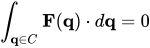
An arbitrary vector field Failed to parse (MathML with SVG or PNG fallback (recommended for modern browsers and accessibility tools): Invalid response ("Math extension cannot connect to Restbase.") from server "https://wikimedia.org/api/rest_v1/":): {\displaystyle \mathbf{F}} that is differentiable everywhere is considered to be "irrotational" or "conservative" if Failed to parse (MathML with SVG or PNG fallback (recommended for modern browsers and accessibility tools): Invalid response ("Math extension cannot connect to Restbase.") from server "https://wikimedia.org/api/rest_v1/":): {\displaystyle \nabla \times \mathbf{F} = \mathbf{0}} everywhere, or equivalently that Failed to parse (MathML with SVG or PNG fallback (recommended for modern browsers and accessibility tools): Invalid response ("Math extension cannot connect to Restbase.") from server "https://wikimedia.org/api/rest_v1/":): {\displaystyle \int_{\mathbf{q} \in C} \mathbf{F}(\mathbf{q}) \cdot d\mathbf{q} = 0} for all continuous closed curves Failed to parse (MathML with SVG or PNG fallback (recommended for modern browsers and accessibility tools): Invalid response ("Math extension cannot connect to Restbase.") from server "https://wikimedia.org/api/rest_v1/":): {\displaystyle C}
Conservative vector fields
A vector field Failed to parse (MathML with SVG or PNG fallback (recommended for modern browsers and accessibility tools): Invalid response ("Math extension cannot connect to Restbase.") from server "https://wikimedia.org/api/rest_v1/":): {\displaystyle \mathbf{F}} for which Failed to parse (MathML with SVG or PNG fallback (recommended for modern browsers and accessibility tools): Invalid response ("Math extension cannot connect to Restbase.") from server "https://wikimedia.org/api/rest_v1/":): {\displaystyle \nabla \times \mathbf{F} = \mathbf{0}} at all points is an "conservative" vector field. Failed to parse (MathML with SVG or PNG fallback (recommended for modern browsers and accessibility tools): Invalid response ("Math extension cannot connect to Restbase.") from server "https://wikimedia.org/api/rest_v1/":): {\displaystyle \mathbf{F}} can also be referred to as being "irrotational" since the gain around any closed curve is always 0.
A key property of a conservative vector field Failed to parse (MathML with SVG or PNG fallback (recommended for modern browsers and accessibility tools): Invalid response ("Math extension cannot connect to Restbase.") from server "https://wikimedia.org/api/rest_v1/":): {\displaystyle \mathbf{F}} is that the gain of Failed to parse (MathML with SVG or PNG fallback (recommended for modern browsers and accessibility tools): Invalid response ("Math extension cannot connect to Restbase.") from server "https://wikimedia.org/api/rest_v1/":): {\displaystyle \mathbf{F}} along a continuous curve is purely a function of the curve's end points. If Failed to parse (MathML with SVG or PNG fallback (recommended for modern browsers and accessibility tools): Invalid response ("Math extension cannot connect to Restbase.") from server "https://wikimedia.org/api/rest_v1/":): {\displaystyle C_1} and Failed to parse (MathML with SVG or PNG fallback (recommended for modern browsers and accessibility tools): Invalid response ("Math extension cannot connect to Restbase.") from server "https://wikimedia.org/api/rest_v1/":): {\displaystyle C_2} are two continuous curves which share the same starting point Failed to parse (MathML with SVG or PNG fallback (recommended for modern browsers and accessibility tools): Invalid response ("Math extension cannot connect to Restbase.") from server "https://wikimedia.org/api/rest_v1/":): {\displaystyle \mathbf{q}_0} and end point Failed to parse (MathML with SVG or PNG fallback (recommended for modern browsers and accessibility tools): Invalid response ("Math extension cannot connect to Restbase.") from server "https://wikimedia.org/api/rest_v1/":): {\displaystyle \mathbf{q}_1} , then Failed to parse (MathML with SVG or PNG fallback (recommended for modern browsers and accessibility tools): Invalid response ("Math extension cannot connect to Restbase.") from server "https://wikimedia.org/api/rest_v1/":): {\displaystyle \int_{\mathbf{q} \in C_1} \mathbf{F}(\mathbf{q}) \cdot d\mathbf{q} = \int_{\mathbf{q} \in C_2} \mathbf{F}(\mathbf{q}) \cdot d\mathbf{q}} . In other words, the gain is purely a function of Failed to parse (MathML with SVG or PNG fallback (recommended for modern browsers and accessibility tools): Invalid response ("Math extension cannot connect to Restbase.") from server "https://wikimedia.org/api/rest_v1/":): {\displaystyle \mathbf{q}_0} and Failed to parse (MathML with SVG or PNG fallback (recommended for modern browsers and accessibility tools): Invalid response ("Math extension cannot connect to Restbase.") from server "https://wikimedia.org/api/rest_v1/":): {\displaystyle \mathbf{q}_1} . This property can be derived from Stokes' theorem as follows:
Invert the orientation of Failed to parse (MathML with SVG or PNG fallback (recommended for modern browsers and accessibility tools): Invalid response ("Math extension cannot connect to Restbase.") from server "https://wikimedia.org/api/rest_v1/":): {\displaystyle C_2} to get Failed to parse (MathML with SVG or PNG fallback (recommended for modern browsers and accessibility tools): Invalid response ("Math extension cannot connect to Restbase.") from server "https://wikimedia.org/api/rest_v1/":): {\displaystyle -C_2} and combine Failed to parse (MathML with SVG or PNG fallback (recommended for modern browsers and accessibility tools): Invalid response ("Math extension cannot connect to Restbase.") from server "https://wikimedia.org/api/rest_v1/":): {\displaystyle C_1} and Failed to parse (MathML with SVG or PNG fallback (recommended for modern browsers and accessibility tools): Invalid response ("Math extension cannot connect to Restbase.") from server "https://wikimedia.org/api/rest_v1/":): {\displaystyle -C_2} to get a continuous closed curve Failed to parse (MathML with SVG or PNG fallback (recommended for modern browsers and accessibility tools): Invalid response ("Math extension cannot connect to Restbase.") from server "https://wikimedia.org/api/rest_v1/":): {\displaystyle C_3 = C_1 - C_2} , linking the curves together at the endpoints Failed to parse (MathML with SVG or PNG fallback (recommended for modern browsers and accessibility tools): Invalid response ("Math extension cannot connect to Restbase.") from server "https://wikimedia.org/api/rest_v1/":): {\displaystyle \mathbf{q}_0} and Failed to parse (MathML with SVG or PNG fallback (recommended for modern browsers and accessibility tools): Invalid response ("Math extension cannot connect to Restbase.") from server "https://wikimedia.org/api/rest_v1/":): {\displaystyle \mathbf{q}_1} . Let Failed to parse (MathML with SVG or PNG fallback (recommended for modern browsers and accessibility tools): Invalid response ("Math extension cannot connect to Restbase.") from server "https://wikimedia.org/api/rest_v1/":): {\displaystyle \sigma} denote a surface for which Failed to parse (MathML with SVG or PNG fallback (recommended for modern browsers and accessibility tools): Invalid response ("Math extension cannot connect to Restbase.") from server "https://wikimedia.org/api/rest_v1/":): {\displaystyle C_3} is the counterclockwise oriented boundary.
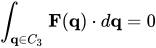
Stokes' theorem states that Failed to parse (MathML with SVG or PNG fallback (recommended for modern browsers and accessibility tools): Invalid response ("Math extension cannot connect to Restbase.") from server "https://wikimedia.org/api/rest_v1/":): {\displaystyle \int_{\mathbf{q} \in C_3} \mathbf{F}(\mathbf{q}) \cdot d\mathbf{q} = \iint_{\mathbf{q} \in \sigma} (\nabla \times \mathbf{F})|_\mathbf{q} \cdot \mathbf{dS} = 0} . The gain around Failed to parse (MathML with SVG or PNG fallback (recommended for modern browsers and accessibility tools): Invalid response ("Math extension cannot connect to Restbase.") from server "https://wikimedia.org/api/rest_v1/":): {\displaystyle C_3} is the gain along Failed to parse (MathML with SVG or PNG fallback (recommended for modern browsers and accessibility tools): Invalid response ("Math extension cannot connect to Restbase.") from server "https://wikimedia.org/api/rest_v1/":): {\displaystyle C_1} minus the gain along Failed to parse (MathML with SVG or PNG fallback (recommended for modern browsers and accessibility tools): Invalid response ("Math extension cannot connect to Restbase.") from server "https://wikimedia.org/api/rest_v1/":): {\displaystyle C_2} : Failed to parse (MathML with SVG or PNG fallback (recommended for modern browsers and accessibility tools): Invalid response ("Math extension cannot connect to Restbase.") from server "https://wikimedia.org/api/rest_v1/":): {\displaystyle \int_{\mathbf{q} \in C_3} \mathbf{F}(\mathbf{q}) \cdot d\mathbf{q} = \int_{\mathbf{q} \in C_1} \mathbf{F}(\mathbf{q}) \cdot d\mathbf{q} + \int_{\mathbf{q} \in -C_2} \mathbf{F}(\mathbf{q}) \cdot d\mathbf{q}} Failed to parse (MathML with SVG or PNG fallback (recommended for modern browsers and accessibility tools): Invalid response ("Math extension cannot connect to Restbase.") from server "https://wikimedia.org/api/rest_v1/":): {\displaystyle = \int_{\mathbf{q} \in C_1} \mathbf{F}(\mathbf{q}) \cdot d\mathbf{q} - \int_{\mathbf{q} \in C_2} \mathbf{F}(\mathbf{q}) \cdot d\mathbf{q}} . Therefore:
Failed to parse (MathML with SVG or PNG fallback (recommended for modern browsers and accessibility tools): Invalid response ("Math extension cannot connect to Restbase.") from server "https://wikimedia.org/api/rest_v1/":): {\displaystyle \int_{\mathbf{q} \in C_3} \mathbf{F}(\mathbf{q}) \cdot d\mathbf{q} = 0} Failed to parse (MathML with SVG or PNG fallback (recommended for modern browsers and accessibility tools): Invalid response ("Math extension cannot connect to Restbase.") from server "https://wikimedia.org/api/rest_v1/":): {\displaystyle \implies \int_{\mathbf{q} \in C_1} \mathbf{F}(\mathbf{q}) \cdot d\mathbf{q} = \int_{\mathbf{q} \in C_2} \mathbf{F}(\mathbf{q}) \cdot d\mathbf{q}}
Resources
- Vector Calculus, Wikibooks: Calculus
Conservative Vector Fields
- Conservative Vector Fields Video by James Sousa, Math is Power 4U
- Conservative Vector Fields - The Definition and a Few Remarks Video by Patrick JMT
- Showing a Vector Field on R^2 is Conservative Video by Patrick JMT
Finding a Potential Function of a Conservative Vector Field
- Determining the Potential Function of a Conservative Vector Field Video by James Sousa, Math is Power 4U
- Finding a Potential for a Conservative Vector Field Video by Patrick JMT
- Finding a Potential for a Conservative Vector Field Ex 2 Video by Patrick JMT
- Potential Function of a Conservative Vector Field Video by Krista King
- Potential Function of a Conservative Vector Field in 3D Video by Krista King
The Fundamental Theorem of Line Integrals
- The Fundamental Theorem of Line Integrals Part 1 Video by James Sousa, Math is Power 4U
- The Fundamental Theorem of Line Integrals Part 2 Video by James Sousa, Math is Power 4U
- The Fundamental Theorem of Line Integrals on a Closed Path Video by James Sousa, Math is Power 4U
- Ex 1: Fundamental Theorem of Line Integrals in the Plane Video by James Sousa, Math is Power 4U
- Ex 2: Fundamental Theorem of Line Integrals in the Plane Video by James Sousa, Math is Power 4U
- Ex 3: Fundamental Theorem of Line Integrals in the Plane Video by James Sousa, Math is Power 4U
- Ex 4: Fundamental Theorem of Line Integrals in Space Video by James Sousa, Math is Power 4U
- The Fundamental Theorem for Line Integrals Video by Patrick JMT
- Potential Function of a Conservative Vector Field to Evaluate a Line Integral Video by Krista King
Licensing
Content obtained and/or adapted from:
- Vector calculus, Wikibooks: Calculus under a CC BY-SA license