Difference between revisions of "Conservative Vector Fields"
| Line 71: | Line 71: | ||
<math>\int_{\mathbf{q} \in C_3} \mathbf{F}(\mathbf{q}) \cdot d\mathbf{q} = 0</math> <math>\implies \int_{\mathbf{q} \in C_1} \mathbf{F}(\mathbf{q}) \cdot d\mathbf{q} = \int_{\mathbf{q} \in C_2} \mathbf{F}(\mathbf{q}) \cdot d\mathbf{q}</math> | <math>\int_{\mathbf{q} \in C_3} \mathbf{F}(\mathbf{q}) \cdot d\mathbf{q} = 0</math> <math>\implies \int_{\mathbf{q} \in C_1} \mathbf{F}(\mathbf{q}) \cdot d\mathbf{q} = \int_{\mathbf{q} \in C_2} \mathbf{F}(\mathbf{q}) \cdot d\mathbf{q}</math> | ||
| + | |||
| + | ==Scalar Potential Function== | ||
| + | If '''F''' is a [[conservative vector field]] (also called ''irrotational'', ''[[Curl (mathematics)|curl]]-free'', or ''potential''), and its components have [[continuous function|continuous]] [[partial derivative]]s, the '''potential''' of '''F''' with respect to a reference point <math>\mathbf r_0</math> is defined in terms of the [[line integral]]: | ||
| + | |||
| + | :<math>V(\mathbf r) = -\int_C \mathbf{F}(\mathbf{r})\cdot\,d\mathbf{r} = -\int_a^b \mathbf{F}(\mathbf{r}(t))\cdot\mathbf{r}'(t)\,dt,</math> | ||
| + | |||
| + | where ''C'' is a parametrized path from <math>\mathbf r_0</math> to <math>\mathbf r,</math> | ||
| + | |||
| + | : <math>\mathbf{r}(t), a\leq t\leq b, \mathbf{r}(a)=\mathbf{r_0}, \mathbf{r}(b)=\mathbf{r}.</math> | ||
| + | |||
| + | The fact that the line integral depends on the path ''C'' only through its terminal points <math>\mathbf r_0</math> and <math>\mathbf r</math> is, in essence, the '''path independence property''' of a conservative vector field. The [[Gradient theorem|fundamental theorem of line integrals]] implies that if ''V'' is defined in this way, then <math> \mathbf{F}= -\nabla V,</math> so that ''V'' is a scalar potential of the conservative vector field '''F'''. Scalar potential is not determined by the vector field alone: indeed, the gradient of a function is unaffected if a constant is added to it. If ''V'' is defined in terms of the line integral, the ambiguity of ''V'' reflects the freedom in the choice of the reference point <math>\mathbf r_0.</math> | ||
| + | |||
| Line 105: | Line 117: | ||
Content obtained and/or adapted from: | Content obtained and/or adapted from: | ||
* [https://en.wikibooks.org/wiki/Calculus/Vector_calculus#Volume,_path,_and_surface_integrals Vector calculus, Wikibooks: Calculus] under a CC BY-SA license | * [https://en.wikibooks.org/wiki/Calculus/Vector_calculus#Volume,_path,_and_surface_integrals Vector calculus, Wikibooks: Calculus] under a CC BY-SA license | ||
| + | * [https://en.wikipedia.org/wiki/Scalar_potential Scalar potential, Wikipedia] under a CC BY-SA license | ||
Revision as of 08:14, 3 November 2021
Contents
Path Independence
If a vector field F is the gradient of a scalar field G (i.e. if F is conservative), that is,
- Failed to parse (MathML with SVG or PNG fallback (recommended for modern browsers and accessibility tools): Invalid response ("Math extension cannot connect to Restbase.") from server "https://wikimedia.org/api/rest_v1/":): {\displaystyle \mathbf{F} = \nabla G ,}
then by the multivariable chain rule, the derivative of the composition of G and r(t) is
- Failed to parse (MathML with SVG or PNG fallback (recommended for modern browsers and accessibility tools): Invalid response ("Math extension cannot connect to Restbase.") from server "https://wikimedia.org/api/rest_v1/":): {\displaystyle \frac{dG(\mathbf{r}(t))}{dt} = \nabla G(\mathbf{r}(t)) \cdot \mathbf{r}'(t) = \mathbf{F}(\mathbf{r}(t)) \cdot \mathbf{r}'(t)}
which happens to be the integrand for the line integral of F on r(t). It follows, given a path C , that

In other words, the integral of F over C depends solely on the values of G at the points r(b) and r(a), and is thus independent of the path between them. For this reason, a line integral of a conservative vector field is called path independent.
Stokes' Theorem
Stokes' Theorem is effectively a generalization of Green's theorem to 3 dimensions, and the "curl" is a generalization of the quantity to 3 dimensions. An arbitrary oriented surface can be articulated into a family of infinitesimal surfaces, some parallel to the xy-plane, others parallel to the zx-plane, and the remainder parallel to the yz-plane. Let denote an arbitrary vector field.


Let be a surface that is parallel to the yz-plane with counter-clockwise oriented boundary . Green's theorem gives:


is positive if the normal direction to points in the positive x direction and is negative if otherwise. If the normal direction to points in the negative x direction, then is oriented clockwise instead of counter-clockwise in the yz-plane.


Repeating this argument for being parallel to the zx-plane and xy-plane respectively gives:

and

Treating as an ensemble of infinitesimal surfaces parallel to the yz-plane, zx-plane, or xy-plane gives:

This is Stokes' theorem, and is the "curl" of which generalizes the "circulation density" to 3 dimensions.

The direction of at is effectively an "axis of rotation" around which the counterclockwise circulation density in a plane whose normal is parallel to is . Out of all planes that pass through , the plane whose normal is parallel to has the largest counterclockwise circulation density at which is .


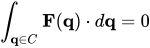
An arbitrary vector field that is differentiable everywhere is considered to be "irrotational" or "conservative" if everywhere, or equivalently that for all continuous closed curves

Conservative vector fields
A vector field for which at all points is an "conservative" vector field. Failed to parse (MathML with SVG or PNG fallback (recommended for modern browsers and accessibility tools): Invalid response ("Math extension cannot connect to Restbase.") from server "https://wikimedia.org/api/rest_v1/":): {\displaystyle \mathbf{F}} can also be referred to as being "irrotational" since the gain around any closed curve is always 0.
A key property of a conservative vector field Failed to parse (MathML with SVG or PNG fallback (recommended for modern browsers and accessibility tools): Invalid response ("Math extension cannot connect to Restbase.") from server "https://wikimedia.org/api/rest_v1/":): {\displaystyle \mathbf{F}} is that the gain of Failed to parse (MathML with SVG or PNG fallback (recommended for modern browsers and accessibility tools): Invalid response ("Math extension cannot connect to Restbase.") from server "https://wikimedia.org/api/rest_v1/":): {\displaystyle \mathbf{F}} along a continuous curve is purely a function of the curve's end points. If Failed to parse (MathML with SVG or PNG fallback (recommended for modern browsers and accessibility tools): Invalid response ("Math extension cannot connect to Restbase.") from server "https://wikimedia.org/api/rest_v1/":): {\displaystyle C_1} and Failed to parse (MathML with SVG or PNG fallback (recommended for modern browsers and accessibility tools): Invalid response ("Math extension cannot connect to Restbase.") from server "https://wikimedia.org/api/rest_v1/":): {\displaystyle C_2} are two continuous curves which share the same starting point Failed to parse (MathML with SVG or PNG fallback (recommended for modern browsers and accessibility tools): Invalid response ("Math extension cannot connect to Restbase.") from server "https://wikimedia.org/api/rest_v1/":): {\displaystyle \mathbf{q}_0} and end point Failed to parse (MathML with SVG or PNG fallback (recommended for modern browsers and accessibility tools): Invalid response ("Math extension cannot connect to Restbase.") from server "https://wikimedia.org/api/rest_v1/":): {\displaystyle \mathbf{q}_1} , then Failed to parse (MathML with SVG or PNG fallback (recommended for modern browsers and accessibility tools): Invalid response ("Math extension cannot connect to Restbase.") from server "https://wikimedia.org/api/rest_v1/":): {\displaystyle \int_{\mathbf{q} \in C_1} \mathbf{F}(\mathbf{q}) \cdot d\mathbf{q} = \int_{\mathbf{q} \in C_2} \mathbf{F}(\mathbf{q}) \cdot d\mathbf{q}} . In other words, the gain is purely a function of Failed to parse (MathML with SVG or PNG fallback (recommended for modern browsers and accessibility tools): Invalid response ("Math extension cannot connect to Restbase.") from server "https://wikimedia.org/api/rest_v1/":): {\displaystyle \mathbf{q}_0} and Failed to parse (MathML with SVG or PNG fallback (recommended for modern browsers and accessibility tools): Invalid response ("Math extension cannot connect to Restbase.") from server "https://wikimedia.org/api/rest_v1/":): {\displaystyle \mathbf{q}_1} . This property can be derived from Stokes' theorem as follows:
Invert the orientation of Failed to parse (MathML with SVG or PNG fallback (recommended for modern browsers and accessibility tools): Invalid response ("Math extension cannot connect to Restbase.") from server "https://wikimedia.org/api/rest_v1/":): {\displaystyle C_2} to get Failed to parse (MathML with SVG or PNG fallback (recommended for modern browsers and accessibility tools): Invalid response ("Math extension cannot connect to Restbase.") from server "https://wikimedia.org/api/rest_v1/":): {\displaystyle -C_2} and combine Failed to parse (MathML with SVG or PNG fallback (recommended for modern browsers and accessibility tools): Invalid response ("Math extension cannot connect to Restbase.") from server "https://wikimedia.org/api/rest_v1/":): {\displaystyle C_1} and Failed to parse (MathML with SVG or PNG fallback (recommended for modern browsers and accessibility tools): Invalid response ("Math extension cannot connect to Restbase.") from server "https://wikimedia.org/api/rest_v1/":): {\displaystyle -C_2} to get a continuous closed curve Failed to parse (MathML with SVG or PNG fallback (recommended for modern browsers and accessibility tools): Invalid response ("Math extension cannot connect to Restbase.") from server "https://wikimedia.org/api/rest_v1/":): {\displaystyle C_3 = C_1 - C_2} , linking the curves together at the endpoints Failed to parse (MathML with SVG or PNG fallback (recommended for modern browsers and accessibility tools): Invalid response ("Math extension cannot connect to Restbase.") from server "https://wikimedia.org/api/rest_v1/":): {\displaystyle \mathbf{q}_0} and . Let Failed to parse (MathML with SVG or PNG fallback (recommended for modern browsers and accessibility tools): Invalid response ("Math extension cannot connect to Restbase.") from server "https://wikimedia.org/api/rest_v1/":): {\displaystyle \sigma} denote a surface for which Failed to parse (MathML with SVG or PNG fallback (recommended for modern browsers and accessibility tools): Invalid response ("Math extension cannot connect to Restbase.") from server "https://wikimedia.org/api/rest_v1/":): {\displaystyle C_3} is the counterclockwise oriented boundary.

Stokes' theorem states that Failed to parse (MathML with SVG or PNG fallback (recommended for modern browsers and accessibility tools): Invalid response ("Math extension cannot connect to Restbase.") from server "https://wikimedia.org/api/rest_v1/":): {\displaystyle \int_{\mathbf{q} \in C_3} \mathbf{F}(\mathbf{q}) \cdot d\mathbf{q} = \iint_{\mathbf{q} \in \sigma} (\nabla \times \mathbf{F})|_\mathbf{q} \cdot \mathbf{dS} = 0} . The gain around Failed to parse (MathML with SVG or PNG fallback (recommended for modern browsers and accessibility tools): Invalid response ("Math extension cannot connect to Restbase.") from server "https://wikimedia.org/api/rest_v1/":): {\displaystyle C_3} is the gain along Failed to parse (MathML with SVG or PNG fallback (recommended for modern browsers and accessibility tools): Invalid response ("Math extension cannot connect to Restbase.") from server "https://wikimedia.org/api/rest_v1/":): {\displaystyle C_1} minus the gain along Failed to parse (MathML with SVG or PNG fallback (recommended for modern browsers and accessibility tools): Invalid response ("Math extension cannot connect to Restbase.") from server "https://wikimedia.org/api/rest_v1/":): {\displaystyle C_2} : Failed to parse (MathML with SVG or PNG fallback (recommended for modern browsers and accessibility tools): Invalid response ("Math extension cannot connect to Restbase.") from server "https://wikimedia.org/api/rest_v1/":): {\displaystyle \int_{\mathbf{q} \in C_3} \mathbf{F}(\mathbf{q}) \cdot d\mathbf{q} = \int_{\mathbf{q} \in C_1} \mathbf{F}(\mathbf{q}) \cdot d\mathbf{q} + \int_{\mathbf{q} \in -C_2} \mathbf{F}(\mathbf{q}) \cdot d\mathbf{q}} Failed to parse (MathML with SVG or PNG fallback (recommended for modern browsers and accessibility tools): Invalid response ("Math extension cannot connect to Restbase.") from server "https://wikimedia.org/api/rest_v1/":): {\displaystyle = \int_{\mathbf{q} \in C_1} \mathbf{F}(\mathbf{q}) \cdot d\mathbf{q} - \int_{\mathbf{q} \in C_2} \mathbf{F}(\mathbf{q}) \cdot d\mathbf{q}} . Therefore:
Failed to parse (MathML with SVG or PNG fallback (recommended for modern browsers and accessibility tools): Invalid response ("Math extension cannot connect to Restbase.") from server "https://wikimedia.org/api/rest_v1/":): {\displaystyle \int_{\mathbf{q} \in C_3} \mathbf{F}(\mathbf{q}) \cdot d\mathbf{q} = 0} Failed to parse (MathML with SVG or PNG fallback (recommended for modern browsers and accessibility tools): Invalid response ("Math extension cannot connect to Restbase.") from server "https://wikimedia.org/api/rest_v1/":): {\displaystyle \implies \int_{\mathbf{q} \in C_1} \mathbf{F}(\mathbf{q}) \cdot d\mathbf{q} = \int_{\mathbf{q} \in C_2} \mathbf{F}(\mathbf{q}) \cdot d\mathbf{q}}
Scalar Potential Function
If F is a conservative vector field (also called irrotational, curl-free, or potential), and its components have continuous partial derivatives, the potential of F with respect to a reference point Failed to parse (MathML with SVG or PNG fallback (recommended for modern browsers and accessibility tools): Invalid response ("Math extension cannot connect to Restbase.") from server "https://wikimedia.org/api/rest_v1/":): {\displaystyle \mathbf r_0} is defined in terms of the line integral:
- Failed to parse (MathML with SVG or PNG fallback (recommended for modern browsers and accessibility tools): Invalid response ("Math extension cannot connect to Restbase.") from server "https://wikimedia.org/api/rest_v1/":): {\displaystyle V(\mathbf r) = -\int_C \mathbf{F}(\mathbf{r})\cdot\,d\mathbf{r} = -\int_a^b \mathbf{F}(\mathbf{r}(t))\cdot\mathbf{r}'(t)\,dt,}
where C is a parametrized path from Failed to parse (MathML with SVG or PNG fallback (recommended for modern browsers and accessibility tools): Invalid response ("Math extension cannot connect to Restbase.") from server "https://wikimedia.org/api/rest_v1/":): {\displaystyle \mathbf r_0} to Failed to parse (MathML with SVG or PNG fallback (recommended for modern browsers and accessibility tools): Invalid response ("Math extension cannot connect to Restbase.") from server "https://wikimedia.org/api/rest_v1/":): {\displaystyle \mathbf r,}
- Failed to parse (MathML with SVG or PNG fallback (recommended for modern browsers and accessibility tools): Invalid response ("Math extension cannot connect to Restbase.") from server "https://wikimedia.org/api/rest_v1/":): {\displaystyle \mathbf{r}(t), a\leq t\leq b, \mathbf{r}(a)=\mathbf{r_0}, \mathbf{r}(b)=\mathbf{r}.}
The fact that the line integral depends on the path C only through its terminal points Failed to parse (MathML with SVG or PNG fallback (recommended for modern browsers and accessibility tools): Invalid response ("Math extension cannot connect to Restbase.") from server "https://wikimedia.org/api/rest_v1/":): {\displaystyle \mathbf r_0} and Failed to parse (MathML with SVG or PNG fallback (recommended for modern browsers and accessibility tools): Invalid response ("Math extension cannot connect to Restbase.") from server "https://wikimedia.org/api/rest_v1/":): {\displaystyle \mathbf r} is, in essence, the path independence property of a conservative vector field. The fundamental theorem of line integrals implies that if V is defined in this way, then Failed to parse (MathML with SVG or PNG fallback (recommended for modern browsers and accessibility tools): Invalid response ("Math extension cannot connect to Restbase.") from server "https://wikimedia.org/api/rest_v1/":): {\displaystyle \mathbf{F}= -\nabla V,} so that V is a scalar potential of the conservative vector field F. Scalar potential is not determined by the vector field alone: indeed, the gradient of a function is unaffected if a constant is added to it. If V is defined in terms of the line integral, the ambiguity of V reflects the freedom in the choice of the reference point Failed to parse (MathML with SVG or PNG fallback (recommended for modern browsers and accessibility tools): Invalid response ("Math extension cannot connect to Restbase.") from server "https://wikimedia.org/api/rest_v1/":): {\displaystyle \mathbf r_0.}
Resources
- Vector Calculus, Wikibooks: Calculus
Conservative Vector Fields
- Conservative Vector Fields Video by James Sousa, Math is Power 4U
- Conservative Vector Fields - The Definition and a Few Remarks Video by Patrick JMT
- Showing a Vector Field on R^2 is Conservative Video by Patrick JMT
Finding a Potential Function of a Conservative Vector Field
- Determining the Potential Function of a Conservative Vector Field Video by James Sousa, Math is Power 4U
- Finding a Potential for a Conservative Vector Field Video by Patrick JMT
- Finding a Potential for a Conservative Vector Field Ex 2 Video by Patrick JMT
- Potential Function of a Conservative Vector Field Video by Krista King
- Potential Function of a Conservative Vector Field in 3D Video by Krista King
The Fundamental Theorem of Line Integrals
- The Fundamental Theorem of Line Integrals Part 1 Video by James Sousa, Math is Power 4U
- The Fundamental Theorem of Line Integrals Part 2 Video by James Sousa, Math is Power 4U
- The Fundamental Theorem of Line Integrals on a Closed Path Video by James Sousa, Math is Power 4U
- Ex 1: Fundamental Theorem of Line Integrals in the Plane Video by James Sousa, Math is Power 4U
- Ex 2: Fundamental Theorem of Line Integrals in the Plane Video by James Sousa, Math is Power 4U
- Ex 3: Fundamental Theorem of Line Integrals in the Plane Video by James Sousa, Math is Power 4U
- Ex 4: Fundamental Theorem of Line Integrals in Space Video by James Sousa, Math is Power 4U
- The Fundamental Theorem for Line Integrals Video by Patrick JMT
- Potential Function of a Conservative Vector Field to Evaluate a Line Integral Video by Krista King
Licensing
Content obtained and/or adapted from:
- Vector calculus, Wikibooks: Calculus under a CC BY-SA license
- Scalar potential, Wikipedia under a CC BY-SA license

