Difference between revisions of "Initial Value Problem"
(Blanked the page) Tag: Blanking |
|||
| (4 intermediate revisions by one other user not shown) | |||
| Line 1: | Line 1: | ||
| + | == Definition == | ||
| + | An '''initial value problem''' is a differential equation | ||
| + | :<math>y'(t) = f(t, y(t))</math> with <math>f\colon \Omega \subset \mathbb{R} \times \mathbb{R}^n \to \mathbb{R}^n</math> where <math>\Omega</math> is an open set of <math>\mathbb{R} \times \mathbb{R}^n</math>, | ||
| + | together with a point in the domain of <math>f</math> | ||
| + | :<math>(t_0, y_0) \in \Omega,</math> | ||
| + | called the initial condition. | ||
| + | A '''solution''' to an initial value problem is a function <math>y</math> that is a solution to the differential equation and satisfies | ||
| + | :<math>y(t_0) = y_0.</math> | ||
| + | |||
| + | In higher dimensions, the differential equation is replaced with a family of equations <math>y_i'(t)=f_i(t, y_1(t), y_2(t), \dotsc)</math>, and <math>y(t)</math> is viewed as the vector <math>(y_1(t), \dotsc, y_n(t))</math>, most commonly associated with the position in space. More generally, the unknown function <math>y</math> can take values on infinite dimensional spaces, such as Banach spaces or spaces of distributions. | ||
| + | |||
| + | Initial value problems are extended to higher orders by treating the derivatives in the same way as an independent function, e.g. <math>y''(t)=f(t,y(t),y'(t))</math>. | ||
| + | |||
| + | ===Examples=== | ||
| + | |||
| + | With initial value problems, we are given a differential equation, and one or more points (depending on the order of the equation) to solve the constants in the general solution. For a first order differential equation we need 1 point <math>(x, y(x))</math>, for a second order equation we need 2 points (typically <math>(x_1, y(x_1))</math> and either <math>(x_2, y(x_2))</math> or <math>(x_2, y'(x_2))</math>), and so on. | ||
| + | |||
| + | A simple example is to solve <math>y'(t) = 0.85 y(t)</math> and <math>y(0) = 19</math>. We are trying to find a formula for <math>y(t)</math> that satisfies these two equations. | ||
| + | |||
| + | Rearrange the equation so that <math>y</math> is on the left hand side | ||
| + | |||
| + | : <math>\frac{y'(t)}{y(t)} = 0.85</math> | ||
| + | |||
| + | Now integrate both sides with respect to <math>t</math> (this introduces an unknown constant <math>B</math>). | ||
| + | |||
| + | : <math>\int \frac{y'(t)}{y(t)}\,dt = \int 0.85\,dt</math> | ||
| + | : <math>\ln |y(t)| = 0.85t + B </math> | ||
| + | |||
| + | Eliminate the logarithm with exponentiation on both sides | ||
| + | |||
| + | : <math> | y(t) | = e^Be^{0.85t} </math> | ||
| + | |||
| + | Let <math>C</math> be a new unknown constant, <math>C = \pm e^B</math>, so | ||
| + | |||
| + | : <math> y(t) = Ce^{0.85t} </math> | ||
| + | |||
| + | Now we need to find a value for <math>C</math>. Use <math>y(0) = 19</math> as given at the start and substitute 0 for <math>t</math> and 19 for <math>y</math> | ||
| + | |||
| + | : <math> 19 = C e^{0.85 \cdot 0}</math> | ||
| + | : <math> C = 19 </math> | ||
| + | |||
| + | this gives the final solution of <math> y(t) = 19e^{0.85t}</math>. | ||
| + | |||
| + | ;Second example | ||
| + | The solution of | ||
| + | |||
| + | : <math>y'+3y=6t+5,\qquad y(0)=3</math> | ||
| + | |||
| + | can be found to be | ||
| + | |||
| + | : <math>y(t)=2e^{-3t}+2t+1. \,</math> | ||
| + | |||
| + | Indeed, | ||
| + | |||
| + | : <math> \begin{align} | ||
| + | y'+3y &= \tfrac{d}{dt} (2e^{-3t}+2t+1)+3(2e^{-3t}+2t+1) \\ | ||
| + | &= (-6e^{-3t}+2)+(6e^{-3t}+6t+3) \\ | ||
| + | &= 6t+5. | ||
| + | \end{align} </math> | ||
| + | |||
| + | Some more simple examples of initial value problems: | ||
| + | * <math> y' = 2x </math>, <math> y(2) = 0 </math>. With this point and the general solution <math>y = x^2 + C</math>, we can calculate the constant C to be -4. Thus the particular solution is <math>y = x^2 - 4</math>. | ||
| + | * <math> y' - y = 0 </math>, <math> y(0) = 3 </math>. <math> 3 = Ce^{0} \implies C = 3</math>, so the particular solution is <math> y = 3e^{x} </math>. | ||
| + | * <math> y'' + y' - 2y = 0 </math>, <math> y(0) = 2 </math>, <math> y'(0) = -1 </math>. So, <math> 2 = Ce^{0} + De^{0} = C + D </math> and <math> -1 = Ce^{0} - 2De^{0} = C - 2D</math>. Thus C = 1 and D = 1, and the particular solution is <math> y = e^{x} + e^{-2x} </math>. | ||
| + | |||
| + | == Licensing == | ||
| + | Content obtained and/or adapted from: | ||
| + | * [https://en.wikipedia.org/wiki/Initial_value_problem Initial value problem, Wikipedia] under a CC BY-SA license | ||
Latest revision as of 21:40, 5 November 2021
Definition
An initial value problem is a differential equation
- with where is an open set of ,




together with a point in the domain of


called the initial condition.
A solution to an initial value problem is a function that is a solution to the differential equation and satisfies


In higher dimensions, the differential equation is replaced with a family of equations , and is viewed as the vector , most commonly associated with the position in space. More generally, the unknown function can take values on infinite dimensional spaces, such as Banach spaces or spaces of distributions.



Initial value problems are extended to higher orders by treating the derivatives in the same way as an independent function, e.g. .

Examples
With initial value problems, we are given a differential equation, and one or more points (depending on the order of the equation) to solve the constants in the general solution. For a first order differential equation we need 1 point , for a second order equation we need 2 points (typically and either or ), and so on.


A simple example is to solve and . We are trying to find a formula for that satisfies these two equations.


Rearrange the equation so that is on the left hand side
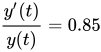
Now integrate both sides with respect to (this introduces an unknown constant ).


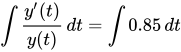

Eliminate the logarithm with exponentiation on both sides
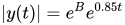
Let be a new unknown constant, , so


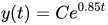
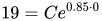
Now we need to find a value for . Use as given at the start and substitute 0 for and 19 for

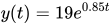
this gives the final solution of .
- Second example
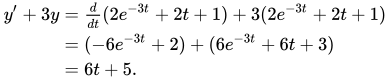
The solution of

can be found to be

Indeed,
Some more simple examples of initial value problems:
- , . With this point and the general solution , we can calculate the constant C to be -4. Thus the particular solution is Failed to parse (MathML with SVG or PNG fallback (recommended for modern browsers and accessibility tools): Invalid response ("Math extension cannot connect to Restbase.") from server "https://wikimedia.org/api/rest_v1/":): {\displaystyle y = x^2 - 4} .
- Failed to parse (MathML with SVG or PNG fallback (recommended for modern browsers and accessibility tools): Invalid response ("Math extension cannot connect to Restbase.") from server "https://wikimedia.org/api/rest_v1/":): {\displaystyle y' - y = 0 } , Failed to parse (MathML with SVG or PNG fallback (recommended for modern browsers and accessibility tools): Invalid response ("Math extension cannot connect to Restbase.") from server "https://wikimedia.org/api/rest_v1/":): {\displaystyle y(0) = 3 } . Failed to parse (MathML with SVG or PNG fallback (recommended for modern browsers and accessibility tools): Invalid response ("Math extension cannot connect to Restbase.") from server "https://wikimedia.org/api/rest_v1/":): {\displaystyle 3 = Ce^{0} \implies C = 3} , so the particular solution is Failed to parse (MathML with SVG or PNG fallback (recommended for modern browsers and accessibility tools): Invalid response ("Math extension cannot connect to Restbase.") from server "https://wikimedia.org/api/rest_v1/":): {\displaystyle y = 3e^{x} } .
- Failed to parse (MathML with SVG or PNG fallback (recommended for modern browsers and accessibility tools): Invalid response ("Math extension cannot connect to Restbase.") from server "https://wikimedia.org/api/rest_v1/":): {\displaystyle y'' + y' - 2y = 0 } , Failed to parse (MathML with SVG or PNG fallback (recommended for modern browsers and accessibility tools): Invalid response ("Math extension cannot connect to Restbase.") from server "https://wikimedia.org/api/rest_v1/":): {\displaystyle y(0) = 2 } , Failed to parse (MathML with SVG or PNG fallback (recommended for modern browsers and accessibility tools): Invalid response ("Math extension cannot connect to Restbase.") from server "https://wikimedia.org/api/rest_v1/":): {\displaystyle y'(0) = -1 } . So, Failed to parse (MathML with SVG or PNG fallback (recommended for modern browsers and accessibility tools): Invalid response ("Math extension cannot connect to Restbase.") from server "https://wikimedia.org/api/rest_v1/":): {\displaystyle 2 = Ce^{0} + De^{0} = C + D } and Failed to parse (MathML with SVG or PNG fallback (recommended for modern browsers and accessibility tools): Invalid response ("Math extension cannot connect to Restbase.") from server "https://wikimedia.org/api/rest_v1/":): {\displaystyle -1 = Ce^{0} - 2De^{0} = C - 2D} . Thus C = 1 and D = 1, and the particular solution is Failed to parse (MathML with SVG or PNG fallback (recommended for modern browsers and accessibility tools): Invalid response ("Math extension cannot connect to Restbase.") from server "https://wikimedia.org/api/rest_v1/":): {\displaystyle y = e^{x} + e^{-2x} } .


Licensing
Content obtained and/or adapted from:
- Initial value problem, Wikipedia under a CC BY-SA license

