Difference between revisions of "Solutions of Differential Equations"
| (3 intermediate revisions by 2 users not shown) | |||
| Line 6: | Line 6: | ||
* <math> y'' + y' - 2y = 0 </math>. The G.S. is <math> y = Ce^{x} + De^{-2x} </math>. <math> y' = Ce^{x} - 2De^{-2x} </math> and <math> y'' = Ce^{x} + 4De^{-2x} </math>, so <math> 0 = y'' + y' - 2y </math> becomes <math> 0 = Ce^{x} + 4De^{-2x} + Ce^{x} - 2De^{-2x} - 2(Ce^{x} + De^{-2x}) = Ce^{x} + Ce^{x} - 2Ce^{x} + 4De^{-2x} - 2De^{-2x} - 2De^{-2x}) = 0 </math>. | * <math> y'' + y' - 2y = 0 </math>. The G.S. is <math> y = Ce^{x} + De^{-2x} </math>. <math> y' = Ce^{x} - 2De^{-2x} </math> and <math> y'' = Ce^{x} + 4De^{-2x} </math>, so <math> 0 = y'' + y' - 2y </math> becomes <math> 0 = Ce^{x} + 4De^{-2x} + Ce^{x} - 2De^{-2x} - 2(Ce^{x} + De^{-2x}) = Ce^{x} + Ce^{x} - 2Ce^{x} + 4De^{-2x} - 2De^{-2x} - 2De^{-2x}) = 0 </math>. | ||
| − | The particular solution of a differential equation can be solved if we have enough points to solve for the arbitrary constants. | + | The particular solution of a differential equation can be solved if we have enough points to solve for the arbitrary constants (see initial value problems for more). |
| − | + | ==Existence of solutions== | |
| − | + | ||
| − | + | Solving differential equations is not like solving algebraic equations. Not only are their solutions often unclear, but whether solutions are unique or exist at all are also notable subjects of interest. | |
| − | + | ||
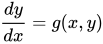
| + | For first order initial value problems, the Peano existence theorem gives one set of circumstances in which a solution exists. Given any point <math>(a,b)</math> in the xy-plane, define some rectangular region <math>Z</math>, such that <math>Z = [l,m]\times[n,p]</math> and <math>(a,b)</math> is in the interior of <math>Z</math>. If we are given a differential equation <math>\frac{dy}{dx} = g(x,y)</math> and the condition that <math>y=b</math> when <math>x=a</math>, then there is locally a solution to this problem if <math>g(x,y)</math> and <math>\frac{\partial g}{\partial x}</math> are both continuous on <math>Z</math>. This solution exists on some interval with its center at <math>a</math>. The solution may not be unique. | ||
| + | |||
| + | However, this only helps us with first order initial value problems. Suppose we had a linear initial value problem of the nth order: | ||
| + | |||
| + | :<math> | ||
| + | f_{n}(x)\frac{d^n y}{dx^n} + \cdots + f_{1}(x)\frac{d y}{dx} + f_{0}(x)y = g(x) | ||
| + | </math> | ||
| + | such that | ||
| + | :<math> | ||
| + | y(x_{0})=y_{0}, y'(x_{0}) = y'_{0}, y''(x_{0}) = y''_{0}, \ldots | ||
| + | </math> | ||
| + | |||
| + | For any nonzero <math>f_{n}(x)</math>, if <math>\{f_{0},f_{1},\ldots\}</math> and <math>g</math> are continuous on some interval containing <math>x_{0}</math>, <math>y</math> is unique and exists. | ||
==Resources== | ==Resources== | ||
* [http://www.maths.gla.ac.uk/~cc/2x/2005_2xnotes/2x_chap5.pdf Differential Equations], University of Glascow | * [http://www.maths.gla.ac.uk/~cc/2x/2005_2xnotes/2x_chap5.pdf Differential Equations], University of Glascow | ||
* [https://www.api.simply.science/index.php/math/calculus/differential-equations/types-of-differential-equations/9869-general-and-particular-solutions-of-a-differential-equation General and Particular Solutions], Simply Math | * [https://www.api.simply.science/index.php/math/calculus/differential-equations/types-of-differential-equations/9869-general-and-particular-solutions-of-a-differential-equation General and Particular Solutions], Simply Math | ||
| + | |||
| + | == Licensing == | ||
| + | Content obtained and/or adapted from: | ||
| + | * [https://en.wikipedia.org/wiki/Differential_equation Differential equation, Wikipedia] under a CC BY-SA license | ||
Latest revision as of 23:38, 5 November 2021
A solution of a differential equation is an expression of the dependent variable that satisfies the relation established in the differential equation. For example, the solution of will be some equation y = f(x) such that y and its first derivative, y', satisfy the relation . The general solution of a differential equation will have one or more arbitrary constants, depending on the order of the original differential equation (the solution of a first order diff. eq. will have one arbitrary constant, a second order one will have two, etc.).

Examples:
- . Through simple integration, we can calculate the general solution of this equation to be , where C is an arbitrary constant.
- Failed to parse (MathML with SVG or PNG fallback (recommended for modern browsers and accessibility tools): Invalid response ("Math extension cannot connect to Restbase.") from server "https://wikimedia.org/api/rest_v1/":): {\displaystyle y' - y = 0 } . The G.S. is Failed to parse (MathML with SVG or PNG fallback (recommended for modern browsers and accessibility tools): Invalid response ("Math extension cannot connect to Restbase.") from server "https://wikimedia.org/api/rest_v1/":): {\displaystyle y = Ce^{x} } . Failed to parse (MathML with SVG or PNG fallback (recommended for modern browsers and accessibility tools): Invalid response ("Math extension cannot connect to Restbase.") from server "https://wikimedia.org/api/rest_v1/":): {\displaystyle y' = Ce^{x} } , so Failed to parse (MathML with SVG or PNG fallback (recommended for modern browsers and accessibility tools): Invalid response ("Math extension cannot connect to Restbase.") from server "https://wikimedia.org/api/rest_v1/":): {\displaystyle y' - y = 0 \to Ce^{x} - Ce^{x} = 0} , so this solution satisfies the relationship for all arbitrary constants C.
- Failed to parse (MathML with SVG or PNG fallback (recommended for modern browsers and accessibility tools): Invalid response ("Math extension cannot connect to Restbase.") from server "https://wikimedia.org/api/rest_v1/":): {\displaystyle y'' + y' - 2y = 0 } . The G.S. is Failed to parse (MathML with SVG or PNG fallback (recommended for modern browsers and accessibility tools): Invalid response ("Math extension cannot connect to Restbase.") from server "https://wikimedia.org/api/rest_v1/":): {\displaystyle y = Ce^{x} + De^{-2x} } . Failed to parse (MathML with SVG or PNG fallback (recommended for modern browsers and accessibility tools): Invalid response ("Math extension cannot connect to Restbase.") from server "https://wikimedia.org/api/rest_v1/":): {\displaystyle y' = Ce^{x} - 2De^{-2x} } and Failed to parse (MathML with SVG or PNG fallback (recommended for modern browsers and accessibility tools): Invalid response ("Math extension cannot connect to Restbase.") from server "https://wikimedia.org/api/rest_v1/":): {\displaystyle y'' = Ce^{x} + 4De^{-2x} } , so Failed to parse (MathML with SVG or PNG fallback (recommended for modern browsers and accessibility tools): Invalid response ("Math extension cannot connect to Restbase.") from server "https://wikimedia.org/api/rest_v1/":): {\displaystyle 0 = y'' + y' - 2y } becomes Failed to parse (MathML with SVG or PNG fallback (recommended for modern browsers and accessibility tools): Invalid response ("Math extension cannot connect to Restbase.") from server "https://wikimedia.org/api/rest_v1/":): {\displaystyle 0 = Ce^{x} + 4De^{-2x} + Ce^{x} - 2De^{-2x} - 2(Ce^{x} + De^{-2x}) = Ce^{x} + Ce^{x} - 2Ce^{x} + 4De^{-2x} - 2De^{-2x} - 2De^{-2x}) = 0 } .
The particular solution of a differential equation can be solved if we have enough points to solve for the arbitrary constants (see initial value problems for more).
Existence of solutions
Solving differential equations is not like solving algebraic equations. Not only are their solutions often unclear, but whether solutions are unique or exist at all are also notable subjects of interest.
For first order initial value problems, the Peano existence theorem gives one set of circumstances in which a solution exists. Given any point Failed to parse (MathML with SVG or PNG fallback (recommended for modern browsers and accessibility tools): Invalid response ("Math extension cannot connect to Restbase.") from server "https://wikimedia.org/api/rest_v1/":): {\displaystyle (a,b)} in the xy-plane, define some rectangular region Failed to parse (MathML with SVG or PNG fallback (recommended for modern browsers and accessibility tools): Invalid response ("Math extension cannot connect to Restbase.") from server "https://wikimedia.org/api/rest_v1/":): {\displaystyle Z} , such that Failed to parse (MathML with SVG or PNG fallback (recommended for modern browsers and accessibility tools): Invalid response ("Math extension cannot connect to Restbase.") from server "https://wikimedia.org/api/rest_v1/":): {\displaystyle Z = [l,m]\times[n,p]} and Failed to parse (MathML with SVG or PNG fallback (recommended for modern browsers and accessibility tools): Invalid response ("Math extension cannot connect to Restbase.") from server "https://wikimedia.org/api/rest_v1/":): {\displaystyle (a,b)} is in the interior of Failed to parse (MathML with SVG or PNG fallback (recommended for modern browsers and accessibility tools): Invalid response ("Math extension cannot connect to Restbase.") from server "https://wikimedia.org/api/rest_v1/":): {\displaystyle Z} . If we are given a differential equation Failed to parse (MathML with SVG or PNG fallback (recommended for modern browsers and accessibility tools): Invalid response ("Math extension cannot connect to Restbase.") from server "https://wikimedia.org/api/rest_v1/":): {\displaystyle \frac{dy}{dx} = g(x,y)} and the condition that Failed to parse (MathML with SVG or PNG fallback (recommended for modern browsers and accessibility tools): Invalid response ("Math extension cannot connect to Restbase.") from server "https://wikimedia.org/api/rest_v1/":): {\displaystyle y=b} when Failed to parse (MathML with SVG or PNG fallback (recommended for modern browsers and accessibility tools): Invalid response ("Math extension cannot connect to Restbase.") from server "https://wikimedia.org/api/rest_v1/":): {\displaystyle x=a} , then there is locally a solution to this problem if Failed to parse (MathML with SVG or PNG fallback (recommended for modern browsers and accessibility tools): Invalid response ("Math extension cannot connect to Restbase.") from server "https://wikimedia.org/api/rest_v1/":): {\displaystyle g(x,y)} and Failed to parse (MathML with SVG or PNG fallback (recommended for modern browsers and accessibility tools): Invalid response ("Math extension cannot connect to Restbase.") from server "https://wikimedia.org/api/rest_v1/":): {\displaystyle \frac{\partial g}{\partial x}} are both continuous on Failed to parse (MathML with SVG or PNG fallback (recommended for modern browsers and accessibility tools): Invalid response ("Math extension cannot connect to Restbase.") from server "https://wikimedia.org/api/rest_v1/":): {\displaystyle Z} . This solution exists on some interval with its center at Failed to parse (MathML with SVG or PNG fallback (recommended for modern browsers and accessibility tools): Invalid response ("Math extension cannot connect to Restbase.") from server "https://wikimedia.org/api/rest_v1/":): {\displaystyle a} . The solution may not be unique.
However, this only helps us with first order initial value problems. Suppose we had a linear initial value problem of the nth order:

- Failed to parse (MathML with SVG or PNG fallback (recommended for modern browsers and accessibility tools): Invalid response ("Math extension cannot connect to Restbase.") from server "https://wikimedia.org/api/rest_v1/":): {\displaystyle f_{n}(x)\frac{d^n y}{dx^n} + \cdots + f_{1}(x)\frac{d y}{dx} + f_{0}(x)y = g(x) }
such that
- Failed to parse (MathML with SVG or PNG fallback (recommended for modern browsers and accessibility tools): Invalid response ("Math extension cannot connect to Restbase.") from server "https://wikimedia.org/api/rest_v1/":): {\displaystyle y(x_{0})=y_{0}, y'(x_{0}) = y'_{0}, y''(x_{0}) = y''_{0}, \ldots }
For any nonzero Failed to parse (MathML with SVG or PNG fallback (recommended for modern browsers and accessibility tools): Invalid response ("Math extension cannot connect to Restbase.") from server "https://wikimedia.org/api/rest_v1/":): {\displaystyle f_{n}(x)} , if Failed to parse (MathML with SVG or PNG fallback (recommended for modern browsers and accessibility tools): Invalid response ("Math extension cannot connect to Restbase.") from server "https://wikimedia.org/api/rest_v1/":): {\displaystyle \{f_{0},f_{1},\ldots\}} and Failed to parse (MathML with SVG or PNG fallback (recommended for modern browsers and accessibility tools): Invalid response ("Math extension cannot connect to Restbase.") from server "https://wikimedia.org/api/rest_v1/":): {\displaystyle g} are continuous on some interval containing Failed to parse (MathML with SVG or PNG fallback (recommended for modern browsers and accessibility tools): Invalid response ("Math extension cannot connect to Restbase.") from server "https://wikimedia.org/api/rest_v1/":): {\displaystyle x_{0}} , Failed to parse (MathML with SVG or PNG fallback (recommended for modern browsers and accessibility tools): Invalid response ("Math extension cannot connect to Restbase.") from server "https://wikimedia.org/api/rest_v1/":): {\displaystyle y} is unique and exists.
Resources
- Differential Equations, University of Glascow
- General and Particular Solutions, Simply Math
Licensing
Content obtained and/or adapted from:
- Differential equation, Wikipedia under a CC BY-SA license