Difference between revisions of "Derivatives of Functions with Inverses"
(Created page with "File:Umkehrregel 2.png|thumb|right|250px|Rule:<br><math>{\color{CornflowerBlue}{f'}}(x) = \frac{1}{{\color{Salmon}{(f^{-1})'}}({\color{Blue}{f}}(x))}</math><br><br>Example f...") |
|||
| (2 intermediate revisions by one other user not shown) | |||
| Line 1: | Line 1: | ||
[[File:Umkehrregel 2.png|thumb|right|250px|Rule:<br><math>{\color{CornflowerBlue}{f'}}(x) = \frac{1}{{\color{Salmon}{(f^{-1})'}}({\color{Blue}{f}}(x))}</math><br><br>Example for arbitrary <math>x_0 \approx 5.8</math>:<br><math>{\color{CornflowerBlue}{f'}}(x_0) = \frac{1}{4}</math><br><math>{\color{Salmon}{(f^{-1})'}}({\color{Blue}{f}}(x_0)) = 4~</math>]] | [[File:Umkehrregel 2.png|thumb|right|250px|Rule:<br><math>{\color{CornflowerBlue}{f'}}(x) = \frac{1}{{\color{Salmon}{(f^{-1})'}}({\color{Blue}{f}}(x))}</math><br><br>Example for arbitrary <math>x_0 \approx 5.8</math>:<br><math>{\color{CornflowerBlue}{f'}}(x_0) = \frac{1}{4}</math><br><math>{\color{Salmon}{(f^{-1})'}}({\color{Blue}{f}}(x_0)) = 4~</math>]] | ||
| − | |||
| − | |||
| − | Their two derivatives, assuming they exist, are | + | The '''inverse''' of a function <math>y = f(x)</math> is a function that, in some fashion, "undoes" the effect of <math>f</math>. The inverse of <math>f</math> is denoted as <math>f^{-1}</math>, where <math>f^{-1}(y) = x</math> if and only if <math>f(x) = y</math>. |
| + | |||
| + | Their two derivatives, assuming they exist, are reciprocal, as the Leibniz notation suggests; that is: | ||
:<math>\frac{dx}{dy}\,\cdot\, \frac{dy}{dx} = 1.</math> | :<math>\frac{dx}{dy}\,\cdot\, \frac{dy}{dx} = 1.</math> | ||
| − | This relation is obtained by differentiating the equation <math>f^{-1}(y)=x</math> in terms of {{Mvar|x}} and applying the | + | This relation is obtained by differentiating the equation <math>f^{-1}(y)=x</math> in terms of {{Mvar|x}} and applying the chain rule, yielding that: |
:<math>\frac{dx}{dy}\,\cdot\, \frac{dy}{dx} = \frac{dx}{dx}</math> | :<math>\frac{dx}{dy}\,\cdot\, \frac{dy}{dx} = \frac{dx}{dx}</math> | ||
| Line 17: | Line 17: | ||
:<math>\left[f^{-1}\right]'(a)=\frac{1}{f'\left( f^{-1}(a) \right)}</math>. | :<math>\left[f^{-1}\right]'(a)=\frac{1}{f'\left( f^{-1}(a) \right)}</math>. | ||
| − | This formula holds in general whenever <math>f</math> is | + | This formula holds in general whenever <math>f</math> is continuous and injective on an interval {{Mvar|I}}, with <math>f</math> being differentiable at <math>f^{-1}(a)</math>(<math>\in I</math>) and where<math>f'(f^{-1}(a)) \ne 0</math>. The same formula is also equivalent to the expression |
:<math>\mathcal{D}\left[f^{-1}\right]=\frac{1}{(\mathcal{D} f)\circ \left(f^{-1}\right)},</math> | :<math>\mathcal{D}\left[f^{-1}\right]=\frac{1}{(\mathcal{D} f)\circ \left(f^{-1}\right)},</math> | ||
| − | where <math>\mathcal{D}</math> denotes the unary derivative operator (on the space of functions) and <math>\circ</math> denotes | + | where <math>\mathcal{D}</math> denotes the unary derivative operator (on the space of functions) and <math>\circ</math> denotes function composition. |
| − | Geometrically, a function and inverse function have | + | Geometrically, a function and inverse function have graphs that are reflections, in the line <math>y=x</math>. This reflection operation turns the gradient of any line into its reciprocal. |
| − | Assuming that <math>f</math> has an inverse in a | + | Assuming that <math>f</math> has an inverse in a neighbourhood of <math>x</math> and that its derivative at that point is non-zero, its inverse is guaranteed to be differentiable at <math>x</math> and have a derivative given by the above formula. |
==Examples== | ==Examples== | ||
| Line 51: | Line 51: | ||
==Additional properties== | ==Additional properties== | ||
| − | * | + | * Integrating this relationship gives |
::<math>{f^{-1}}(x)=\int\frac{1}{f'({f^{-1}}(x))}\,{dx} + C.</math> | ::<math>{f^{-1}}(x)=\int\frac{1}{f'({f^{-1}}(x))}\,{dx} + C.</math> | ||
| Line 57: | Line 57: | ||
:This is only useful if the integral exists. In particular we need <math>f'(x)</math> to be non-zero across the range of integration. | :This is only useful if the integral exists. In particular we need <math>f'(x)</math> to be non-zero across the range of integration. | ||
| − | :It follows that a function that has a | + | :It follows that a function that has a continuous derivative has an inverse in a neighbourhood of every point where the derivative is non-zero. This need not be true if the derivative is not continuous. |
* Another very interesting and useful property is the following: | * Another very interesting and useful property is the following: | ||
| Line 67: | Line 67: | ||
==Higher derivatives== | ==Higher derivatives== | ||
| − | The | + | The chain rule given above is obtained by differentiating the identity <math>f^{-1}(f(x))=x</math> with respect to {{Mvar|x}}. One can continue the same process for higher derivatives. Differentiating the identity twice with respect to ''{{Mvar|x}}'', one obtains |
:<math> \frac{d^2y}{dx^2}\,\cdot\,\frac{dx}{dy} + \frac{d}{dx} \left(\frac{dx}{dy}\right)\,\cdot\,\left(\frac{dy}{dx}\right) = 0, </math> | :<math> \frac{d^2y}{dx^2}\,\cdot\,\frac{dx}{dy} + \frac{d}{dx} \left(\frac{dx}{dy}\right)\,\cdot\,\left(\frac{dy}{dx}\right) = 0, </math> | ||
| Line 89: | Line 89: | ||
3 \left(\frac{d^2x}{dy^2}\right)^2\,\cdot\,\left(\frac{dy}{dx}\right)^5</math> | 3 \left(\frac{d^2x}{dy^2}\right)^2\,\cdot\,\left(\frac{dy}{dx}\right)^5</math> | ||
| − | These formulas are generalized by the | + | These formulas are generalized by the Faà di Bruno's formula. |
These formulas can also be written using Lagrange's notation. If ''{{Mvar|f}}'' and ''{{Mvar|g}}'' are inverses, then | These formulas can also be written using Lagrange's notation. If ''{{Mvar|f}}'' and ''{{Mvar|g}}'' are inverses, then | ||
| Line 115: | Line 115: | ||
which agrees with the direct calculation. | which agrees with the direct calculation. | ||
| − | == | + | == Licensing == |
| − | * [https://en.wikipedia.org/wiki/Inverse_functions_and_differentiation Inverse functions and differentiation | + | Content obtained and/or adapted from: |
| + | * [https://en.wikipedia.org/wiki/Inverse_functions_and_differentiation Inverse functions and differentiation, Wikipedia] under a CC BY-SA license | ||
Latest revision as of 11:33, 6 November 2021

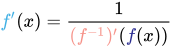



The inverse of a function is a function that, in some fashion, "undoes" the effect of . The inverse of is denoted as , where Failed to parse (MathML with SVG or PNG fallback (recommended for modern browsers and accessibility tools): Invalid response ("Math extension cannot connect to Restbase.") from server "https://wikimedia.org/api/rest_v1/":): {\displaystyle f^{-1}(y) = x} if and only if Failed to parse (MathML with SVG or PNG fallback (recommended for modern browsers and accessibility tools): Invalid response ("Math extension cannot connect to Restbase.") from server "https://wikimedia.org/api/rest_v1/":): {\displaystyle f(x) = y} .


Their two derivatives, assuming they exist, are reciprocal, as the Leibniz notation suggests; that is:
- Failed to parse (MathML with SVG or PNG fallback (recommended for modern browsers and accessibility tools): Invalid response ("Math extension cannot connect to Restbase.") from server "https://wikimedia.org/api/rest_v1/":): {\displaystyle \frac{dx}{dy}\,\cdot\, \frac{dy}{dx} = 1.}
This relation is obtained by differentiating the equation Failed to parse (MathML with SVG or PNG fallback (recommended for modern browsers and accessibility tools): Invalid response ("Math extension cannot connect to Restbase.") from server "https://wikimedia.org/api/rest_v1/":): {\displaystyle f^{-1}(y)=x} in terms of x and applying the chain rule, yielding that:
- Failed to parse (MathML with SVG or PNG fallback (recommended for modern browsers and accessibility tools): Invalid response ("Math extension cannot connect to Restbase.") from server "https://wikimedia.org/api/rest_v1/":): {\displaystyle \frac{dx}{dy}\,\cdot\, \frac{dy}{dx} = \frac{dx}{dx}}
considering that the derivative of x with respect to x is 1.
Writing explicitly the dependence of y on x, and the point at which the differentiation takes place, the formula for the derivative of the inverse becomes (in Lagrange's notation):
- Failed to parse (MathML with SVG or PNG fallback (recommended for modern browsers and accessibility tools): Invalid response ("Math extension cannot connect to Restbase.") from server "https://wikimedia.org/api/rest_v1/":): {\displaystyle \left[f^{-1}\right]'(a)=\frac{1}{f'\left( f^{-1}(a) \right)}} .
This formula holds in general whenever Failed to parse (MathML with SVG or PNG fallback (recommended for modern browsers and accessibility tools): Invalid response ("Math extension cannot connect to Restbase.") from server "https://wikimedia.org/api/rest_v1/":): {\displaystyle f} is continuous and injective on an interval I, with Failed to parse (MathML with SVG or PNG fallback (recommended for modern browsers and accessibility tools): Invalid response ("Math extension cannot connect to Restbase.") from server "https://wikimedia.org/api/rest_v1/":): {\displaystyle f} being differentiable at Failed to parse (MathML with SVG or PNG fallback (recommended for modern browsers and accessibility tools): Invalid response ("Math extension cannot connect to Restbase.") from server "https://wikimedia.org/api/rest_v1/":): {\displaystyle f^{-1}(a)} (Failed to parse (MathML with SVG or PNG fallback (recommended for modern browsers and accessibility tools): Invalid response ("Math extension cannot connect to Restbase.") from server "https://wikimedia.org/api/rest_v1/":): {\displaystyle \in I} ) and whereFailed to parse (MathML with SVG or PNG fallback (recommended for modern browsers and accessibility tools): Invalid response ("Math extension cannot connect to Restbase.") from server "https://wikimedia.org/api/rest_v1/":): {\displaystyle f'(f^{-1}(a)) \ne 0} . The same formula is also equivalent to the expression
- Failed to parse (MathML with SVG or PNG fallback (recommended for modern browsers and accessibility tools): Invalid response ("Math extension cannot connect to Restbase.") from server "https://wikimedia.org/api/rest_v1/":): {\displaystyle \mathcal{D}\left[f^{-1}\right]=\frac{1}{(\mathcal{D} f)\circ \left(f^{-1}\right)},}
where Failed to parse (MathML with SVG or PNG fallback (recommended for modern browsers and accessibility tools): Invalid response ("Math extension cannot connect to Restbase.") from server "https://wikimedia.org/api/rest_v1/":): {\displaystyle \mathcal{D}} denotes the unary derivative operator (on the space of functions) and Failed to parse (MathML with SVG or PNG fallback (recommended for modern browsers and accessibility tools): Invalid response ("Math extension cannot connect to Restbase.") from server "https://wikimedia.org/api/rest_v1/":): {\displaystyle \circ} denotes function composition.
Geometrically, a function and inverse function have graphs that are reflections, in the line Failed to parse (MathML with SVG or PNG fallback (recommended for modern browsers and accessibility tools): Invalid response ("Math extension cannot connect to Restbase.") from server "https://wikimedia.org/api/rest_v1/":): {\displaystyle y=x} . This reflection operation turns the gradient of any line into its reciprocal.
Assuming that Failed to parse (MathML with SVG or PNG fallback (recommended for modern browsers and accessibility tools): Invalid response ("Math extension cannot connect to Restbase.") from server "https://wikimedia.org/api/rest_v1/":): {\displaystyle f} has an inverse in a neighbourhood of Failed to parse (MathML with SVG or PNG fallback (recommended for modern browsers and accessibility tools): Invalid response ("Math extension cannot connect to Restbase.") from server "https://wikimedia.org/api/rest_v1/":): {\displaystyle x} and that its derivative at that point is non-zero, its inverse is guaranteed to be differentiable at Failed to parse (MathML with SVG or PNG fallback (recommended for modern browsers and accessibility tools): Invalid response ("Math extension cannot connect to Restbase.") from server "https://wikimedia.org/api/rest_v1/":): {\displaystyle x} and have a derivative given by the above formula.
Examples
- Failed to parse (MathML with SVG or PNG fallback (recommended for modern browsers and accessibility tools): Invalid response ("Math extension cannot connect to Restbase.") from server "https://wikimedia.org/api/rest_v1/":): {\displaystyle y = x^2} (for positive x) has inverse Failed to parse (MathML with SVG or PNG fallback (recommended for modern browsers and accessibility tools): Invalid response ("Math extension cannot connect to Restbase.") from server "https://wikimedia.org/api/rest_v1/":): {\displaystyle x = \sqrt{y}} .
- Failed to parse (MathML with SVG or PNG fallback (recommended for modern browsers and accessibility tools): Invalid response ("Math extension cannot connect to Restbase.") from server "https://wikimedia.org/api/rest_v1/":): {\displaystyle \frac{dy}{dx} = 2x \mbox{ }\mbox{ }\mbox{ }\mbox{ }; \mbox{ }\mbox{ }\mbox{ }\mbox{ } \frac{dx}{dy} = \frac{1}{2\sqrt{y}}=\frac{1}{2x} }
- Failed to parse (MathML with SVG or PNG fallback (recommended for modern browsers and accessibility tools): Invalid response ("Math extension cannot connect to Restbase.") from server "https://wikimedia.org/api/rest_v1/":): {\displaystyle \frac{dy}{dx}\,\cdot\,\frac{dx}{dy} = 2x \cdot\frac{1}{2x} = 1.}
At Failed to parse (MathML with SVG or PNG fallback (recommended for modern browsers and accessibility tools): Invalid response ("Math extension cannot connect to Restbase.") from server "https://wikimedia.org/api/rest_v1/":): {\displaystyle x=0} , however, there is a problem: the graph of the square root function becomes vertical, corresponding to a horizontal tangent for the square function.
- Failed to parse (MathML with SVG or PNG fallback (recommended for modern browsers and accessibility tools): Invalid response ("Math extension cannot connect to Restbase.") from server "https://wikimedia.org/api/rest_v1/":): {\displaystyle y = e^x} (for real x) has inverse Failed to parse (MathML with SVG or PNG fallback (recommended for modern browsers and accessibility tools): Invalid response ("Math extension cannot connect to Restbase.") from server "https://wikimedia.org/api/rest_v1/":): {\displaystyle x = \ln{y}} (for positive Failed to parse (MathML with SVG or PNG fallback (recommended for modern browsers and accessibility tools): Invalid response ("Math extension cannot connect to Restbase.") from server "https://wikimedia.org/api/rest_v1/":): {\displaystyle y} )
- Failed to parse (MathML with SVG or PNG fallback (recommended for modern browsers and accessibility tools): Invalid response ("Math extension cannot connect to Restbase.") from server "https://wikimedia.org/api/rest_v1/":): {\displaystyle \frac{dy}{dx} = e^x \mbox{ }\mbox{ }\mbox{ }\mbox{ }; \mbox{ }\mbox{ }\mbox{ }\mbox{ } \frac{dx}{dy} = \frac{1}{y} }
- Failed to parse (MathML with SVG or PNG fallback (recommended for modern browsers and accessibility tools): Invalid response ("Math extension cannot connect to Restbase.") from server "https://wikimedia.org/api/rest_v1/":): {\displaystyle \frac{dy}{dx}\,\cdot\,\frac{dx}{dy} = e^x \cdot \frac{1}{y} = \frac{e^x}{e^x} = 1 }
Additional properties
- Integrating this relationship gives
- Failed to parse (MathML with SVG or PNG fallback (recommended for modern browsers and accessibility tools): Invalid response ("Math extension cannot connect to Restbase.") from server "https://wikimedia.org/api/rest_v1/":): {\displaystyle {f^{-1}}(x)=\int\frac{1}{f'({f^{-1}}(x))}\,{dx} + C.}
- This is only useful if the integral exists. In particular we need Failed to parse (MathML with SVG or PNG fallback (recommended for modern browsers and accessibility tools): Invalid response ("Math extension cannot connect to Restbase.") from server "https://wikimedia.org/api/rest_v1/":): {\displaystyle f'(x)} to be non-zero across the range of integration.
- It follows that a function that has a continuous derivative has an inverse in a neighbourhood of every point where the derivative is non-zero. This need not be true if the derivative is not continuous.
- Another very interesting and useful property is the following:
- Failed to parse (MathML with SVG or PNG fallback (recommended for modern browsers and accessibility tools): Invalid response ("Math extension cannot connect to Restbase.") from server "https://wikimedia.org/api/rest_v1/":): {\displaystyle \int f^{-1}(x)\, {dx} = x f^{-1}(x) - F(f^{-1}(x)) + C }
- Where Failed to parse (MathML with SVG or PNG fallback (recommended for modern browsers and accessibility tools): Invalid response ("Math extension cannot connect to Restbase.") from server "https://wikimedia.org/api/rest_v1/":): {\displaystyle F } denotes the antiderivative of Failed to parse (MathML with SVG or PNG fallback (recommended for modern browsers and accessibility tools): Invalid response ("Math extension cannot connect to Restbase.") from server "https://wikimedia.org/api/rest_v1/":): {\displaystyle f } .
Higher derivatives
The chain rule given above is obtained by differentiating the identity Failed to parse (MathML with SVG or PNG fallback (recommended for modern browsers and accessibility tools): Invalid response ("Math extension cannot connect to Restbase.") from server "https://wikimedia.org/api/rest_v1/":): {\displaystyle f^{-1}(f(x))=x} with respect to x. One can continue the same process for higher derivatives. Differentiating the identity twice with respect to x, one obtains
- Failed to parse (MathML with SVG or PNG fallback (recommended for modern browsers and accessibility tools): Invalid response ("Math extension cannot connect to Restbase.") from server "https://wikimedia.org/api/rest_v1/":): {\displaystyle \frac{d^2y}{dx^2}\,\cdot\,\frac{dx}{dy} + \frac{d}{dx} \left(\frac{dx}{dy}\right)\,\cdot\,\left(\frac{dy}{dx}\right) = 0, }
that is simplified further by the chain rule as
- Failed to parse (MathML with SVG or PNG fallback (recommended for modern browsers and accessibility tools): Invalid response ("Math extension cannot connect to Restbase.") from server "https://wikimedia.org/api/rest_v1/":): {\displaystyle \frac{d^2y}{dx^2}\,\cdot\,\frac{dx}{dy} + \frac{d^2x}{dy^2}\,\cdot\,\left(\frac{dy}{dx}\right)^2 = 0.}
Replacing the first derivative, using the identity obtained earlier, we get
- Failed to parse (MathML with SVG or PNG fallback (recommended for modern browsers and accessibility tools): Invalid response ("Math extension cannot connect to Restbase.") from server "https://wikimedia.org/api/rest_v1/":): {\displaystyle \frac{d^2y}{dx^2} = - \frac{d^2x}{dy^2}\,\cdot\,\left(\frac{dy}{dx}\right)^3. }
Similarly for the third derivative:
- Failed to parse (MathML with SVG or PNG fallback (recommended for modern browsers and accessibility tools): Invalid response ("Math extension cannot connect to Restbase.") from server "https://wikimedia.org/api/rest_v1/":): {\displaystyle \frac{d^3y}{dx^3} = - \frac{d^3x}{dy^3}\,\cdot\,\left(\frac{dy}{dx}\right)^4 - 3 \frac{d^2x}{dy^2}\,\cdot\,\frac{d^2y}{dx^2}\,\cdot\,\left(\frac{dy}{dx}\right)^2}
or using the formula for the second derivative,
- Failed to parse (MathML with SVG or PNG fallback (recommended for modern browsers and accessibility tools): Invalid response ("Math extension cannot connect to Restbase.") from server "https://wikimedia.org/api/rest_v1/":): {\displaystyle \frac{d^3y}{dx^3} = - \frac{d^3x}{dy^3}\,\cdot\,\left(\frac{dy}{dx}\right)^4 + 3 \left(\frac{d^2x}{dy^2}\right)^2\,\cdot\,\left(\frac{dy}{dx}\right)^5}
These formulas are generalized by the Faà di Bruno's formula.
These formulas can also be written using Lagrange's notation. If f and g are inverses, then
- Failed to parse (MathML with SVG or PNG fallback (recommended for modern browsers and accessibility tools): Invalid response ("Math extension cannot connect to Restbase.") from server "https://wikimedia.org/api/rest_v1/":): {\displaystyle g''(x) = \frac{-f''(g(x))}{[f'(g(x))]^3}}
Example
- Failed to parse (MathML with SVG or PNG fallback (recommended for modern browsers and accessibility tools): Invalid response ("Math extension cannot connect to Restbase.") from server "https://wikimedia.org/api/rest_v1/":): {\displaystyle y = e^x} has the inverse Failed to parse (MathML with SVG or PNG fallback (recommended for modern browsers and accessibility tools): Invalid response ("Math extension cannot connect to Restbase.") from server "https://wikimedia.org/api/rest_v1/":): {\displaystyle x = \ln y} . Using the formula for the second derivative of the inverse function,

so that
- Failed to parse (MathML with SVG or PNG fallback (recommended for modern browsers and accessibility tools): Invalid response ("Math extension cannot connect to Restbase.") from server "https://wikimedia.org/api/rest_v1/":): {\displaystyle \frac{d^2x}{dy^2}\,\cdot\,y^3 + y = 0 \mbox{ }\mbox{ }\mbox{ }\mbox{ }; \mbox{ }\mbox{ }\mbox{ }\mbox{ } \frac{d^2x}{dy^2} = -\frac{1}{y^2} } ,
which agrees with the direct calculation.
Licensing
Content obtained and/or adapted from:
- Inverse functions and differentiation, Wikipedia under a CC BY-SA license

