Difference between revisions of "Series"
(→Proofs) |
|||
| (4 intermediate revisions by 2 users not shown) | |||
| Line 116: | Line 116: | ||
'''Remark''' To give an example of how to use this to test for divergence of a series consider the example of a geometric series <math>\textstyle \sum_{n=0}^\infty r^n</math>. We have already shown that this series converges if |''r''| < 1. On the other hand we have not determined if the series converges or diverges for other values of ''r''. Now it is clear that if |''r''| ≥ 1 then the sequence ''r''<sub>''n''</sub> does not tend to zero. So we now know that the geometric series <math>\textstyle \sum_{n=0}^\infty r^n</math> converges if and only of |''r''| < 1. | '''Remark''' To give an example of how to use this to test for divergence of a series consider the example of a geometric series <math>\textstyle \sum_{n=0}^\infty r^n</math>. We have already shown that this series converges if |''r''| < 1. On the other hand we have not determined if the series converges or diverges for other values of ''r''. Now it is clear that if |''r''| ≥ 1 then the sequence ''r''<sub>''n''</sub> does not tend to zero. So we now know that the geometric series <math>\textstyle \sum_{n=0}^\infty r^n</math> converges if and only of |''r''| < 1. | ||
| + | |||
| + | ===Theorem (Nth-term Test)=== | ||
| + | In mathematics, the '''''n''th-term test for divergence''' is a simple test for the divergence of an infinite series: | ||
| + | |||
| + | * If <math>\lim_{n \to \infty} a_n \neq 0</math> or if the limit does not exist, then <math>\sum_{n=1}^\infty a_n</math> diverges. | ||
| + | |||
| + | When testing if a series converges or diverges, this test is often checked first due to its ease of use. | ||
| + | |||
| + | Unlike stronger convergence tests, the term test cannot prove by itself that a series converges. In particular, the converse to the test is not true; instead all one can say is: | ||
| + | * If <math>\lim_{n \to \infty} a_n = 0,</math> then <math>\sum_{n=1}^\infty a_n</math> may or may not converge. In other words, if <math>\lim_{n \to \infty} a_n = 0,</math> the test is inconclusive. | ||
| + | |||
| + | ====Proofs==== | ||
| + | The test is typically proven in contrapositive form: | ||
| + | : If <math>\sum_{n=1}^\infty a_n</math> converges, then <math>\lim_{n \to \infty} a_n = 0.</math> | ||
| + | |||
| + | *'''Limit manipulation''' | ||
| + | If ''s''<sub>''n''</sub> are the partial sums of the series, then the assumption that the series | ||
| + | converges means that | ||
| + | :<math>\lim_{n\to\infty} s_n = L</math> | ||
| + | for some number ''s''. Then | ||
| + | :<math>\lim_{n\to\infty} a_n = \lim_{n\to\infty}(s_n-s_{n-1}) = \lim_{n\to\infty} s_n - \lim_{n\to\infty} s_{n-1} = L-L = 0.</math> | ||
| + | |||
| + | *'''Cauchy's criterion''' | ||
| + | The assumption that the series converges means that it passes Cauchy's convergence test: for every <math>\varepsilon>0</math> there is a number ''N'' such that | ||
| + | |||
| + | :<math>\left|a_{n+1}+a_{n+2}+\cdots+a_{n+p}\right|<\varepsilon</math> | ||
| + | holds for all ''n'' > ''N'' and ''p'' ≥ 1. Setting ''p'' = 1 recovers the definition of the statement | ||
| + | :<math>\lim_{n\to\infty} a_n = 0.</math> | ||
===Theorem (Positive Series Converge)=== | ===Theorem (Positive Series Converge)=== | ||
| Line 309: | Line 337: | ||
Thus <math>|\sum_{n=0}^{k} \frac{x_n}{10^n} -1| < \frac{1}{10^k} < \epsilon</math> for all <math>k > N</math>. That is, <math>x = \sum_{n=0}^{\infty} \frac{x_n}{10^n} </math>. | Thus <math>|\sum_{n=0}^{k} \frac{x_n}{10^n} -1| < \frac{1}{10^k} < \epsilon</math> for all <math>k > N</math>. That is, <math>x = \sum_{n=0}^{\infty} \frac{x_n}{10^n} </math>. | ||
| + | |||
| + | ==Resources== | ||
| + | * [https://en.wikibooks.org/wiki/Real_Analysis/Series Series], Wikibooks: Real Analysis | ||
| + | |||
| + | ==Licensing== | ||
| + | Content obtained and/or adapted from: | ||
| + | * [https://en.wikibooks.org/wiki/Real_Analysis/Series Series, Wikibooks: Real Analysis] under a CC BY-SA license | ||
Latest revision as of 15:45, 6 November 2021
Frequently in analysis it is useful to consider the sum of infinitely many numbers. So for some sequence of numbers (an) we may want to consider expressions like
- .

But the exact meaning of this may not be immediately clear. Intuitively we would like to say that the sum of infinitely many numbers should be the number we get close to after we have summed a large number of terms. We will use the notion of the limit of a sequence to make this precise. The standard terminology in the study of series sometimes has room for improvement, but we follow the standard terminology in this section.
Contents
- 1 Definition
- 2 Examples
- 3 Basic Facts
- 4 Absolute Convergence
- 5 Tests for convergence and divergence
- 6 Examples with Proof
- 7 Resources
- 8 Licensing
Definition
We begin with a sequence (an) of the numbers we would like to sum.
- Definition A series of real numbers is an infinite formal sum
- where each term an is a real number.
This definition deserves a few comments. The first is that no attempt is being made to define a formal sum. It is possible to define a formal sum simply as the sequence of terms, but this doesn't add any clarity to the discussion. The reason for allowing the series to be formal is merely a matter of convenience. It is frequently easier to refer to a series before it as been determined if there is any number that should represent the sum. This is very similar to the standard practice of saying does not exist - we have only defined the meaning of the symbols in the case when the limit does exist. We should instead say that the sequence an does not converge. However, the meaning of the previous statement is perfectly clear.

- Definition The n-th partial sum of a sequence an is defined to be the sum of the first n terms of (an), that is
- .
- When the sequence an is being thought of as the terms of a series, then Sn is often called the n-th partial sum of the series.
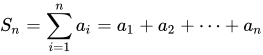
Often several partial sums may appear in the same argument, so the partial sum is often written simply as instead of Sn when we wish to avoid confusion.

- Definition For a series Failed to parse (MathML with SVG or PNG fallback (recommended for modern browsers and accessibility tools): Invalid response ("Math extension cannot connect to Restbase.") from server "https://wikimedia.org/api/rest_v1/":): {\displaystyle \textstyle \sum_{n=1}^\infty a_n}
we define the sum of the series to be the limit of the partial sums. That is, we define:
- Failed to parse (MathML with SVG or PNG fallback (recommended for modern browsers and accessibility tools): Invalid response ("Math extension cannot connect to Restbase.") from server "https://wikimedia.org/api/rest_v1/":): {\displaystyle \sum_{n=1}^{\infty} a_{n}=\lim_{N\to\infty} \sum_{n=1}^N a_n=\lim_{N\to\infty}S_N} .
- If the limit exists we say the series converges, otherwise we say the series diverges.
It should be emphasized when a series diverges, we cannot interpret Failed to parse (MathML with SVG or PNG fallback (recommended for modern browsers and accessibility tools): Invalid response ("Math extension cannot connect to Restbase.") from server "https://wikimedia.org/api/rest_v1/":): {\displaystyle \textstyle \sum_{n=1}^\infty a_n} as a number, but only as a formal sum. On the other hand when the series does converge, it is often not known what number the series converges to, so this number is usually denoted by Failed to parse (MathML with SVG or PNG fallback (recommended for modern browsers and accessibility tools): Invalid response ("Math extension cannot connect to Restbase.") from server "https://wikimedia.org/api/rest_v1/":): {\displaystyle \textstyle \sum_{n=1}^\infty a_n} . Again this is similar to writing Failed to parse (MathML with SVG or PNG fallback (recommended for modern browsers and accessibility tools): Invalid response ("Math extension cannot connect to Restbase.") from server "https://wikimedia.org/api/rest_v1/":): {\displaystyle \textstyle \lim_{n\to\infty}a_n} before the convergence of the sequence an is established. In practice the meaning of the symbols Failed to parse (MathML with SVG or PNG fallback (recommended for modern browsers and accessibility tools): Invalid response ("Math extension cannot connect to Restbase.") from server "https://wikimedia.org/api/rest_v1/":): {\displaystyle \textstyle \sum_{n=1}^\infty a_n} is clear from context.
Often it is convenient to sum series starting from some number other than n = 1, and start the series some other point like 0, 2, −10, etc. This hopefully should cause no confusion; the sum of the series is still defined as the limit of the partial sums. Often, it is clear from context where the sum begins. In these cases it is not uncommon to leave the index out of the sigma notation - that is, it is useful to write ∑an for Failed to parse (MathML with SVG or PNG fallback (recommended for modern browsers and accessibility tools): Invalid response ("Math extension cannot connect to Restbase.") from server "https://wikimedia.org/api/rest_v1/":): {\displaystyle \textstyle \sum_{n=1}^\infty a_n}
Examples
- The notion of an infinite sum can be a little more subtle than it first appears. For example, consider the sequence an = (−1)n. Does the sum of the an converge or diverge? We could consider the partial sums SN, which are 1 if N is odd and 0 if N is even. So it seems the series diverges. On the other hand, 1 − 1 + 1 − 1 + 1 − 1 + … = (1 − 1) + (1 − 1) + (1 − 1) + … = 0 + 0 + 0 + … = 0. Does then the series diverge or converge to 0, according to our theory? The answer is it diverges; the fallacy in the previous sentence was in asserting that 1 − 1 + 1 − 1 + 1 − 1 + … = (1 − 1) + (1 − 1) + (1 − 1) + …. It is no longer true that for infinite series that we may sum in any order we choose; we must justify why we are allowed to group the +1's together with the -1's without changing the sum. Stated formally, associativity does not necessarily hold for infinite series. We will investigate when it is possible to rearrange the elements of a series and still get the same sum.
- Perhaps the most familiar examples of series come from decimal expansions of real numbers. While we have not given a rigorous definition of decimal expansions here, it can be shown that every real number r can be expressed in the form Failed to parse (MathML with SVG or PNG fallback (recommended for modern browsers and accessibility tools): Invalid response ("Math extension cannot connect to Restbase.") from server "https://wikimedia.org/api/rest_v1/":): {\displaystyle \textstyle r = \sum_{n=0}^{\infty} \frac{a_n}{10^n}} where an ∈ {0, 1, 2, 3, 4, 5, 6, 7, 8, 9}
- Consider the series Failed to parse (MathML with SVG or PNG fallback (recommended for modern browsers and accessibility tools): Invalid response ("Math extension cannot connect to Restbase.") from server "https://wikimedia.org/api/rest_v1/":): {\displaystyle \textstyle \tfrac{1}{1\cdot 2}+\tfrac{1}{2\cdot 3}+\tfrac{1}{3\cdot 4}\cdots=\sum_{n=1}^\infty\tfrac{1}{n(n+1)}}
. At first it may seem difficult to determine the partial sums and decide whether or not the series converges. However, it turns out that this series is nicer than it first appears, since Failed to parse (MathML with SVG or PNG fallback (recommended for modern browsers and accessibility tools): Invalid response ("Math extension cannot connect to Restbase.") from server "https://wikimedia.org/api/rest_v1/":): {\displaystyle \textstyle \frac{1}{n(n+1)}=\frac{1}{n}-\frac{1}{n+1}.}
Thus
- Failed to parse (MathML with SVG or PNG fallback (recommended for modern browsers and accessibility tools): Invalid response ("Math extension cannot connect to Restbase.") from server "https://wikimedia.org/api/rest_v1/":): {\displaystyle \sum_{n=1}^N \frac{1}{n(n+1)}=\sum_{n=1}^N \frac{1}{n}-\frac{1}{n+1}=1-\frac{1}{2}+\frac{1}{2}-\frac{1}{3}+\frac{1}{3}-\frac{1}{4}+\cdots+\frac{1}{N}-\frac{1}{N+1}=1-\frac{1}{N+1}.}
Thus Failed to parse (MathML with SVG or PNG fallback (recommended for modern browsers and accessibility tools): Invalid response ("Math extension cannot connect to Restbase.") from server "https://wikimedia.org/api/rest_v1/":): {\displaystyle \textstyle \lim_{N\to\infty}\sum_{n=1}^N\tfrac{1}{n(n+1)}=\lim_{N\to\infty}(1-\tfrac{1}{N+1})=1.} This is an example of a telescoping series - that is, a series that can be written in the form such that the next term cancels with the previous terms. That is,- Failed to parse (MathML with SVG or PNG fallback (recommended for modern browsers and accessibility tools): Invalid response ("Math extension cannot connect to Restbase.") from server "https://wikimedia.org/api/rest_v1/":): {\displaystyle \sum_{n=1}^{\infty}a_n-a_{n+1}}
- Another important example of a series is the geometric series given by Failed to parse (MathML with SVG or PNG fallback (recommended for modern browsers and accessibility tools): Invalid response ("Math extension cannot connect to Restbase.") from server "https://wikimedia.org/api/rest_v1/":): {\displaystyle \sum_{n=0}^{\infty} r^n } . The partial sums for the geometric series first appear quite complicated. At first glance the partial sums would just appear to be SN = 1 + r +r2 + … + rN, but if we calculate (1 − r)SN then the sum telescopes and we are left with (1 − r)SN = (1 − r)N+1. Notice that this sum holds for any r or N, so we conclude that Failed to parse (MathML with SVG or PNG fallback (recommended for modern browsers and accessibility tools): Invalid response ("Math extension cannot connect to Restbase.") from server "https://wikimedia.org/api/rest_v1/":): {\displaystyle \textstyle S_N=\tfrac{1-r^{N+1}}{1-r}} . Thus a geometric series converges if |r| < 1.
Basic Facts
Here we collect facts about series that follow immediately from the properties of finite sums a limits and do not require a delicate analysis of the limits involved.
Theorem (Algebraic Operations)
Suppose ∑ an and ∑ bn are convergent series, then we immediately have the following two theorems.
- For any real number c the series ∑ (c·an) is convergent and converges to c·(∑ an).
- The series ∑ (an + bn) is convergent and converges to (∑ an ) + (∑ bn )
Proof
For the first statement notice that for any natural number N, we have that Failed to parse (MathML with SVG or PNG fallback (recommended for modern browsers and accessibility tools): Invalid response ("Math extension cannot connect to Restbase.") from server "https://wikimedia.org/api/rest_v1/":): {\displaystyle \textstyle \sum_{n=1}^N c\cdot a_n=\textstyle c\cdot \sum_{n=1}^N a_n} . Thus
- Failed to parse (MathML with SVG or PNG fallback (recommended for modern browsers and accessibility tools): Invalid response ("Math extension cannot connect to Restbase.") from server "https://wikimedia.org/api/rest_v1/":): {\displaystyle \lim_{N\to\infty}\sum_{n=1}^N c\cdot a_n=\lim_{N\to\infty}c\cdot \sum_{n=1}^N a_n=c\cdot \lim_{N\to\infty}\sum_{n=1}^N a_n} .
This proves the first statement.
For the second statement again notice that for any N we have that Failed to parse (MathML with SVG or PNG fallback (recommended for modern browsers and accessibility tools): Invalid response ("Math extension cannot connect to Restbase.") from server "https://wikimedia.org/api/rest_v1/":): {\displaystyle \textstyle \sum_{n=1}^N a_n+b_n=\sum_{n=1}^N a_n+\sum_{n=1}^N b_n} . Thus
- Failed to parse (MathML with SVG or PNG fallback (recommended for modern browsers and accessibility tools): Invalid response ("Math extension cannot connect to Restbase.") from server "https://wikimedia.org/api/rest_v1/":): {\displaystyle \lim_{N\to\infty}\sum_{n=1}^N a_n+b_n=\lim_{N\to\infty}\left(\sum_{n=1}^N a_n+\sum_{n=1}^N b_n\right)=\lim_{N\to\infty}\sum_{n=1}^N a_n+\lim_{N\to\infty}\sum_{n=1}^N b_n} .
This proves the second statement. Failed to parse (MathML with SVG or PNG fallback (recommended for modern browsers and accessibility tools): Invalid response ("Math extension cannot connect to Restbase.") from server "https://wikimedia.org/api/rest_v1/":): {\displaystyle \Box}
The following is merely a restatement of Cauchy's Criterion.
Theorem (Cauchy's Criterion for Series)
A series Failed to parse (MathML with SVG or PNG fallback (recommended for modern browsers and accessibility tools): Invalid response ("Math extension cannot connect to Restbase.") from server "https://wikimedia.org/api/rest_v1/":): {\displaystyle \textstyle \sum_{n=1}^{\infty} a_n} converges if and only if for any ε > 0 there is a natural number N so that Failed to parse (MathML with SVG or PNG fallback (recommended for modern browsers and accessibility tools): Invalid response ("Math extension cannot connect to Restbase.") from server "https://wikimedia.org/api/rest_v1/":): {\displaystyle \textstyle |\sum_{k=n+1}^m a_k| < \epsilon} for any natural numbers m > n > N.
Proof
By the definition of convergence for a series Failed to parse (MathML with SVG or PNG fallback (recommended for modern browsers and accessibility tools): Invalid response ("Math extension cannot connect to Restbase.") from server "https://wikimedia.org/api/rest_v1/":): {\displaystyle \textstyle \sum_{n=1}^{\infty} a_n} converges if and only if Failed to parse (MathML with SVG or PNG fallback (recommended for modern browsers and accessibility tools): Invalid response ("Math extension cannot connect to Restbase.") from server "https://wikimedia.org/api/rest_v1/":): {\displaystyle \textstyle\lim_{N\to\infty}\sum_{k=1}^N a_k} converges. But by the Cauchy criterion for sequences this limit exists if and only if for any ε > 0 we can find a natural number N so that for n, m > N we have that
- Failed to parse (MathML with SVG or PNG fallback (recommended for modern browsers and accessibility tools): Invalid response ("Math extension cannot connect to Restbase.") from server "https://wikimedia.org/api/rest_v1/":): {\displaystyle \left|\sum_{k=1}^n a_k-\sum_{k=1}^m a_k\right|<\epsilon.}
Without loss of generality we may assume m > n. Canceling the terms that occurs in both sums completes the proof. Failed to parse (MathML with SVG or PNG fallback (recommended for modern browsers and accessibility tools): Invalid response ("Math extension cannot connect to Restbase.") from server "https://wikimedia.org/api/rest_v1/":): {\displaystyle \Box}
Absolute Convergence
As we will see series may behave in ways that defy our intuition. So, it is useful to identify which classes of convergent series behave in a way more consistent with our intuition. We shall see that once such class of series are the so called absolutely convergent series.
- Definition A series Failed to parse (MathML with SVG or PNG fallback (recommended for modern browsers and accessibility tools): Invalid response ("Math extension cannot connect to Restbase.") from server "https://wikimedia.org/api/rest_v1/":): {\displaystyle \textstyle \sum_{n=1}^{\infty} a_n} converges absolutely if the series of the absolute values of its terms converges, that is, if Failed to parse (MathML with SVG or PNG fallback (recommended for modern browsers and accessibility tools): Invalid response ("Math extension cannot connect to Restbase.") from server "https://wikimedia.org/api/rest_v1/":): {\displaystyle \textstyle\sum_{n=1}^{\infty} |a_n|} is a convergent series.
Notice we have not said required that ∑ an is convergent, this is because the property of absolute convergence implies that ∑ an is convergent.
Theorem (Absolute Convergence)
If Failed to parse (MathML with SVG or PNG fallback (recommended for modern browsers and accessibility tools): Invalid response ("Math extension cannot connect to Restbase.") from server "https://wikimedia.org/api/rest_v1/":): {\displaystyle \textstyle\sum_{n=1}^{\infty} a_n} converges absolutely, then it converges.
Proof
Suppose Failed to parse (MathML with SVG or PNG fallback (recommended for modern browsers and accessibility tools): Invalid response ("Math extension cannot connect to Restbase.") from server "https://wikimedia.org/api/rest_v1/":): {\displaystyle \textstyle\sum_{n=1}^{\infty} a_n} is absolutely convergent. By the Cauchy criterion we can show that Failed to parse (MathML with SVG or PNG fallback (recommended for modern browsers and accessibility tools): Invalid response ("Math extension cannot connect to Restbase.") from server "https://wikimedia.org/api/rest_v1/":): {\displaystyle \textstyle \sum_{n=1}^\infty a_n} converges if for any ε > 0 we can find an N so that if m > n > N then Failed to parse (MathML with SVG or PNG fallback (recommended for modern browsers and accessibility tools): Invalid response ("Math extension cannot connect to Restbase.") from server "https://wikimedia.org/api/rest_v1/":): {\displaystyle \textstyle |\sum_{k=n+1}^{m} a_k|<\epsilon} . But we know that Failed to parse (MathML with SVG or PNG fallback (recommended for modern browsers and accessibility tools): Invalid response ("Math extension cannot connect to Restbase.") from server "https://wikimedia.org/api/rest_v1/":): {\displaystyle \textstyle \sum_{n=1}^\infty |a_n|} converges, so ε > 0 by the Cauchy criterion choose N so that if m > n > N then Failed to parse (MathML with SVG or PNG fallback (recommended for modern browsers and accessibility tools): Invalid response ("Math extension cannot connect to Restbase.") from server "https://wikimedia.org/api/rest_v1/":): {\displaystyle \textstyle |\sum_{k=n+1}^{m} |a_k||=\textstyle \sum_{k=n+1}^{m} |a_k|<\epsilon} . With this N in hand take any m > n > N, it then follows from the triangle inequality that
- Failed to parse (MathML with SVG or PNG fallback (recommended for modern browsers and accessibility tools): Invalid response ("Math extension cannot connect to Restbase.") from server "https://wikimedia.org/api/rest_v1/":): {\displaystyle |\sum_{k=n+1}^m a_k|\leq \sum_{k=n+1}^m |a_k|< \epsilon.}
Therefore by the Cauchy criterion Failed to parse (MathML with SVG or PNG fallback (recommended for modern browsers and accessibility tools): Invalid response ("Math extension cannot connect to Restbase.") from server "https://wikimedia.org/api/rest_v1/":): {\displaystyle \sum_{n=1}^\infty a_n} converges. Failed to parse (MathML with SVG or PNG fallback (recommended for modern browsers and accessibility tools): Invalid response ("Math extension cannot connect to Restbase.") from server "https://wikimedia.org/api/rest_v1/":): {\displaystyle \Box}
Tests for convergence and divergence
Given a series Failed to parse (MathML with SVG or PNG fallback (recommended for modern browsers and accessibility tools): Invalid response ("Math extension cannot connect to Restbase.") from server "https://wikimedia.org/api/rest_v1/":): {\displaystyle \textstyle \sum_{n=1}^\infty a_n} it is very useful to be able to tell if the series converges or diverges. Particularly if we can do so simply by looking at the terms. In this section we set out to collect such theorems. Notice we have already seen one example. That is a series is convergent if it is absolutely convergent, now we explore when we can decide if a series is convergent.
Although the following theorem is stated in terms of convergence, it actually gives a useful test for divergence. Namely, if the terms of a series do not have limit 0, the series must diverge.
Theorem (Terms Have Limit 0)
For any converging series Failed to parse (MathML with SVG or PNG fallback (recommended for modern browsers and accessibility tools): Invalid response ("Math extension cannot connect to Restbase.") from server "https://wikimedia.org/api/rest_v1/":): {\displaystyle \textstyle\sum_{n=1}^{\infty} a_n} the terms must tend to 0, that is Failed to parse (MathML with SVG or PNG fallback (recommended for modern browsers and accessibility tools): Invalid response ("Math extension cannot connect to Restbase.") from server "https://wikimedia.org/api/rest_v1/":): {\displaystyle \textstyle \lim_{n\rightarrow \infty} a_n = 0. }
Proof
Given any ε > 0, by the Cauchy Criterion for series, we can choose a natural number N so that Failed to parse (MathML with SVG or PNG fallback (recommended for modern browsers and accessibility tools): Invalid response ("Math extension cannot connect to Restbase.") from server "https://wikimedia.org/api/rest_v1/":): {\displaystyle \textstyle |\sum_{i=n+1}^m a_i|<\epsilon} when ever m > n ≥ N. In particular, for any k > N we may apply this in the case when n = k − 1 and m = k. In this case the sum reduces to the single term ak. Thus if k > N we have that |ak| < ε and therefore the sequence (an) → 0. Failed to parse (MathML with SVG or PNG fallback (recommended for modern browsers and accessibility tools): Invalid response ("Math extension cannot connect to Restbase.") from server "https://wikimedia.org/api/rest_v1/":): {\displaystyle \Box}
Remark To give an example of how to use this to test for divergence of a series consider the example of a geometric series Failed to parse (MathML with SVG or PNG fallback (recommended for modern browsers and accessibility tools): Invalid response ("Math extension cannot connect to Restbase.") from server "https://wikimedia.org/api/rest_v1/":): {\displaystyle \textstyle \sum_{n=0}^\infty r^n} . We have already shown that this series converges if |r| < 1. On the other hand we have not determined if the series converges or diverges for other values of r. Now it is clear that if |r| ≥ 1 then the sequence rn does not tend to zero. So we now know that the geometric series Failed to parse (MathML with SVG or PNG fallback (recommended for modern browsers and accessibility tools): Invalid response ("Math extension cannot connect to Restbase.") from server "https://wikimedia.org/api/rest_v1/":): {\displaystyle \textstyle \sum_{n=0}^\infty r^n} converges if and only of |r| < 1.
Theorem (Nth-term Test)
In mathematics, the nth-term test for divergence is a simple test for the divergence of an infinite series:
- If or if the limit does not exist, then diverges.

When testing if a series converges or diverges, this test is often checked first due to its ease of use.
Unlike stronger convergence tests, the term test cannot prove by itself that a series converges. In particular, the converse to the test is not true; instead all one can say is:
- If then Failed to parse (MathML with SVG or PNG fallback (recommended for modern browsers and accessibility tools): Invalid response ("Math extension cannot connect to Restbase.") from server "https://wikimedia.org/api/rest_v1/":): {\displaystyle \sum_{n=1}^\infty a_n} may or may not converge. In other words, if Failed to parse (MathML with SVG or PNG fallback (recommended for modern browsers and accessibility tools): Invalid response ("Math extension cannot connect to Restbase.") from server "https://wikimedia.org/api/rest_v1/":): {\displaystyle \lim_{n \to \infty} a_n = 0,} the test is inconclusive.

Proofs
The test is typically proven in contrapositive form:
- If Failed to parse (MathML with SVG or PNG fallback (recommended for modern browsers and accessibility tools): Invalid response ("Math extension cannot connect to Restbase.") from server "https://wikimedia.org/api/rest_v1/":): {\displaystyle \sum_{n=1}^\infty a_n} converges, then Failed to parse (MathML with SVG or PNG fallback (recommended for modern browsers and accessibility tools): Invalid response ("Math extension cannot connect to Restbase.") from server "https://wikimedia.org/api/rest_v1/":): {\displaystyle \lim_{n \to \infty} a_n = 0.}
- Limit manipulation
If sn are the partial sums of the series, then the assumption that the series converges means that
- Failed to parse (MathML with SVG or PNG fallback (recommended for modern browsers and accessibility tools): Invalid response ("Math extension cannot connect to Restbase.") from server "https://wikimedia.org/api/rest_v1/":): {\displaystyle \lim_{n\to\infty} s_n = L}
for some number s. Then
- Failed to parse (MathML with SVG or PNG fallback (recommended for modern browsers and accessibility tools): Invalid response ("Math extension cannot connect to Restbase.") from server "https://wikimedia.org/api/rest_v1/":): {\displaystyle \lim_{n\to\infty} a_n = \lim_{n\to\infty}(s_n-s_{n-1}) = \lim_{n\to\infty} s_n - \lim_{n\to\infty} s_{n-1} = L-L = 0.}
- Cauchy's criterion
The assumption that the series converges means that it passes Cauchy's convergence test: for every Failed to parse (MathML with SVG or PNG fallback (recommended for modern browsers and accessibility tools): Invalid response ("Math extension cannot connect to Restbase.") from server "https://wikimedia.org/api/rest_v1/":): {\displaystyle \varepsilon>0} there is a number N such that
- Failed to parse (MathML with SVG or PNG fallback (recommended for modern browsers and accessibility tools): Invalid response ("Math extension cannot connect to Restbase.") from server "https://wikimedia.org/api/rest_v1/":): {\displaystyle \left|a_{n+1}+a_{n+2}+\cdots+a_{n+p}\right|<\varepsilon}
holds for all n > N and p ≥ 1. Setting p = 1 recovers the definition of the statement
- Failed to parse (MathML with SVG or PNG fallback (recommended for modern browsers and accessibility tools): Invalid response ("Math extension cannot connect to Restbase.") from server "https://wikimedia.org/api/rest_v1/":): {\displaystyle \lim_{n\to\infty} a_n = 0.}
Theorem (Positive Series Converge)
Suppose Failed to parse (MathML with SVG or PNG fallback (recommended for modern browsers and accessibility tools): Invalid response ("Math extension cannot connect to Restbase.") from server "https://wikimedia.org/api/rest_v1/":): {\displaystyle \textstyle \sum_{n=1}^{\infty} a_n} is a series of non-negative terms, that is an ≥ 0, then the series either converges if and only if the partial sums are bounded above.
Proof
Since the terms are non-negative, we clearly have Failed to parse (MathML with SVG or PNG fallback (recommended for modern browsers and accessibility tools): Invalid response ("Math extension cannot connect to Restbase.") from server "https://wikimedia.org/api/rest_v1/":): {\displaystyle \textstyle \sum_{n=1}^N a_n \leq \sum_{n=1}^{N+1} a_n} and hence the partial sums form a monotonic sequence. If the partial sums are bounded then the series converges. If they are unbounded, then for any M > 0 we can find an N so that Failed to parse (MathML with SVG or PNG fallback (recommended for modern browsers and accessibility tools): Invalid response ("Math extension cannot connect to Restbase.") from server "https://wikimedia.org/api/rest_v1/":): {\displaystyle \textstyle \sum_{n=1}^N a_n \geq M} , since the partial sums are non-decreasing, we have that Failed to parse (MathML with SVG or PNG fallback (recommended for modern browsers and accessibility tools): Invalid response ("Math extension cannot connect to Restbase.") from server "https://wikimedia.org/api/rest_v1/":): {\displaystyle \textstyle\lim_{N \rightarrow \infty}\sum_{n=1}^N a_n = \infty } , and hence the series does not converge. Failed to parse (MathML with SVG or PNG fallback (recommended for modern browsers and accessibility tools): Invalid response ("Math extension cannot connect to Restbase.") from server "https://wikimedia.org/api/rest_v1/":): {\displaystyle \Box}
Remark It follows from the proof, together with the Convergence of monotone sequences, that if a sequence of non-negative terms converges we may take the sum of the sequence as an upper bound for the partial sums, as our intuition would dictate.
To determine whether or not a series converges, sometimes it is useful to compare it term-by-term with another series whose convergence is understood. The following theorem gives one such method for comparing.
Theorem (Comparison Test)
Suppose that 0 ≤ an ≤ bn for all natural numbers n and consider the series Failed to parse (MathML with SVG or PNG fallback (recommended for modern browsers and accessibility tools): Invalid response ("Math extension cannot connect to Restbase.") from server "https://wikimedia.org/api/rest_v1/":): {\displaystyle \textstyle \sum_{n=1}^{\infty} a_n } and Failed to parse (MathML with SVG or PNG fallback (recommended for modern browsers and accessibility tools): Invalid response ("Math extension cannot connect to Restbase.") from server "https://wikimedia.org/api/rest_v1/":): {\displaystyle \textstyle \sum_{n=1}^{\infty} b_n } . If the Failed to parse (MathML with SVG or PNG fallback (recommended for modern browsers and accessibility tools): Invalid response ("Math extension cannot connect to Restbase.") from server "https://wikimedia.org/api/rest_v1/":): {\displaystyle \textstyle \sum_{n=1}^{\infty} b_n} converges, then Failed to parse (MathML with SVG or PNG fallback (recommended for modern browsers and accessibility tools): Invalid response ("Math extension cannot connect to Restbase.") from server "https://wikimedia.org/api/rest_v1/":): {\displaystyle \textstyle \sum_{n=1}^{\infty} a_n} converges. Furthermore, if Failed to parse (MathML with SVG or PNG fallback (recommended for modern browsers and accessibility tools): Invalid response ("Math extension cannot connect to Restbase.") from server "https://wikimedia.org/api/rest_v1/":): {\displaystyle \textstyle \sum_{n=1}^{\infty} a_n} diverges, then Failed to parse (MathML with SVG or PNG fallback (recommended for modern browsers and accessibility tools): Invalid response ("Math extension cannot connect to Restbase.") from server "https://wikimedia.org/api/rest_v1/":): {\displaystyle \textstyle \sum_{n=1}^{\infty} b_n } diverges.
Proof
First suppose that the ∑ bn converges. Then by our previous theorem we know that the partial sums for some real number we know that Failed to parse (MathML with SVG or PNG fallback (recommended for modern browsers and accessibility tools): Invalid response ("Math extension cannot connect to Restbase.") from server "https://wikimedia.org/api/rest_v1/":): {\displaystyle \textstyle\sum_{n=1}^N b_n\leq\sum_{n=1}^\infty b_n} . Since an ≤ bn if follows that
- Failed to parse (MathML with SVG or PNG fallback (recommended for modern browsers and accessibility tools): Invalid response ("Math extension cannot connect to Restbase.") from server "https://wikimedia.org/api/rest_v1/":): {\displaystyle \sum_{k=1}^{N} a_n \leq \sum_{k=1}^{N} b_n \leq \sum_{n=1}^{\infty} b_n } .
Thus the partial sums of ∑ an are bounded above, since ∑ an is also a series of non-negative terms it follows that ∑ an converges.
Now suppose that ∑ an diverges. Since it is a series of non-negative terms the pervious theorem tells us that for any real number M we can find an N so that Failed to parse (MathML with SVG or PNG fallback (recommended for modern browsers and accessibility tools): Invalid response ("Math extension cannot connect to Restbase.") from server "https://wikimedia.org/api/rest_v1/":): {\displaystyle \textstyle M<\sum_{n=1}^N a_n} . Since an ≤ bn we have that
- Failed to parse (MathML with SVG or PNG fallback (recommended for modern browsers and accessibility tools): Invalid response ("Math extension cannot connect to Restbase.") from server "https://wikimedia.org/api/rest_v1/":): {\displaystyle M<\sum_{k=1}^{N} a_n \leq \sum_{k=1}^{N} b_n} .
Therefore the partial sums of ∑ bn cannot be bounded above, and hence by the previous theorem ∑ bn diverges. Failed to parse (MathML with SVG or PNG fallback (recommended for modern browsers and accessibility tools): Invalid response ("Math extension cannot connect to Restbase.") from server "https://wikimedia.org/api/rest_v1/":): {\displaystyle \Box}
Theorem (Limit Comparison Test)
Suppose Failed to parse (MathML with SVG or PNG fallback (recommended for modern browsers and accessibility tools): Invalid response ("Math extension cannot connect to Restbase.") from server "https://wikimedia.org/api/rest_v1/":): {\displaystyle \textstyle \sum_{n=1}^{\infty} a_n } and Failed to parse (MathML with SVG or PNG fallback (recommended for modern browsers and accessibility tools): Invalid response ("Math extension cannot connect to Restbase.") from server "https://wikimedia.org/api/rest_v1/":): {\displaystyle \textstyle \sum_{n=1}^{\infty} b_n} series of positive terms so that Failed to parse (MathML with SVG or PNG fallback (recommended for modern browsers and accessibility tools): Invalid response ("Math extension cannot connect to Restbase.") from server "https://wikimedia.org/api/rest_v1/":): {\displaystyle \textstyle 0\leq\limsup_{n\to\infty} \tfrac{a_n}{b_n}<\infty} . In this case, if Failed to parse (MathML with SVG or PNG fallback (recommended for modern browsers and accessibility tools): Invalid response ("Math extension cannot connect to Restbase.") from server "https://wikimedia.org/api/rest_v1/":): {\displaystyle \textstyle \sum_{n=1}^{\infty} b_n } converges, then Failed to parse (MathML with SVG or PNG fallback (recommended for modern browsers and accessibility tools): Invalid response ("Math extension cannot connect to Restbase.") from server "https://wikimedia.org/api/rest_v1/":): {\displaystyle \textstyle \sum_{n=1}^{\infty} a_n} converges.
Proof
Suppose the limit of the absolute value of their ratios converges to some positive number r < ∞. Then there exists an N such that if n > N, that Failed to parse (MathML with SVG or PNG fallback (recommended for modern browsers and accessibility tools): Invalid response ("Math extension cannot connect to Restbase.") from server "https://wikimedia.org/api/rest_v1/":): {\displaystyle |\,|\tfrac{a_n}{b_n}|-r|<\tfrac{r}{2}} , so Failed to parse (MathML with SVG or PNG fallback (recommended for modern browsers and accessibility tools): Invalid response ("Math extension cannot connect to Restbase.") from server "https://wikimedia.org/api/rest_v1/":): {\displaystyle \tfrac{r}{2}<|\tfrac{a_n}{b_n}|<\tfrac{3r}{2}} . This means that Failed to parse (MathML with SVG or PNG fallback (recommended for modern browsers and accessibility tools): Invalid response ("Math extension cannot connect to Restbase.") from server "https://wikimedia.org/api/rest_v1/":): {\displaystyle \tfrac{r}{2}|b_n|<|a_n|<\tfrac{3r}{2}|b_n|} . Hence, by the comparison test, if Failed to parse (MathML with SVG or PNG fallback (recommended for modern browsers and accessibility tools): Invalid response ("Math extension cannot connect to Restbase.") from server "https://wikimedia.org/api/rest_v1/":): {\displaystyle \sum_{n=1}^{\infty} b_n} converges, then Failed to parse (MathML with SVG or PNG fallback (recommended for modern browsers and accessibility tools): Invalid response ("Math extension cannot connect to Restbase.") from server "https://wikimedia.org/api/rest_v1/":): {\displaystyle \sum_{n=1}^{\infty} a_n } also converges. Dividing by Failed to parse (MathML with SVG or PNG fallback (recommended for modern browsers and accessibility tools): Invalid response ("Math extension cannot connect to Restbase.") from server "https://wikimedia.org/api/rest_v1/":): {\displaystyle \tfrac{r}{2}} , one can also see by the comparison test that if Failed to parse (MathML with SVG or PNG fallback (recommended for modern browsers and accessibility tools): Invalid response ("Math extension cannot connect to Restbase.") from server "https://wikimedia.org/api/rest_v1/":): {\displaystyle \sum_{n=1}^{\infty} a_n } converges, then Failed to parse (MathML with SVG or PNG fallback (recommended for modern browsers and accessibility tools): Invalid response ("Math extension cannot connect to Restbase.") from server "https://wikimedia.org/api/rest_v1/":): {\displaystyle \sum_{n=1}^{\infty} b_n } also converges.
We need to have ways of checking for convergence and divergence of various series. The following types of series arise quite often, and it is easy to verify when they converge and diverge:
Theorem (Ratio Test)
Supoose that Failed to parse (MathML with SVG or PNG fallback (recommended for modern browsers and accessibility tools): Invalid response ("Math extension cannot connect to Restbase.") from server "https://wikimedia.org/api/rest_v1/":): {\displaystyle \textstyle \lim_{n \rightarrow \infty} \left|\frac{x_{n+1}}{x_n}\right|} converges and equals some real number r. If r < 1, then Failed to parse (MathML with SVG or PNG fallback (recommended for modern browsers and accessibility tools): Invalid response ("Math extension cannot connect to Restbase.") from server "https://wikimedia.org/api/rest_v1/":): {\displaystyle \textstyle \sum_{n=1}^{\infty} x_n} converges absolutely. If r > 1, then Failed to parse (MathML with SVG or PNG fallback (recommended for modern browsers and accessibility tools): Invalid response ("Math extension cannot connect to Restbase.") from server "https://wikimedia.org/api/rest_v1/":): {\displaystyle \textstyle \sum_{n=1}^{\infty} x_n } diverges. Finally, if r = 1, then Failed to parse (MathML with SVG or PNG fallback (recommended for modern browsers and accessibility tools): Invalid response ("Math extension cannot connect to Restbase.") from server "https://wikimedia.org/api/rest_v1/":): {\displaystyle \textstyle \sum_{n=1}^{\infty} x_n} may either converge or diverge.
Proof
First suppose that r < 1. Let ε = 1 − r, since r < 1 it follows that ε > 0.
Since Failed to parse (MathML with SVG or PNG fallback (recommended for modern browsers and accessibility tools): Invalid response ("Math extension cannot connect to Restbase.") from server "https://wikimedia.org/api/rest_v1/":): {\displaystyle \textstyle\lim_{n \rightarrow \infty} \left|\frac{x_{n+1}}{x_n}\right| = r } , we can choose an N so that | |xn+1/xn| − r| < ε/2 for all n ≥ N. In particular, if n ≥ N, then |xn+1|/|xn'| < r + ε/2. Notice that our particular choice of ε guarantees that the ratio r + ε/2 is less than 1.
Thus
- Failed to parse (MathML with SVG or PNG fallback (recommended for modern browsers and accessibility tools): Invalid response ("Math extension cannot connect to Restbase.") from server "https://wikimedia.org/api/rest_v1/":): {\displaystyle \sum_{n=1}^{\infty} |x_n| } = Failed to parse (MathML with SVG or PNG fallback (recommended for modern browsers and accessibility tools): Invalid response ("Math extension cannot connect to Restbase.") from server "https://wikimedia.org/api/rest_v1/":): {\displaystyle \sum_{n=1}^{N} |x_n| + \sum_{n=N+1}^{\infty} |x_n|}
- Failed to parse (MathML with SVG or PNG fallback (recommended for modern browsers and accessibility tools): Invalid response ("Math extension cannot connect to Restbase.") from server "https://wikimedia.org/api/rest_v1/":): {\displaystyle = \sum_{n=1}^N |x_n| + \sum_{n=N+1}^{\infty} |x_N|\frac{|x_{N+1}|}{|x_N|}\frac{|x_{N+2}|}{|x_{N+1}|}\cdots\frac{|x_{n}|}{|x_{n-1}|}}
- Failed to parse (MathML with SVG or PNG fallback (recommended for modern browsers and accessibility tools): Invalid response ("Math extension cannot connect to Restbase.") from server "https://wikimedia.org/api/rest_v1/":): {\displaystyle \leq \sum_{n=1}^N |x_n| + |x_N|\sum_{n=N+1}^{\infty}(r + \frac{\epsilon}{2})^{n-N}.}
The last series converges because it is a geometric series whose ratio, r + ε/2 , is less than 1.
By the comparison test, Failed to parse (MathML with SVG or PNG fallback (recommended for modern browsers and accessibility tools): Invalid response ("Math extension cannot connect to Restbase.") from server "https://wikimedia.org/api/rest_v1/":): {\displaystyle \textstyle\sum_{n=1}^{\infty} |x_n| } converges. Thus converges absolutely.


The next theorem, the root test, is stronger than the ratio test in the sense that it works whenever the ratio test works (and returns the same number r), and it sometimes works even when the ratio test does not.
Theorem (Root Test)
Let . If R < 1, then the series Failed to parse (MathML with SVG or PNG fallback (recommended for modern browsers and accessibility tools): Invalid response ("Math extension cannot connect to Restbase.") from server "https://wikimedia.org/api/rest_v1/":): {\displaystyle \sum_{n=1}^{\infty}a_n} converges absolutely. If R > 1, then it diverges.

Proof
If R<1, let Failed to parse (MathML with SVG or PNG fallback (recommended for modern browsers and accessibility tools): Invalid response ("Math extension cannot connect to Restbase.") from server "https://wikimedia.org/api/rest_v1/":): {\displaystyle R<\rho<1} . Since Failed to parse (MathML with SVG or PNG fallback (recommended for modern browsers and accessibility tools): Invalid response ("Math extension cannot connect to Restbase.") from server "https://wikimedia.org/api/rest_v1/":): {\displaystyle \limsup_{n\rightarrow\infty}(|a_n|^{\frac{1}{n}}) = R} Failed to parse (MathML with SVG or PNG fallback (recommended for modern browsers and accessibility tools): Invalid response ("Math extension cannot connect to Restbase.") from server "https://wikimedia.org/api/rest_v1/":): {\displaystyle \exists N: \forall n \geq N: |\sup\{|a_k|^{\frac{1}{k}}|k > n\} - R| < \rho - R} .
That is, Failed to parse (MathML with SVG or PNG fallback (recommended for modern browsers and accessibility tools): Invalid response ("Math extension cannot connect to Restbase.") from server "https://wikimedia.org/api/rest_v1/":): {\displaystyle \forall n \geq N: \sup\{|a_k|^{\frac{1}{k}}|k > n\} < \rho}
Thus Failed to parse (MathML with SVG or PNG fallback (recommended for modern browsers and accessibility tools): Invalid response ("Math extension cannot connect to Restbase.") from server "https://wikimedia.org/api/rest_v1/":): {\displaystyle \sum_{n=1}^{\infty}|a_n| } Failed to parse (MathML with SVG or PNG fallback (recommended for modern browsers and accessibility tools): Invalid response ("Math extension cannot connect to Restbase.") from server "https://wikimedia.org/api/rest_v1/":): {\displaystyle = \sum_{n=1}^{\infty}(|a_n|^{\frac{1}{n}})^n } Failed to parse (MathML with SVG or PNG fallback (recommended for modern browsers and accessibility tools): Invalid response ("Math extension cannot connect to Restbase.") from server "https://wikimedia.org/api/rest_v1/":): {\displaystyle = \sum_{n=1}^{N-1}|a_n| + \sum_{n=N}^{\infty}(|a_n|^{\frac{1}{n}})^n } Failed to parse (MathML with SVG or PNG fallback (recommended for modern browsers and accessibility tools): Invalid response ("Math extension cannot connect to Restbase.") from server "https://wikimedia.org/api/rest_v1/":): {\displaystyle < \sum_{n=1}^{N-1}|a_n| + \sum_{n=N}^{\infty}(\sup\{|a_k|^{\frac{1}{k}}|k > n \})^n } Failed to parse (MathML with SVG or PNG fallback (recommended for modern browsers and accessibility tools): Invalid response ("Math extension cannot connect to Restbase.") from server "https://wikimedia.org/api/rest_v1/":): {\displaystyle < \sum_{n=1}^{N-1}|a_n| + \sum_{n=N}^{\infty}(\rho)^n} , which converges since it is a constant plus a geometric series.
By the comparison test, Failed to parse (MathML with SVG or PNG fallback (recommended for modern browsers and accessibility tools): Invalid response ("Math extension cannot connect to Restbase.") from server "https://wikimedia.org/api/rest_v1/":): {\displaystyle \sum_{n=1}^{\infty}|a_n| } converges as well. Thus Failed to parse (MathML with SVG or PNG fallback (recommended for modern browsers and accessibility tools): Invalid response ("Math extension cannot connect to Restbase.") from server "https://wikimedia.org/api/rest_v1/":): {\displaystyle \sum_{n=1}^{\infty}a_n } converges absolutely.
If R > 1, then Failed to parse (MathML with SVG or PNG fallback (recommended for modern browsers and accessibility tools): Invalid response ("Math extension cannot connect to Restbase.") from server "https://wikimedia.org/api/rest_v1/":): {\displaystyle \sup\{|a_n|^{\frac{1}{n}} | k>n\} > 1}
. Thus there are infinitely many n such that Failed to parse (MathML with SVG or PNG fallback (recommended for modern browsers and accessibility tools): Invalid response ("Math extension cannot connect to Restbase.") from server "https://wikimedia.org/api/rest_v1/":): {\displaystyle |a_n|^{\frac{1}{n}} > 1 \implies |a_n| > 1 }
.
Thus Failed to parse (MathML with SVG or PNG fallback (recommended for modern browsers and accessibility tools): Invalid response ("Math extension cannot connect to Restbase.") from server "https://wikimedia.org/api/rest_v1/":): {\displaystyle (a_n) \not\rightarrow 0} , which implies that Failed to parse (MathML with SVG or PNG fallback (recommended for modern browsers and accessibility tools): Invalid response ("Math extension cannot connect to Restbase.") from server "https://wikimedia.org/api/rest_v1/":): {\displaystyle \sum_{n=1}^{\infty}a_n} diverges. Failed to parse (MathML with SVG or PNG fallback (recommended for modern browsers and accessibility tools): Invalid response ("Math extension cannot connect to Restbase.") from server "https://wikimedia.org/api/rest_v1/":): {\displaystyle \Box}
We'll often be asked to consider series of the form Failed to parse (MathML with SVG or PNG fallback (recommended for modern browsers and accessibility tools): Invalid response ("Math extension cannot connect to Restbase.") from server "https://wikimedia.org/api/rest_v1/":): {\displaystyle \sum_{n=1}^{\infty} a_nb_n }
. The following theorems give criteria for convergence of these series.
Theorem (Dirichlet's Test)
If the partial sums Failed to parse (MathML with SVG or PNG fallback (recommended for modern browsers and accessibility tools): Invalid response ("Math extension cannot connect to Restbase.") from server "https://wikimedia.org/api/rest_v1/":): {\displaystyle \sum_{n=1}^{N}x_n} are bounded, and Failed to parse (MathML with SVG or PNG fallback (recommended for modern browsers and accessibility tools): Invalid response ("Math extension cannot connect to Restbase.") from server "https://wikimedia.org/api/rest_v1/":): {\displaystyle (y_n)} is a decreasing sequence with Failed to parse (MathML with SVG or PNG fallback (recommended for modern browsers and accessibility tools): Invalid response ("Math extension cannot connect to Restbase.") from server "https://wikimedia.org/api/rest_v1/":): {\displaystyle \lim_{n\rightarrow\infty} y_n = 0} , then Failed to parse (MathML with SVG or PNG fallback (recommended for modern browsers and accessibility tools): Invalid response ("Math extension cannot connect to Restbase.") from server "https://wikimedia.org/api/rest_v1/":): {\displaystyle \sum_{n=1}^{\infty}x_ny_n} converges. [Note: Failed to parse (MathML with SVG or PNG fallback (recommended for modern browsers and accessibility tools): Invalid response ("Math extension cannot connect to Restbase.") from server "https://wikimedia.org/api/rest_v1/":): {\displaystyle \sum_{n=1}^{\infty}x_n} need not converge]
Proof
Let Failed to parse (MathML with SVG or PNG fallback (recommended for modern browsers and accessibility tools): Invalid response ("Math extension cannot connect to Restbase.") from server "https://wikimedia.org/api/rest_v1/":): {\displaystyle s_n = \sum_{m=1}^n x_m} be the Failed to parse (MathML with SVG or PNG fallback (recommended for modern browsers and accessibility tools): Invalid response ("Math extension cannot connect to Restbase.") from server "https://wikimedia.org/api/rest_v1/":): {\displaystyle n} th partial sum, so that there exists Failed to parse (MathML with SVG or PNG fallback (recommended for modern browsers and accessibility tools): Invalid response ("Math extension cannot connect to Restbase.") from server "https://wikimedia.org/api/rest_v1/":): {\displaystyle B>0} such that Failed to parse (MathML with SVG or PNG fallback (recommended for modern browsers and accessibility tools): Invalid response ("Math extension cannot connect to Restbase.") from server "https://wikimedia.org/api/rest_v1/":): {\displaystyle |s_n| \le B} .
We can write
Failed to parse (MathML with SVG or PNG fallback (recommended for modern browsers and accessibility tools): Invalid response ("Math extension cannot connect to Restbase.") from server "https://wikimedia.org/api/rest_v1/":): {\displaystyle \sum_{n=1}^N x_ny_n = x_1y_1 + \sum_{n=2}^N (s_n-s_{n-1})y_n = x_1y_1 + \sum_{n=2}^N s_ny_n - \sum_{n=2}^N s_{n-1}y_n} .
Changing the index of summation in the last sum, this becomes
Failed to parse (MathML with SVG or PNG fallback (recommended for modern browsers and accessibility tools): Invalid response ("Math extension cannot connect to Restbase.") from server "https://wikimedia.org/api/rest_v1/":): {\displaystyle \sum_{n=1}^N x_ny_n = x_1y_1 + \sum_{n=2}^N s_ny_n - \sum_{n=1}^{N-1} s_ny_{n+1} = x_1y_1 - x_1y_2 + \sum_{n=2}^{N-1} s_n(y_n-y_{n+1}) + s_Ny_N} .
The sum on the right-hand side is bounded absolutely by the telescoping sum
Failed to parse (MathML with SVG or PNG fallback (recommended for modern browsers and accessibility tools): Invalid response ("Math extension cannot connect to Restbase.") from server "https://wikimedia.org/api/rest_v1/":): {\displaystyle \sum_{n=2}^{N-1} |s_n(y_n-y_{n+1})| \le B \sum_{n=2}^{N-1} (y_n-y_{n+1}) = B(y_2-y_N) \le By_2} ;
here we have used the fact that Failed to parse (MathML with SVG or PNG fallback (recommended for modern browsers and accessibility tools): Invalid response ("Math extension cannot connect to Restbase.") from server "https://wikimedia.org/api/rest_v1/":): {\displaystyle (y_n)} is positive and decreasing. It follows that
Failed to parse (MathML with SVG or PNG fallback (recommended for modern browsers and accessibility tools): Invalid response ("Math extension cannot connect to Restbase.") from server "https://wikimedia.org/api/rest_v1/":): {\displaystyle \sum_{n=2}^\infty s_n(y_n-y_{n+1})} is absolutely convergent, hence convergent.
Notice that Failed to parse (MathML with SVG or PNG fallback (recommended for modern browsers and accessibility tools): Invalid response ("Math extension cannot connect to Restbase.") from server "https://wikimedia.org/api/rest_v1/":): {\displaystyle \lim_{N\to\infty} s_Ny_N = 0} since Failed to parse (MathML with SVG or PNG fallback (recommended for modern browsers and accessibility tools): Invalid response ("Math extension cannot connect to Restbase.") from server "https://wikimedia.org/api/rest_v1/":): {\displaystyle s_N} is bounded and Failed to parse (MathML with SVG or PNG fallback (recommended for modern browsers and accessibility tools): Invalid response ("Math extension cannot connect to Restbase.") from server "https://wikimedia.org/api/rest_v1/":): {\displaystyle (y_n)} tends to 0 as Failed to parse (MathML with SVG or PNG fallback (recommended for modern browsers and accessibility tools): Invalid response ("Math extension cannot connect to Restbase.") from server "https://wikimedia.org/api/rest_v1/":): {\displaystyle n} tends to infinity. Therefore we can take limits as Failed to parse (MathML with SVG or PNG fallback (recommended for modern browsers and accessibility tools): Invalid response ("Math extension cannot connect to Restbase.") from server "https://wikimedia.org/api/rest_v1/":): {\displaystyle N} goes to infinity:
Failed to parse (MathML with SVG or PNG fallback (recommended for modern browsers and accessibility tools): Invalid response ("Math extension cannot connect to Restbase.") from server "https://wikimedia.org/api/rest_v1/":): {\displaystyle \sum_{n=1}^\infty x_ny_n = x_1y_1 - x_1y_2 + \sum_{n=2}^\infty s_n(y_n-y_{n+1}) + \lim_{N\to\infty} s_Ny_N = x_1y_1 - x_1y_2 + \sum_{n=2}^\infty s_n(y_n-y_{n+1})} ,
which proves that the left-hand side is convergent.
Abel's Test can be regarded as a special case of Dirichlet's Test, once some modifications have been made:
Theorem (Abel's Test)
If Failed to parse (MathML with SVG or PNG fallback (recommended for modern browsers and accessibility tools): Invalid response ("Math extension cannot connect to Restbase.") from server "https://wikimedia.org/api/rest_v1/":): {\displaystyle \sum_{n=1}^{\infty}x_n} converges and Failed to parse (MathML with SVG or PNG fallback (recommended for modern browsers and accessibility tools): Invalid response ("Math extension cannot connect to Restbase.") from server "https://wikimedia.org/api/rest_v1/":): {\displaystyle (y_n)} is a positive, decreasing sequence, then Failed to parse (MathML with SVG or PNG fallback (recommended for modern browsers and accessibility tools): Invalid response ("Math extension cannot connect to Restbase.") from server "https://wikimedia.org/api/rest_v1/":): {\displaystyle \sum_{n=1}^{\infty}x_ny_n} converges.
Proof
Because Failed to parse (MathML with SVG or PNG fallback (recommended for modern browsers and accessibility tools): Invalid response ("Math extension cannot connect to Restbase.") from server "https://wikimedia.org/api/rest_v1/":): {\displaystyle (y_n)} is a bounded, monotone sequence, it converges to some limit y.
Let Failed to parse (MathML with SVG or PNG fallback (recommended for modern browsers and accessibility tools): Invalid response ("Math extension cannot connect to Restbase.") from server "https://wikimedia.org/api/rest_v1/":): {\displaystyle z_n = y_n - y} . Then Failed to parse (MathML with SVG or PNG fallback (recommended for modern browsers and accessibility tools): Invalid response ("Math extension cannot connect to Restbase.") from server "https://wikimedia.org/api/rest_v1/":): {\displaystyle \sum_{n=1}^{\infty}x_n} and Failed to parse (MathML with SVG or PNG fallback (recommended for modern browsers and accessibility tools): Invalid response ("Math extension cannot connect to Restbase.") from server "https://wikimedia.org/api/rest_v1/":): {\displaystyle (z_n)} satisfy the conditions for Dirichlet's test.
Failed to parse (MathML with SVG or PNG fallback (recommended for modern browsers and accessibility tools): Invalid response ("Math extension cannot connect to Restbase.") from server "https://wikimedia.org/api/rest_v1/":): {\displaystyle \sum_{n=1}^{k}x_ny_n} . By Dirichlet's test, Failed to parse (MathML with SVG or PNG fallback (recommended for modern browsers and accessibility tools): Invalid response ("Math extension cannot connect to Restbase.") from server "https://wikimedia.org/api/rest_v1/":): {\displaystyle \sum_{n=1}^{k}x_nz_n} converges as Failed to parse (MathML with SVG or PNG fallback (recommended for modern browsers and accessibility tools): Invalid response ("Math extension cannot connect to Restbase.") from server "https://wikimedia.org/api/rest_v1/":): {\displaystyle k \rightarrow \infty} .
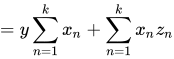
Since both sums on the right converge, Failed to parse (MathML with SVG or PNG fallback (recommended for modern browsers and accessibility tools): Invalid response ("Math extension cannot connect to Restbase.") from server "https://wikimedia.org/api/rest_v1/":): {\displaystyle \sum_{n=1}^{\infty}x_ny_n} converges as well. Failed to parse (MathML with SVG or PNG fallback (recommended for modern browsers and accessibility tools): Invalid response ("Math extension cannot connect to Restbase.") from server "https://wikimedia.org/api/rest_v1/":): {\displaystyle \Box}
Examples with Proof
Now we'll do the computations promised in the Examples, plus a few extra.
Theorem (Geometric Series)
If Failed to parse (MathML with SVG or PNG fallback (recommended for modern browsers and accessibility tools): Invalid response ("Math extension cannot connect to Restbase.") from server "https://wikimedia.org/api/rest_v1/":): {\displaystyle |r|<1} , the geometric series Failed to parse (MathML with SVG or PNG fallback (recommended for modern browsers and accessibility tools): Invalid response ("Math extension cannot connect to Restbase.") from server "https://wikimedia.org/api/rest_v1/":): {\displaystyle \sum_{n=1}^{\infty} a r^n = \frac{a}{1-r}} . If Failed to parse (MathML with SVG or PNG fallback (recommended for modern browsers and accessibility tools): Invalid response ("Math extension cannot connect to Restbase.") from server "https://wikimedia.org/api/rest_v1/":): {\displaystyle |r| \geq 1} , the series diverges.
Proof
In this case, it is best to explicitly compute the partial sums and take the limit. Without loss of generality, we'll consider the case Failed to parse (MathML with SVG or PNG fallback (recommended for modern browsers and accessibility tools): Invalid response ("Math extension cannot connect to Restbase.") from server "https://wikimedia.org/api/rest_v1/":): {\displaystyle a = 1} . Then we can apply the theorem on algebraic operations to obtain the general result.
Note that Failed to parse (MathML with SVG or PNG fallback (recommended for modern browsers and accessibility tools): Invalid response ("Math extension cannot connect to Restbase.") from server "https://wikimedia.org/api/rest_v1/":): {\displaystyle s_n(1-r) = (1 + r + r^2 + ... + r^n)(1-r) = (1 + r + r^2 + ... + r^n) - (r + r^2 + ... + r^{n+1}) = 1 - r^{n+1}}
Thus Failed to parse (MathML with SVG or PNG fallback (recommended for modern browsers and accessibility tools): Invalid response ("Math extension cannot connect to Restbase.") from server "https://wikimedia.org/api/rest_v1/":): {\displaystyle s_n = \frac{1-r^n}{1-r} } . Taking the limit (and remembering some basic facts about sequences):
If Failed to parse (MathML with SVG or PNG fallback (recommended for modern browsers and accessibility tools): Invalid response ("Math extension cannot connect to Restbase.") from server "https://wikimedia.org/api/rest_v1/":): {\displaystyle |r| < 1} , Failed to parse (MathML with SVG or PNG fallback (recommended for modern browsers and accessibility tools): Invalid response ("Math extension cannot connect to Restbase.") from server "https://wikimedia.org/api/rest_v1/":): {\displaystyle \sum_{n=1}^{\infty} r^n = \lim_{n \rightarrow \infty} s_n = \lim_{n \rightarrow \infty} \frac{1-r^n}{1-r} = \frac{1}{1-r}} .
If Failed to parse (MathML with SVG or PNG fallback (recommended for modern browsers and accessibility tools): Invalid response ("Math extension cannot connect to Restbase.") from server "https://wikimedia.org/api/rest_v1/":): {\displaystyle |r| \geq 1} , the sequence of partial sums diverges to infinity, and thus by definition the series diverges.
This proof seems to work except for the fact that this series will converge to Failed to parse (MathML with SVG or PNG fallback (recommended for modern browsers and accessibility tools): Invalid response ("Math extension cannot connect to Restbase.") from server "https://wikimedia.org/api/rest_v1/":): {\displaystyle \frac{a} {1-r}} Failed to parse (MathML with SVG or PNG fallback (recommended for modern browsers and accessibility tools): Invalid response ("Math extension cannot connect to Restbase.") from server "https://wikimedia.org/api/rest_v1/":): {\displaystyle \Box}
Theorem (p-series)
The p-series Failed to parse (MathML with SVG or PNG fallback (recommended for modern browsers and accessibility tools): Invalid response ("Math extension cannot connect to Restbase.") from server "https://wikimedia.org/api/rest_v1/":): {\displaystyle \sum_{n=1}^{\infty} \frac{1}{n^p}} converges for Failed to parse (MathML with SVG or PNG fallback (recommended for modern browsers and accessibility tools): Invalid response ("Math extension cannot connect to Restbase.") from server "https://wikimedia.org/api/rest_v1/":): {\displaystyle p>1} and diverges for Failed to parse (MathML with SVG or PNG fallback (recommended for modern browsers and accessibility tools): Invalid response ("Math extension cannot connect to Restbase.") from server "https://wikimedia.org/api/rest_v1/":): {\displaystyle 0<p\le 1} . [Note: We have technically only defined this series for p rational. However, the theorem is still valid when p is irrational, for the same reasons]
Proof
First we'll consider the special cases Failed to parse (MathML with SVG or PNG fallback (recommended for modern browsers and accessibility tools): Invalid response ("Math extension cannot connect to Restbase.") from server "https://wikimedia.org/api/rest_v1/":): {\displaystyle p = 1, p = 2} , and then obtain the general result from these.
- If p = 1, let Failed to parse (MathML with SVG or PNG fallback (recommended for modern browsers and accessibility tools): Invalid response ("Math extension cannot connect to Restbase.") from server "https://wikimedia.org/api/rest_v1/":): {\displaystyle x_n} be the greatest power of 2 less than Failed to parse (MathML with SVG or PNG fallback (recommended for modern browsers and accessibility tools): Invalid response ("Math extension cannot connect to Restbase.") from server "https://wikimedia.org/api/rest_v1/":): {\displaystyle \frac{1}{n}} . That is, Failed to parse (MathML with SVG or PNG fallback (recommended for modern browsers and accessibility tools): Invalid response ("Math extension cannot connect to Restbase.") from server "https://wikimedia.org/api/rest_v1/":): {\displaystyle (x_n) = (\frac{1}{2}, \frac{1}{4},\frac{1}{4}, \frac{1}{8}, \frac{1}{8},\frac{1}{8},\frac{1}{8},\dots)} .
Grouping like terms together, Failed to parse (MathML with SVG or PNG fallback (recommended for modern browsers and accessibility tools): Invalid response ("Math extension cannot connect to Restbase.") from server "https://wikimedia.org/api/rest_v1/":): {\displaystyle \sum_{i=1}^{\infty} x_n} Failed to parse (MathML with SVG or PNG fallback (recommended for modern browsers and accessibility tools): Invalid response ("Math extension cannot connect to Restbase.") from server "https://wikimedia.org/api/rest_v1/":): {\displaystyle = \sum_{i=0}^{\infty}(\sum_{j=2^i}^{2^{i+1}-1}x_j) } Failed to parse (MathML with SVG or PNG fallback (recommended for modern browsers and accessibility tools): Invalid response ("Math extension cannot connect to Restbase.") from server "https://wikimedia.org/api/rest_v1/":): {\displaystyle = \sum_{i=0}^{\infty}(\sum_{j=2^i}^{2^{i+1}-1} \frac{1}{2^{i+1}}) } Failed to parse (MathML with SVG or PNG fallback (recommended for modern browsers and accessibility tools): Invalid response ("Math extension cannot connect to Restbase.") from server "https://wikimedia.org/api/rest_v1/":): {\displaystyle = \sum_{i=1}^{\infty} \frac{1}{2}} , which diverges.
By definition, Failed to parse (MathML with SVG or PNG fallback (recommended for modern browsers and accessibility tools): Invalid response ("Math extension cannot connect to Restbase.") from server "https://wikimedia.org/api/rest_v1/":): {\displaystyle x_n < \frac{1}{n}} , so by the comparison test Failed to parse (MathML with SVG or PNG fallback (recommended for modern browsers and accessibility tools): Invalid response ("Math extension cannot connect to Restbase.") from server "https://wikimedia.org/api/rest_v1/":): {\displaystyle \sum_{n=1}^{\infty} \frac{1}{n}} diverges.
- If p = 2, let Failed to parse (MathML with SVG or PNG fallback (recommended for modern browsers and accessibility tools): Invalid response ("Math extension cannot connect to Restbase.") from server "https://wikimedia.org/api/rest_v1/":): {\displaystyle x_n = \frac{1}{n(n-1)} = \frac{1}{n-1} - \frac{1}{n}} if n>1 and 1 if n=1.
Using the theorem on telescoping series, Failed to parse (MathML with SVG or PNG fallback (recommended for modern browsers and accessibility tools): Invalid response ("Math extension cannot connect to Restbase.") from server "https://wikimedia.org/api/rest_v1/":): {\displaystyle \sum_{n=1}^{\infty} x_n} Failed to parse (MathML with SVG or PNG fallback (recommended for modern browsers and accessibility tools): Invalid response ("Math extension cannot connect to Restbase.") from server "https://wikimedia.org/api/rest_v1/":): {\displaystyle = 1 + \sum_{n=2}^{\infty}(\frac{1}{n-1} - \frac{1}{n})} Failed to parse (MathML with SVG or PNG fallback (recommended for modern browsers and accessibility tools): Invalid response ("Math extension cannot connect to Restbase.") from server "https://wikimedia.org/api/rest_v1/":): {\displaystyle = 1 + 1 - \lim_{n\rightarrow\infty}(1/n) = 2}
By definition, Failed to parse (MathML with SVG or PNG fallback (recommended for modern browsers and accessibility tools): Invalid response ("Math extension cannot connect to Restbase.") from server "https://wikimedia.org/api/rest_v1/":): {\displaystyle x_n > \frac{1}{n \cdot n} = \frac{1}{n^2}} , so by the comparison test Failed to parse (MathML with SVG or PNG fallback (recommended for modern browsers and accessibility tools): Invalid response ("Math extension cannot connect to Restbase.") from server "https://wikimedia.org/api/rest_v1/":): {\displaystyle \sum_{n=1}^{\infty} \frac{1}{n^2}} converges as well.
- If 0 < p < 1, then Failed to parse (MathML with SVG or PNG fallback (recommended for modern browsers and accessibility tools): Invalid response ("Math extension cannot connect to Restbase.") from server "https://wikimedia.org/api/rest_v1/":): {\displaystyle \frac{1}{n^p} > \frac{1}{n}} . By the comparison test Failed to parse (MathML with SVG or PNG fallback (recommended for modern browsers and accessibility tools): Invalid response ("Math extension cannot connect to Restbase.") from server "https://wikimedia.org/api/rest_v1/":): {\displaystyle \sum_{n=1}^{\infty} \frac{1}{n^p}} diverges.
Theorem (Decimal Expansions)
Given any real number x, Failed to parse (MathML with SVG or PNG fallback (recommended for modern browsers and accessibility tools): Invalid response ("Math extension cannot connect to Restbase.") from server "https://wikimedia.org/api/rest_v1/":): {\displaystyle 0<x<1} there is a unique sequence Failed to parse (MathML with SVG or PNG fallback (recommended for modern browsers and accessibility tools): Invalid response ("Math extension cannot connect to Restbase.") from server "https://wikimedia.org/api/rest_v1/":): {\displaystyle (x_n): \sum_{n=0}^{\infty} \frac{x_n}{10^n} = x} , Failed to parse (MathML with SVG or PNG fallback (recommended for modern browsers and accessibility tools): Invalid response ("Math extension cannot connect to Restbase.") from server "https://wikimedia.org/api/rest_v1/":): {\displaystyle 0 \leq x_n<10} and Failed to parse (MathML with SVG or PNG fallback (recommended for modern browsers and accessibility tools): Invalid response ("Math extension cannot connect to Restbase.") from server "https://wikimedia.org/api/rest_v1/":): {\displaystyle \forall N: \exists n \geq N: x_n \not= 9}
Proof
Inductively, assume that there exist Failed to parse (MathML with SVG or PNG fallback (recommended for modern browsers and accessibility tools): Invalid response ("Math extension cannot connect to Restbase.") from server "https://wikimedia.org/api/rest_v1/":): {\displaystyle x_0, x_1, \dots, x_k} such that Failed to parse (MathML with SVG or PNG fallback (recommended for modern browsers and accessibility tools): Invalid response ("Math extension cannot connect to Restbase.") from server "https://wikimedia.org/api/rest_v1/":): {\displaystyle \sum_{n=0}^{k} \frac{x_n}{10^n} \leq x < \sum_{n=0}^{k} \frac{x_n}{10^n} + \frac{1}{10^k}} .
Rearranging, we see that Failed to parse (MathML with SVG or PNG fallback (recommended for modern browsers and accessibility tools): Invalid response ("Math extension cannot connect to Restbase.") from server "https://wikimedia.org/api/rest_v1/":): {\displaystyle 0 \leq x - \sum_{n=0}^{k} \frac{x_n}{10^n} < \frac{1}{10^k}} , or Failed to parse (MathML with SVG or PNG fallback (recommended for modern browsers and accessibility tools): Invalid response ("Math extension cannot connect to Restbase.") from server "https://wikimedia.org/api/rest_v1/":): {\displaystyle 0 \leq (x - \sum_{n=0}^{k} \frac{x_n}{10^n})10^{k+1} < 10} .
Let Failed to parse (MathML with SVG or PNG fallback (recommended for modern browsers and accessibility tools): Invalid response ("Math extension cannot connect to Restbase.") from server "https://wikimedia.org/api/rest_v1/":): {\displaystyle x_{k+1}} by the greatest integer such that Failed to parse (MathML with SVG or PNG fallback (recommended for modern browsers and accessibility tools): Invalid response ("Math extension cannot connect to Restbase.") from server "https://wikimedia.org/api/rest_v1/":): {\displaystyle x_{k+1} \leq (x - \sum_{n=0}^{k} \frac{x_n}{10^n})10^{k+1}} .
Then Failed to parse (MathML with SVG or PNG fallback (recommended for modern browsers and accessibility tools): Invalid response ("Math extension cannot connect to Restbase.") from server "https://wikimedia.org/api/rest_v1/":): {\displaystyle \frac{x_{k+1}}{10^{k+1}} \leq x - \sum_{n=0}^{k} \frac{x_n}{10^n} < \frac{x_{k+1}+1}{10^{k+1}}} (otherwise, Failed to parse (MathML with SVG or PNG fallback (recommended for modern browsers and accessibility tools): Invalid response ("Math extension cannot connect to Restbase.") from server "https://wikimedia.org/api/rest_v1/":): {\displaystyle x_{k+1}} would not be the greatest).
Adding Failed to parse (MathML with SVG or PNG fallback (recommended for modern browsers and accessibility tools): Invalid response ("Math extension cannot connect to Restbase.") from server "https://wikimedia.org/api/rest_v1/":): {\displaystyle \sum_{n=0}^{k} \frac{x_n}{10^n}} , we see that Failed to parse (MathML with SVG or PNG fallback (recommended for modern browsers and accessibility tools): Invalid response ("Math extension cannot connect to Restbase.") from server "https://wikimedia.org/api/rest_v1/":): {\displaystyle \sum_{n=0}^{k+1} \frac{x_n}{10^n} \leq x < \sum_{n=0}^{k+1} \frac{x_n}{10^n} + \frac{1}{10^{k+1}}} .
Given pick N such that Failed to parse (MathML with SVG or PNG fallback (recommended for modern browsers and accessibility tools): Invalid response ("Math extension cannot connect to Restbase.") from server "https://wikimedia.org/api/rest_v1/":): {\displaystyle \epsilon > \frac{1}{10^N} } .

Thus Failed to parse (MathML with SVG or PNG fallback (recommended for modern browsers and accessibility tools): Invalid response ("Math extension cannot connect to Restbase.") from server "https://wikimedia.org/api/rest_v1/":): {\displaystyle |\sum_{n=0}^{k} \frac{x_n}{10^n} -1| < \frac{1}{10^k} < \epsilon} for all Failed to parse (MathML with SVG or PNG fallback (recommended for modern browsers and accessibility tools): Invalid response ("Math extension cannot connect to Restbase.") from server "https://wikimedia.org/api/rest_v1/":): {\displaystyle k > N} . That is, Failed to parse (MathML with SVG or PNG fallback (recommended for modern browsers and accessibility tools): Invalid response ("Math extension cannot connect to Restbase.") from server "https://wikimedia.org/api/rest_v1/":): {\displaystyle x = \sum_{n=0}^{\infty} \frac{x_n}{10^n} } .
Resources
- Series, Wikibooks: Real Analysis
Licensing
Content obtained and/or adapted from:
- Series, Wikibooks: Real Analysis under a CC BY-SA license

