Difference between revisions of "Convergent Sequences in Metric Spaces"
| Line 18: | Line 18: | ||
<p>Furthermore, it's not hard to see that this sequence converges to <span class="math-inline"><math>x</math></span>, i.e., <span class="math-inline"><math>\lim_{n \to \infty} x_n = x</math></span>, i.e., <span class="math-inline"><math>\lim_{n \to \infty} d(x_n, x) = 0</math></span> since for all <span class="math-inline"><math>x_n</math></span> we have that <span class="math-inline"><math>d(x_n, x) = 0</math></span>, so <span class="math-inline"><math>\lim_{n \to \infty} d(x_n, x) = \lim_{n \to \infty} 0 = 0</math></span>.</p> | <p>Furthermore, it's not hard to see that this sequence converges to <span class="math-inline"><math>x</math></span>, i.e., <span class="math-inline"><math>\lim_{n \to \infty} x_n = x</math></span>, i.e., <span class="math-inline"><math>\lim_{n \to \infty} d(x_n, x) = 0</math></span> since for all <span class="math-inline"><math>x_n</math></span> we have that <span class="math-inline"><math>d(x_n, x) = 0</math></span>, so <span class="math-inline"><math>\lim_{n \to \infty} d(x_n, x) = \lim_{n \to \infty} 0 = 0</math></span>.</p> | ||
<p>We will soon see that many of theorems regarding limits of sequences of real numbers are analogous to limits of sequences of elements from metric spaces.</p> | <p>We will soon see that many of theorems regarding limits of sequences of real numbers are analogous to limits of sequences of elements from metric spaces.</p> | ||
| + | |||
| + | ===The Boundedness of Convergent Sequences in Metric Spaces=== | ||
| + | <p>If <span class="math-inline"><math>(M, d)</math></span> is a metric space and <span class="math-inline"><math>(x_n)_{n=1}^{\infty}</math></span> is a sequence in <span class="math-inline"><math>M</math></span> that is convergent then the limit of this sequence <span class="math-inline"><math>p \in M</math></span> is unique.</p> | ||
| + | <p>We will now look at another rather nice theorem which states that if <span class="math-inline"><math>(x_n)_{n=1}^{\infty}</math></span> is convergent then it is also bounded.</p> | ||
| + | <table class="wiki-content-table"> | ||
| + | <tr> | ||
| + | <td><strong>Theorem 1:</strong> Let <span class="math-inline"><math>(M, d)</math></span> be a metric space and let <span class="math-inline"><math>(x_n)_{n=1}^{\infty}</math></span> be a sequence in <span class="math-inline"><math>M</math></span>. If <span class="math-inline"><math>(x_n)_{n=1}^{\infty}</math></span> is convergent then the set <span class="math-inline"><math>\{ x_1, x_2, ..., x_n, ... \}</math></span> is bounded.</td> | ||
| + | </tr> | ||
| + | </table> | ||
| + | <ul> | ||
| + | <li><strong>Proof:</strong> Let <span class="math-inline"><math>(M, d)</math></span> be a metric space and let <span class="math-inline"><math>(x_n)_{n=1}^{\infty}</math></span> be a sequence in <span class="math-inline"><math>M</math></span> that converges to <span class="math-inline"><math>p \in M</math></span>, i.e., <span class="math-inline"><math>\lim_{n \to \infty} x_n = p</math></span>. Then <span class="math-inline"><math>\lim_{n \to \infty} d(x_n, p) = 0</math></span>. So for all <span class="math-inline"><math>\epsilon > 0</math></span> there exists an <span class="math-inline"><math>N \in \mathbb{N}</math></span> such that if <span class="math-inline"><math>n \geq N</math></span> then <span class="math-inline"><math>d(x_n, p) < \epsilon</math></span>. So for <span class="math-inline"><math>\epsilon_0 = 1 > 0</math></span> there exists an <span class="math-inline"><math>N(\epsilon_0) \in \mathbb{N}</math></span> such that if <span class="math-inline"><math>n \geq N(\epsilon_0)</math></span> then:</li> | ||
| + | </ul> | ||
| + | |||
| + | <div style="text-align: center;"><math>\begin{align} \quad d(x_n, p) < \epsilon_0 = 1 \end{align}</math></div> | ||
| + | <ul> | ||
| + | <li>Now consider the elements <span class="math-inline"><math>x_1, x_2, ..., x_{N(\epsilon_0)}</math></span>. This is a finite set of elements and furthermore the set of distances from these elements to <span class="math-inline"><math>p</math></span> is finite:</li> | ||
| + | </ul> | ||
| + | |||
| + | <div style="text-align: center;"><math>\begin{align} \quad \{ d(x_1, p), d(x_2, p), ..., d(x_{N(\epsilon_0) - 1}, p) \} \end{align}</math></div> | ||
| + | <ul> | ||
| + | <li>Define <span class="math-inline"><math>M ^*</math></span> to be the maximum of these distances:</li> | ||
| + | </ul> | ||
| + | |||
| + | <div style="text-align: center;"><math>\begin{align} \quad M^* = \max \{ d(x_1, p), d(x_2, p), ..., d(x_{N(\epsilon_0) - 1}, p) \} \end{align}</math></div> | ||
| + | <ul> | ||
| + | <li>So if <span class="math-inline"><math>1 \leq n < N(\epsilon_0)</math></span> we have that <span class="math-inline"><math>d(x_n, p) \leq M^*</math></span> and if <span class="math-inline"><math>n \geq N(\epsilon_0)</math></span> then <span class="math-inline"><math>d(x_n, p) < 1</math></span>. Let <span class="math-inline"><math>M = \max \{ M^*, 1 \}</math></span>. Then for all <span class="math-inline"><math>n \in \mathbb{N}</math></span>, <span class="math-inline"><math>d(x_n, p) \leq M</math></span>. So consider the open ball <span class="math-inline"><math>B(p, M + 1)</math></span>. Then <span class="math-inline"><math>x_n \in B(p, M + 1)</math></span> for all <span class="math-inline"><math>n \in \{1, 2, ... \}</math></span> so:</li> | ||
| + | </ul> | ||
| + | |||
| + | <div style="text-align: center;"><math>\begin{align} \quad \{ x_1, x_2, ..., x_n, ... \} \subseteq B(p, M+1) \end{align}</math></div> | ||
| + | <ul> | ||
| + | <li>Therefore <span class="math-inline"><math>\{ x_1, x_2, ..., x_n, ... \}</math></span> is a bounded set in <span class="math-inline"><math>M</math></span>. <span class="math-inline"><math>\blacksquare</math></span></li> | ||
| + | </ul> | ||
== Licensing == | == Licensing == | ||
Content obtained and/or adapted from: | Content obtained and/or adapted from: | ||
* [http://mathonline.wikidot.com/limits-of-sequences-in-metric-spaces Limits of Sequences in Metric Spaces, mathonline.wikidot.com] under a CC BY-SA license | * [http://mathonline.wikidot.com/limits-of-sequences-in-metric-spaces Limits of Sequences in Metric Spaces, mathonline.wikidot.com] under a CC BY-SA license | ||
Revision as of 10:50, 8 November 2021
Limits of Sequences in Metric Spaces
Recall that if a sequence of real numbers is an infinite ordered list where for every . We will now generalize the concept of a sequence to contain elements from a metric space .


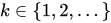

Definition: Let be a metric space. An (infinite) Sequence in denoted is an infinite ordered list of elements for all .


Finite sequences in a metric space can be defined as a finite ordered list of elements in but their study is not that interesting to us.
We can also define whether a sequence of elements from a metric space converges or diverges.

Definition: Let be a metric space. A sequence in Failed to parse (MathML with SVG or PNG fallback (recommended for modern browsers and accessibility tools): Invalid response ("Math extension cannot connect to Restbase.") from server "https://wikimedia.org/api/rest_v1/":): {\displaystyle M} is said to be Convergent to the element Failed to parse (MathML with SVG or PNG fallback (recommended for modern browsers and accessibility tools): Invalid response ("Math extension cannot connect to Restbase.") from server "https://wikimedia.org/api/rest_v1/":): {\displaystyle p \in M} written Failed to parse (MathML with SVG or PNG fallback (recommended for modern browsers and accessibility tools): Invalid response ("Math extension cannot connect to Restbase.") from server "https://wikimedia.org/api/rest_v1/":): {\displaystyle \lim_{n \to \infty} x_n = p} if Failed to parse (MathML with SVG or PNG fallback (recommended for modern browsers and accessibility tools): Invalid response ("Math extension cannot connect to Restbase.") from server "https://wikimedia.org/api/rest_v1/":): {\displaystyle \lim_{n \to \infty} d(x_n, p) = 0} and the element Failed to parse (MathML with SVG or PNG fallback (recommended for modern browsers and accessibility tools): Invalid response ("Math extension cannot connect to Restbase.") from server "https://wikimedia.org/api/rest_v1/":): {\displaystyle p} is said to be the Limit of the sequence Failed to parse (MathML with SVG or PNG fallback (recommended for modern browsers and accessibility tools): Invalid response ("Math extension cannot connect to Restbase.") from server "https://wikimedia.org/api/rest_v1/":): {\displaystyle (x_n)_{n=1}^{\infty}} . If no such Failed to parse (MathML with SVG or PNG fallback (recommended for modern browsers and accessibility tools): Invalid response ("Math extension cannot connect to Restbase.") from server "https://wikimedia.org/api/rest_v1/":): {\displaystyle p \in M} exists, then Failed to parse (MathML with SVG or PNG fallback (recommended for modern browsers and accessibility tools): Invalid response ("Math extension cannot connect to Restbase.") from server "https://wikimedia.org/api/rest_v1/":): {\displaystyle (x_n)_{n=1}^{\infty}} is said to be Divergent.
There is a subtle but important point to make. In the definition above, Failed to parse (MathML with SVG or PNG fallback (recommended for modern browsers and accessibility tools): Invalid response ("Math extension cannot connect to Restbase.") from server "https://wikimedia.org/api/rest_v1/":): {\displaystyle \lim_{n \to \infty} x_n = p} represents the limit of a sequence of elements from the metric space Failed to parse (MathML with SVG or PNG fallback (recommended for modern browsers and accessibility tools): Invalid response ("Math extension cannot connect to Restbase.") from server "https://wikimedia.org/api/rest_v1/":): {\displaystyle (M,d)} to an element Failed to parse (MathML with SVG or PNG fallback (recommended for modern browsers and accessibility tools): Invalid response ("Math extension cannot connect to Restbase.") from server "https://wikimedia.org/api/rest_v1/":): {\displaystyle p \in M} while Failed to parse (MathML with SVG or PNG fallback (recommended for modern browsers and accessibility tools): Invalid response ("Math extension cannot connect to Restbase.") from server "https://wikimedia.org/api/rest_v1/":): {\displaystyle \lim_{n \to \infty} d(x_n, p) = 0} represents the limit of a sequence of positive real numbers to Failed to parse (MathML with SVG or PNG fallback (recommended for modern browsers and accessibility tools): Invalid response ("Math extension cannot connect to Restbase.") from server "https://wikimedia.org/api/rest_v1/":): {\displaystyle 0} - such limits we already have experience with.

For example, if Failed to parse (MathML with SVG or PNG fallback (recommended for modern browsers and accessibility tools): Invalid response ("Math extension cannot connect to Restbase.") from server "https://wikimedia.org/api/rest_v1/":): {\displaystyle M} is any nonempty set, Failed to parse (MathML with SVG or PNG fallback (recommended for modern browsers and accessibility tools): Invalid response ("Math extension cannot connect to Restbase.") from server "https://wikimedia.org/api/rest_v1/":): {\displaystyle d : M \times M \to [0, \infty)} is the discrete metric, and Failed to parse (MathML with SVG or PNG fallback (recommended for modern browsers and accessibility tools): Invalid response ("Math extension cannot connect to Restbase.") from server "https://wikimedia.org/api/rest_v1/":): {\displaystyle x \in M} , then the sequence defined by Failed to parse (MathML with SVG or PNG fallback (recommended for modern browsers and accessibility tools): Invalid response ("Math extension cannot connect to Restbase.") from server "https://wikimedia.org/api/rest_v1/":): {\displaystyle x_n = x} for all Failed to parse (MathML with SVG or PNG fallback (recommended for modern browsers and accessibility tools): Invalid response ("Math extension cannot connect to Restbase.") from server "https://wikimedia.org/api/rest_v1/":): {\displaystyle n \in \{ 1, 2, ... \}} , then the sequence:
Furthermore, it's not hard to see that this sequence converges to Failed to parse (MathML with SVG or PNG fallback (recommended for modern browsers and accessibility tools): Invalid response ("Math extension cannot connect to Restbase.") from server "https://wikimedia.org/api/rest_v1/":): {\displaystyle x} , i.e., Failed to parse (MathML with SVG or PNG fallback (recommended for modern browsers and accessibility tools): Invalid response ("Math extension cannot connect to Restbase.") from server "https://wikimedia.org/api/rest_v1/":): {\displaystyle \lim_{n \to \infty} x_n = x} , i.e., Failed to parse (MathML with SVG or PNG fallback (recommended for modern browsers and accessibility tools): Invalid response ("Math extension cannot connect to Restbase.") from server "https://wikimedia.org/api/rest_v1/":): {\displaystyle \lim_{n \to \infty} d(x_n, x) = 0} since for all Failed to parse (MathML with SVG or PNG fallback (recommended for modern browsers and accessibility tools): Invalid response ("Math extension cannot connect to Restbase.") from server "https://wikimedia.org/api/rest_v1/":): {\displaystyle x_n} we have that Failed to parse (MathML with SVG or PNG fallback (recommended for modern browsers and accessibility tools): Invalid response ("Math extension cannot connect to Restbase.") from server "https://wikimedia.org/api/rest_v1/":): {\displaystyle d(x_n, x) = 0} , so Failed to parse (MathML with SVG or PNG fallback (recommended for modern browsers and accessibility tools): Invalid response ("Math extension cannot connect to Restbase.") from server "https://wikimedia.org/api/rest_v1/":): {\displaystyle \lim_{n \to \infty} d(x_n, x) = \lim_{n \to \infty} 0 = 0} .
We will soon see that many of theorems regarding limits of sequences of real numbers are analogous to limits of sequences of elements from metric spaces.
The Boundedness of Convergent Sequences in Metric Spaces
If Failed to parse (MathML with SVG or PNG fallback (recommended for modern browsers and accessibility tools): Invalid response ("Math extension cannot connect to Restbase.") from server "https://wikimedia.org/api/rest_v1/":): {\displaystyle (M, d)} is a metric space and Failed to parse (MathML with SVG or PNG fallback (recommended for modern browsers and accessibility tools): Invalid response ("Math extension cannot connect to Restbase.") from server "https://wikimedia.org/api/rest_v1/":): {\displaystyle (x_n)_{n=1}^{\infty}} is a sequence in Failed to parse (MathML with SVG or PNG fallback (recommended for modern browsers and accessibility tools): Invalid response ("Math extension cannot connect to Restbase.") from server "https://wikimedia.org/api/rest_v1/":): {\displaystyle M} that is convergent then the limit of this sequence Failed to parse (MathML with SVG or PNG fallback (recommended for modern browsers and accessibility tools): Invalid response ("Math extension cannot connect to Restbase.") from server "https://wikimedia.org/api/rest_v1/":): {\displaystyle p \in M} is unique.
We will now look at another rather nice theorem which states that if Failed to parse (MathML with SVG or PNG fallback (recommended for modern browsers and accessibility tools): Invalid response ("Math extension cannot connect to Restbase.") from server "https://wikimedia.org/api/rest_v1/":): {\displaystyle (x_n)_{n=1}^{\infty}} is convergent then it is also bounded.
| Theorem 1: Let Failed to parse (MathML with SVG or PNG fallback (recommended for modern browsers and accessibility tools): Invalid response ("Math extension cannot connect to Restbase.") from server "https://wikimedia.org/api/rest_v1/":): {\displaystyle (M, d)} be a metric space and let Failed to parse (MathML with SVG or PNG fallback (recommended for modern browsers and accessibility tools): Invalid response ("Math extension cannot connect to Restbase.") from server "https://wikimedia.org/api/rest_v1/":): {\displaystyle (x_n)_{n=1}^{\infty}} be a sequence in Failed to parse (MathML with SVG or PNG fallback (recommended for modern browsers and accessibility tools): Invalid response ("Math extension cannot connect to Restbase.") from server "https://wikimedia.org/api/rest_v1/":): {\displaystyle M} . If Failed to parse (MathML with SVG or PNG fallback (recommended for modern browsers and accessibility tools): Invalid response ("Math extension cannot connect to Restbase.") from server "https://wikimedia.org/api/rest_v1/":): {\displaystyle (x_n)_{n=1}^{\infty}} is convergent then the set Failed to parse (MathML with SVG or PNG fallback (recommended for modern browsers and accessibility tools): Invalid response ("Math extension cannot connect to Restbase.") from server "https://wikimedia.org/api/rest_v1/":): {\displaystyle \{ x_1, x_2, ..., x_n, ... \}} is bounded. |
- Proof: Let Failed to parse (MathML with SVG or PNG fallback (recommended for modern browsers and accessibility tools): Invalid response ("Math extension cannot connect to Restbase.") from server "https://wikimedia.org/api/rest_v1/":): {\displaystyle (M, d)} be a metric space and let Failed to parse (MathML with SVG or PNG fallback (recommended for modern browsers and accessibility tools): Invalid response ("Math extension cannot connect to Restbase.") from server "https://wikimedia.org/api/rest_v1/":): {\displaystyle (x_n)_{n=1}^{\infty}} be a sequence in that converges to , i.e., Failed to parse (MathML with SVG or PNG fallback (recommended for modern browsers and accessibility tools): Invalid response ("Math extension cannot connect to Restbase.") from server "https://wikimedia.org/api/rest_v1/":): {\displaystyle \lim_{n \to \infty} x_n = p} . Then Failed to parse (MathML with SVG or PNG fallback (recommended for modern browsers and accessibility tools): Invalid response ("Math extension cannot connect to Restbase.") from server "https://wikimedia.org/api/rest_v1/":): {\displaystyle \lim_{n \to \infty} d(x_n, p) = 0} . So for all Failed to parse (MathML with SVG or PNG fallback (recommended for modern browsers and accessibility tools): Invalid response ("Math extension cannot connect to Restbase.") from server "https://wikimedia.org/api/rest_v1/":): {\displaystyle \epsilon > 0} there exists an Failed to parse (MathML with SVG or PNG fallback (recommended for modern browsers and accessibility tools): Invalid response ("Math extension cannot connect to Restbase.") from server "https://wikimedia.org/api/rest_v1/":): {\displaystyle N \in \mathbb{N}} such that if Failed to parse (MathML with SVG or PNG fallback (recommended for modern browsers and accessibility tools): Invalid response ("Math extension cannot connect to Restbase.") from server "https://wikimedia.org/api/rest_v1/":): {\displaystyle n \geq N} then Failed to parse (MathML with SVG or PNG fallback (recommended for modern browsers and accessibility tools): Invalid response ("Math extension cannot connect to Restbase.") from server "https://wikimedia.org/api/rest_v1/":): {\displaystyle d(x_n, p) < \epsilon} . So for Failed to parse (MathML with SVG or PNG fallback (recommended for modern browsers and accessibility tools): Invalid response ("Math extension cannot connect to Restbase.") from server "https://wikimedia.org/api/rest_v1/":): {\displaystyle \epsilon_0 = 1 > 0} there exists an Failed to parse (MathML with SVG or PNG fallback (recommended for modern browsers and accessibility tools): Invalid response ("Math extension cannot connect to Restbase.") from server "https://wikimedia.org/api/rest_v1/":): {\displaystyle N(\epsilon_0) \in \mathbb{N}} such that if Failed to parse (MathML with SVG or PNG fallback (recommended for modern browsers and accessibility tools): Invalid response ("Math extension cannot connect to Restbase.") from server "https://wikimedia.org/api/rest_v1/":): {\displaystyle n \geq N(\epsilon_0)} then:

- Now consider the elements Failed to parse (MathML with SVG or PNG fallback (recommended for modern browsers and accessibility tools): Invalid response ("Math extension cannot connect to Restbase.") from server "https://wikimedia.org/api/rest_v1/":): {\displaystyle x_1, x_2, ..., x_{N(\epsilon_0)}} . This is a finite set of elements and furthermore the set of distances from these elements to Failed to parse (MathML with SVG or PNG fallback (recommended for modern browsers and accessibility tools): Invalid response ("Math extension cannot connect to Restbase.") from server "https://wikimedia.org/api/rest_v1/":): {\displaystyle p} is finite:
- Define Failed to parse (MathML with SVG or PNG fallback (recommended for modern browsers and accessibility tools): Invalid response ("Math extension cannot connect to Restbase.") from server "https://wikimedia.org/api/rest_v1/":): {\displaystyle M ^*} to be the maximum of these distances:
- So if Failed to parse (MathML with SVG or PNG fallback (recommended for modern browsers and accessibility tools): Invalid response ("Math extension cannot connect to Restbase.") from server "https://wikimedia.org/api/rest_v1/":): {\displaystyle 1 \leq n < N(\epsilon_0)} we have that Failed to parse (MathML with SVG or PNG fallback (recommended for modern browsers and accessibility tools): Invalid response ("Math extension cannot connect to Restbase.") from server "https://wikimedia.org/api/rest_v1/":): {\displaystyle d(x_n, p) \leq M^*} and if Failed to parse (MathML with SVG or PNG fallback (recommended for modern browsers and accessibility tools): Invalid response ("Math extension cannot connect to Restbase.") from server "https://wikimedia.org/api/rest_v1/":): {\displaystyle n \geq N(\epsilon_0)} then Failed to parse (MathML with SVG or PNG fallback (recommended for modern browsers and accessibility tools): Invalid response ("Math extension cannot connect to Restbase.") from server "https://wikimedia.org/api/rest_v1/":): {\displaystyle d(x_n, p) < 1} . Let Failed to parse (MathML with SVG or PNG fallback (recommended for modern browsers and accessibility tools): Invalid response ("Math extension cannot connect to Restbase.") from server "https://wikimedia.org/api/rest_v1/":): {\displaystyle M = \max \{ M^*, 1 \}} . Then for all Failed to parse (MathML with SVG or PNG fallback (recommended for modern browsers and accessibility tools): Invalid response ("Math extension cannot connect to Restbase.") from server "https://wikimedia.org/api/rest_v1/":): {\displaystyle n \in \mathbb{N}} , Failed to parse (MathML with SVG or PNG fallback (recommended for modern browsers and accessibility tools): Invalid response ("Math extension cannot connect to Restbase.") from server "https://wikimedia.org/api/rest_v1/":): {\displaystyle d(x_n, p) \leq M} . So consider the open ball Failed to parse (MathML with SVG or PNG fallback (recommended for modern browsers and accessibility tools): Invalid response ("Math extension cannot connect to Restbase.") from server "https://wikimedia.org/api/rest_v1/":): {\displaystyle B(p, M + 1)} . Then Failed to parse (MathML with SVG or PNG fallback (recommended for modern browsers and accessibility tools): Invalid response ("Math extension cannot connect to Restbase.") from server "https://wikimedia.org/api/rest_v1/":): {\displaystyle x_n \in B(p, M + 1)} for all Failed to parse (MathML with SVG or PNG fallback (recommended for modern browsers and accessibility tools): Invalid response ("Math extension cannot connect to Restbase.") from server "https://wikimedia.org/api/rest_v1/":): {\displaystyle n \in \{1, 2, ... \}} so:
- Therefore Failed to parse (MathML with SVG or PNG fallback (recommended for modern browsers and accessibility tools): Invalid response ("Math extension cannot connect to Restbase.") from server "https://wikimedia.org/api/rest_v1/":): {\displaystyle \{ x_1, x_2, ..., x_n, ... \}} is a bounded set in Failed to parse (MathML with SVG or PNG fallback (recommended for modern browsers and accessibility tools): Invalid response ("Math extension cannot connect to Restbase.") from server "https://wikimedia.org/api/rest_v1/":): {\displaystyle M} . Failed to parse (MathML with SVG or PNG fallback (recommended for modern browsers and accessibility tools): Invalid response ("Math extension cannot connect to Restbase.") from server "https://wikimedia.org/api/rest_v1/":): {\displaystyle \blacksquare}
Licensing
Content obtained and/or adapted from:
- Limits of Sequences in Metric Spaces, mathonline.wikidot.com under a CC BY-SA license

