Difference between revisions of "Iterated Integrals and Fubini's Theorem"
| Line 63: | Line 63: | ||
In this particular example, we are integrating over the square <math>R = [0, \pi] \times [0, \pi]</math>. | In this particular example, we are integrating over the square <math>R = [0, \pi] \times [0, \pi]</math>. | ||
| + | |||
| + | == Fubini's Theorem and Evaluating Double Integrals over Rectangles == | ||
| + | We have just looked at Iterated Integrals over rectangles. You might now wonder how iterated integrals relate to double integrals that we looked are earlier. Fubini's Theorem gives us a relationship between double integrals and these iterated integrals. | ||
| + | |||
| + | <blockquote style="background: white; border: 1px solid black; padding: 1em;"> | ||
| + | :'''Theorem 1 (Fubini's Theorem):''' Let <math>z = f(x, y)</math> be a two variable real-valued function. If <math>f</math> is continuous on the rectangle <math>R = [a, b] \times [c, d]</math> then the double integral over <math>R</math> can be computed as an iterated integrals and <math>\iint_{R} f(x, y) \, dA = \int_a^b \int_c^d f(x, y) \, dy \, dx = \int_c^d \int_a^b f(x, y) \, dx \, dy</math>. | ||
| + | </blockquote> | ||
| + | |||
| + | Fubini's Theorem is critically important as it gives us a method to evaluate double integrals over rectangles without having to use the definition of a double integral directly. | ||
| + | |||
| + | Now the following corollary will give us another method for evaluating double integrals over a rectangle <math>R = [a, b] \times [c, d]</math> provided that <math>f</math> can be written as a product of a function in terms of <math>x</math> and a function in terms of <math>y</math>. | ||
| + | |||
| + | <blockquote style="background: white; border: 1px solid black; padding: 1em;"> | ||
| + | :'''Corollary 1:''' Let <math>z = f(x, y)</math> be a two variable real-valued function. If <math>f(x, y) = g(x) h(y)</math> and <math>f</math></span> and <math>R = [a, b] \times [c, d]</math> then <math>\iint_R f(x, y) \, dA = \iint_R g(x) h(y) \, dA = \left [ \int_a^b g(x) \, dx \right ] \left [ \int_c^d h(y) \, dy \right ]</math>. | ||
| + | </blockquote> | ||
| + | |||
| + | === Example 1 === | ||
| + | '''Evaluate <math>\iint_R xy + y^2 \, dA</math> where <math>R = [0, 1] \times [1, 2]</math>.''' | ||
| + | |||
| + | By Fubini's Theorem we have that: | ||
| + | <div style="text-align: center;"><math>\begin{align} \quad \iint_R xy + y^2 \, dA = \int_0^1 \int_1^2 xy + y^2 \, dy \, dx \end{align}</math></div> | ||
| + | |||
| + | Now let's evaluate the inner integral <math>\int_1^2 xy + y^2 \, dy</math></span> first while holding <math>x</math> as fixed: | ||
| + | |||
| + | <div style="text-align: center;"><math>\begin{align} \quad \int_1^2 xy + y^2 \, dy = \left [ \frac{xy^2}{2} + \frac{y^3}{3} \right ]_1^2 = \left ( 2x + \frac{8}{3} \right ) - \left ( \frac{x}{2} + \frac{1}{3} \right ) = \frac{3x}{2} + \frac{7}{3} \end{align}</math></div> | ||
| + | |||
| + | And so we have that: | ||
| + | <div style="text-align: center;"><math>\begin{align} \quad \int_0^1 \int_1^2 xy + y^2 \, dy \, dx = \int_0^1 \frac{3x}{2} + \frac{7}{3} \, dx = \left [ \frac{3x^2}{4} + \frac{7x}{3} \right ]_0^1 = \frac{3}{4} + \frac{7}{3} = \frac{37}{12} \end{align}</math></div> | ||
| + | |||
| + | === Example 2 === | ||
| + | '''Evaluate <math>\iint_R e^x \cos y \, dA</math> where <math>R = [0, 1] \times \left [ \frac{\pi}{2} , \pi \right ]</math>.''' | ||
| + | |||
| + | Note that <math>f(x, y) = e^x \cos y</math></span> can be written as the product of a function of <math>x</math> and a function of <math>y</math></span> if we let <math>g(x) = e^x</math> and <math>h(y) = \cos y</math> (then <math>f(x, y) = g(x) h(y)</math>). Therefore applying Corollary 1 and we get that: | ||
| + | |||
| + | <div style="text-align: center;"><math>\begin{align} \quad \iint_R e^x \cos y \, dA = \left [ \int_0^1 e^x \, dx \right ] \left [ \int_{\frac{\pi}{2}}^{\pi} \cos y \, dy \right ] = [ e - 1 ] [ -1] = 1 - e \end{align}</math></div> | ||
| + | |||
| + | == Fubini's Theorem for Evaluating Triple Integrals over Boxes == | ||
| + | We will now look at an analogous Theorem for evaluating triple integrals over a rectangular box <math>B</math> with iterated integrals. | ||
| + | |||
| + | <blockquote style="background: white; border: 1px solid black; padding: 1em;"> | ||
| + | :'''Theorem 1:''' Let <math>w = f(x, y, z)</math> be a three variable real-valued function such that <math>f</math> is continuous on the rectangular box <math>B = [a, b] \times [c, d] \times [r, s]</math>. Then the triple integral of <math>f</math> over <math>B</math> can be evaluated as iterated integrals, that is, <math>\iiint_B f(x, y, z) \, dV = \int_r^s \int_c^d \int_a^b f(x, y, z) \, dx \, dy \, dz</math>. | ||
| + | </blockquote> | ||
| + | |||
| + | ''There are six total ways to evaluate a triple integral over a box using iterated integrals. For example, we could get that <math>\iiint_B f(x, y, z) \, dV = \int_a^b \int_c^d \int_r^s f(x, y, z) \, dz \, dy \, dx</math>, or <math>\iiint_B f(x, y, z) \, dV = \int_c^d \int_a^b \int_r^s f(x, y, z) \, dz \, dx \, dy</math>. Each of these six possible orders will give rise to the same value.'' | ||
| + | |||
| + | Let's now look at an example of evaluating a triple integral over a box. | ||
| + | |||
| + | ===Example 1=== | ||
| + | '''Evaluate the triple integral <math>\iiint_B 2x - e^y + 3z^2 \, dV</math> over the box <math>B = [0, 2] \times [0, 1] \times [1, 3]</math>.''' | ||
| + | |||
| + | By Fubini's Theorem we can rewrite this triple integral as iterated integrals: | ||
| + | <div style="text-align: center;"><math>\begin{align} \quad \iiint_B 2x - e^y + 3z^2 \, dV = \int_1^3 \int_0^1 \int_0^2 2x - e^y + 3z^2 \, dx \, dy \, dz \\ \quad \iiint_B 2x - e^y + 3z^2 \, dV = \int_1^3 \int_0^1 \left [x^2 - xe^y + 3xz^2 \right ]_0^2 \, dy \, dz \\ \quad \iiint_B 2x - e^y + 3z^2 \, dV = \int_1^3 \int_0^1 4 - 2e^y + 6z^2 \, dy \, dz \\ \quad \iiint_B 2x - e^y + 3z^2 \, dV = \int_1^3 \left [ 4y - 2e^y + 6yz^2 \right ]_0^1 \, dz \\ \quad \iiint_B 2x - e^y + 3z^2 \, dV = \int_1^3 6 - 2e + 6z^2 \, dz \\ \quad \iiint_B 2x - e^y + 3z^2 \, dV = \left [ 6z - 2ez + 2z^3 \right]_1^3 \\ \quad \iiint_B 2x - e^y + 3z^2 \, dV = (18 - 6e + 54) - (6 - 2e + 2) \\ \quad \iiint_B 2x - e^y + 3z^2 \, dV = 64-4e \end{align}</math></div> | ||
==Resources== | ==Resources== | ||
Latest revision as of 14:51, 13 November 2021
Contents
Iterated Integrals
We are about to look at a method of evaluating double integrals over rectangles and more general domains without using the definition of a double integral, but before we do so, we will first need to learn what an iterated integral.
Suppose that is a two variable real-valued function, and suppose that is integrable for and , that is is integrable over the rectangle:


![{\displaystyle {\begin{aligned}\quad R=\{(x,y)\in \mathbb {R} ^{2}:a\leq x\leq b,c\leq y\leq d\}=[a,b]\times [c,d]\end{aligned}}}](https://wikimedia.org/api/rest_v1/media/math/render/svg/c8877a66f3d306d8d2886adbc19eb4e245b69647)
Just like partial differentiation with respect to a specific variable, we can also partial integrate with respect to a specific variable. For example, means that we integrate Failed to parse (MathML with SVG or PNG fallback (recommended for modern browsers and accessibility tools): Invalid response ("Math extension cannot connect to Restbase.") from server "https://wikimedia.org/api/rest_v1/":): {\displaystyle f} with respect to Failed to parse (MathML with SVG or PNG fallback (recommended for modern browsers and accessibility tools): Invalid response ("Math extension cannot connect to Restbase.") from server "https://wikimedia.org/api/rest_v1/":): {\displaystyle y} while holding the variable Failed to parse (MathML with SVG or PNG fallback (recommended for modern browsers and accessibility tools): Invalid response ("Math extension cannot connect to Restbase.") from server "https://wikimedia.org/api/rest_v1/":): {\displaystyle x} as fixed. When we evaluate this integral, we will obtain a function in terms of Failed to parse (MathML with SVG or PNG fallback (recommended for modern browsers and accessibility tools): Invalid response ("Math extension cannot connect to Restbase.") from server "https://wikimedia.org/api/rest_v1/":): {\displaystyle x} only, and hence, we could then integrate the result from Failed to parse (MathML with SVG or PNG fallback (recommended for modern browsers and accessibility tools): Invalid response ("Math extension cannot connect to Restbase.") from server "https://wikimedia.org/api/rest_v1/":): {\displaystyle a} to Failed to parse (MathML with SVG or PNG fallback (recommended for modern browsers and accessibility tools): Invalid response ("Math extension cannot connect to Restbase.") from server "https://wikimedia.org/api/rest_v1/":): {\displaystyle b} with respect to Failed to parse (MathML with SVG or PNG fallback (recommended for modern browsers and accessibility tools): Invalid response ("Math extension cannot connect to Restbase.") from server "https://wikimedia.org/api/rest_v1/":): {\displaystyle x} as:
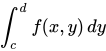
The result above is what we call an iterated integral which we will define below.
- Definition: If Failed to parse (MathML with SVG or PNG fallback (recommended for modern browsers and accessibility tools): Invalid response ("Math extension cannot connect to Restbase.") from server "https://wikimedia.org/api/rest_v1/":): {\displaystyle z = f(x, y)} is a two variable real valued function, and if Failed to parse (MathML with SVG or PNG fallback (recommended for modern browsers and accessibility tools): Invalid response ("Math extension cannot connect to Restbase.") from server "https://wikimedia.org/api/rest_v1/":): {\displaystyle f} is integrable over the rectangle Failed to parse (MathML with SVG or PNG fallback (recommended for modern browsers and accessibility tools): Invalid response ("Math extension cannot connect to Restbase.") from server "https://wikimedia.org/api/rest_v1/":): {\displaystyle R = [a, b] \times [c, d]} , then the Iterated Integral of Failed to parse (MathML with SVG or PNG fallback (recommended for modern browsers and accessibility tools): Invalid response ("Math extension cannot connect to Restbase.") from server "https://wikimedia.org/api/rest_v1/":): {\displaystyle f} over Failed to parse (MathML with SVG or PNG fallback (recommended for modern browsers and accessibility tools): Invalid response ("Math extension cannot connect to Restbase.") from server "https://wikimedia.org/api/rest_v1/":): {\displaystyle R} is
Failed to parse (MathML with SVG or PNG fallback (recommended for modern browsers and accessibility tools): Invalid response ("Math extension cannot connect to Restbase.") from server "https://wikimedia.org/api/rest_v1/":): {\displaystyle \int_a^b \int_c^d f(x, y) \, dy \, dx} .
We will see later that iterated integrals need not be over rectangles but instead can be done over more general domains.
One important property about iterated integrals is that we can partially integrate Failed to parse (MathML with SVG or PNG fallback (recommended for modern browsers and accessibility tools): Invalid response ("Math extension cannot connect to Restbase.") from server "https://wikimedia.org/api/rest_v1/":): {\displaystyle f(x, y)} with respect to either variable Failed to parse (MathML with SVG or PNG fallback (recommended for modern browsers and accessibility tools): Invalid response ("Math extension cannot connect to Restbase.") from server "https://wikimedia.org/api/rest_v1/":): {\displaystyle x} or Failed to parse (MathML with SVG or PNG fallback (recommended for modern browsers and accessibility tools): Invalid response ("Math extension cannot connect to Restbase.") from server "https://wikimedia.org/api/rest_v1/":): {\displaystyle y} first, and then continue onward with integrating with respect to the second variable, that is:
However, it is important to note that sometimes partial integrating with respect to a certain variable first will be a much easier process. Let's now look at some examples of evaluating iterated integrals.
Example 1
Evaluate the following iterated integral Failed to parse (MathML with SVG or PNG fallback (recommended for modern browsers and accessibility tools): Invalid response ("Math extension cannot connect to Restbase.") from server "https://wikimedia.org/api/rest_v1/":): {\displaystyle \int_2^4 \int_1^3 x^3 + xy^2 \, dy \, dx} . Over what rectangle is Failed to parse (MathML with SVG or PNG fallback (recommended for modern browsers and accessibility tools): Invalid response ("Math extension cannot connect to Restbase.") from server "https://wikimedia.org/api/rest_v1/":): {\displaystyle f(x, y) = x^3 + xy^2} being integrated?
When evaluated iterated integrals over rectangles, we always want to work from the inside out. Let's first evaluate the inside integral with respect to Failed to parse (MathML with SVG or PNG fallback (recommended for modern browsers and accessibility tools): Invalid response ("Math extension cannot connect to Restbase.") from server "https://wikimedia.org/api/rest_v1/":): {\displaystyle y} while holding Failed to parse (MathML with SVG or PNG fallback (recommended for modern browsers and accessibility tools): Invalid response ("Math extension cannot connect to Restbase.") from server "https://wikimedia.org/api/rest_v1/":): {\displaystyle x} as fixed.
Therefore we have that:
Evaluating this definite integral and we get that:
Therefore we have that:
In this particular example, we are integrating over the rectangle Failed to parse (MathML with SVG or PNG fallback (recommended for modern browsers and accessibility tools): Invalid response ("Math extension cannot connect to Restbase.") from server "https://wikimedia.org/api/rest_v1/":): {\displaystyle R = [2, 4] \times [1, 3]} .
Example 2
Evaluate the following iterated integral Failed to parse (MathML with SVG or PNG fallback (recommended for modern browsers and accessibility tools): Invalid response ("Math extension cannot connect to Restbase.") from server "https://wikimedia.org/api/rest_v1/":): {\displaystyle \int_0^{\pi} \int_{0}^{\pi} \sin x \cos y \, dx \, dy} . Over what rectangle is Failed to parse (MathML with SVG or PNG fallback (recommended for modern browsers and accessibility tools): Invalid response ("Math extension cannot connect to Restbase.") from server "https://wikimedia.org/api/rest_v1/":): {\displaystyle f(x, y) = \sin x \cos y} being integrated?
We will first start by evaluating the inner integral while holding Failed to parse (MathML with SVG or PNG fallback (recommended for modern browsers and accessibility tools): Invalid response ("Math extension cannot connect to Restbase.") from server "https://wikimedia.org/api/rest_v1/":): {\displaystyle y} as fixed:
Therefore we have that:
Evaluating this definite integral and we get that:
In this particular example, we are integrating over the square Failed to parse (MathML with SVG or PNG fallback (recommended for modern browsers and accessibility tools): Invalid response ("Math extension cannot connect to Restbase.") from server "https://wikimedia.org/api/rest_v1/":): {\displaystyle R = [0, \pi] \times [0, \pi]} .
Fubini's Theorem and Evaluating Double Integrals over Rectangles
We have just looked at Iterated Integrals over rectangles. You might now wonder how iterated integrals relate to double integrals that we looked are earlier. Fubini's Theorem gives us a relationship between double integrals and these iterated integrals.
- Theorem 1 (Fubini's Theorem): Let Failed to parse (MathML with SVG or PNG fallback (recommended for modern browsers and accessibility tools): Invalid response ("Math extension cannot connect to Restbase.") from server "https://wikimedia.org/api/rest_v1/":): {\displaystyle z = f(x, y)} be a two variable real-valued function. If Failed to parse (MathML with SVG or PNG fallback (recommended for modern browsers and accessibility tools): Invalid response ("Math extension cannot connect to Restbase.") from server "https://wikimedia.org/api/rest_v1/":): {\displaystyle f} is continuous on the rectangle Failed to parse (MathML with SVG or PNG fallback (recommended for modern browsers and accessibility tools): Invalid response ("Math extension cannot connect to Restbase.") from server "https://wikimedia.org/api/rest_v1/":): {\displaystyle R = [a, b] \times [c, d]} then the double integral over Failed to parse (MathML with SVG or PNG fallback (recommended for modern browsers and accessibility tools): Invalid response ("Math extension cannot connect to Restbase.") from server "https://wikimedia.org/api/rest_v1/":): {\displaystyle R} can be computed as an iterated integrals and Failed to parse (MathML with SVG or PNG fallback (recommended for modern browsers and accessibility tools): Invalid response ("Math extension cannot connect to Restbase.") from server "https://wikimedia.org/api/rest_v1/":): {\displaystyle \iint_{R} f(x, y) \, dA = \int_a^b \int_c^d f(x, y) \, dy \, dx = \int_c^d \int_a^b f(x, y) \, dx \, dy} .
Fubini's Theorem is critically important as it gives us a method to evaluate double integrals over rectangles without having to use the definition of a double integral directly.
Now the following corollary will give us another method for evaluating double integrals over a rectangle Failed to parse (MathML with SVG or PNG fallback (recommended for modern browsers and accessibility tools): Invalid response ("Math extension cannot connect to Restbase.") from server "https://wikimedia.org/api/rest_v1/":): {\displaystyle R = [a, b] \times [c, d]} provided that Failed to parse (MathML with SVG or PNG fallback (recommended for modern browsers and accessibility tools): Invalid response ("Math extension cannot connect to Restbase.") from server "https://wikimedia.org/api/rest_v1/":): {\displaystyle f} can be written as a product of a function in terms of Failed to parse (MathML with SVG or PNG fallback (recommended for modern browsers and accessibility tools): Invalid response ("Math extension cannot connect to Restbase.") from server "https://wikimedia.org/api/rest_v1/":): {\displaystyle x} and a function in terms of Failed to parse (MathML with SVG or PNG fallback (recommended for modern browsers and accessibility tools): Invalid response ("Math extension cannot connect to Restbase.") from server "https://wikimedia.org/api/rest_v1/":): {\displaystyle y} .
- Corollary 1: Let be a two variable real-valued function. If and Failed to parse (MathML with SVG or PNG fallback (recommended for modern browsers and accessibility tools): Invalid response ("Math extension cannot connect to Restbase.") from server "https://wikimedia.org/api/rest_v1/":): {\displaystyle f} and Failed to parse (MathML with SVG or PNG fallback (recommended for modern browsers and accessibility tools): Invalid response ("Math extension cannot connect to Restbase.") from server "https://wikimedia.org/api/rest_v1/":): {\displaystyle R = [a, b] \times [c, d]} then Failed to parse (MathML with SVG or PNG fallback (recommended for modern browsers and accessibility tools): Invalid response ("Math extension cannot connect to Restbase.") from server "https://wikimedia.org/api/rest_v1/":): {\displaystyle \iint_R f(x, y) \, dA = \iint_R g(x) h(y) \, dA = \left [ \int_a^b g(x) \, dx \right ] \left [ \int_c^d h(y) \, dy \right ]} .

Example 1
Evaluate Failed to parse (MathML with SVG or PNG fallback (recommended for modern browsers and accessibility tools): Invalid response ("Math extension cannot connect to Restbase.") from server "https://wikimedia.org/api/rest_v1/":): {\displaystyle \iint_R xy + y^2 \, dA} where Failed to parse (MathML with SVG or PNG fallback (recommended for modern browsers and accessibility tools): Invalid response ("Math extension cannot connect to Restbase.") from server "https://wikimedia.org/api/rest_v1/":): {\displaystyle R = [0, 1] \times [1, 2]} .
By Fubini's Theorem we have that:
Now let's evaluate the inner integral Failed to parse (MathML with SVG or PNG fallback (recommended for modern browsers and accessibility tools): Invalid response ("Math extension cannot connect to Restbase.") from server "https://wikimedia.org/api/rest_v1/":): {\displaystyle \int_1^2 xy + y^2 \, dy} first while holding Failed to parse (MathML with SVG or PNG fallback (recommended for modern browsers and accessibility tools): Invalid response ("Math extension cannot connect to Restbase.") from server "https://wikimedia.org/api/rest_v1/":): {\displaystyle x} as fixed:
And so we have that:
Example 2
Evaluate Failed to parse (MathML with SVG or PNG fallback (recommended for modern browsers and accessibility tools): Invalid response ("Math extension cannot connect to Restbase.") from server "https://wikimedia.org/api/rest_v1/":): {\displaystyle \iint_R e^x \cos y \, dA} where Failed to parse (MathML with SVG or PNG fallback (recommended for modern browsers and accessibility tools): Invalid response ("Math extension cannot connect to Restbase.") from server "https://wikimedia.org/api/rest_v1/":): {\displaystyle R = [0, 1] \times \left [ \frac{\pi}{2} , \pi \right ]} .
Note that Failed to parse (MathML with SVG or PNG fallback (recommended for modern browsers and accessibility tools): Invalid response ("Math extension cannot connect to Restbase.") from server "https://wikimedia.org/api/rest_v1/":): {\displaystyle f(x, y) = e^x \cos y} can be written as the product of a function of Failed to parse (MathML with SVG or PNG fallback (recommended for modern browsers and accessibility tools): Invalid response ("Math extension cannot connect to Restbase.") from server "https://wikimedia.org/api/rest_v1/":): {\displaystyle x} and a function of Failed to parse (MathML with SVG or PNG fallback (recommended for modern browsers and accessibility tools): Invalid response ("Math extension cannot connect to Restbase.") from server "https://wikimedia.org/api/rest_v1/":): {\displaystyle y} if we let Failed to parse (MathML with SVG or PNG fallback (recommended for modern browsers and accessibility tools): Invalid response ("Math extension cannot connect to Restbase.") from server "https://wikimedia.org/api/rest_v1/":): {\displaystyle g(x) = e^x} and Failed to parse (MathML with SVG or PNG fallback (recommended for modern browsers and accessibility tools): Invalid response ("Math extension cannot connect to Restbase.") from server "https://wikimedia.org/api/rest_v1/":): {\displaystyle h(y) = \cos y} (then Failed to parse (MathML with SVG or PNG fallback (recommended for modern browsers and accessibility tools): Invalid response ("Math extension cannot connect to Restbase.") from server "https://wikimedia.org/api/rest_v1/":): {\displaystyle f(x, y) = g(x) h(y)} ). Therefore applying Corollary 1 and we get that:
Fubini's Theorem for Evaluating Triple Integrals over Boxes
We will now look at an analogous Theorem for evaluating triple integrals over a rectangular box Failed to parse (MathML with SVG or PNG fallback (recommended for modern browsers and accessibility tools): Invalid response ("Math extension cannot connect to Restbase.") from server "https://wikimedia.org/api/rest_v1/":): {\displaystyle B} with iterated integrals.
- Theorem 1: Let Failed to parse (MathML with SVG or PNG fallback (recommended for modern browsers and accessibility tools): Invalid response ("Math extension cannot connect to Restbase.") from server "https://wikimedia.org/api/rest_v1/":): {\displaystyle w = f(x, y, z)} be a three variable real-valued function such that Failed to parse (MathML with SVG or PNG fallback (recommended for modern browsers and accessibility tools): Invalid response ("Math extension cannot connect to Restbase.") from server "https://wikimedia.org/api/rest_v1/":): {\displaystyle f} is continuous on the rectangular box Failed to parse (MathML with SVG or PNG fallback (recommended for modern browsers and accessibility tools): Invalid response ("Math extension cannot connect to Restbase.") from server "https://wikimedia.org/api/rest_v1/":): {\displaystyle B = [a, b] \times [c, d] \times [r, s]} . Then the triple integral of Failed to parse (MathML with SVG or PNG fallback (recommended for modern browsers and accessibility tools): Invalid response ("Math extension cannot connect to Restbase.") from server "https://wikimedia.org/api/rest_v1/":): {\displaystyle f} over Failed to parse (MathML with SVG or PNG fallback (recommended for modern browsers and accessibility tools): Invalid response ("Math extension cannot connect to Restbase.") from server "https://wikimedia.org/api/rest_v1/":): {\displaystyle B} can be evaluated as iterated integrals, that is, Failed to parse (MathML with SVG or PNG fallback (recommended for modern browsers and accessibility tools): Invalid response ("Math extension cannot connect to Restbase.") from server "https://wikimedia.org/api/rest_v1/":): {\displaystyle \iiint_B f(x, y, z) \, dV = \int_r^s \int_c^d \int_a^b f(x, y, z) \, dx \, dy \, dz} .
There are six total ways to evaluate a triple integral over a box using iterated integrals. For example, we could get that Failed to parse (MathML with SVG or PNG fallback (recommended for modern browsers and accessibility tools): Invalid response ("Math extension cannot connect to Restbase.") from server "https://wikimedia.org/api/rest_v1/":): {\displaystyle \iiint_B f(x, y, z) \, dV = \int_a^b \int_c^d \int_r^s f(x, y, z) \, dz \, dy \, dx} , or Failed to parse (MathML with SVG or PNG fallback (recommended for modern browsers and accessibility tools): Invalid response ("Math extension cannot connect to Restbase.") from server "https://wikimedia.org/api/rest_v1/":): {\displaystyle \iiint_B f(x, y, z) \, dV = \int_c^d \int_a^b \int_r^s f(x, y, z) \, dz \, dx \, dy} . Each of these six possible orders will give rise to the same value.
Let's now look at an example of evaluating a triple integral over a box.
Example 1
Evaluate the triple integral Failed to parse (MathML with SVG or PNG fallback (recommended for modern browsers and accessibility tools): Invalid response ("Math extension cannot connect to Restbase.") from server "https://wikimedia.org/api/rest_v1/":): {\displaystyle \iiint_B 2x - e^y + 3z^2 \, dV} over the box Failed to parse (MathML with SVG or PNG fallback (recommended for modern browsers and accessibility tools): Invalid response ("Math extension cannot connect to Restbase.") from server "https://wikimedia.org/api/rest_v1/":): {\displaystyle B = [0, 2] \times [0, 1] \times [1, 3]} .
By Fubini's Theorem we can rewrite this triple integral as iterated integrals:
Resources
Licensing
Content obtained and/or adapted from:
- Iterated integrals, mathonline.wikidot.com under a CC BY-SA license
- Fubini's Theorem and Evaluating Double Integrals over Rectangles, mathonline.wikidot.com under a CC BY-SA license
- Fubini's Theorem for Evaluating Triple Integrals over Boxes, mathonline.wikidot.com under a CC BY-SA license

