Difference between revisions of "Limits of Functions"
| Line 62: | Line 62: | ||
* [https://www.khanacademy.org/math/ap-calculus-ab/ab-limits-new/ab-1-5a/v/limits-of-combined-functions Limits of Combined Functions], Khan Academy | * [https://www.khanacademy.org/math/ap-calculus-ab/ab-limits-new/ab-1-5a/v/limits-of-combined-functions Limits of Combined Functions], Khan Academy | ||
| − | == | + | == Licensing == |
| − | + | Content obtained and/or adapted from: | |
| − | + | * [https://en.wikipedia.org/wiki/Limit_(mathematics) Limit (mathematics), Wikipedia] under a CC BY-SA license | |
| − | |||
| − | |||
| − | |||
| − | |||
Latest revision as of 22:50, 13 November 2021
In mathematics, a limit is the value that a function (or sequence) approaches as the input (or index) approaches some value. Limits are essential to calculus and mathematical analysis, and are used to define continuity, derivatives, and integrals.
The concept of a limit of a sequence is further generalized to the concept of a limit of a topological net, and is closely related to limit and direct limit in category theory.
In formulas, a limit of a function is usually written as
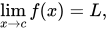
and is read as "the limit of f of x as x approaches c equals L". The fact that a function f approaches the limit L as x approaches c is sometimes denoted by a right arrow (→ or ), as in


which reads " of tends to as tends to ".


Limit of a function
Suppose f is a real-valued function and c is a real number. Intuitively speaking, the expression

means that f(x) can be made to be as close to L as desired, by making x sufficiently close to c. In that case, the above equation can be read as "the limit of f of x, as x approaches c, is L".
Augustin-Louis Cauchy in 1821, followed by Karl Weierstrass, formalized the definition of the limit of a function which became known as the (ε, δ)-definition of limit. The definition uses ε (the lowercase Greek letter epsilon) to represent any small positive number, so that "f(x) becomes arbitrarily close to L" means that f(x) eventually lies in the interval (L − ε, L + ε), which can also be written using the absolute value sign as |f(x) − L| < ε. The phrase "as x approaches c" then indicates that we refer to values of x, whose distance from c is less than some positive number δ (the lower case Greek letter delta)—that is, values of x within either (c − δ, c) or (c, c + δ), which can be expressed with 0 < |x − c| < δ. The first inequality means that the distance between x and c is greater than 0 and that x ≠ c, while the second indicates that x is within distance δ of c.
The above definition of a limit is true even if f(c) ≠ L. Indeed, the function f need not even be defined at c.
For example, if

then f(1) is not defined (indeterminate forms), yet as x moves arbitrarily close to 1, f(x) correspondingly approaches 2:
| f(0.9) | f(0.99) | f(0.999) | f(1.0) | f(1.001) | f(1.01) | f(1.1) |
| 1.900 | 1.990 | 1.999 | undefined | 2.001 | 2.010 | 2.100 |
Thus, f(x) can be made arbitrarily close to the limit of 2—just by making x sufficiently close to 1.
In other words,
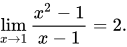
This can also be calculated algebraically, as for all real numbers x ≠ 1.

Now, since x + 1 is continuous in x at 1, we can now plug in 1 for x, leading to the equation
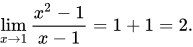
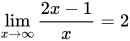
In addition to limits at finite values, functions can also have limits at infinity. For example, consider the function
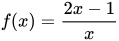
- f(100) = 1.9900
- f(1000) = 1.9990
- f(10000) = 1.9999
As x becomes extremely large, the value of f(x) approaches 2, and the value of f(x) can be made as close to 2 as one could wish—by making x sufficiently large. So in this case, the limit of f(x) as x approaches infinity is 2, or in mathematical notation,
Resources
- The Limit, Paul's Online Notes
- Introduction to Limits, Khan Academy
- Limits of Combined Functions, Khan Academy
Licensing
Content obtained and/or adapted from:
- Limit (mathematics), Wikipedia under a CC BY-SA license


