Difference between revisions of "Real Function Limits:Infinite"
| (10 intermediate revisions by one other user not shown) | |||
| Line 1: | Line 1: | ||
| − | == | + | ==Infinite limits== |
| + | |||
| + | For a function whose values grow without bound, the function diverges and the usual limit does not exist. However, in this case one may introduce limits with infinite values. Let <math>S\subseteq\mathbb{R}</math>, <math>x\in S</math> and <math>f:S\mapsto\mathbb{R}</math>. The statement '''the limit of ''f'' as ''x'' approaches ''a'' is infinity''', denoted | ||
| + | |||
| + | :<math> \lim_{x \to a} f(x) = \infty, </math> | ||
| + | |||
| + | means that for all <math>N > 0</math> there exists <math>\delta > 0</math> such that <math>f(x) > N</math> whenever <math>0 < |x - a| < \delta.</math> | ||
| + | |||
| + | These ideas can be combined in a natural way to produce definitions for different combinations, such as | ||
| + | |||
| + | :<math> \lim_{x \to \infty} f(x) = \infty, \lim_{x \to a^+}f(x) = -\infty. </math> | ||
| + | |||
| + | For example, | ||
| + | :<math>\lim_{x \to 0^+} \ln x = -\infty. </math> | ||
| + | |||
| + | Limits involving infinity are connected with the concept of asymptotes. | ||
| + | |||
| + | These notions of a limit attempt to provide a metric space interpretation to limits at infinity. In fact, they are consistent with the topological space definition of limit if | ||
| + | *a neighborhood of −∞ is defined to contain an interval [−∞, ''c'') for some ''c'' ∈ '''R''', | ||
| + | *a neighborhood of ∞ is defined to contain an interval (''c'', ∞] where ''c'' ∈ '''R''', and | ||
| + | *a neighborhood of ''a'' ∈ '''R''' is defined in the normal way metric space '''R'''. | ||
| + | In this case, <span style="text-decoration: overline">'''R'''</span> is a topological space and any function of the form ''f'': ''X'' → ''Y'' with ''X'', ''Y''⊆ <span style="text-decoration: overline">'''R'''</span> is subject to the topological definition of a limit. Note that with this topological definition, it is easy to define infinite limits at finite points, which have not been defined above in the metric sense. | ||
| + | |||
| + | ==Limits at Infinity== | ||
Another kind of limit involves looking at what happens to <math>f(x)</math> as <math>x</math> gets very big. For example, consider the function <math>f(x)=\frac{1}{x}</math> . As <math>x</math> gets very big, <math>\frac{1}{x}</math> gets very small. In fact, <math>\frac{1}{x}</math> gets closer and closer to 0 the bigger <math>x</math> gets. Without limits it is very difficult to talk about this fact, because <math>x</math> can keep getting bigger and bigger and <math>\frac{1}{x}</math> never actually gets to 0; but the language of limits exists precisely to let us talk about the behavior of a function as it approaches something - without caring about the fact that it will never get there. In this case, however, we have the same problem as before: how big does <math>x</math> have to be to be sure that <math>f(x)</math> is really going towards 0? | Another kind of limit involves looking at what happens to <math>f(x)</math> as <math>x</math> gets very big. For example, consider the function <math>f(x)=\frac{1}{x}</math> . As <math>x</math> gets very big, <math>\frac{1}{x}</math> gets very small. In fact, <math>\frac{1}{x}</math> gets closer and closer to 0 the bigger <math>x</math> gets. Without limits it is very difficult to talk about this fact, because <math>x</math> can keep getting bigger and bigger and <math>\frac{1}{x}</math> never actually gets to 0; but the language of limits exists precisely to let us talk about the behavior of a function as it approaches something - without caring about the fact that it will never get there. In this case, however, we have the same problem as before: how big does <math>x</math> have to be to be sure that <math>f(x)</math> is really going towards 0? | ||
In this case, we want to say that, however close we want <math>f(x)</math> to get to 0, for <math>x</math> big enough <math>f(x)</math> is guaranteed to get that close. So we have yet another definition. | In this case, we want to say that, however close we want <math>f(x)</math> to get to 0, for <math>x</math> big enough <math>f(x)</math> is guaranteed to get that close. So we have yet another definition. | ||
| − | + | <blockquote style="background: white; border: 1px solid black; padding: 1em;"> | |
| − | + | '''Definition: (Definition of a limit at infinity)''' | |
| − | + | :We call <math>L</math> the '''limit of <math>f(x)</math> as <math>x</math> approaches infinity''' if <math>f(x)</math> becomes '''arbitrarily close''' to <math>L</math> '''whenever''' <math>x</math> is '''sufficiently large'''. | |
| − | When this holds we write | + | :When this holds we write |
| − | :<math>\lim_{x\to\infty}f(x)=L</math> | + | ::<math>\lim_{x\to\infty}f(x)=L</math> |
or | or | ||
| − | :<math>f(x)\to L\quad\mbox{as}\quad x\to\infty</math> | + | ::<math>f(x)\to L\quad\mbox{as}\quad x\to\infty</math> |
| − | Similarly, we call <math>L</math> the '''limit of <math>f(x)</math> as <math>x</math> approaches negative infinity''' if <math>f(x)</math> becomes '''arbitrarily close''' to <math>L</math> '''whenever''' <math>x</math> is '''sufficiently negative'''. | + | :Similarly, we call <math>L</math> the '''limit of <math>f(x)</math> as <math>x</math> approaches negative infinity''' if <math>f(x)</math> becomes '''arbitrarily close''' to <math>L</math> '''whenever''' <math>x</math> is '''sufficiently negative'''. |
| − | When this holds we write | + | :When this holds we write |
| − | :<math>\lim_{x\to-\infty}f(x)=L</math> | + | ::<math>\lim_{x\to-\infty}f(x)=L</math> |
or | or | ||
| − | :<math>f(x)\to L\quad\mbox{as}\quad x\to-\infty</math> | + | ::<math>f(x)\to L\quad\mbox{as}\quad x\to-\infty</math> |
| − | + | </blockquote> | |
| + | |||
So, in this case, we write: | So, in this case, we write: | ||
| Line 28: | Line 52: | ||
because making <math>x</math> very negative also forces <math>\frac{1}{x}</math> to be close to <math>0</math> . | because making <math>x</math> very negative also forces <math>\frac{1}{x}</math> to be close to <math>0</math> . | ||
| − | '''Notice''', however, that | + | '''Notice''', however, that infinity is not a number; it's just shorthand for saying "no matter how big." Thus, this is not the same as the regular limits we learned about in the last two chapters. |
===Limits at Infinity of Rational Functions=== | ===Limits at Infinity of Rational Functions=== | ||
| Line 45: | Line 69: | ||
Note that, if the numerator or denominator is a constant (including 1, as above), then this is the same as <math>x^0</math> . Also, a straight power of <math>x</math> , like <math>x^3</math> , has coefficient 1, since it is the same as <math>1x^3</math> . | Note that, if the numerator or denominator is a constant (including 1, as above), then this is the same as <math>x^0</math> . Also, a straight power of <math>x</math> , like <math>x^3</math> , has coefficient 1, since it is the same as <math>1x^3</math> . | ||
| − | + | ===Examples=== | |
;Example 1 | ;Example 1 | ||
Find <math>\lim_{x\to\infty}\frac{x-5}{x-3}</math> . | Find <math>\lim_{x\to\infty}\frac{x-5}{x-3}</math> . | ||
| Line 65: | Line 89: | ||
:<math>\lim_{x\to\infty}\frac{x^3+x-6}{x^2-4x+3}=\infty</math> . | :<math>\lim_{x\to\infty}\frac{x^3+x-6}{x^2-4x+3}=\infty</math> . | ||
| − | ==Formal | + | ==Formal Definitions of Limits Involving Infinity== |
[[File:Limit-at-infinity-graph.png|thumb|alt=A graph which has a hump in the beginning, then a smaller valley, as it tapers off.|A graphical example of a function converging to a limit as it approaches infinity]] | [[File:Limit-at-infinity-graph.png|thumb|alt=A graph which has a hump in the beginning, then a smaller valley, as it tapers off.|A graphical example of a function converging to a limit as it approaches infinity]] | ||
| Line 78: | Line 102: | ||
So, the definition needs to be rewritten, which is done in the following chart. The definitions for when either the limit as ''x'' ''approaches'' positive or negative infinity; or the limit as ƒ(x) ''converges'' to positive or negative infinity are as follows: | So, the definition needs to be rewritten, which is done in the following chart. The definitions for when either the limit as ''x'' ''approaches'' positive or negative infinity; or the limit as ƒ(x) ''converges'' to positive or negative infinity are as follows: | ||
| − | + | '''Note:''' Yes, the ''approaching'' and ''converging'' distinction is important. You can look at it as either referencing the delta or the epsilon, respectively.}} | |
{| class="wikitable" style="margin: auto;" | {| class="wikitable" style="margin: auto;" | ||
| Line 106: | Line 130: | ||
We only use big ''N'' and ''M'' because the connotation associated with ε and δ is that they are small numbers. Big ''N'' and ''M'' has the opposite connotation. | We only use big ''N'' and ''M'' because the connotation associated with ε and δ is that they are small numbers. Big ''N'' and ''M'' has the opposite connotation. | ||
| − | == | + | == Licensing == |
| − | * [https://en.wikibooks.org/wiki/Calculus/Infinite_Limits Infinite limits | + | Content obtained and/or adapted from: |
| − | * [https://en.wikibooks.org/wiki/Real_Analysis/Limits Limits | + | * [https://en.wikibooks.org/wiki/Calculus/Infinite_Limits Infinite limits, Wikibooks: Calculus] under a CC BY-SA license |
| + | * [https://en.wikibooks.org/wiki/Real_Analysis/Limits Limits, Wikibooks: Real Analysis] under a CC BY-SA license | ||
| + | * [https://en.wikipedia.org/wiki/Limit_of_a_function#Limits_at_infinity Limit of a function, Wikipedia] under a CC BY-SA license | ||
Latest revision as of 16:15, 6 November 2021
Contents
Infinite limits
For a function whose values grow without bound, the function diverges and the usual limit does not exist. However, in this case one may introduce limits with infinite values. Let , and . The statement the limit of f as x approaches a is infinity, denoted


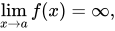
means that for all there exists such that whenever



These ideas can be combined in a natural way to produce definitions for different combinations, such as

For example,
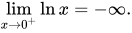
Limits involving infinity are connected with the concept of asymptotes.
These notions of a limit attempt to provide a metric space interpretation to limits at infinity. In fact, they are consistent with the topological space definition of limit if
- a neighborhood of −∞ is defined to contain an interval [−∞, c) for some c ∈ R,
- a neighborhood of ∞ is defined to contain an interval (c, ∞] where c ∈ R, and
- a neighborhood of a ∈ R is defined in the normal way metric space R.
In this case, R is a topological space and any function of the form f: X → Y with X, Y⊆ R is subject to the topological definition of a limit. Note that with this topological definition, it is easy to define infinite limits at finite points, which have not been defined above in the metric sense.
Limits at Infinity
Another kind of limit involves looking at what happens to as gets very big. For example, consider the function . As gets very big, gets very small. In fact, gets closer and closer to 0 the bigger gets. Without limits it is very difficult to talk about this fact, because can keep getting bigger and bigger and never actually gets to 0; but the language of limits exists precisely to let us talk about the behavior of a function as it approaches something - without caring about the fact that it will never get there. In this case, however, we have the same problem as before: how big does have to be to be sure that is really going towards 0?


In this case, we want to say that, however close we want to get to 0, for Failed to parse (MathML with SVG or PNG fallback (recommended for modern browsers and accessibility tools): Invalid response ("Math extension cannot connect to Restbase.") from server "https://wikimedia.org/api/rest_v1/":): {\displaystyle x} big enough Failed to parse (MathML with SVG or PNG fallback (recommended for modern browsers and accessibility tools): Invalid response ("Math extension cannot connect to Restbase.") from server "https://wikimedia.org/api/rest_v1/":): {\displaystyle f(x)} is guaranteed to get that close. So we have yet another definition.
Definition: (Definition of a limit at infinity)
- We call Failed to parse (MathML with SVG or PNG fallback (recommended for modern browsers and accessibility tools): Invalid response ("Math extension cannot connect to Restbase.") from server "https://wikimedia.org/api/rest_v1/":): {\displaystyle L} the limit of Failed to parse (MathML with SVG or PNG fallback (recommended for modern browsers and accessibility tools): Invalid response ("Math extension cannot connect to Restbase.") from server "https://wikimedia.org/api/rest_v1/":): {\displaystyle f(x)} as Failed to parse (MathML with SVG or PNG fallback (recommended for modern browsers and accessibility tools): Invalid response ("Math extension cannot connect to Restbase.") from server "https://wikimedia.org/api/rest_v1/":): {\displaystyle x} approaches infinity if Failed to parse (MathML with SVG or PNG fallback (recommended for modern browsers and accessibility tools): Invalid response ("Math extension cannot connect to Restbase.") from server "https://wikimedia.org/api/rest_v1/":): {\displaystyle f(x)} becomes arbitrarily close to Failed to parse (MathML with SVG or PNG fallback (recommended for modern browsers and accessibility tools): Invalid response ("Math extension cannot connect to Restbase.") from server "https://wikimedia.org/api/rest_v1/":): {\displaystyle L} whenever Failed to parse (MathML with SVG or PNG fallback (recommended for modern browsers and accessibility tools): Invalid response ("Math extension cannot connect to Restbase.") from server "https://wikimedia.org/api/rest_v1/":): {\displaystyle x} is sufficiently large.
- When this holds we write
- Failed to parse (MathML with SVG or PNG fallback (recommended for modern browsers and accessibility tools): Invalid response ("Math extension cannot connect to Restbase.") from server "https://wikimedia.org/api/rest_v1/":): {\displaystyle \lim_{x\to\infty}f(x)=L}
or
- Failed to parse (MathML with SVG or PNG fallback (recommended for modern browsers and accessibility tools): Invalid response ("Math extension cannot connect to Restbase.") from server "https://wikimedia.org/api/rest_v1/":): {\displaystyle f(x)\to L\quad\mbox{as}\quad x\to\infty}
- Similarly, we call Failed to parse (MathML with SVG or PNG fallback (recommended for modern browsers and accessibility tools): Invalid response ("Math extension cannot connect to Restbase.") from server "https://wikimedia.org/api/rest_v1/":): {\displaystyle L} the limit of Failed to parse (MathML with SVG or PNG fallback (recommended for modern browsers and accessibility tools): Invalid response ("Math extension cannot connect to Restbase.") from server "https://wikimedia.org/api/rest_v1/":): {\displaystyle f(x)} as Failed to parse (MathML with SVG or PNG fallback (recommended for modern browsers and accessibility tools): Invalid response ("Math extension cannot connect to Restbase.") from server "https://wikimedia.org/api/rest_v1/":): {\displaystyle x} approaches negative infinity if Failed to parse (MathML with SVG or PNG fallback (recommended for modern browsers and accessibility tools): Invalid response ("Math extension cannot connect to Restbase.") from server "https://wikimedia.org/api/rest_v1/":): {\displaystyle f(x)} becomes arbitrarily close to Failed to parse (MathML with SVG or PNG fallback (recommended for modern browsers and accessibility tools): Invalid response ("Math extension cannot connect to Restbase.") from server "https://wikimedia.org/api/rest_v1/":): {\displaystyle L} whenever Failed to parse (MathML with SVG or PNG fallback (recommended for modern browsers and accessibility tools): Invalid response ("Math extension cannot connect to Restbase.") from server "https://wikimedia.org/api/rest_v1/":): {\displaystyle x} is sufficiently negative.
- When this holds we write
- Failed to parse (MathML with SVG or PNG fallback (recommended for modern browsers and accessibility tools): Invalid response ("Math extension cannot connect to Restbase.") from server "https://wikimedia.org/api/rest_v1/":): {\displaystyle \lim_{x\to-\infty}f(x)=L}
or
- Failed to parse (MathML with SVG or PNG fallback (recommended for modern browsers and accessibility tools): Invalid response ("Math extension cannot connect to Restbase.") from server "https://wikimedia.org/api/rest_v1/":): {\displaystyle f(x)\to L\quad\mbox{as}\quad x\to-\infty}
So, in this case, we write:
- Failed to parse (MathML with SVG or PNG fallback (recommended for modern browsers and accessibility tools): Invalid response ("Math extension cannot connect to Restbase.") from server "https://wikimedia.org/api/rest_v1/":): {\displaystyle \quad\lim_{x\to\infty}\frac{1}{x}=0}
and say "The limit, as Failed to parse (MathML with SVG or PNG fallback (recommended for modern browsers and accessibility tools): Invalid response ("Math extension cannot connect to Restbase.") from server "https://wikimedia.org/api/rest_v1/":): {\displaystyle x} approaches infinity, equals Failed to parse (MathML with SVG or PNG fallback (recommended for modern browsers and accessibility tools): Invalid response ("Math extension cannot connect to Restbase.") from server "https://wikimedia.org/api/rest_v1/":): {\displaystyle 0} ," or "as Failed to parse (MathML with SVG or PNG fallback (recommended for modern browsers and accessibility tools): Invalid response ("Math extension cannot connect to Restbase.") from server "https://wikimedia.org/api/rest_v1/":): {\displaystyle x} approaches infinity, the function approaches 0.
We can also write:
- Failed to parse (MathML with SVG or PNG fallback (recommended for modern browsers and accessibility tools): Invalid response ("Math extension cannot connect to Restbase.") from server "https://wikimedia.org/api/rest_v1/":): {\displaystyle \lim_{x\to-\infty}\frac{1}{x}=0}
because making Failed to parse (MathML with SVG or PNG fallback (recommended for modern browsers and accessibility tools): Invalid response ("Math extension cannot connect to Restbase.") from server "https://wikimedia.org/api/rest_v1/":): {\displaystyle x} very negative also forces Failed to parse (MathML with SVG or PNG fallback (recommended for modern browsers and accessibility tools): Invalid response ("Math extension cannot connect to Restbase.") from server "https://wikimedia.org/api/rest_v1/":): {\displaystyle \frac{1}{x}} to be close to Failed to parse (MathML with SVG or PNG fallback (recommended for modern browsers and accessibility tools): Invalid response ("Math extension cannot connect to Restbase.") from server "https://wikimedia.org/api/rest_v1/":): {\displaystyle 0} .
Notice, however, that infinity is not a number; it's just shorthand for saying "no matter how big." Thus, this is not the same as the regular limits we learned about in the last two chapters.
Limits at Infinity of Rational Functions
One special case that comes up frequently is when we want to find the limit at Failed to parse (MathML with SVG or PNG fallback (recommended for modern browsers and accessibility tools): Invalid response ("Math extension cannot connect to Restbase.") from server "https://wikimedia.org/api/rest_v1/":): {\displaystyle \infty} (or Failed to parse (MathML with SVG or PNG fallback (recommended for modern browsers and accessibility tools): Invalid response ("Math extension cannot connect to Restbase.") from server "https://wikimedia.org/api/rest_v1/":): {\displaystyle -\infty} ) of a rational function. A rational function is just one made by dividing two polynomials by each other. For example, Failed to parse (MathML with SVG or PNG fallback (recommended for modern browsers and accessibility tools): Invalid response ("Math extension cannot connect to Restbase.") from server "https://wikimedia.org/api/rest_v1/":): {\displaystyle f(x)=\frac{x^3+x-6}{x^2-4x+3}} is a rational function. Also, any polynomial is a rational function, since is just a (very simple) polynomial, so we can write the function as , the quotient of two polynomials.

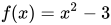

Consider the numerator of a rational function as we allow the variable to grow very large (in either the positive or negative sense). The term with the highest exponent on the variable will dominate the numerator, and the other terms become more and more insignificant compared to the dominating term. The same applies to the denominator. In the limit, the other terms become negligible, and we only need to examine the dominating term in the numerator and denominator.
There is a simple rule for determining a limit of a rational function as the variable approaches infinity. Look for the term with the highest exponent on the variable in the numerator. Look for the same in the denominator. This rule is based on that information.
- If the exponent of the highest term in the numerator matches the exponent of the highest term in the denominator, the limit (at both Failed to parse (MathML with SVG or PNG fallback (recommended for modern browsers and accessibility tools): Invalid response ("Math extension cannot connect to Restbase.") from server "https://wikimedia.org/api/rest_v1/":): {\displaystyle \infty} and Failed to parse (MathML with SVG or PNG fallback (recommended for modern browsers and accessibility tools): Invalid response ("Math extension cannot connect to Restbase.") from server "https://wikimedia.org/api/rest_v1/":): {\displaystyle -\infty} ) is the ratio of the coefficients of the highest terms.
- If the numerator has the highest term, then the fraction is called "top-heavy". If, when you divide the numerator by the denominator the resulting exponent on the variable is even, then the limit (at both Failed to parse (MathML with SVG or PNG fallback (recommended for modern browsers and accessibility tools): Invalid response ("Math extension cannot connect to Restbase.") from server "https://wikimedia.org/api/rest_v1/":): {\displaystyle \infty} and Failed to parse (MathML with SVG or PNG fallback (recommended for modern browsers and accessibility tools): Invalid response ("Math extension cannot connect to Restbase.") from server "https://wikimedia.org/api/rest_v1/":): {\displaystyle -\infty} ) is Failed to parse (MathML with SVG or PNG fallback (recommended for modern browsers and accessibility tools): Invalid response ("Math extension cannot connect to Restbase.") from server "https://wikimedia.org/api/rest_v1/":): {\displaystyle \infty} . If it is odd, then the limit at Failed to parse (MathML with SVG or PNG fallback (recommended for modern browsers and accessibility tools): Invalid response ("Math extension cannot connect to Restbase.") from server "https://wikimedia.org/api/rest_v1/":): {\displaystyle \infty} is Failed to parse (MathML with SVG or PNG fallback (recommended for modern browsers and accessibility tools): Invalid response ("Math extension cannot connect to Restbase.") from server "https://wikimedia.org/api/rest_v1/":): {\displaystyle \infty} , and the limit at Failed to parse (MathML with SVG or PNG fallback (recommended for modern browsers and accessibility tools): Invalid response ("Math extension cannot connect to Restbase.") from server "https://wikimedia.org/api/rest_v1/":): {\displaystyle -\infty} is Failed to parse (MathML with SVG or PNG fallback (recommended for modern browsers and accessibility tools): Invalid response ("Math extension cannot connect to Restbase.") from server "https://wikimedia.org/api/rest_v1/":): {\displaystyle -\infty} .
- If the denominator has the highest term, then the fraction is called "bottom-heavy" and the limit at both Failed to parse (MathML with SVG or PNG fallback (recommended for modern browsers and accessibility tools): Invalid response ("Math extension cannot connect to Restbase.") from server "https://wikimedia.org/api/rest_v1/":): {\displaystyle \pm\infty} is 0.
Note that, if the numerator or denominator is a constant (including 1, as above), then this is the same as Failed to parse (MathML with SVG or PNG fallback (recommended for modern browsers and accessibility tools): Invalid response ("Math extension cannot connect to Restbase.") from server "https://wikimedia.org/api/rest_v1/":): {\displaystyle x^0} . Also, a straight power of Failed to parse (MathML with SVG or PNG fallback (recommended for modern browsers and accessibility tools): Invalid response ("Math extension cannot connect to Restbase.") from server "https://wikimedia.org/api/rest_v1/":): {\displaystyle x} , like Failed to parse (MathML with SVG or PNG fallback (recommended for modern browsers and accessibility tools): Invalid response ("Math extension cannot connect to Restbase.") from server "https://wikimedia.org/api/rest_v1/":): {\displaystyle x^3} , has coefficient 1, since it is the same as Failed to parse (MathML with SVG or PNG fallback (recommended for modern browsers and accessibility tools): Invalid response ("Math extension cannot connect to Restbase.") from server "https://wikimedia.org/api/rest_v1/":): {\displaystyle 1x^3} .
Examples
- Example 1
Find Failed to parse (MathML with SVG or PNG fallback (recommended for modern browsers and accessibility tools): Invalid response ("Math extension cannot connect to Restbase.") from server "https://wikimedia.org/api/rest_v1/":): {\displaystyle \lim_{x\to\infty}\frac{x-5}{x-3}} .
The function Failed to parse (MathML with SVG or PNG fallback (recommended for modern browsers and accessibility tools): Invalid response ("Math extension cannot connect to Restbase.") from server "https://wikimedia.org/api/rest_v1/":): {\displaystyle f(x)=\frac{x-5}{x-3}} is the quotient of two polynomials, Failed to parse (MathML with SVG or PNG fallback (recommended for modern browsers and accessibility tools): Invalid response ("Math extension cannot connect to Restbase.") from server "https://wikimedia.org/api/rest_v1/":): {\displaystyle x-5} and Failed to parse (MathML with SVG or PNG fallback (recommended for modern browsers and accessibility tools): Invalid response ("Math extension cannot connect to Restbase.") from server "https://wikimedia.org/api/rest_v1/":): {\displaystyle x-3} . By our rule we look for the term with highest exponent in the numerator; it's Failed to parse (MathML with SVG or PNG fallback (recommended for modern browsers and accessibility tools): Invalid response ("Math extension cannot connect to Restbase.") from server "https://wikimedia.org/api/rest_v1/":): {\displaystyle x} . The term with highest exponent in the denominator is also Failed to parse (MathML with SVG or PNG fallback (recommended for modern browsers and accessibility tools): Invalid response ("Math extension cannot connect to Restbase.") from server "https://wikimedia.org/api/rest_v1/":): {\displaystyle x} . So, the limit is the ratio of their coefficients. Since Failed to parse (MathML with SVG or PNG fallback (recommended for modern browsers and accessibility tools): Invalid response ("Math extension cannot connect to Restbase.") from server "https://wikimedia.org/api/rest_v1/":): {\displaystyle x=1x} , both coefficients are 1, Failed to parse (MathML with SVG or PNG fallback (recommended for modern browsers and accessibility tools): Invalid response ("Math extension cannot connect to Restbase.") from server "https://wikimedia.org/api/rest_v1/":): {\displaystyle \lim_{x\to\infty}\frac{x-5}{x-3}=\frac11=1} .
- Example 2
Find Failed to parse (MathML with SVG or PNG fallback (recommended for modern browsers and accessibility tools): Invalid response ("Math extension cannot connect to Restbase.") from server "https://wikimedia.org/api/rest_v1/":): {\displaystyle \lim_{x\to\infty}\frac{x^3+x-6}{x^2-4x+3}} .
Using L'Hôpital's rule Failed to parse (MathML with SVG or PNG fallback (recommended for modern browsers and accessibility tools): Invalid response ("Math extension cannot connect to Restbase.") from server "https://wikimedia.org/api/rest_v1/":): {\displaystyle d/dx (x^3+x-6) = 3x^2+1}
and
Failed to parse (MathML with SVG or PNG fallback (recommended for modern browsers and accessibility tools): Invalid response ("Math extension cannot connect to Restbase.") from server "https://wikimedia.org/api/rest_v1/":): {\displaystyle d/dx (x^2-4x+3)=2x-4 }
We look at the terms with the highest exponents; for the numerator, it is Failed to parse (MathML with SVG or PNG fallback (recommended for modern browsers and accessibility tools): Invalid response ("Math extension cannot connect to Restbase.") from server "https://wikimedia.org/api/rest_v1/":): {\displaystyle x^3} , while for the denominator it is Failed to parse (MathML with SVG or PNG fallback (recommended for modern browsers and accessibility tools): Invalid response ("Math extension cannot connect to Restbase.") from server "https://wikimedia.org/api/rest_v1/":): {\displaystyle x^2} . Since the exponent on the numerator is higher, we know the limit at Failed to parse (MathML with SVG or PNG fallback (recommended for modern browsers and accessibility tools): Invalid response ("Math extension cannot connect to Restbase.") from server "https://wikimedia.org/api/rest_v1/":): {\displaystyle \infty} will be Failed to parse (MathML with SVG or PNG fallback (recommended for modern browsers and accessibility tools): Invalid response ("Math extension cannot connect to Restbase.") from server "https://wikimedia.org/api/rest_v1/":): {\displaystyle \infty} . So,
- Failed to parse (MathML with SVG or PNG fallback (recommended for modern browsers and accessibility tools): Invalid response ("Math extension cannot connect to Restbase.") from server "https://wikimedia.org/api/rest_v1/":): {\displaystyle \lim_{x\to\infty}\frac{x^3+x-6}{x^2-4x+3}=\infty} .
Formal Definitions of Limits Involving Infinity

It is very common, given limits, to work with the concept of infinity. However, the concept of infinity has yet to be well defined. Intuitively, we know that infinity represents endlessness and it is represented as ∞. Yet, infinity itself is not a number. The current limit definition will fail if we use infinity like a number. If you suppose some limit where c = ∞ and we use our original definition, it would mean that
- Failed to parse (MathML with SVG or PNG fallback (recommended for modern browsers and accessibility tools): Invalid response ("Math extension cannot connect to Restbase.") from server "https://wikimedia.org/api/rest_v1/":): {\displaystyle \lim_{x \rightarrow \infty}f(x) = L} means that Failed to parse (MathML with SVG or PNG fallback (recommended for modern browsers and accessibility tools): Invalid response ("Math extension cannot connect to Restbase.") from server "https://wikimedia.org/api/rest_v1/":): {\displaystyle \forall M>0: \exists \delta : 0 < |x - \infty| < \delta \implies |f(x) - L| < \epsilon }
Which is clearly nonsense!
- You cannot "subtract by infinity" - infinity isn't a number nor is it really a variable.
- Infinity cannot be bounded, yet by putting infinity in a Failed to parse (MathML with SVG or PNG fallback (recommended for modern browsers and accessibility tools): Invalid response ("Math extension cannot connect to Restbase.") from server "https://wikimedia.org/api/rest_v1/":): {\displaystyle |a - b| < x} format, it implies boundedness.
So, the definition needs to be rewritten, which is done in the following chart. The definitions for when either the limit as x approaches positive or negative infinity; or the limit as ƒ(x) converges to positive or negative infinity are as follows:
Note: Yes, the approaching and converging distinction is important. You can look at it as either referencing the delta or the epsilon, respectively.}}
| Notation | Formulation |
|---|---|
| Failed to parse (MathML with SVG or PNG fallback (recommended for modern browsers and accessibility tools): Invalid response ("Math extension cannot connect to Restbase.") from server "https://wikimedia.org/api/rest_v1/":): {\displaystyle \lim_{x \rightarrow c}f(x) = \infty} | Failed to parse (MathML with SVG or PNG fallback (recommended for modern browsers and accessibility tools): Invalid response ("Math extension cannot connect to Restbase.") from server "https://wikimedia.org/api/rest_v1/":): {\displaystyle \forall N>0: \exists \delta: 0<|x-c|<\delta \implies f(x) > N} |
| Failed to parse (MathML with SVG or PNG fallback (recommended for modern browsers and accessibility tools): Invalid response ("Math extension cannot connect to Restbase.") from server "https://wikimedia.org/api/rest_v1/":): {\displaystyle \lim_{x \rightarrow c}f(x) = -\infty} | Failed to parse (MathML with SVG or PNG fallback (recommended for modern browsers and accessibility tools): Invalid response ("Math extension cannot connect to Restbase.") from server "https://wikimedia.org/api/rest_v1/":): {\displaystyle \forall N>0: \exists \delta: 0<|x-c|<\delta \implies f(x) < -N} |
| Failed to parse (MathML with SVG or PNG fallback (recommended for modern browsers and accessibility tools): Invalid response ("Math extension cannot connect to Restbase.") from server "https://wikimedia.org/api/rest_v1/":): {\displaystyle \lim_{x \rightarrow \infty}f(x) = L} | Failed to parse (MathML with SVG or PNG fallback (recommended for modern browsers and accessibility tools): Invalid response ("Math extension cannot connect to Restbase.") from server "https://wikimedia.org/api/rest_v1/":): {\displaystyle \forall \epsilon > 0: \exists M: x > M \implies |f(x)-L| < \epsilon} |
| Failed to parse (MathML with SVG or PNG fallback (recommended for modern browsers and accessibility tools): Invalid response ("Math extension cannot connect to Restbase.") from server "https://wikimedia.org/api/rest_v1/":): {\displaystyle \lim_{x \rightarrow -\infty}f(x) = L} | Failed to parse (MathML with SVG or PNG fallback (recommended for modern browsers and accessibility tools): Invalid response ("Math extension cannot connect to Restbase.") from server "https://wikimedia.org/api/rest_v1/":): {\displaystyle \forall \epsilon > 0: \exists M: x < -M \implies |f(x)-L| < \epsilon} |
| Failed to parse (MathML with SVG or PNG fallback (recommended for modern browsers and accessibility tools): Invalid response ("Math extension cannot connect to Restbase.") from server "https://wikimedia.org/api/rest_v1/":): {\displaystyle \lim_{x \rightarrow \infty}f(x) = \infty} | Failed to parse (MathML with SVG or PNG fallback (recommended for modern browsers and accessibility tools): Invalid response ("Math extension cannot connect to Restbase.") from server "https://wikimedia.org/api/rest_v1/":): {\displaystyle \forall N > 0: \exists M: x > M \implies f(x) > N} |
| Failed to parse (MathML with SVG or PNG fallback (recommended for modern browsers and accessibility tools): Invalid response ("Math extension cannot connect to Restbase.") from server "https://wikimedia.org/api/rest_v1/":): {\displaystyle \lim_{x \rightarrow \infty}f(x) = -\infty} | Failed to parse (MathML with SVG or PNG fallback (recommended for modern browsers and accessibility tools): Invalid response ("Math extension cannot connect to Restbase.") from server "https://wikimedia.org/api/rest_v1/":): {\displaystyle \forall N > 0: \exists M: x > M \implies f(x) < -N} |
| Failed to parse (MathML with SVG or PNG fallback (recommended for modern browsers and accessibility tools): Invalid response ("Math extension cannot connect to Restbase.") from server "https://wikimedia.org/api/rest_v1/":): {\displaystyle \lim_{x \rightarrow -\infty}f(x) = \infty} | Failed to parse (MathML with SVG or PNG fallback (recommended for modern browsers and accessibility tools): Invalid response ("Math extension cannot connect to Restbase.") from server "https://wikimedia.org/api/rest_v1/":): {\displaystyle \forall N > 0: \exists M: x < -M \implies f(x) > N} |
| Failed to parse (MathML with SVG or PNG fallback (recommended for modern browsers and accessibility tools): Invalid response ("Math extension cannot connect to Restbase.") from server "https://wikimedia.org/api/rest_v1/":): {\displaystyle \forall N > 0: \exists M: x < -M \implies f(x) < -N} |
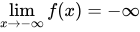
Take a note of the following variables:
- N usually notates a limit with infinity and is analogous to ε.
- M usually notates a limit with infinity and is analogous to δ.
We only use big N and M because the connotation associated with ε and δ is that they are small numbers. Big N and M has the opposite connotation.
Licensing
Content obtained and/or adapted from:
- Infinite limits, Wikibooks: Calculus under a CC BY-SA license
- Limits, Wikibooks: Real Analysis under a CC BY-SA license
- Limit of a function, Wikipedia under a CC BY-SA license

