Difference between revisions of "Uniform Convergence of Sequences of Functions"
| (4 intermediate revisions by the same user not shown) | |||
| Line 11: | Line 11: | ||
<math>\begin{align} \quad ( f_n(x) )_{n=1}^{\infty} = \left ( nx \right )_{n=1}^{\infty} = (x, 2x, ..., nx, ...) \end{align}</math> | <math>\begin{align} \quad ( f_n(x) )_{n=1}^{\infty} = \left ( nx \right )_{n=1}^{\infty} = (x, 2x, ..., nx, ...) \end{align}</math> | ||
<p>This is a sequence of diagonal straight lines that pass through the origin and whose slope is increasing. The following illustrates a few of the functions in this sequence:</p> | <p>This is a sequence of diagonal straight lines that pass through the origin and whose slope is increasing. The following illustrates a few of the functions in this sequence:</p> | ||
| − | + | ||
| + | :::[http://mathonline.wdfiles.com/local--files/sequences-of-functions/Screen%20Shot%202015-10-19%20at%205.44.29%20PM.png Graph of a Sequence of Linear Functions] | ||
| + | |||
<p>For another example, consider the following sequence of functions:</p> | <p>For another example, consider the following sequence of functions:</p> | ||
| Line 17: | Line 19: | ||
<p>This is a sequence of the simplest <math>n^{\mathrm{th}}</math> degree polynomials whose exponent is increasing. The following illustrates a few of the functions in this sequence:</p> | <p>This is a sequence of the simplest <math>n^{\mathrm{th}}</math> degree polynomials whose exponent is increasing. The following illustrates a few of the functions in this sequence:</p> | ||
| − | [http://mathonline.wdfiles.com/local--files/sequences-of-functions/Screen%20Shot%202015-10-19%20at%205.48.10%20PM.png Graph of a Sequence of | + | :::[http://mathonline.wdfiles.com/local--files/sequences-of-functions/Screen%20Shot%202015-10-19%20at%205.48.10%20PM.png Graph of a Sequence of Polynomials] |
==Pointwise Convergence of Functions== | ==Pointwise Convergence of Functions== | ||
| Line 42: | Line 44: | ||
==Uniform Convergence of Sequences of Functions== | ==Uniform Convergence of Sequences of Functions== | ||
| − | <p> | + | <p>The sequence of functions <math>(f_n(x))_{n=1}^{\infty}</math> with common domain <math>X</math> is convergent to the limit function <math>f(x)</math> if for all <math>x \in X</math> and for all <math>\varepsilon > 0</math> there exists an <math>N \in \mathbb{N}</math> such that if <math>n \geq N</math> then <math>\mid f_n(x) - f(x) \mid < \varepsilon</math>.</p> |
<p>Another somewhat stronger type of convergence of a sequence of functions is called uniform convergence which we define below. Note the subtle but very important difference in the definition below!</p> | <p>Another somewhat stronger type of convergence of a sequence of functions is called uniform convergence which we define below. Note the subtle but very important difference in the definition below!</p> | ||
| Line 53: | Line 55: | ||
<math>\begin{align} \quad f_n(x) - \varepsilon < f(x) < f_n(x) + \varepsilon \end{align}</math> | <math>\begin{align} \quad f_n(x) - \varepsilon < f(x) < f_n(x) + \varepsilon \end{align}</math> | ||
| − | <p>The following graphic illustrates the concept of uniform convergence of a sequence of functions <math>(f_n(x))_{n=1}^{\infty}<math>:</p> | + | <p>The following graphic illustrates the concept of uniform convergence of a sequence of functions <math>(f_n(x))_{n=1}^{\infty}</math>:</p> |
| − | + | ||
| + | :::[http://mathonline.wdfiles.com/local--files/uniform-convergence-of-sequences-of-functions/Screen%20Shot%202015-10-19%20at%209.25.38%20PM.png Uniform Convergence of a Sequence of Functions] | ||
==Licensing== | ==Licensing== | ||
Content obtained and/or adapted from: | Content obtained and/or adapted from: | ||
* [http://mathonline.wikidot.com/sequences-of-functions Sequences of Functions, mathonline.wikidot.com] under a CC BY-SA license | * [http://mathonline.wikidot.com/sequences-of-functions Sequences of Functions, mathonline.wikidot.com] under a CC BY-SA license | ||
| − | * [http://mathonline.wikidot.com/pointwise-convergence-of-sequences-of-functions] under a CC BY-SA license | + | * [http://mathonline.wikidot.com/pointwise-convergence-of-sequences-of-functions Pointwise Convergence of Sequences of Functions] under a CC BY-SA license |
| − | * [http://mathonline.wikidot.com/uniform-convergence-of-sequences-of-functions] under a CC BY-SA license | + | * [http://mathonline.wikidot.com/uniform-convergence-of-sequences-of-functions Uniform Convergence of Sequences of Functions] under a CC BY-SA license |
Latest revision as of 11:48, 27 October 2021
Contents
Sequences of Functions
Definition: An Infinite Sequence of Functions is a sequence of functions with a common domain. The Term of the sequence is the function .



We can define a finite sequence of functions analogously. A finite sequence of functions is denoted .

We can also denote an infinite sequence of functions as simply . We can also use curly brackets to denote a sequence of functions such as or simply .


For example, consider the following sequence of functions:

This is a sequence of diagonal straight lines that pass through the origin and whose slope is increasing. The following illustrates a few of the functions in this sequence:
For another example, consider the following sequence of functions:

This is a sequence of the simplest degree polynomials whose exponent is increasing. The following illustrates a few of the functions in this sequence:
Pointwise Convergence of Functions
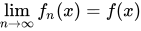
Definition: Let be a sequence of functions with common domain . Then is said to be Pointwise Convergent to the the function written if for all and for all there exists a such that if then .





For example, consider the following sequence of functions defined on :
![{\displaystyle [0,1]}](https://wikimedia.org/api/rest_v1/media/math/render/svg/738f7d23bb2d9642bab520020873cccbef49768d)

We claim that is pointwise convergent to . The following image shows the first six functions in the sequence given above. It should be intuitively clear that the sequence converges to the limit function .

To show this, fix and assume that and let be given. Then since we have that:
![{\displaystyle x\in [0,1]}](https://wikimedia.org/api/rest_v1/media/math/render/svg/64a15936df283add394ab909aa7a5e24e7fb6bb2)


Failed to parse (MathML with SVG or PNG fallback (recommended for modern browsers and accessibility tools): Invalid response ("Math extension cannot connect to Restbase.") from server "https://wikimedia.org/api/rest_v1/":): {\displaystyle \begin{align} \quad \left|f_n(x) - f(x)\right| = \left|\frac{1}{n} x - 0 \right| = \left|\frac{x}{n} \right| = \frac{x}{n} \end{align}}
Choose Failed to parse (MathML with SVG or PNG fallback (recommended for modern browsers and accessibility tools): Invalid response ("Math extension cannot connect to Restbase.") from server "https://wikimedia.org/api/rest_v1/":): {\displaystyle N \in \mathbb{N}} such that Failed to parse (MathML with SVG or PNG fallback (recommended for modern browsers and accessibility tools): Invalid response ("Math extension cannot connect to Restbase.") from server "https://wikimedia.org/api/rest_v1/":): {\displaystyle N > \frac{x}{\varepsilon}} which can be done by the Archimedean property. Then Failed to parse (MathML with SVG or PNG fallback (recommended for modern browsers and accessibility tools): Invalid response ("Math extension cannot connect to Restbase.") from server "https://wikimedia.org/api/rest_v1/":): {\displaystyle \frac{1}{N} < \frac{\varepsilon}{x}} and so for Failed to parse (MathML with SVG or PNG fallback (recommended for modern browsers and accessibility tools): Invalid response ("Math extension cannot connect to Restbase.") from server "https://wikimedia.org/api/rest_v1/":): {\displaystyle n \geq N} we have that:
Failed to parse (MathML with SVG or PNG fallback (recommended for modern browsers and accessibility tools): Invalid response ("Math extension cannot connect to Restbase.") from server "https://wikimedia.org/api/rest_v1/":): {\displaystyle \begin{align} \quad \frac{x}{n} \leq \frac{x}{N} < \frac{\varepsilon x}{x} = \varepsilon \end{align}}
Therefore Failed to parse (MathML with SVG or PNG fallback (recommended for modern browsers and accessibility tools): Invalid response ("Math extension cannot connect to Restbase.") from server "https://wikimedia.org/api/rest_v1/":): {\displaystyle \lim_{n \to \infty} f_n(x) = f(x)} for Failed to parse (MathML with SVG or PNG fallback (recommended for modern browsers and accessibility tools): Invalid response ("Math extension cannot connect to Restbase.") from server "https://wikimedia.org/api/rest_v1/":): {\displaystyle x \in (0, 1]} . Now, for Failed to parse (MathML with SVG or PNG fallback (recommended for modern browsers and accessibility tools): Invalid response ("Math extension cannot connect to Restbase.") from server "https://wikimedia.org/api/rest_v1/":): {\displaystyle x = 0} , notice that:
Failed to parse (MathML with SVG or PNG fallback (recommended for modern browsers and accessibility tools): Invalid response ("Math extension cannot connect to Restbase.") from server "https://wikimedia.org/api/rest_v1/":): {\displaystyle \begin{align} \quad (f_n(0))_{n=1}^{\infty} = (0)_{n=1}^{\infty} = (0, 0, ...) \end{align}}
This sequence clearly converges to Failed to parse (MathML with SVG or PNG fallback (recommended for modern browsers and accessibility tools): Invalid response ("Math extension cannot connect to Restbase.") from server "https://wikimedia.org/api/rest_v1/":): {\displaystyle f(0) = 0} . So, we conclude that Failed to parse (MathML with SVG or PNG fallback (recommended for modern browsers and accessibility tools): Invalid response ("Math extension cannot connect to Restbase.") from server "https://wikimedia.org/api/rest_v1/":): {\displaystyle \displaystyle{\lim_{n \to \infty} f_n(x) = f(x)}} for all Failed to parse (MathML with SVG or PNG fallback (recommended for modern browsers and accessibility tools): Invalid response ("Math extension cannot connect to Restbase.") from server "https://wikimedia.org/api/rest_v1/":): {\displaystyle x \in [0, 1]} . Hence the sequence Failed to parse (MathML with SVG or PNG fallback (recommended for modern browsers and accessibility tools): Invalid response ("Math extension cannot connect to Restbase.") from server "https://wikimedia.org/api/rest_v1/":): {\displaystyle (f_n(x))_{n=1}^{\infty}} is pointwise convergent on all of Failed to parse (MathML with SVG or PNG fallback (recommended for modern browsers and accessibility tools): Invalid response ("Math extension cannot connect to Restbase.") from server "https://wikimedia.org/api/rest_v1/":): {\displaystyle [0, 1]} .
Uniform Convergence of Sequences of Functions
The sequence of functions Failed to parse (MathML with SVG or PNG fallback (recommended for modern browsers and accessibility tools): Invalid response ("Math extension cannot connect to Restbase.") from server "https://wikimedia.org/api/rest_v1/":): {\displaystyle (f_n(x))_{n=1}^{\infty}} with common domain Failed to parse (MathML with SVG or PNG fallback (recommended for modern browsers and accessibility tools): Invalid response ("Math extension cannot connect to Restbase.") from server "https://wikimedia.org/api/rest_v1/":): {\displaystyle X} is convergent to the limit function Failed to parse (MathML with SVG or PNG fallback (recommended for modern browsers and accessibility tools): Invalid response ("Math extension cannot connect to Restbase.") from server "https://wikimedia.org/api/rest_v1/":): {\displaystyle f(x)} if for all Failed to parse (MathML with SVG or PNG fallback (recommended for modern browsers and accessibility tools): Invalid response ("Math extension cannot connect to Restbase.") from server "https://wikimedia.org/api/rest_v1/":): {\displaystyle x \in X} and for all Failed to parse (MathML with SVG or PNG fallback (recommended for modern browsers and accessibility tools): Invalid response ("Math extension cannot connect to Restbase.") from server "https://wikimedia.org/api/rest_v1/":): {\displaystyle \varepsilon > 0} there exists an such that if Failed to parse (MathML with SVG or PNG fallback (recommended for modern browsers and accessibility tools): Invalid response ("Math extension cannot connect to Restbase.") from server "https://wikimedia.org/api/rest_v1/":): {\displaystyle n \geq N} then Failed to parse (MathML with SVG or PNG fallback (recommended for modern browsers and accessibility tools): Invalid response ("Math extension cannot connect to Restbase.") from server "https://wikimedia.org/api/rest_v1/":): {\displaystyle \mid f_n(x) - f(x) \mid < \varepsilon} .
Another somewhat stronger type of convergence of a sequence of functions is called uniform convergence which we define below. Note the subtle but very important difference in the definition below!
Definition: Let Failed to parse (MathML with SVG or PNG fallback (recommended for modern browsers and accessibility tools): Invalid response ("Math extension cannot connect to Restbase.") from server "https://wikimedia.org/api/rest_v1/":): {\displaystyle (f_n(x))_{n=1}^{\infty}} be a sequence of functions with common domain Failed to parse (MathML with SVG or PNG fallback (recommended for modern browsers and accessibility tools): Invalid response ("Math extension cannot connect to Restbase.") from server "https://wikimedia.org/api/rest_v1/":): {\displaystyle X} . Then Failed to parse (MathML with SVG or PNG fallback (recommended for modern browsers and accessibility tools): Invalid response ("Math extension cannot connect to Restbase.") from server "https://wikimedia.org/api/rest_v1/":): {\displaystyle (f_n(x))_{n=1}^{\infty}} is said to be Uniformly Convergent to the the limit function Failed to parse (MathML with SVG or PNG fallback (recommended for modern browsers and accessibility tools): Invalid response ("Math extension cannot connect to Restbase.") from server "https://wikimedia.org/api/rest_v1/":): {\displaystyle f} (written as Failed to parse (MathML with SVG or PNG fallback (recommended for modern browsers and accessibility tools): Invalid response ("Math extension cannot connect to Restbase.") from server "https://wikimedia.org/api/rest_v1/":): {\displaystyle \lim_{n \to \infty} f_n(x) = f(x)} uniformly on Failed to parse (MathML with SVG or PNG fallback (recommended for modern browsers and accessibility tools): Invalid response ("Math extension cannot connect to Restbase.") from server "https://wikimedia.org/api/rest_v1/":): {\displaystyle X} or as Failed to parse (MathML with SVG or PNG fallback (recommended for modern browsers and accessibility tools): Invalid response ("Math extension cannot connect to Restbase.") from server "https://wikimedia.org/api/rest_v1/":): {\displaystyle f_n \to f } uniformly on Failed to parse (MathML with SVG or PNG fallback (recommended for modern browsers and accessibility tools): Invalid response ("Math extension cannot connect to Restbase.") from server "https://wikimedia.org/api/rest_v1/":): {\displaystyle X} ) if for all Failed to parse (MathML with SVG or PNG fallback (recommended for modern browsers and accessibility tools): Invalid response ("Math extension cannot connect to Restbase.") from server "https://wikimedia.org/api/rest_v1/":): {\displaystyle \varepsilon > 0} there exists a Failed to parse (MathML with SVG or PNG fallback (recommended for modern browsers and accessibility tools): Invalid response ("Math extension cannot connect to Restbase.") from server "https://wikimedia.org/api/rest_v1/":): {\displaystyle N \in \mathbb{N}} such that if Failed to parse (MathML with SVG or PNG fallback (recommended for modern browsers and accessibility tools): Invalid response ("Math extension cannot connect to Restbase.") from server "https://wikimedia.org/api/rest_v1/":): {\displaystyle n \geq N} then Failed to parse (MathML with SVG or PNG fallback (recommended for modern browsers and accessibility tools): Invalid response ("Math extension cannot connect to Restbase.") from server "https://wikimedia.org/api/rest_v1/":): {\displaystyle \mid f_n(x) - f(x) \mid < \varepsilon} for all Failed to parse (MathML with SVG or PNG fallback (recommended for modern browsers and accessibility tools): Invalid response ("Math extension cannot connect to Restbase.") from server "https://wikimedia.org/api/rest_v1/":): {\displaystyle x \in X} .
Graphically, if the sequence of functions Failed to parse (MathML with SVG or PNG fallback (recommended for modern browsers and accessibility tools): Invalid response ("Math extension cannot connect to Restbase.") from server "https://wikimedia.org/api/rest_v1/":): {\displaystyle (f_n(x))_{n=1}^{\infty}} are all real-valued and uniformly converge to the limit function Failed to parse (MathML with SVG or PNG fallback (recommended for modern browsers and accessibility tools): Invalid response ("Math extension cannot connect to Restbase.") from server "https://wikimedia.org/api/rest_v1/":): {\displaystyle f} , then from the definition above, we see that for all Failed to parse (MathML with SVG or PNG fallback (recommended for modern browsers and accessibility tools): Invalid response ("Math extension cannot connect to Restbase.") from server "https://wikimedia.org/api/rest_v1/":): {\displaystyle \varepsilon > 0} there exists an Failed to parse (MathML with SVG or PNG fallback (recommended for modern browsers and accessibility tools): Invalid response ("Math extension cannot connect to Restbase.") from server "https://wikimedia.org/api/rest_v1/":): {\displaystyle N \in \mathbb{N}} such that for all Failed to parse (MathML with SVG or PNG fallback (recommended for modern browsers and accessibility tools): Invalid response ("Math extension cannot connect to Restbase.") from server "https://wikimedia.org/api/rest_v1/":): {\displaystyle n \geq N} we have that the following inequality holds for all Failed to parse (MathML with SVG or PNG fallback (recommended for modern browsers and accessibility tools): Invalid response ("Math extension cannot connect to Restbase.") from server "https://wikimedia.org/api/rest_v1/":): {\displaystyle x \in X} :
Failed to parse (MathML with SVG or PNG fallback (recommended for modern browsers and accessibility tools): Invalid response ("Math extension cannot connect to Restbase.") from server "https://wikimedia.org/api/rest_v1/":): {\displaystyle \begin{align} \quad f_n(x) - \varepsilon < f(x) < f_n(x) + \varepsilon \end{align}}
The following graphic illustrates the concept of uniform convergence of a sequence of functions Failed to parse (MathML with SVG or PNG fallback (recommended for modern browsers and accessibility tools): Invalid response ("Math extension cannot connect to Restbase.") from server "https://wikimedia.org/api/rest_v1/":): {\displaystyle (f_n(x))_{n=1}^{\infty}} :
Licensing
Content obtained and/or adapted from:
- Sequences of Functions, mathonline.wikidot.com under a CC BY-SA license
- Pointwise Convergence of Sequences of Functions under a CC BY-SA license
- Uniform Convergence of Sequences of Functions under a CC BY-SA license


