Difference between revisions of "Limits of Vector Functions"
(Created page with "http://mathonline.wikidot.com/limits-of-vector-valued-functions") |
|||
| (One intermediate revision by the same user not shown) | |||
| Line 1: | Line 1: | ||
| − | http://mathonline.wikidot.com/limits-of-vector-valued-functions | + | |
| + | <blockquote style="background: white; border: 1px solid black; padding: 1em;"> | ||
| + | '''Definition:''' If <span class="math-inline"><math>\vec{r}(t) = (x(t), y(t), z(t))</math></span> is a vector-valued function, then <span class="math-inline"><math>\lim_{t \to a} \vec{r}(t) = \left ( \lim_{t \to a} x(t), \lim_{t \to a} y(t), \lim_{t \to a} z(t) \right )</math></span> provided that the limits of the components exist. | ||
| + | </blockquote> | ||
| + | |||
| + | //Limits of vector-valued functions in <math>\mathbb{R}^n</math> are defined similarly as the limit of each component. // | ||
| + | |||
| + | Let's look at some examples of evaluating limits of vector-valued functions. Consider the vector-valued function <math>\vec{r}(t) = (t^2 - 1, t + 1, e^t)</math> and suppose that we wanted to compute <math>\lim_{t \to 2} \vec{r}(t)</math>. To compute this limit, all we need to do is compute the limits of the components. | ||
| + | |||
| + | <div style="text-align: center;"> <math>\begin{align} \quad \lim_{t \to 2} \vec{r}(t) = \left ( \lim_{t \to 2} t^2 - 1, \lim_{t \to 2} t + 1, \lim_{t \to 2} e^t \right ) = (3, 3, e^2) \end{align}</math></div> | ||
| + | |||
| + | For another example, consider the vector-valued function <math>\vec{r}(t) = \left ( \frac{e^t - 1}{t}, \frac{t - 1}{t+1}, t^2 + 3 \right )</math> and suppose that we wanted to compute <math>\lim_{t \to 0} \vec{r}(t)</math>. To compute this limit, we will compute all of the limits of the components again, however, this time the limits are a little trickier to compute. Fortunately, we have already learned about various rules to evaluate limits. | ||
| + | |||
| + | <div style="text-align: center;"><math>\begin{align} \quad \lim_{t \to 0} \vec{r}(t) = \left ( \lim_{t \to 0} \frac{e^t - 1}{t}, \lim_{t \to 0} \frac{t - 1}{t + 1}, \lim_{t \to 0} t^2 + 3 \right ) \end{align}</math></div> | ||
| + | |||
| + | For <math>\lim_{t \to 0} \frac{e^t - 1}{t}</math> we will use L'Hospital's Rule, and so <math>\lim_{t \to 0} \frac{e^t - 1}{t} \overset{H} = \lim_{t \to 0} \frac{e^t}{1} = 1</math>. | ||
| + | |||
| + | For <math>\lim_{t \to 0} \frac{t - 1}{t+1}</math>, we can use direct substitution and so <math>\lim_{t \to 0} \frac{t-1}{t+1} = -1</math>. | ||
| + | |||
| + | Now <math>\lim_{t \to 0} t^2 + 3</math> is also easy to compute by direct substitution and so <math>\lim_{t \to 0} t^2 + 3 = 3</math>. | ||
| + | |||
| + | Thus we have that <math>\lim_{t \to 0} \vec{r}(t) = (1, -1, 3)</math>. | ||
| + | |||
| + | The following theorem gives us a formal definition to say a vector-valued function <math>\vec{r}(t)</math> has limit <math>\vec{b}</math> at <math>t = a</math>, which is analogous to that of limits of real-valued functions. | ||
| + | |||
| + | <blockquote style="background: white; border: 1px solid black; padding: 1em;"> | ||
| + | :'''Theorem 1:''' Let <math>\vec{r}(t) = (x(t), y(t), z(t))</math> be a vector-valued function and let <math>\vec{b} = (b_1, b_2, b_3) \in \mathbb{R}^3</math>. Then <math>\lim_{t \to a} \vec{r}(t) = \vec{b}</math> if and only if <math>\forall \epsilon > 0</math> <math>\exists \delta > 0</math> such that if <math>0 < \mid t - a \mid < \delta</math> then <math>\| \vec{r}(t) - \vec{b} \| < \epsilon</math>. | ||
| + | </blockquote> | ||
| + | |||
| + | * '''Proof:''' <math>\Rightarrow</math> Suppose that <math>\lim_{t \to a} \vec{r}(t) = \vec{b}</math>. Then we have that:</li> | ||
| + | <div style="text-align: center;"><math>\begin{align} \left ( \lim_{t \to a} x(t), \lim_{t \to a} y(t), \lim_{t \to a} z(t) \right ) = (b_1, b_2, b_3) \end{align}</math></div> | ||
| + | |||
| + | * Now recall that two vectors are equal if and only if their components are equal, and so the equation above implies that <math>\lim_{t \to a} x(t) = b_1</math>, <math>\lim_{t \to a} y(t) = b_2</math>, and <math>\lim_{t \to a} z(t) = b_3</math>. Now notice that these three limits are limits of real-valued functions. | ||
| + | |||
| + | * Since <math>\lim_{t \to a} x(t) = b_1</math> then <math>\forall \epsilon > 0</math> <math>\exists \delta_1 > 0</math> such that if <math>0 < \mid t - a \mid < \delta_1</math> then <math>\mid x(t) - b_1 \mid < \frac{\epsilon}{3}</math>. | ||
| + | |||
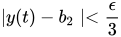
| + | * Since <math>\lim_{t \to a} y(t) = b_2</math> then <math>\forall \epsilon > 0</math> <math>\exists \delta_2 > 0</math> such that if <math>0 < \mid t - a \mid < \delta_2</math> then <math>\mid y(t) - b_2 \mid < \frac{\epsilon}{3}</math>. | ||
| + | |||
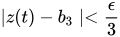
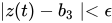
| + | * Since <math>\lim_{t \to a} z(t) = b_3</math> then <math>\forall \epsilon > 0</math> <math>\exists \delta_3 > 0</math> such that if <math>0 < \mid t - a \mid < \delta_3</math> then <math>\mid z(t) - b_3 \mid < \frac{\epsilon}{3}</math>. | ||
| + | |||
| + | * Let <math>\delta = \mathrm{min} \{ \delta_1, \delta_2, \delta_3 \}</math>. Then if <math>0 < \mid t - a \mid < \delta</math> we have that: | ||
| + | <div style="text-align: center;"><math>\begin{align} \quad \quad \| \vec{r}(t) - \vec{b} \| = \| (x(t) - b_1, y(t) - b_2, z(t) - b_3)) \| = \sqrt{(x(t) - b_1)^2 + (y(t) - b_2)^2 + (z(t) - b_3)^2} \\ \quad \quad \leq \sqrt{(x(t) - b_1)^2} + \sqrt{(y(t) - b_2)^2} + \sqrt{(z(t) - b_3)^2} = \mid x(t) - b_1 \mid + \mid y(t) - b_2 \mid + \mid z(t) - b_3 \mid < \frac{\epsilon}{3} + \frac{\epsilon}{3} + \frac{\epsilon}{3} = \epsilon \end{align}</math></div> | ||
| + | |||
| + | * <math>\Leftarrow</math> Suppose that <math>\forall \epsilon > 0</math> <math>\exists \delta > 0</math> such that if <math>0 < \mid t - a \mid < \delta</math> then <math>\| \vec{r}(t) - \vec{b} \| < \epsilon</math>. Therefore we have that | ||
| + | :<math>\| \vec{r}(t) - \vec{b} \| = \| (x(t) - b_1, y(t) - b_2, z(t) - b_3) \| < \epsilon</math>, which implies that: | ||
| + | <div style="text-align: center;"><math>\begin{align} \sqrt{(x(t) - b_1)^2 + (y(t) - b_2)^2 + (z(t) - b_3)^2} < \epsilon \\ (x(t) - b_1)^2 + (y(t) - b_2)^2 + (z(t) - b_3)^2 < \epsilon^2 \\ \end{align}</math></div> | ||
| + | |||
| + | |||
| + | |||
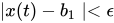
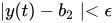
| + | * Now since all terms of the lefthand side of this equation are positive, we must have that for <math>0 < \mid t - a \mid < \delta</math> then <math>(x(t) - b_1)^2 < \epsilon^2</math>, <math>(y(t) - b_2)^2 < \epsilon^2</math>, and <math>(z(t) - b_3)^2 < \epsilon^2</math>, and so <math>\mid x(t) - b_1 \mid < \epsilon</math>, <math>\mid y(t) - b_2 \mid < \epsilon</math> and <math>\mid z(t) - b_3 \mid < \epsilon</math>. Therefore by the definition of real-valued function limits we have that <math>\lim_{t \to a} x(t) = b_1</math>, <math>\lim_{t \to a} y(t) = b_2</math>, and <math>\lim_{t \to a} z(t) = b_3</math>. | ||
| + | |||
| + | * Thus <math>\lim_{t \to a} \vec{r}(t) = \left ( \lim_{t \to a} x(t), \lim_{t \to a} y(t), \lim_{t \to a} z(t) \right ) = (b_1, b_2, b_3) = \vec{b}</math>. <math>\blacksquare</math></li> | ||
| + | |||
| + | == Licensing == | ||
| + | Content obtained and/or adapted from: | ||
| + | * [http://mathonline.wikidot.com/limits-of-vector-valued-functions Limits of Vector-Valued Functions, mathonline.wikidot.com] under a CC BY-SA license | ||
Latest revision as of 16:56, 29 October 2021
Definition: If is a vector-valued function, then provided that the limits of the components exist.

//Limits of vector-valued functions in are defined similarly as the limit of each component. //
Let's look at some examples of evaluating limits of vector-valued functions. Consider the vector-valued function and suppose that we wanted to compute . To compute this limit, all we need to do is compute the limits of the components.

For another example, consider the vector-valued function and suppose that we wanted to compute . To compute this limit, we will compute all of the limits of the components again, however, this time the limits are a little trickier to compute. Fortunately, we have already learned about various rules to evaluate limits.

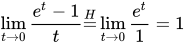
For we will use L'Hospital's Rule, and so .
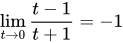
For , we can use direct substitution and so .
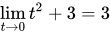
Now Failed to parse (MathML with SVG or PNG fallback (recommended for modern browsers and accessibility tools): Invalid response ("Math extension cannot connect to Restbase.") from server "https://wikimedia.org/api/rest_v1/":): {\displaystyle \lim_{t \to 0} t^2 + 3} is also easy to compute by direct substitution and so Failed to parse (MathML with SVG or PNG fallback (recommended for modern browsers and accessibility tools): Invalid response ("Math extension cannot connect to Restbase.") from server "https://wikimedia.org/api/rest_v1/":): {\displaystyle \lim_{t \to 0} t^2 + 3 = 3} .
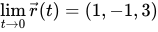
Thus we have that Failed to parse (MathML with SVG or PNG fallback (recommended for modern browsers and accessibility tools): Invalid response ("Math extension cannot connect to Restbase.") from server "https://wikimedia.org/api/rest_v1/":): {\displaystyle \lim_{t \to 0} \vec{r}(t) = (1, -1, 3)} .
The following theorem gives us a formal definition to say a vector-valued function Failed to parse (MathML with SVG or PNG fallback (recommended for modern browsers and accessibility tools): Invalid response ("Math extension cannot connect to Restbase.") from server "https://wikimedia.org/api/rest_v1/":): {\displaystyle \vec{r}(t)} has limit Failed to parse (MathML with SVG or PNG fallback (recommended for modern browsers and accessibility tools): Invalid response ("Math extension cannot connect to Restbase.") from server "https://wikimedia.org/api/rest_v1/":): {\displaystyle \vec{b}} at Failed to parse (MathML with SVG or PNG fallback (recommended for modern browsers and accessibility tools): Invalid response ("Math extension cannot connect to Restbase.") from server "https://wikimedia.org/api/rest_v1/":): {\displaystyle t = a} , which is analogous to that of limits of real-valued functions.
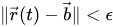
- Theorem 1: Let Failed to parse (MathML with SVG or PNG fallback (recommended for modern browsers and accessibility tools): Invalid response ("Math extension cannot connect to Restbase.") from server "https://wikimedia.org/api/rest_v1/":): {\displaystyle \vec{r}(t) = (x(t), y(t), z(t))} be a vector-valued function and let Failed to parse (MathML with SVG or PNG fallback (recommended for modern browsers and accessibility tools): Invalid response ("Math extension cannot connect to Restbase.") from server "https://wikimedia.org/api/rest_v1/":): {\displaystyle \vec{b} = (b_1, b_2, b_3) \in \mathbb{R}^3} . Then Failed to parse (MathML with SVG or PNG fallback (recommended for modern browsers and accessibility tools): Invalid response ("Math extension cannot connect to Restbase.") from server "https://wikimedia.org/api/rest_v1/":): {\displaystyle \lim_{t \to a} \vec{r}(t) = \vec{b}} if and only if Failed to parse (MathML with SVG or PNG fallback (recommended for modern browsers and accessibility tools): Invalid response ("Math extension cannot connect to Restbase.") from server "https://wikimedia.org/api/rest_v1/":): {\displaystyle \forall \epsilon > 0} Failed to parse (MathML with SVG or PNG fallback (recommended for modern browsers and accessibility tools): Invalid response ("Math extension cannot connect to Restbase.") from server "https://wikimedia.org/api/rest_v1/":): {\displaystyle \exists \delta > 0} such that if Failed to parse (MathML with SVG or PNG fallback (recommended for modern browsers and accessibility tools): Invalid response ("Math extension cannot connect to Restbase.") from server "https://wikimedia.org/api/rest_v1/":): {\displaystyle 0 < \mid t - a \mid < \delta} then Failed to parse (MathML with SVG or PNG fallback (recommended for modern browsers and accessibility tools): Invalid response ("Math extension cannot connect to Restbase.") from server "https://wikimedia.org/api/rest_v1/":): {\displaystyle \| \vec{r}(t) - \vec{b} \| < \epsilon} .
- Proof: Failed to parse (MathML with SVG or PNG fallback (recommended for modern browsers and accessibility tools): Invalid response ("Math extension cannot connect to Restbase.") from server "https://wikimedia.org/api/rest_v1/":): {\displaystyle \Rightarrow} Suppose that Failed to parse (MathML with SVG or PNG fallback (recommended for modern browsers and accessibility tools): Invalid response ("Math extension cannot connect to Restbase.") from server "https://wikimedia.org/api/rest_v1/":): {\displaystyle \lim_{t \to a} \vec{r}(t) = \vec{b}} . Then we have that:
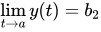
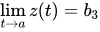
- Now recall that two vectors are equal if and only if their components are equal, and so the equation above implies that Failed to parse (MathML with SVG or PNG fallback (recommended for modern browsers and accessibility tools): Invalid response ("Math extension cannot connect to Restbase.") from server "https://wikimedia.org/api/rest_v1/":): {\displaystyle \lim_{t \to a} x(t) = b_1} , Failed to parse (MathML with SVG or PNG fallback (recommended for modern browsers and accessibility tools): Invalid response ("Math extension cannot connect to Restbase.") from server "https://wikimedia.org/api/rest_v1/":): {\displaystyle \lim_{t \to a} y(t) = b_2} , and Failed to parse (MathML with SVG or PNG fallback (recommended for modern browsers and accessibility tools): Invalid response ("Math extension cannot connect to Restbase.") from server "https://wikimedia.org/api/rest_v1/":): {\displaystyle \lim_{t \to a} z(t) = b_3} . Now notice that these three limits are limits of real-valued functions.
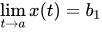
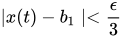
- Since Failed to parse (MathML with SVG or PNG fallback (recommended for modern browsers and accessibility tools): Invalid response ("Math extension cannot connect to Restbase.") from server "https://wikimedia.org/api/rest_v1/":): {\displaystyle \lim_{t \to a} x(t) = b_1} then Failed to parse (MathML with SVG or PNG fallback (recommended for modern browsers and accessibility tools): Invalid response ("Math extension cannot connect to Restbase.") from server "https://wikimedia.org/api/rest_v1/":): {\displaystyle \forall \epsilon > 0} Failed to parse (MathML with SVG or PNG fallback (recommended for modern browsers and accessibility tools): Invalid response ("Math extension cannot connect to Restbase.") from server "https://wikimedia.org/api/rest_v1/":): {\displaystyle \exists \delta_1 > 0} such that if Failed to parse (MathML with SVG or PNG fallback (recommended for modern browsers and accessibility tools): Invalid response ("Math extension cannot connect to Restbase.") from server "https://wikimedia.org/api/rest_v1/":): {\displaystyle 0 < \mid t - a \mid < \delta_1} then Failed to parse (MathML with SVG or PNG fallback (recommended for modern browsers and accessibility tools): Invalid response ("Math extension cannot connect to Restbase.") from server "https://wikimedia.org/api/rest_v1/":): {\displaystyle \mid x(t) - b_1 \mid < \frac{\epsilon}{3}} .
- Since Failed to parse (MathML with SVG or PNG fallback (recommended for modern browsers and accessibility tools): Invalid response ("Math extension cannot connect to Restbase.") from server "https://wikimedia.org/api/rest_v1/":): {\displaystyle \lim_{t \to a} y(t) = b_2} then Failed to parse (MathML with SVG or PNG fallback (recommended for modern browsers and accessibility tools): Invalid response ("Math extension cannot connect to Restbase.") from server "https://wikimedia.org/api/rest_v1/":): {\displaystyle \forall \epsilon > 0} Failed to parse (MathML with SVG or PNG fallback (recommended for modern browsers and accessibility tools): Invalid response ("Math extension cannot connect to Restbase.") from server "https://wikimedia.org/api/rest_v1/":): {\displaystyle \exists \delta_2 > 0} such that if Failed to parse (MathML with SVG or PNG fallback (recommended for modern browsers and accessibility tools): Invalid response ("Math extension cannot connect to Restbase.") from server "https://wikimedia.org/api/rest_v1/":): {\displaystyle 0 < \mid t - a \mid < \delta_2} then Failed to parse (MathML with SVG or PNG fallback (recommended for modern browsers and accessibility tools): Invalid response ("Math extension cannot connect to Restbase.") from server "https://wikimedia.org/api/rest_v1/":): {\displaystyle \mid y(t) - b_2 \mid < \frac{\epsilon}{3}} .
- Since Failed to parse (MathML with SVG or PNG fallback (recommended for modern browsers and accessibility tools): Invalid response ("Math extension cannot connect to Restbase.") from server "https://wikimedia.org/api/rest_v1/":): {\displaystyle \lim_{t \to a} z(t) = b_3} then Failed to parse (MathML with SVG or PNG fallback (recommended for modern browsers and accessibility tools): Invalid response ("Math extension cannot connect to Restbase.") from server "https://wikimedia.org/api/rest_v1/":): {\displaystyle \forall \epsilon > 0} Failed to parse (MathML with SVG or PNG fallback (recommended for modern browsers and accessibility tools): Invalid response ("Math extension cannot connect to Restbase.") from server "https://wikimedia.org/api/rest_v1/":): {\displaystyle \exists \delta_3 > 0} such that if Failed to parse (MathML with SVG or PNG fallback (recommended for modern browsers and accessibility tools): Invalid response ("Math extension cannot connect to Restbase.") from server "https://wikimedia.org/api/rest_v1/":): {\displaystyle 0 < \mid t - a \mid < \delta_3} then Failed to parse (MathML with SVG or PNG fallback (recommended for modern browsers and accessibility tools): Invalid response ("Math extension cannot connect to Restbase.") from server "https://wikimedia.org/api/rest_v1/":): {\displaystyle \mid z(t) - b_3 \mid < \frac{\epsilon}{3}} .
- Let Failed to parse (MathML with SVG or PNG fallback (recommended for modern browsers and accessibility tools): Invalid response ("Math extension cannot connect to Restbase.") from server "https://wikimedia.org/api/rest_v1/":): {\displaystyle \delta = \mathrm{min} \{ \delta_1, \delta_2, \delta_3 \}} . Then if Failed to parse (MathML with SVG or PNG fallback (recommended for modern browsers and accessibility tools): Invalid response ("Math extension cannot connect to Restbase.") from server "https://wikimedia.org/api/rest_v1/":): {\displaystyle 0 < \mid t - a \mid < \delta} we have that:
- Suppose that Failed to parse (MathML with SVG or PNG fallback (recommended for modern browsers and accessibility tools): Invalid response ("Math extension cannot connect to Restbase.") from server "https://wikimedia.org/api/rest_v1/":): {\displaystyle \forall \epsilon > 0} Failed to parse (MathML with SVG or PNG fallback (recommended for modern browsers and accessibility tools): Invalid response ("Math extension cannot connect to Restbase.") from server "https://wikimedia.org/api/rest_v1/":): {\displaystyle \exists \delta > 0} such that if Failed to parse (MathML with SVG or PNG fallback (recommended for modern browsers and accessibility tools): Invalid response ("Math extension cannot connect to Restbase.") from server "https://wikimedia.org/api/rest_v1/":): {\displaystyle 0 < \mid t - a \mid < \delta} then Failed to parse (MathML with SVG or PNG fallback (recommended for modern browsers and accessibility tools): Invalid response ("Math extension cannot connect to Restbase.") from server "https://wikimedia.org/api/rest_v1/":): {\displaystyle \| \vec{r}(t) - \vec{b} \| < \epsilon} . Therefore we have that
- Failed to parse (MathML with SVG or PNG fallback (recommended for modern browsers and accessibility tools): Invalid response ("Math extension cannot connect to Restbase.") from server "https://wikimedia.org/api/rest_v1/":): {\displaystyle \| \vec{r}(t) - \vec{b} \| = \| (x(t) - b_1, y(t) - b_2, z(t) - b_3) \| < \epsilon} , which implies that:
- Now since all terms of the lefthand side of this equation are positive, we must have that for Failed to parse (MathML with SVG or PNG fallback (recommended for modern browsers and accessibility tools): Invalid response ("Math extension cannot connect to Restbase.") from server "https://wikimedia.org/api/rest_v1/":): {\displaystyle 0 < \mid t - a \mid < \delta} then Failed to parse (MathML with SVG or PNG fallback (recommended for modern browsers and accessibility tools): Invalid response ("Math extension cannot connect to Restbase.") from server "https://wikimedia.org/api/rest_v1/":): {\displaystyle (x(t) - b_1)^2 < \epsilon^2} , Failed to parse (MathML with SVG or PNG fallback (recommended for modern browsers and accessibility tools): Invalid response ("Math extension cannot connect to Restbase.") from server "https://wikimedia.org/api/rest_v1/":): {\displaystyle (y(t) - b_2)^2 < \epsilon^2} , and Failed to parse (MathML with SVG or PNG fallback (recommended for modern browsers and accessibility tools): Invalid response ("Math extension cannot connect to Restbase.") from server "https://wikimedia.org/api/rest_v1/":): {\displaystyle (z(t) - b_3)^2 < \epsilon^2} , and so Failed to parse (MathML with SVG or PNG fallback (recommended for modern browsers and accessibility tools): Invalid response ("Math extension cannot connect to Restbase.") from server "https://wikimedia.org/api/rest_v1/":): {\displaystyle \mid x(t) - b_1 \mid < \epsilon} , Failed to parse (MathML with SVG or PNG fallback (recommended for modern browsers and accessibility tools): Invalid response ("Math extension cannot connect to Restbase.") from server "https://wikimedia.org/api/rest_v1/":): {\displaystyle \mid y(t) - b_2 \mid < \epsilon} and Failed to parse (MathML with SVG or PNG fallback (recommended for modern browsers and accessibility tools): Invalid response ("Math extension cannot connect to Restbase.") from server "https://wikimedia.org/api/rest_v1/":): {\displaystyle \mid z(t) - b_3 \mid < \epsilon} . Therefore by the definition of real-valued function limits we have that Failed to parse (MathML with SVG or PNG fallback (recommended for modern browsers and accessibility tools): Invalid response ("Math extension cannot connect to Restbase.") from server "https://wikimedia.org/api/rest_v1/":): {\displaystyle \lim_{t \to a} x(t) = b_1} , Failed to parse (MathML with SVG or PNG fallback (recommended for modern browsers and accessibility tools): Invalid response ("Math extension cannot connect to Restbase.") from server "https://wikimedia.org/api/rest_v1/":): {\displaystyle \lim_{t \to a} y(t) = b_2} , and Failed to parse (MathML with SVG or PNG fallback (recommended for modern browsers and accessibility tools): Invalid response ("Math extension cannot connect to Restbase.") from server "https://wikimedia.org/api/rest_v1/":): {\displaystyle \lim_{t \to a} z(t) = b_3} .
- Thus Failed to parse (MathML with SVG or PNG fallback (recommended for modern browsers and accessibility tools): Invalid response ("Math extension cannot connect to Restbase.") from server "https://wikimedia.org/api/rest_v1/":): {\displaystyle \lim_{t \to a} \vec{r}(t) = \left ( \lim_{t \to a} x(t), \lim_{t \to a} y(t), \lim_{t \to a} z(t) \right ) = (b_1, b_2, b_3) = \vec{b}} . Failed to parse (MathML with SVG or PNG fallback (recommended for modern browsers and accessibility tools): Invalid response ("Math extension cannot connect to Restbase.") from server "https://wikimedia.org/api/rest_v1/":): {\displaystyle \blacksquare}
Licensing
Content obtained and/or adapted from:
- Limits of Vector-Valued Functions, mathonline.wikidot.com under a CC BY-SA license