Difference between revisions of "Separable Metric Spaces"
(Created page with "===Dense Sets in a Metric Space=== <p>We will now look at a new concept regarding metric spaces known as dense sets which we define below.</p> <blockquote style="background: w...") |
|||
| Line 6: | Line 6: | ||
<p>In any metric space <span class="math-inline"><math>(M, d)</math></span> the whole set <span class="math-inline"><math>M</math></span> is always dense in <span class="math-inline"><math>M</math></span>. Furthermore, the empty set <span class="math-inline"><math>\emptyset</math></span> is not dense in <span class="math-inline"><math>M</math></span>.</p> | <p>In any metric space <span class="math-inline"><math>(M, d)</math></span> the whole set <span class="math-inline"><math>M</math></span> is always dense in <span class="math-inline"><math>M</math></span>. Furthermore, the empty set <span class="math-inline"><math>\emptyset</math></span> is not dense in <span class="math-inline"><math>M</math></span>.</p> | ||
<p>For a less trivial example, consider the metric space <span class="math-inline"><math>(\mathbb{R}, d)</math></span> where <span class="math-inline"><math>d</math></span> is the usual Euclidean metric defined for all <span class="math-inline"><math>x, y \in \mathbb{R}</math></span> by <span class="math-inline"><math>d(x, y) = \mid x - y \mid</math></span>, and consider the subset <span class="math-inline"><math>\mathbb{Q} \subset \mathbb{R}</math></span> of rational numbers.</p> | <p>For a less trivial example, consider the metric space <span class="math-inline"><math>(\mathbb{R}, d)</math></span> where <span class="math-inline"><math>d</math></span> is the usual Euclidean metric defined for all <span class="math-inline"><math>x, y \in \mathbb{R}</math></span> by <span class="math-inline"><math>d(x, y) = \mid x - y \mid</math></span>, and consider the subset <span class="math-inline"><math>\mathbb{Q} \subset \mathbb{R}</math></span> of rational numbers.</p> | ||
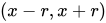
| − | <p>The set <span class="math-inline"><math>\mathbb{Q}</math></span> is dense in <span class="math-inline"><math>\mathbb{R}</math></span> because for any open ball, i.e., for any <span class="math-inline"><math>x \in \mathbb{R}</math></span> and for any <span class="math-inline"><math>r > 0</math></span> we have that the open interval <span class="math-inline"><math>(x - r, x + r)</math></span> contains a rational number | + | <p>The set <span class="math-inline"><math>\mathbb{Q}</math></span> is dense in <span class="math-inline"><math>\mathbb{R}</math></span> because for any open ball, i.e., for any <span class="math-inline"><math>x \in \mathbb{R}</math></span> and for any <span class="math-inline"><math>r > 0</math></span> we have that the open interval <span class="math-inline"><math>(x - r, x + r)</math></span> contains a rational number.</p> |
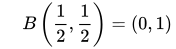
<p>For a counterexample, consider the set <span class="math-inline"><math>\mathbb{Z} \subset \mathbb{R}</math></span> of integers. We claim that <span class="math-inline"><math>\mathbb{Z}</math></span> is not dense in <span class="math-inline"><math>\mathbb{R}</math></span>. To show this, consider the following ball:</p> | <p>For a counterexample, consider the set <span class="math-inline"><math>\mathbb{Z} \subset \mathbb{R}</math></span> of integers. We claim that <span class="math-inline"><math>\mathbb{Z}</math></span> is not dense in <span class="math-inline"><math>\mathbb{R}</math></span>. To show this, consider the following ball:</p> | ||
<div style="text-align: center;"><math>\begin{align} \quad B \left ( \frac{1}{2}, \frac{1}{2} \right ) = (0, 1) \end{align}</math></div> | <div style="text-align: center;"><math>\begin{align} \quad B \left ( \frac{1}{2}, \frac{1}{2} \right ) = (0, 1) \end{align}</math></div> | ||
| Line 14: | Line 14: | ||
<td><strong>Theorem 1:</strong> Let <span class="math-inline"><math>(M, d)</math></span> be a metric space and let <span class="math-inline"><math>S \subseteq M</math></span>. Then, <span class="math-inline"><math>S</math></span> is dense in <span class="math-inline"><math>M</math></span> if and only if <span class="math-inline"><math>\bar{S} = M</math></span>.</td> | <td><strong>Theorem 1:</strong> Let <span class="math-inline"><math>(M, d)</math></span> be a metric space and let <span class="math-inline"><math>S \subseteq M</math></span>. Then, <span class="math-inline"><math>S</math></span> is dense in <span class="math-inline"><math>M</math></span> if and only if <span class="math-inline"><math>\bar{S} = M</math></span>.</td> | ||
</blockquote> | </blockquote> | ||
| − | <p><em>Recall | + | <p><em>Recall that <span class="math-inline"><math>\bar{S}</math></span> denotes the closure of <span class="math-inline"><math>S</math></span>, and we defined the closure of <span class="math-inline"><math>S</math></span> to be the set of adherent points of <span class="math-inline"><math>S</math></span>.</em></p> |
<ul> | <ul> | ||
<li><strong>Proof:</strong> <span class="math-inline"><math>\Rightarrow</math></span> Suppose that <span class="math-inline"><math>S</math></span> is dense in <span class="math-inline"><math>M</math></span>. Then for all <span class="math-inline"><math>x \in M</math></span> and all <span class="math-inline"><math>r > 0</math></span> we have that:</li> | <li><strong>Proof:</strong> <span class="math-inline"><math>\Rightarrow</math></span> Suppose that <span class="math-inline"><math>S</math></span> is dense in <span class="math-inline"><math>M</math></span>. Then for all <span class="math-inline"><math>x \in M</math></span> and all <span class="math-inline"><math>r > 0</math></span> we have that:</li> | ||
| Line 31: | Line 31: | ||
===Separable Metric Spaces=== | ===Separable Metric Spaces=== | ||
| − | <p>Recall | + | <p>Recall that if <span class="math-inline"><math>(M, d)</math></span> is a metric space then a subset <span class="math-inline"><math>S \subseteq M</math></span> is said to be dense in <span class="math-inline"><math>M</math></span> if for every <span class="math-inline"><math>x \in M</math></span> and for all <span class="math-inline"><math>r > 0</math></span> we have that:</p> |
<div style="text-align: center;"><math>\begin{align} \quad B(x, r) \cap S \neq \emptyset \end{align}</math></div> | <div style="text-align: center;"><math>\begin{align} \quad B(x, r) \cap S \neq \emptyset \end{align}</math></div> | ||
<p>In other words, <span class="math-inline"><math>S</math></span> is dense in <span class="math-inline"><math>M</math></span> if every open ball contains a point of <span class="math-inline"><math>S</math></span>.</p> | <p>In other words, <span class="math-inline"><math>S</math></span> is dense in <span class="math-inline"><math>M</math></span> if every open ball contains a point of <span class="math-inline"><math>S</math></span>.</p> | ||
Latest revision as of 11:54, 8 November 2021
Dense Sets in a Metric Space
We will now look at a new concept regarding metric spaces known as dense sets which we define below.
Definition: Let Failed to parse (MathML with SVG or PNG fallback (recommended for modern browsers and accessibility tools): Invalid response ("Math extension cannot connect to Restbase.") from server "https://wikimedia.org/api/rest_v1/":): {\displaystyle (M, d)} be a metric space and let Failed to parse (MathML with SVG or PNG fallback (recommended for modern browsers and accessibility tools): Invalid response ("Math extension cannot connect to Restbase.") from server "https://wikimedia.org/api/rest_v1/":): {\displaystyle S \subseteq M} . Then is said to be Dense in if for every and for every we have that , i.e., every open ball in contains a point of .
In any metric space the whole set is always dense in . Furthermore, the empty set is not dense in .
For a less trivial example, consider the metric space where is the usual Euclidean metric defined for all by , and consider the subset of rational numbers.
The set is dense in because for any open ball, i.e., for any and for any we have that the open interval Failed to parse (MathML with SVG or PNG fallback (recommended for modern browsers and accessibility tools): Invalid response ("Math extension cannot connect to Restbase.") from server "https://wikimedia.org/api/rest_v1/":): {\displaystyle (x - r, x + r)} contains a rational number.
For a counterexample, consider the set Failed to parse (MathML with SVG or PNG fallback (recommended for modern browsers and accessibility tools): Invalid response ("Math extension cannot connect to Restbase.") from server "https://wikimedia.org/api/rest_v1/":): {\displaystyle \mathbb{Z} \subset \mathbb{R}} of integers. We claim that Failed to parse (MathML with SVG or PNG fallback (recommended for modern browsers and accessibility tools): Invalid response ("Math extension cannot connect to Restbase.") from server "https://wikimedia.org/api/rest_v1/":): {\displaystyle \mathbb{Z}} is not dense in Failed to parse (MathML with SVG or PNG fallback (recommended for modern browsers and accessibility tools): Invalid response ("Math extension cannot connect to Restbase.") from server "https://wikimedia.org/api/rest_v1/":): {\displaystyle \mathbb{R}} . To show this, consider the following ball:
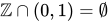
Clearly Failed to parse (MathML with SVG or PNG fallback (recommended for modern browsers and accessibility tools): Invalid response ("Math extension cannot connect to Restbase.") from server "https://wikimedia.org/api/rest_v1/":): {\displaystyle \mathbb{Z} \cap (0, 1) = \emptyset} and so Failed to parse (MathML with SVG or PNG fallback (recommended for modern browsers and accessibility tools): Invalid response ("Math extension cannot connect to Restbase.") from server "https://wikimedia.org/api/rest_v1/":): {\displaystyle \mathbb{Z}} is not dense in Failed to parse (MathML with SVG or PNG fallback (recommended for modern browsers and accessibility tools): Invalid response ("Math extension cannot connect to Restbase.") from server "https://wikimedia.org/api/rest_v1/":): {\displaystyle \mathbb{R}} .
We will now look at a nice theorem which tells us that for a metric space Failed to parse (MathML with SVG or PNG fallback (recommended for modern browsers and accessibility tools): Invalid response ("Math extension cannot connect to Restbase.") from server "https://wikimedia.org/api/rest_v1/":): {\displaystyle (M, d)} a set Failed to parse (MathML with SVG or PNG fallback (recommended for modern browsers and accessibility tools): Invalid response ("Math extension cannot connect to Restbase.") from server "https://wikimedia.org/api/rest_v1/":): {\displaystyle S \subseteq M} is dense in Failed to parse (MathML with SVG or PNG fallback (recommended for modern browsers and accessibility tools): Invalid response ("Math extension cannot connect to Restbase.") from server "https://wikimedia.org/api/rest_v1/":): {\displaystyle M} if and only if its closure equals Failed to parse (MathML with SVG or PNG fallback (recommended for modern browsers and accessibility tools): Invalid response ("Math extension cannot connect to Restbase.") from server "https://wikimedia.org/api/rest_v1/":): {\displaystyle M} .
Theorem 1: Let Failed to parse (MathML with SVG or PNG fallback (recommended for modern browsers and accessibility tools): Invalid response ("Math extension cannot connect to Restbase.") from server "https://wikimedia.org/api/rest_v1/":): {\displaystyle (M, d)} be a metric space and let Failed to parse (MathML with SVG or PNG fallback (recommended for modern browsers and accessibility tools): Invalid response ("Math extension cannot connect to Restbase.") from server "https://wikimedia.org/api/rest_v1/":): {\displaystyle S \subseteq M} . Then, Failed to parse (MathML with SVG or PNG fallback (recommended for modern browsers and accessibility tools): Invalid response ("Math extension cannot connect to Restbase.") from server "https://wikimedia.org/api/rest_v1/":): {\displaystyle S} is dense in Failed to parse (MathML with SVG or PNG fallback (recommended for modern browsers and accessibility tools): Invalid response ("Math extension cannot connect to Restbase.") from server "https://wikimedia.org/api/rest_v1/":): {\displaystyle M} if and only if Failed to parse (MathML with SVG or PNG fallback (recommended for modern browsers and accessibility tools): Invalid response ("Math extension cannot connect to Restbase.") from server "https://wikimedia.org/api/rest_v1/":): {\displaystyle \bar{S} = M} .
Recall that Failed to parse (MathML with SVG or PNG fallback (recommended for modern browsers and accessibility tools): Invalid response ("Math extension cannot connect to Restbase.") from server "https://wikimedia.org/api/rest_v1/":): {\displaystyle \bar{S}} denotes the closure of Failed to parse (MathML with SVG or PNG fallback (recommended for modern browsers and accessibility tools): Invalid response ("Math extension cannot connect to Restbase.") from server "https://wikimedia.org/api/rest_v1/":): {\displaystyle S} , and we defined the closure of Failed to parse (MathML with SVG or PNG fallback (recommended for modern browsers and accessibility tools): Invalid response ("Math extension cannot connect to Restbase.") from server "https://wikimedia.org/api/rest_v1/":): {\displaystyle S} to be the set of adherent points of Failed to parse (MathML with SVG or PNG fallback (recommended for modern browsers and accessibility tools): Invalid response ("Math extension cannot connect to Restbase.") from server "https://wikimedia.org/api/rest_v1/":): {\displaystyle S} .
- Proof: Failed to parse (MathML with SVG or PNG fallback (recommended for modern browsers and accessibility tools): Invalid response ("Math extension cannot connect to Restbase.") from server "https://wikimedia.org/api/rest_v1/":): {\displaystyle \Rightarrow} Suppose that Failed to parse (MathML with SVG or PNG fallback (recommended for modern browsers and accessibility tools): Invalid response ("Math extension cannot connect to Restbase.") from server "https://wikimedia.org/api/rest_v1/":): {\displaystyle S} is dense in Failed to parse (MathML with SVG or PNG fallback (recommended for modern browsers and accessibility tools): Invalid response ("Math extension cannot connect to Restbase.") from server "https://wikimedia.org/api/rest_v1/":): {\displaystyle M} . Then for all Failed to parse (MathML with SVG or PNG fallback (recommended for modern browsers and accessibility tools): Invalid response ("Math extension cannot connect to Restbase.") from server "https://wikimedia.org/api/rest_v1/":): {\displaystyle x \in M} and all Failed to parse (MathML with SVG or PNG fallback (recommended for modern browsers and accessibility tools): Invalid response ("Math extension cannot connect to Restbase.") from server "https://wikimedia.org/api/rest_v1/":): {\displaystyle r > 0} we have that:
- So every is an adherent point of . The set of all adherent points of Failed to parse (MathML with SVG or PNG fallback (recommended for modern browsers and accessibility tools): Invalid response ("Math extension cannot connect to Restbase.") from server "https://wikimedia.org/api/rest_v1/":): {\displaystyle S} is the closure of Failed to parse (MathML with SVG or PNG fallback (recommended for modern browsers and accessibility tools): Invalid response ("Math extension cannot connect to Restbase.") from server "https://wikimedia.org/api/rest_v1/":): {\displaystyle S} , so Failed to parse (MathML with SVG or PNG fallback (recommended for modern browsers and accessibility tools): Invalid response ("Math extension cannot connect to Restbase.") from server "https://wikimedia.org/api/rest_v1/":): {\displaystyle \bar{S} = M} .
- Failed to parse (MathML with SVG or PNG fallback (recommended for modern browsers and accessibility tools): Invalid response ("Math extension cannot connect to Restbase.") from server "https://wikimedia.org/api/rest_v1/":): {\displaystyle \Leftarrow} Suppose that Failed to parse (MathML with SVG or PNG fallback (recommended for modern browsers and accessibility tools): Invalid response ("Math extension cannot connect to Restbase.") from server "https://wikimedia.org/api/rest_v1/":): {\displaystyle \bar{S} = M} . Then every point of Failed to parse (MathML with SVG or PNG fallback (recommended for modern browsers and accessibility tools): Invalid response ("Math extension cannot connect to Restbase.") from server "https://wikimedia.org/api/rest_v1/":): {\displaystyle M} is an adherent point of Failed to parse (MathML with SVG or PNG fallback (recommended for modern browsers and accessibility tools): Invalid response ("Math extension cannot connect to Restbase.") from server "https://wikimedia.org/api/rest_v1/":): {\displaystyle S} , i.e., for all Failed to parse (MathML with SVG or PNG fallback (recommended for modern browsers and accessibility tools): Invalid response ("Math extension cannot connect to Restbase.") from server "https://wikimedia.org/api/rest_v1/":): {\displaystyle x \in M} and for all Failed to parse (MathML with SVG or PNG fallback (recommended for modern browsers and accessibility tools): Invalid response ("Math extension cannot connect to Restbase.") from server "https://wikimedia.org/api/rest_v1/":): {\displaystyle r > 0} we have that:
- Therefore Failed to parse (MathML with SVG or PNG fallback (recommended for modern browsers and accessibility tools): Invalid response ("Math extension cannot connect to Restbase.") from server "https://wikimedia.org/api/rest_v1/":): {\displaystyle S} is dense in Failed to parse (MathML with SVG or PNG fallback (recommended for modern browsers and accessibility tools): Invalid response ("Math extension cannot connect to Restbase.") from server "https://wikimedia.org/api/rest_v1/":): {\displaystyle M} . Failed to parse (MathML with SVG or PNG fallback (recommended for modern browsers and accessibility tools): Invalid response ("Math extension cannot connect to Restbase.") from server "https://wikimedia.org/api/rest_v1/":): {\displaystyle \blacksquare}
Separable Metric Spaces
Recall that if Failed to parse (MathML with SVG or PNG fallback (recommended for modern browsers and accessibility tools): Invalid response ("Math extension cannot connect to Restbase.") from server "https://wikimedia.org/api/rest_v1/":): {\displaystyle (M, d)} is a metric space then a subset Failed to parse (MathML with SVG or PNG fallback (recommended for modern browsers and accessibility tools): Invalid response ("Math extension cannot connect to Restbase.") from server "https://wikimedia.org/api/rest_v1/":): {\displaystyle S \subseteq M} is said to be dense in Failed to parse (MathML with SVG or PNG fallback (recommended for modern browsers and accessibility tools): Invalid response ("Math extension cannot connect to Restbase.") from server "https://wikimedia.org/api/rest_v1/":): {\displaystyle M} if for every Failed to parse (MathML with SVG or PNG fallback (recommended for modern browsers and accessibility tools): Invalid response ("Math extension cannot connect to Restbase.") from server "https://wikimedia.org/api/rest_v1/":): {\displaystyle x \in M} and for all Failed to parse (MathML with SVG or PNG fallback (recommended for modern browsers and accessibility tools): Invalid response ("Math extension cannot connect to Restbase.") from server "https://wikimedia.org/api/rest_v1/":): {\displaystyle r > 0} we have that:
In other words, Failed to parse (MathML with SVG or PNG fallback (recommended for modern browsers and accessibility tools): Invalid response ("Math extension cannot connect to Restbase.") from server "https://wikimedia.org/api/rest_v1/":): {\displaystyle S} is dense in Failed to parse (MathML with SVG or PNG fallback (recommended for modern browsers and accessibility tools): Invalid response ("Math extension cannot connect to Restbase.") from server "https://wikimedia.org/api/rest_v1/":): {\displaystyle M} if every open ball contains a point of Failed to parse (MathML with SVG or PNG fallback (recommended for modern browsers and accessibility tools): Invalid response ("Math extension cannot connect to Restbase.") from server "https://wikimedia.org/api/rest_v1/":): {\displaystyle S} .
We will now look at a special type of metric space known as a separable metric space which we define below.
Definition: A metric space Failed to parse (MathML with SVG or PNG fallback (recommended for modern browsers and accessibility tools): Invalid response ("Math extension cannot connect to Restbase.") from server "https://wikimedia.org/api/rest_v1/":): {\displaystyle (M, d)} is said to be Separable if there exists a countable dense subset Failed to parse (MathML with SVG or PNG fallback (recommended for modern browsers and accessibility tools): Invalid response ("Math extension cannot connect to Restbase.") from server "https://wikimedia.org/api/rest_v1/":): {\displaystyle S} of Failed to parse (MathML with SVG or PNG fallback (recommended for modern browsers and accessibility tools): Invalid response ("Math extension cannot connect to Restbase.") from server "https://wikimedia.org/api/rest_v1/":): {\displaystyle M} .
For example, consider the metric space Failed to parse (MathML with SVG or PNG fallback (recommended for modern browsers and accessibility tools): Invalid response ("Math extension cannot connect to Restbase.") from server "https://wikimedia.org/api/rest_v1/":): {\displaystyle (\mathbb{R}, d)} where Failed to parse (MathML with SVG or PNG fallback (recommended for modern browsers and accessibility tools): Invalid response ("Math extension cannot connect to Restbase.") from server "https://wikimedia.org/api/rest_v1/":): {\displaystyle d} is the usual Euclidean metric defined for all Failed to parse (MathML with SVG or PNG fallback (recommended for modern browsers and accessibility tools): Invalid response ("Math extension cannot connect to Restbase.") from server "https://wikimedia.org/api/rest_v1/":): {\displaystyle x, y \in \mathbb{R}} by Failed to parse (MathML with SVG or PNG fallback (recommended for modern browsers and accessibility tools): Invalid response ("Math extension cannot connect to Restbase.") from server "https://wikimedia.org/api/rest_v1/":): {\displaystyle d(x, y) = \mid x - y \mid} . Then the subset Failed to parse (MathML with SVG or PNG fallback (recommended for modern browsers and accessibility tools): Invalid response ("Math extension cannot connect to Restbase.") from server "https://wikimedia.org/api/rest_v1/":): {\displaystyle \mathbb{Q}} is dense in Failed to parse (MathML with SVG or PNG fallback (recommended for modern browsers and accessibility tools): Invalid response ("Math extension cannot connect to Restbase.") from server "https://wikimedia.org/api/rest_v1/":): {\displaystyle \mathbb{R}} since every open interval contains rational numbers.
In fact, in general, the metric space Failed to parse (MathML with SVG or PNG fallback (recommended for modern browsers and accessibility tools): Invalid response ("Math extension cannot connect to Restbase.") from server "https://wikimedia.org/api/rest_v1/":): {\displaystyle (\mathbb{R}^n, d)} where Failed to parse (MathML with SVG or PNG fallback (recommended for modern browsers and accessibility tools): Invalid response ("Math extension cannot connect to Restbase.") from server "https://wikimedia.org/api/rest_v1/":): {\displaystyle d} is the usual Euclidean metric defined for all Failed to parse (MathML with SVG or PNG fallback (recommended for modern browsers and accessibility tools): Invalid response ("Math extension cannot connect to Restbase.") from server "https://wikimedia.org/api/rest_v1/":): {\displaystyle \mathbf{x} = (x_1, x_2, ..., x_n), \mathbf{y} = (y_1, y_2, ..., y_n) \in \mathbb{R}^n} by:
Then it can be shown similarly that the following set is dense in Failed to parse (MathML with SVG or PNG fallback (recommended for modern browsers and accessibility tools): Invalid response ("Math extension cannot connect to Restbase.") from server "https://wikimedia.org/api/rest_v1/":): {\displaystyle \mathbb{R}^n} :
Licensing
Content obtained and/or adapted from:
- Dense Sets in a Metric Space, mathonline.wikidot.com under a CC BY-SA license
- Separable Metric Spaces, mathonline.wikidot.com under a CC BY-SA license