Difference between revisions of "Lagrange Multipliers"
| (3 intermediate revisions by 2 users not shown) | |||
| Line 1: | Line 1: | ||
| − | + | The method of Lagrange multipliers solves the constrained optimization problem by transforming it into a non-constrained optimization problem of the form: | |
| − | + | * <math>\operatorname{\mathcal{L}}(x_1,x_2,\ldots, x_n,\lambda)= \operatorname{f}(x_1,x_2,\ldots, x_n)+\operatorname{\lambda}(k-g(x_1,x_2,\ldots, x_n))</math> | |
| − | + | Then finding the gradient and Hessian as was done above will determine any optimum values of <math>\operatorname{\mathcal{L}}(x_1,x_2,\ldots, x_n,\lambda)</math>. | |
| − | + | ||
| − | + | Suppose we now want to find optimum values for <math>f(x,y)=2x^2+y^2</math> subject to <math>x+y=1</math> from [2]. | |
| − | + | ||
| + | Then the Lagrangian method will result in a non-constrained function. | ||
| + | * <math>\operatorname{\mathcal{L}}(x,y,\lambda)= 2x^2+y^2+\lambda (1-x-y)</math> | ||
| + | |||
| + | The gradient for this new function is | ||
| + | * <math>\frac{\partial \mathcal{L}}{\partial x}(x,y,\lambda)= 4x+\lambda (-1)=0</math> | ||
| + | * <math>\frac{\partial \mathcal{L}}{\partial y}(x,y,\lambda)= 2y+\lambda (-1)=0</math> | ||
| + | * <math>\frac{\partial \mathcal{L}}{\partial \lambda}(x,y,\lambda)=1-x-y=0</math> | ||
| + | |||
| + | Finding the stationary points of the above equations can be obtained from their matrix from. | ||
| + | |||
| + | : <math> \begin{bmatrix} | ||
| + | 4 & 0 & -1 \\ | ||
| + | 0& 2 & -1 \\ | ||
| + | -1 & -1 & 0 | ||
| + | \end{bmatrix} \begin{bmatrix} | ||
| + | x\\ | ||
| + | y \\ | ||
| + | \lambda \end{bmatrix}= \begin{bmatrix} | ||
| + | 0\\ | ||
| + | 0\\ | ||
| + | -1 | ||
| + | \end{bmatrix} | ||
| + | </math> | ||
| + | |||
| + | This results in <math>x=1/3, y=2/3, \lambda=4/3</math>. | ||
| + | |||
| + | Next we can use the Hessian as before to determine the type of this stationary point. | ||
| + | |||
| + | : <math> H(\mathcal{L})= | ||
| + | \begin{bmatrix} | ||
| + | 4 & 0 & -1 \\ | ||
| + | 0& 2 & -1 \\ | ||
| + | -1&-1&0 | ||
| + | \end{bmatrix} | ||
| + | </math> | ||
| + | |||
| + | Since <math> H(\mathcal{L}) >0 </math> then the solution <math>(1/3,2/3,4/3)</math> minimizes <math>f(x,y)=2x^2+y^2</math> subject to <math>x+y=1</math> with <math>f(x,y)=2/3</math>. | ||
| + | |||
| + | |||
| + | ==Resources== | ||
| + | * [https://en.wikibooks.org/wiki/Calculus_Optimization_Methods/Lagrange_Multipliers Lagrange Multipliers], WikiBooks: Calculus Optimization Methods | ||
| + | |||
| + | ===Videos=== | ||
| + | *[https://www.youtube.com/watch?v=ry9cgNx1QV8&list=RDCMUCFe6jenM1Bc54qtBsIJGRZQ&index=5 LaGrange Multipliers - Finding Maximum or Minimum Values ]Video by patrickJMT | ||
| + | |||
| + | *[https://www.youtube.com/watch?v=x6j6yFzTUgU Lagrange Multipliers Practice Problems] Video by ames Hamblin 2017 | ||
| + | |||
| + | *[https://www.youtube.com/watch?v=HyqBcD_e_Uw Lagrange multipliers | MIT 18.02SC Multivariable Calculus, Fall 2010] Video by MIT OpenCourseWare | ||
| + | |||
| + | *[https://www.youtube.com/watch?v=qXhcpqslNUU Lagrange Multipliers - Two Constraints -patrickJMT 2009 ] Video by patrickJMT 2009 | ||
| + | |||
| + | *[https://www.youtube.com/watch?v=nDuS5uQ7-lo Lagrange multipliers (3 variables) | MIT 18.02SC Multivariable Calculus, Fall 2010] Video by MIT OpenCourseWare | ||
| + | |||
| + | ==Licensing== | ||
| + | Content obtained and/or adapted from: | ||
| + | * [https://en.wikibooks.org/wiki/Calculus_Optimization_Methods/Lagrange_Multipliers Lagrange Multipliers, WikiBooks: Calculus Optimization Methods] under a CC BY-SA license | ||
Latest revision as of 15:52, 2 November 2021
The method of Lagrange multipliers solves the constrained optimization problem by transforming it into a non-constrained optimization problem of the form:

Then finding the gradient and Hessian as was done above will determine any optimum values of .

Suppose we now want to find optimum values for subject to from [2].


Then the Lagrangian method will result in a non-constrained function.

The gradient for this new function is



Finding the stationary points of the above equations can be obtained from their matrix from.
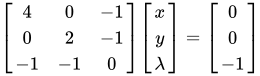
This results in .

Next we can use the Hessian as before to determine the type of this stationary point.
- Failed to parse (MathML with SVG or PNG fallback (recommended for modern browsers and accessibility tools): Invalid response ("Math extension cannot connect to Restbase.") from server "https://wikimedia.org/api/rest_v1/":): {\displaystyle H(\mathcal{L})= \begin{bmatrix} 4 & 0 & -1 \\ 0& 2 & -1 \\ -1&-1&0 \end{bmatrix} }
Since Failed to parse (MathML with SVG or PNG fallback (recommended for modern browsers and accessibility tools): Invalid response ("Math extension cannot connect to Restbase.") from server "https://wikimedia.org/api/rest_v1/":): {\displaystyle H(\mathcal{L}) >0 } then the solution Failed to parse (MathML with SVG or PNG fallback (recommended for modern browsers and accessibility tools): Invalid response ("Math extension cannot connect to Restbase.") from server "https://wikimedia.org/api/rest_v1/":): {\displaystyle (1/3,2/3,4/3)} minimizes Failed to parse (MathML with SVG or PNG fallback (recommended for modern browsers and accessibility tools): Invalid response ("Math extension cannot connect to Restbase.") from server "https://wikimedia.org/api/rest_v1/":): {\displaystyle f(x,y)=2x^2+y^2} subject to Failed to parse (MathML with SVG or PNG fallback (recommended for modern browsers and accessibility tools): Invalid response ("Math extension cannot connect to Restbase.") from server "https://wikimedia.org/api/rest_v1/":): {\displaystyle x+y=1} with Failed to parse (MathML with SVG or PNG fallback (recommended for modern browsers and accessibility tools): Invalid response ("Math extension cannot connect to Restbase.") from server "https://wikimedia.org/api/rest_v1/":): {\displaystyle f(x,y)=2/3} .
Resources
- Lagrange Multipliers, WikiBooks: Calculus Optimization Methods
Videos
- LaGrange Multipliers - Finding Maximum or Minimum Values Video by patrickJMT
- Lagrange Multipliers Practice Problems Video by ames Hamblin 2017
- Lagrange multipliers | MIT 18.02SC Multivariable Calculus, Fall 2010 Video by MIT OpenCourseWare
- Lagrange Multipliers - Two Constraints -patrickJMT 2009 Video by patrickJMT 2009
- Lagrange multipliers (3 variables) | MIT 18.02SC Multivariable Calculus, Fall 2010 Video by MIT OpenCourseWare
Licensing
Content obtained and/or adapted from:
- Lagrange Multipliers, WikiBooks: Calculus Optimization Methods under a CC BY-SA license

