Difference between revisions of "Quantifiers"
| Line 1: | Line 1: | ||
Quantifiers are words, expressions, or phrases that indicate the number of elements that a statement pertains to. In mathematical logic, there are two quantifiers: the universal quantifier ("for all") and the existential quantifier ("there exists"). | Quantifiers are words, expressions, or phrases that indicate the number of elements that a statement pertains to. In mathematical logic, there are two quantifiers: the universal quantifier ("for all") and the existential quantifier ("there exists"). | ||
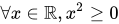
| − | Universal quantifier: This quantifier is used to state a proposition that is true for all variables x of a given set. For example, the proposition "x^2 is a nonnegative number" is true for | + | Universal quantifier: This quantifier is used to state a proposition that is true for all variables x of a given set. For example, the proposition "x^2 is a nonnegative number" is true for every real number, so we state "for all real numbers <math> x </math>, <math> x^2 </math> is nonnegative". Symbolically, we write the universal quantifier as <math> \forall </math> (for example, <math> \forall x \in \R, x^2 \ge 0</math>). |
| + | |||
| + | Universal quantifier: This quantifier is used to state a proposition that is at least true for one element x of a given set. For example, the proposition "n is greater than 7" is not true for all real numbers, but we know it is true for some. | ||
| + | |||
==Resources== | ==Resources== | ||
* [https://math.libretexts.org/Courses/Monroe_Community_College/MATH_220_Discrete_Math/2%3A_Logic/2.7%3A_Quantiers Quantifiers], Mathematics LibreTexts | * [https://math.libretexts.org/Courses/Monroe_Community_College/MATH_220_Discrete_Math/2%3A_Logic/2.7%3A_Quantiers Quantifiers], Mathematics LibreTexts | ||
Revision as of 20:33, 23 September 2021
Quantifiers are words, expressions, or phrases that indicate the number of elements that a statement pertains to. In mathematical logic, there are two quantifiers: the universal quantifier ("for all") and the existential quantifier ("there exists").
Universal quantifier: This quantifier is used to state a proposition that is true for all variables x of a given set. For example, the proposition "x^2 is a nonnegative number" is true for every real number, so we state "for all real numbers , is nonnegative". Symbolically, we write the universal quantifier as (for example, ).


Universal quantifier: This quantifier is used to state a proposition that is at least true for one element x of a given set. For example, the proposition "n is greater than 7" is not true for all real numbers, but we know it is true for some.
Resources
- Quantifiers, Mathematics LibreTexts

