Difference between revisions of "Taylor and Maclaurin Series"
| Line 275: | Line 275: | ||
* [https://www.youtube.com/watch?v=Tq6pNCwI0cM, Maclaurin Series to Estimate a Definite Integral] Video by Krista King | * [https://www.youtube.com/watch?v=Tq6pNCwI0cM, Maclaurin Series to Estimate a Definite Integral] Video by Krista King | ||
* [https://www.youtube.com/watch?v=4WEGEC7mpQU, Maclaurin Series to Estimate an Indefinite Integral] Video by Krista King | * [https://www.youtube.com/watch?v=4WEGEC7mpQU, Maclaurin Series to Estimate an Indefinite Integral] Video by Krista King | ||
| + | |||
| + | ==Licensing== | ||
| + | Content obtained and/or adapted from: | ||
| + | * [https://en.wikibooks.org/wiki/Calculus/Taylor_series Taylor series, Wikibooks: Calculus] under a CC BY-SA license | ||
Latest revision as of 13:41, 29 October 2021
Contents
Taylor Series
- Definition: Taylor series
- A function Failed to parse (MathML with SVG or PNG fallback (recommended for modern browsers and accessibility tools): Invalid response ("Math extension cannot connect to Restbase.") from server "https://wikimedia.org/api/rest_v1/":): {\displaystyle f(x)} is said to be analytic if it can be represented by the an infinite power series
- Failed to parse (MathML with SVG or PNG fallback (recommended for modern browsers and accessibility tools): Invalid response ("Math extension cannot connect to Restbase.") from server "https://wikimedia.org/api/rest_v1/":): {\displaystyle \sum_{n=0}^\infty c_n(x-a)^n}
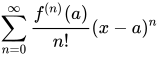
- The Taylor expansion or Taylor series representation of a function, then, is
 sin(x) and Taylor approximations, polynomials of degree 1, 3, 5, 7, 9, 11 and 13.
Here, is the factorial of and denotes the th derivative of at the point . If this series converges for every in the interval and the sum is equal to , then the function is called analytic. To check whether the series converges towards , one normally uses estimates for the remainder term of Taylor's theorem. A function is analytic if and only if a power series converges to the function; the coefficients in that power series are then necessarily the ones given in the above Taylor series formula.


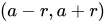

If , the series is also called a Maclaurin series.

The importance of such a power series representation is threefold. First, differentiation and integration of power series can be performed term by term and is hence particularly easy. Second, an analytic function can be uniquely extended to a holomorphic function defined on an open disk in the complex plane, which makes the whole machinery of complex analysis available. Third, the (truncated) series can be used to approximate values of the function near the point of expansion.
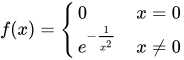
 The function is not analytic: the Taylor series is 0, although the function is not.

Note that there are examples of infinitely often differentiable functions whose Taylor series converge, but are not equal to . For instance, for the function defined piecewise by saying that , all the derivatives are 0 at , so the Taylor series of is 0, and its radius of convergence is infinite, even though the function most definitely is not 0. This particular pathology does not afflict complex-valued functions of a complex variable. Notice that does not approach 0 as approaches 0 along the imaginary axis.


Some functions cannot be written as Taylor series because they have a singularity; in these cases, one can often still achieve a series expansion if one allows also negative powers of the variable ; see Laurent series. For example, can be written as a Laurent series.
The Parker-Sockacki theorem is a recent advance in finding Taylor series which are solutions to differential equations. This theorem is an expansion on the Picard iteration.
Derivation
Suppose we want to represent a function as an infinite power series, or in other words a polynomial with infinite terms of degree "infinity". Each of these terms are assumed to have unique coefficients, as do most finite-polynomials do. We can represent this as an infinite sum like so:

where is the radius of convergence and are coefficients. Next, with summation notation, we can efficiently represent this series as

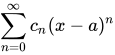
which will become more useful later. As of now, we have no schematic for finding the coefficients other than finding each one in the series by hand. That method would not be particularly useful. Let us, then, try to find a pattern and a general solution for finding the coefficients. As of now, we have a simple method for finding the first coefficient. If we substitute for then we get

This gives us . This is useful, but we still would like a general equation to find any coefficient in the series. We can try differentiating with respect to x the series to get


We can assume and are constant. This proves to be useful, because if we again substitute for we get

- Failed to parse (MathML with SVG or PNG fallback (recommended for modern browsers and accessibility tools): Invalid response ("Math extension cannot connect to Restbase.") from server "https://wikimedia.org/api/rest_v1/":): {\displaystyle f'(a)=c_1}
Noting that the first derivative has one constant term (Failed to parse (MathML with SVG or PNG fallback (recommended for modern browsers and accessibility tools): Invalid response ("Math extension cannot connect to Restbase.") from server "https://wikimedia.org/api/rest_v1/":): {\displaystyle c_1(x-a)^0=c_1} ) we can find the second derivative to find Failed to parse (MathML with SVG or PNG fallback (recommended for modern browsers and accessibility tools): Invalid response ("Math extension cannot connect to Restbase.") from server "https://wikimedia.org/api/rest_v1/":): {\displaystyle c_2} . It is
- Failed to parse (MathML with SVG or PNG fallback (recommended for modern browsers and accessibility tools): Invalid response ("Math extension cannot connect to Restbase.") from server "https://wikimedia.org/api/rest_v1/":): {\displaystyle f''(x)=2c_2+(2\times3)c_3(x-a)^1+(3\times4)c_4(x-a)^2+\cdots+(n)(n-1)c_n(x-a)^{(n-2)}+\cdots}
If we again substitute Failed to parse (MathML with SVG or PNG fallback (recommended for modern browsers and accessibility tools): Invalid response ("Math extension cannot connect to Restbase.") from server "https://wikimedia.org/api/rest_v1/":): {\displaystyle a} for Failed to parse (MathML with SVG or PNG fallback (recommended for modern browsers and accessibility tools): Invalid response ("Math extension cannot connect to Restbase.") from server "https://wikimedia.org/api/rest_v1/":): {\displaystyle x} :
- Failed to parse (MathML with SVG or PNG fallback (recommended for modern browsers and accessibility tools): Invalid response ("Math extension cannot connect to Restbase.") from server "https://wikimedia.org/api/rest_v1/":): {\displaystyle f''(a)=2c_2}
Note that Failed to parse (MathML with SVG or PNG fallback (recommended for modern browsers and accessibility tools): Invalid response ("Math extension cannot connect to Restbase.") from server "https://wikimedia.org/api/rest_v1/":): {\displaystyle c_2} 's initial exponent was 2, and Failed to parse (MathML with SVG or PNG fallback (recommended for modern browsers and accessibility tools): Invalid response ("Math extension cannot connect to Restbase.") from server "https://wikimedia.org/api/rest_v1/":): {\displaystyle c_1} 's initial exponent was 1. This is slightly more enlightening, however it is still slightly ambiguous as to what is happening. Going off the previous examples, if we differentiate again we get
- Failed to parse (MathML with SVG or PNG fallback (recommended for modern browsers and accessibility tools): Invalid response ("Math extension cannot connect to Restbase.") from server "https://wikimedia.org/api/rest_v1/":): {\displaystyle f'''(x)=(2\times3)c_3(x-a)^0+(2\times3\times4)c_4(x-a)^1+(3\times4\times5)c_5(x-a)^2+\cdots+(n)(n-1)(n-2)c_n(x-a)^{n-3}}
If we substitute Failed to parse (MathML with SVG or PNG fallback (recommended for modern browsers and accessibility tools): Invalid response ("Math extension cannot connect to Restbase.") from server "https://wikimedia.org/api/rest_v1/":): {\displaystyle x=a} we, again, that
- Failed to parse (MathML with SVG or PNG fallback (recommended for modern browsers and accessibility tools): Invalid response ("Math extension cannot connect to Restbase.") from server "https://wikimedia.org/api/rest_v1/":): {\displaystyle f'''(a)=(2\times3)c_3}
By now, the pattern should be becoming clearer. Failed to parse (MathML with SVG or PNG fallback (recommended for modern browsers and accessibility tools): Invalid response ("Math extension cannot connect to Restbase.") from server "https://wikimedia.org/api/rest_v1/":): {\displaystyle (n)(n-1)(n-2)} looks suspiciously like Failed to parse (MathML with SVG or PNG fallback (recommended for modern browsers and accessibility tools): Invalid response ("Math extension cannot connect to Restbase.") from server "https://wikimedia.org/api/rest_v1/":): {\displaystyle n!} . And indeed, it is! If we carry this out Failed to parse (MathML with SVG or PNG fallback (recommended for modern browsers and accessibility tools): Invalid response ("Math extension cannot connect to Restbase.") from server "https://wikimedia.org/api/rest_v1/":): {\displaystyle n} times by finding the Failed to parse (MathML with SVG or PNG fallback (recommended for modern browsers and accessibility tools): Invalid response ("Math extension cannot connect to Restbase.") from server "https://wikimedia.org/api/rest_v1/":): {\displaystyle n} th derivative, we find that the multiple of the coefficient is Failed to parse (MathML with SVG or PNG fallback (recommended for modern browsers and accessibility tools): Invalid response ("Math extension cannot connect to Restbase.") from server "https://wikimedia.org/api/rest_v1/":): {\displaystyle n!} . So for some Failed to parse (MathML with SVG or PNG fallback (recommended for modern browsers and accessibility tools): Invalid response ("Math extension cannot connect to Restbase.") from server "https://wikimedia.org/api/rest_v1/":): {\displaystyle c_n} , for any integer Failed to parse (MathML with SVG or PNG fallback (recommended for modern browsers and accessibility tools): Invalid response ("Math extension cannot connect to Restbase.") from server "https://wikimedia.org/api/rest_v1/":): {\displaystyle n\ge0} ,
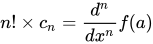
Or, with some simple manipulation, more usefully,
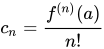
where Failed to parse (MathML with SVG or PNG fallback (recommended for modern browsers and accessibility tools): Invalid response ("Math extension cannot connect to Restbase.") from server "https://wikimedia.org/api/rest_v1/":): {\displaystyle f^{(0)}(x)=f(x)} and Failed to parse (MathML with SVG or PNG fallback (recommended for modern browsers and accessibility tools): Invalid response ("Math extension cannot connect to Restbase.") from server "https://wikimedia.org/api/rest_v1/":): {\displaystyle f^{(1)}(x)=f'(x)} and so on. With this, we can find any coefficient of the "infinite polynomial". Using the summation definition for our "polynomial" given earlier,
- Failed to parse (MathML with SVG or PNG fallback (recommended for modern browsers and accessibility tools): Invalid response ("Math extension cannot connect to Restbase.") from server "https://wikimedia.org/api/rest_v1/":): {\displaystyle \sum_{n=0}^\infty c_n(x-a)^n}
we can substitute for Failed to parse (MathML with SVG or PNG fallback (recommended for modern browsers and accessibility tools): Invalid response ("Math extension cannot connect to Restbase.") from server "https://wikimedia.org/api/rest_v1/":): {\displaystyle c_n} to get
- Failed to parse (MathML with SVG or PNG fallback (recommended for modern browsers and accessibility tools): Invalid response ("Math extension cannot connect to Restbase.") from server "https://wikimedia.org/api/rest_v1/":): {\displaystyle f(x)=\sum_{n=0}^\infty\frac{f^{(n)}(a)}{n!}(x-a)^n}
This is the definition of any Taylor series. But now that we have this series, how can we derive the definition for a given analytic function? We can do just as the definition specifies, and fill in all the necessary information. But we will also want to find a specific pattern, because sometimes we are left with a great many terms simplifying to 0.
First, we have to find Failed to parse (MathML with SVG or PNG fallback (recommended for modern browsers and accessibility tools): Invalid response ("Math extension cannot connect to Restbase.") from server "https://wikimedia.org/api/rest_v1/":): {\displaystyle f(a)} . Because we are now deriving our own Taylor Series, we can choose anything we want for Failed to parse (MathML with SVG or PNG fallback (recommended for modern browsers and accessibility tools): Invalid response ("Math extension cannot connect to Restbase.") from server "https://wikimedia.org/api/rest_v1/":): {\displaystyle f(x)} , but note that not all functions will work. It would be useful to use a function that we can easily find the Failed to parse (MathML with SVG or PNG fallback (recommended for modern browsers and accessibility tools): Invalid response ("Math extension cannot connect to Restbase.") from server "https://wikimedia.org/api/rest_v1/":): {\displaystyle n} -th derivative for. A good example of this would be Failed to parse (MathML with SVG or PNG fallback (recommended for modern browsers and accessibility tools): Invalid response ("Math extension cannot connect to Restbase.") from server "https://wikimedia.org/api/rest_v1/":): {\displaystyle \sin(x)} . With Failed to parse (MathML with SVG or PNG fallback (recommended for modern browsers and accessibility tools): Invalid response ("Math extension cannot connect to Restbase.") from server "https://wikimedia.org/api/rest_v1/":): {\displaystyle \sin(x)} chosen, we can begin to find the derivatives. Before we begin, we should also note that Failed to parse (MathML with SVG or PNG fallback (recommended for modern browsers and accessibility tools): Invalid response ("Math extension cannot connect to Restbase.") from server "https://wikimedia.org/api/rest_v1/":): {\displaystyle a} is essentially the "offset" of the function along the x-axis, because this is also essentially true for any polynomial. With that in mind, we can assume, in this particular case, that the offset is Failed to parse (MathML with SVG or PNG fallback (recommended for modern browsers and accessibility tools): Invalid response ("Math extension cannot connect to Restbase.") from server "https://wikimedia.org/api/rest_v1/":): {\displaystyle 0} and so Failed to parse (MathML with SVG or PNG fallback (recommended for modern browsers and accessibility tools): Invalid response ("Math extension cannot connect to Restbase.") from server "https://wikimedia.org/api/rest_v1/":): {\displaystyle a=0} . With that in mind, "0-th" derivative or the function itself would be
- Failed to parse (MathML with SVG or PNG fallback (recommended for modern browsers and accessibility tools): Invalid response ("Math extension cannot connect to Restbase.") from server "https://wikimedia.org/api/rest_v1/":): {\displaystyle \sin(0)=0}
If we plug that in to the definition of the first term in the series, again noting that Failed to parse (MathML with SVG or PNG fallback (recommended for modern browsers and accessibility tools): Invalid response ("Math extension cannot connect to Restbase.") from server "https://wikimedia.org/api/rest_v1/":): {\displaystyle a=0} , we get
- Failed to parse (MathML with SVG or PNG fallback (recommended for modern browsers and accessibility tools): Invalid response ("Math extension cannot connect to Restbase.") from server "https://wikimedia.org/api/rest_v1/":): {\displaystyle \frac{0}{0!}x^0=0}
where Failed to parse (MathML with SVG or PNG fallback (recommended for modern browsers and accessibility tools): Invalid response ("Math extension cannot connect to Restbase.") from server "https://wikimedia.org/api/rest_v1/":): {\displaystyle 0!=1} . This means that the first term of the series is 0, because anything multiplied by 0 is 0. Take note that not all Taylor series start out with a 0 term. Next, to find the next term, we need to find the first derivative of the function. Remembering that the derivative of Failed to parse (MathML with SVG or PNG fallback (recommended for modern browsers and accessibility tools): Invalid response ("Math extension cannot connect to Restbase.") from server "https://wikimedia.org/api/rest_v1/":): {\displaystyle \sin(x)} is Failed to parse (MathML with SVG or PNG fallback (recommended for modern browsers and accessibility tools): Invalid response ("Math extension cannot connect to Restbase.") from server "https://wikimedia.org/api/rest_v1/":): {\displaystyle \cos(x)} we get that
- Failed to parse (MathML with SVG or PNG fallback (recommended for modern browsers and accessibility tools): Invalid response ("Math extension cannot connect to Restbase.") from server "https://wikimedia.org/api/rest_v1/":): {\displaystyle \frac{d}{dx}\sin(0)=\cos(0)=1}
This means that our second term in the series is
- Failed to parse (MathML with SVG or PNG fallback (recommended for modern browsers and accessibility tools): Invalid response ("Math extension cannot connect to Restbase.") from server "https://wikimedia.org/api/rest_v1/":): {\displaystyle \frac{1}{1!}x^1=x}
Next, we need to find the third term. We repeat this process.
- Failed to parse (MathML with SVG or PNG fallback (recommended for modern browsers and accessibility tools): Invalid response ("Math extension cannot connect to Restbase.") from server "https://wikimedia.org/api/rest_v1/":): {\displaystyle \frac{d^2}{dx^2}\sin(0)=-\sin(0)=0}
Because the derivative of Failed to parse (MathML with SVG or PNG fallback (recommended for modern browsers and accessibility tools): Invalid response ("Math extension cannot connect to Restbase.") from server "https://wikimedia.org/api/rest_v1/":): {\displaystyle \cos(x)=-\sin(x)} . We continue with
- Failed to parse (MathML with SVG or PNG fallback (recommended for modern browsers and accessibility tools): Invalid response ("Math extension cannot connect to Restbase.") from server "https://wikimedia.org/api/rest_v1/":): {\displaystyle \frac{0}{2!}x^2=0}
The fourth term:
- Failed to parse (MathML with SVG or PNG fallback (recommended for modern browsers and accessibility tools): Invalid response ("Math extension cannot connect to Restbase.") from server "https://wikimedia.org/api/rest_v1/":): {\displaystyle \frac{d^3}{dx^3}\sin(0)=-\cos(0)=-1}
- Failed to parse (MathML with SVG or PNG fallback (recommended for modern browsers and accessibility tools): Invalid response ("Math extension cannot connect to Restbase.") from server "https://wikimedia.org/api/rest_v1/":): {\displaystyle \frac{-1}{3!}x^3=\frac{-x^3}{6}}
Repeating this process we can get the sequence
- Failed to parse (MathML with SVG or PNG fallback (recommended for modern browsers and accessibility tools): Invalid response ("Math extension cannot connect to Restbase.") from server "https://wikimedia.org/api/rest_v1/":): {\displaystyle \frac{0}{0!}x^0,\frac{1}{1!}x^1,\frac{0}{2!}x^2,\frac{-1}{3!}x^3,\frac{0}{4!}x^4,\frac{1}{5!}x^5,\frac{0}{6!}x^6,\frac{-1}{7!}x^7,\dots}
which simplifies to
- Failed to parse (MathML with SVG or PNG fallback (recommended for modern browsers and accessibility tools): Invalid response ("Math extension cannot connect to Restbase.") from server "https://wikimedia.org/api/rest_v1/":): {\displaystyle 0,x,0,\frac{-x^3}{6},0,\frac{x^5}{120},0,\frac{-x^7}{5040},\dots}
Because we are ultimately dealing with a series, the zero terms can be ignored, giving use the new sequence
- Failed to parse (MathML with SVG or PNG fallback (recommended for modern browsers and accessibility tools): Invalid response ("Math extension cannot connect to Restbase.") from server "https://wikimedia.org/api/rest_v1/":): {\displaystyle x,\frac{-x^3}{6},\frac{x^5}{120},\frac{-x^7}{5040},\dots}
There is a pattern here, however it may be easier to see if we take the numerator and the denominator separately. The numerator:
- Failed to parse (MathML with SVG or PNG fallback (recommended for modern browsers and accessibility tools): Invalid response ("Math extension cannot connect to Restbase.") from server "https://wikimedia.org/api/rest_v1/":): {\displaystyle 1,-1,1,-1,\dots}
- Failed to parse (MathML with SVG or PNG fallback (recommended for modern browsers and accessibility tools): Invalid response ("Math extension cannot connect to Restbase.") from server "https://wikimedia.org/api/rest_v1/":): {\displaystyle 1!,3!,5!,7!,\dots}
And for the Failed to parse (MathML with SVG or PNG fallback (recommended for modern browsers and accessibility tools): Invalid response ("Math extension cannot connect to Restbase.") from server "https://wikimedia.org/api/rest_v1/":): {\displaystyle x} part of the terms, we have the sequence
- Failed to parse (MathML with SVG or PNG fallback (recommended for modern browsers and accessibility tools): Invalid response ("Math extension cannot connect to Restbase.") from server "https://wikimedia.org/api/rest_v1/":): {\displaystyle x,x^3,x^5,\dots}
By this point, at least for the denominator and the Failed to parse (MathML with SVG or PNG fallback (recommended for modern browsers and accessibility tools): Invalid response ("Math extension cannot connect to Restbase.") from server "https://wikimedia.org/api/rest_v1/":): {\displaystyle x} part, the pattern should be obvious. It is, for the denominator
- Failed to parse (MathML with SVG or PNG fallback (recommended for modern browsers and accessibility tools): Invalid response ("Math extension cannot connect to Restbase.") from server "https://wikimedia.org/api/rest_v1/":): {\displaystyle (2n-1)!=\text{denom}_n}
The Failed to parse (MathML with SVG or PNG fallback (recommended for modern browsers and accessibility tools): Invalid response ("Math extension cannot connect to Restbase.") from server "https://wikimedia.org/api/rest_v1/":): {\displaystyle x} term:
- Failed to parse (MathML with SVG or PNG fallback (recommended for modern browsers and accessibility tools): Invalid response ("Math extension cannot connect to Restbase.") from server "https://wikimedia.org/api/rest_v1/":): {\displaystyle x^{2n-1}=\text{xterm}_n}
Finally, the numerator may not be as obvious, but it follows this pattern:
- Failed to parse (MathML with SVG or PNG fallback (recommended for modern browsers and accessibility tools): Invalid response ("Math extension cannot connect to Restbase.") from server "https://wikimedia.org/api/rest_v1/":): {\displaystyle (-1)^{n-1}}
With all of these things discovered, we can put them together to find the rule for the Failed to parse (MathML with SVG or PNG fallback (recommended for modern browsers and accessibility tools): Invalid response ("Math extension cannot connect to Restbase.") from server "https://wikimedia.org/api/rest_v1/":): {\displaystyle n} th term of the sequence:
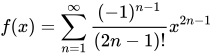
- Failed to parse (MathML with SVG or PNG fallback (recommended for modern browsers and accessibility tools): Invalid response ("Math extension cannot connect to Restbase.") from server "https://wikimedia.org/api/rest_v1/":): {\displaystyle \frac{(-1)^{n-1}}{(2n-1)!}x^{2n-1}=\text{sumterm}_n}
And so our Taylor (Maclaurin) series for Failed to parse (MathML with SVG or PNG fallback (recommended for modern browsers and accessibility tools): Invalid response ("Math extension cannot connect to Restbase.") from server "https://wikimedia.org/api/rest_v1/":): {\displaystyle \sin(x)} is
List of Taylor series
Several important Taylor series expansions follow. All these expansions are also valid for complex arguments .
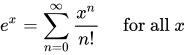
Exponential function and natural logarithm:
- Failed to parse (MathML with SVG or PNG fallback (recommended for modern browsers and accessibility tools): Invalid response ("Math extension cannot connect to Restbase.") from server "https://wikimedia.org/api/rest_v1/":): {\displaystyle \ln(1+x)=\sum_{n=1}^{\infty}\frac{(-1)^{n-1}}n x^n\quad\text{ for }|x|<1}
Geometric series:
- Failed to parse (MathML with SVG or PNG fallback (recommended for modern browsers and accessibility tools): Invalid response ("Math extension cannot connect to Restbase.") from server "https://wikimedia.org/api/rest_v1/":): {\displaystyle \frac{1}{1-x}=\sum_{n=0}^\infty x^n\quad\text{ for }|x|<1}
Binomial series:
- Failed to parse (MathML with SVG or PNG fallback (recommended for modern browsers and accessibility tools): Invalid response ("Math extension cannot connect to Restbase.") from server "https://wikimedia.org/api/rest_v1/":): {\displaystyle (1+x)^\alpha=\sum_{n=0}^\infty\binom{\alpha}{n}x^n\quad\text{ for all }|x|<1\quad\text{ and all complex }\alpha}
Trigonometric functions:
- Failed to parse (MathML with SVG or PNG fallback (recommended for modern browsers and accessibility tools): Invalid response ("Math extension cannot connect to Restbase.") from server "https://wikimedia.org/api/rest_v1/":): {\displaystyle \sin(x)=\sum_{n=1}^\infty\frac{(-1)^{n-1}}{(2n-1)!}x^{2n-1}\quad\text{ for all }x}
- Failed to parse (MathML with SVG or PNG fallback (recommended for modern browsers and accessibility tools): Invalid response ("Math extension cannot connect to Restbase.") from server "https://wikimedia.org/api/rest_v1/":): {\displaystyle \cos(x)=\sum_{n=0}^\infty\frac{(-1)^n}{(2n)!}x^{2n}\quad\text{ for all }x}
- Failed to parse (MathML with SVG or PNG fallback (recommended for modern browsers and accessibility tools): Invalid response ("Math extension cannot connect to Restbase.") from server "https://wikimedia.org/api/rest_v1/":): {\displaystyle \tan(x)=\sum_{n=1}^\infty\frac{B_{2n}(-4)^n(1-4^n)}{(2n)!}x^{2n-1}\quad\text{ for }|x|<\frac{\pi}{2}}
- Failed to parse (MathML with SVG or PNG fallback (recommended for modern browsers and accessibility tools): Invalid response ("Math extension cannot connect to Restbase.") from server "https://wikimedia.org/api/rest_v1/":): {\displaystyle \sec(x)=\sum_{n=0}^\infty\frac{(-1)^nE_{2n}}{(2n)!}x^{2n}\quad\text{ for }|x|<\frac{\pi}{2}}
- Failed to parse (MathML with SVG or PNG fallback (recommended for modern browsers and accessibility tools): Invalid response ("Math extension cannot connect to Restbase.") from server "https://wikimedia.org/api/rest_v1/":): {\displaystyle \arcsin(x)=\sum_{n=0}^\infty\frac{(2n)!}{4^n(n!)^2(2n+1)}x^{2n+1}\quad\text{ for }|x|<1}
- Failed to parse (MathML with SVG or PNG fallback (recommended for modern browsers and accessibility tools): Invalid response ("Math extension cannot connect to Restbase.") from server "https://wikimedia.org/api/rest_v1/":): {\displaystyle \arctan(x)=\sum_{n=0}^\infty\frac{(-1)^n}{2n+1}x^{2n+1}\quad\text{ for }|x|<1}
Hyperbolic functions:
- Failed to parse (MathML with SVG or PNG fallback (recommended for modern browsers and accessibility tools): Invalid response ("Math extension cannot connect to Restbase.") from server "https://wikimedia.org/api/rest_v1/":): {\displaystyle \sinh(x)=\sum_{n=1}^\infty\frac{x^{2n-1}}{(2n-1)!}\quad\text{ for all }x}
- Failed to parse (MathML with SVG or PNG fallback (recommended for modern browsers and accessibility tools): Invalid response ("Math extension cannot connect to Restbase.") from server "https://wikimedia.org/api/rest_v1/":): {\displaystyle \cosh(x)=\sum_{n=0}^\infty\frac{x^{2n}}{(2n)!}\quad\text{ for all }x}
- Failed to parse (MathML with SVG or PNG fallback (recommended for modern browsers and accessibility tools): Invalid response ("Math extension cannot connect to Restbase.") from server "https://wikimedia.org/api/rest_v1/":): {\displaystyle \tanh(x)=\sum_{n=1}^\infty\frac{B_{2n}2^{2n}(2^{2n}-1)}{(2n)!}x^{2n-1}\quad\text{ for }|x|<\frac{\pi}{2}}
- Failed to parse (MathML with SVG or PNG fallback (recommended for modern browsers and accessibility tools): Invalid response ("Math extension cannot connect to Restbase.") from server "https://wikimedia.org/api/rest_v1/":): {\displaystyle {\rm arsinh}(x)=\sum_{n=0}^\infty\frac{(-1)^n(2n)!}{2^{2n}(n!)^2(2n+1)}x^{2n+1}\quad\text{ for }|x|<1}
- Failed to parse (MathML with SVG or PNG fallback (recommended for modern browsers and accessibility tools): Invalid response ("Math extension cannot connect to Restbase.") from server "https://wikimedia.org/api/rest_v1/":): {\displaystyle {\rm artanh}(x)=\sum_{n=1}^\infty\frac{x^{2n-1}}{2n-1}\quad\text{ for }|x|<1}
Lambert's W function:
- Failed to parse (MathML with SVG or PNG fallback (recommended for modern browsers and accessibility tools): Invalid response ("Math extension cannot connect to Restbase.") from server "https://wikimedia.org/api/rest_v1/":): {\displaystyle W_0(x)=\sum_{n=1}^\infty\frac{(-n)^{n-1}}{n!}x^n\quad\text{ for }|x|<\frac{1}{e}}
The numbers Failed to parse (MathML with SVG or PNG fallback (recommended for modern browsers and accessibility tools): Invalid response ("Math extension cannot connect to Restbase.") from server "https://wikimedia.org/api/rest_v1/":): {\displaystyle B_k} appearing in the expansions of Failed to parse (MathML with SVG or PNG fallback (recommended for modern browsers and accessibility tools): Invalid response ("Math extension cannot connect to Restbase.") from server "https://wikimedia.org/api/rest_v1/":): {\displaystyle \tan(x)} and Failed to parse (MathML with SVG or PNG fallback (recommended for modern browsers and accessibility tools): Invalid response ("Math extension cannot connect to Restbase.") from server "https://wikimedia.org/api/rest_v1/":): {\displaystyle \tanh(x)} are the Bernoulli numbers. The Failed to parse (MathML with SVG or PNG fallback (recommended for modern browsers and accessibility tools): Invalid response ("Math extension cannot connect to Restbase.") from server "https://wikimedia.org/api/rest_v1/":): {\displaystyle \binom{\alpha}{n}} in the binomial expansion are the binomial coefficients. The Failed to parse (MathML with SVG or PNG fallback (recommended for modern browsers and accessibility tools): Invalid response ("Math extension cannot connect to Restbase.") from server "https://wikimedia.org/api/rest_v1/":): {\displaystyle E_k} in the expansion of Failed to parse (MathML with SVG or PNG fallback (recommended for modern browsers and accessibility tools): Invalid response ("Math extension cannot connect to Restbase.") from server "https://wikimedia.org/api/rest_v1/":): {\displaystyle sec(x)} are Euler numbers.
Multiple dimensions
The Taylor series may be generalized to functions of more than one variable with
- Failed to parse (MathML with SVG or PNG fallback (recommended for modern browsers and accessibility tools): Invalid response ("Math extension cannot connect to Restbase.") from server "https://wikimedia.org/api/rest_v1/":): {\displaystyle \sum_{n_1=0}^\infty\cdots\sum_{n_d=0}^\infty\frac{\partial^{n_1}}{\partial x_1^{n_1}}\cdots\frac{\partial^{n_d}}{\partial x_d^{n_d}}\frac{f(a_1,\dots,a_d)}{n_1!\cdots n_d!}(x_1-a_1)^{n_1}\cdots (x_d-a_d)^{n_d} }
History
The Taylor series is named for mathematician Brook Taylor, who first published the power series formula in 1715.
Constructing a Taylor Series
Several methods exist for the calculation of Taylor series of a large number of functions. One can attempt to use the Taylor series as-is and generalize the form of the coefficients, or one can use manipulations such as substitution, multiplication or division, addition or subtraction of standard Taylor series (such as those above) to construct the Taylor series of a function, by virtue of Taylor series being power series. In some cases, one can also derive the Taylor series by repeatedly applying integration by parts. The use of computer algebra systems to calculate Taylor series is common, since it eliminates tedious substitution and manipulation.
Example 1
Consider the function
- Failed to parse (MathML with SVG or PNG fallback (recommended for modern browsers and accessibility tools): Invalid response ("Math extension cannot connect to Restbase.") from server "https://wikimedia.org/api/rest_v1/":): {\displaystyle f(x)=\ln\big(1+\cos(x)\big)}
for which we want a Taylor series at 0.
We have for the natural logarithm
- Failed to parse (MathML with SVG or PNG fallback (recommended for modern browsers and accessibility tools): Invalid response ("Math extension cannot connect to Restbase.") from server "https://wikimedia.org/api/rest_v1/":): {\displaystyle \ln(1+x)=\sum_{n=1}^\infty\frac{(-1)^{n+1}}{n}x^n=x-\frac{x^2}{2}+\frac{x^3}{3}-\frac{x^4}{4}+\cdots\quad\text{ for }|x|<1}
and for the cosine function
- Failed to parse (MathML with SVG or PNG fallback (recommended for modern browsers and accessibility tools): Invalid response ("Math extension cannot connect to Restbase.") from server "https://wikimedia.org/api/rest_v1/":): {\displaystyle \cos(x)=\sum_{n=0}^\infty\frac{(-1)^n}{(2n)!}x^{2n}=1-\frac{x^2}{2!}+\frac{x^4}{4!}-\cdots\quad\text{ for all }x\in\C}
We can simply substitute the second series into the first. Doing so gives
- Failed to parse (MathML with SVG or PNG fallback (recommended for modern browsers and accessibility tools): Invalid response ("Math extension cannot connect to Restbase.") from server "https://wikimedia.org/api/rest_v1/":): {\displaystyle \left(1-\frac{x^2}{2!}+\frac{x^4}{4!}-\cdots\right)-\frac12\left(1-\frac{x^2}{2!}+\frac{x^4}{4!}-\cdots\right)^2+\frac13\left(1-\frac{x^2}{2!}+\frac{x^4}{4!}-\cdots\right)^3-\cdots}
Expanding by using multinomial coefficients gives the required Taylor series. Note that cosine and therefore Failed to parse (MathML with SVG or PNG fallback (recommended for modern browsers and accessibility tools): Invalid response ("Math extension cannot connect to Restbase.") from server "https://wikimedia.org/api/rest_v1/":): {\displaystyle f} are even functions, meaning that Failed to parse (MathML with SVG or PNG fallback (recommended for modern browsers and accessibility tools): Invalid response ("Math extension cannot connect to Restbase.") from server "https://wikimedia.org/api/rest_v1/":): {\displaystyle f(x)=f(-x)} , hence the coefficients of the odd powers Failed to parse (MathML with SVG or PNG fallback (recommended for modern browsers and accessibility tools): Invalid response ("Math extension cannot connect to Restbase.") from server "https://wikimedia.org/api/rest_v1/":): {\displaystyle x} , Failed to parse (MathML with SVG or PNG fallback (recommended for modern browsers and accessibility tools): Invalid response ("Math extension cannot connect to Restbase.") from server "https://wikimedia.org/api/rest_v1/":): {\displaystyle x^3} , Failed to parse (MathML with SVG or PNG fallback (recommended for modern browsers and accessibility tools): Invalid response ("Math extension cannot connect to Restbase.") from server "https://wikimedia.org/api/rest_v1/":): {\displaystyle x^5} , Failed to parse (MathML with SVG or PNG fallback (recommended for modern browsers and accessibility tools): Invalid response ("Math extension cannot connect to Restbase.") from server "https://wikimedia.org/api/rest_v1/":): {\displaystyle x^7} and so on have to be zero and don't need to be calculated. The first few terms of the series are
- Failed to parse (MathML with SVG or PNG fallback (recommended for modern browsers and accessibility tools): Invalid response ("Math extension cannot connect to Restbase.") from server "https://wikimedia.org/api/rest_v1/":): {\displaystyle \ln\big(1+\cos(x)\big)=\ln(2)-\frac{x^2}{4}-\frac{x^4}{96}-\frac{x^6}{1440}-\frac{17x^8}{322560}-\frac{31x^{10}}{7257600}-\cdots}
The general coefficient can be represented using Faà di Bruno's formula. However, this representation does not seem to be particularly illuminating and is therefore omitted here.
Example 2
Suppose we want the Taylor series at 0 of the function
- Failed to parse (MathML with SVG or PNG fallback (recommended for modern browsers and accessibility tools): Invalid response ("Math extension cannot connect to Restbase.") from server "https://wikimedia.org/api/rest_v1/":): {\displaystyle g(x)=\frac{e^x}{\cos(x)}}
We have for the exponential function
- Failed to parse (MathML with SVG or PNG fallback (recommended for modern browsers and accessibility tools): Invalid response ("Math extension cannot connect to Restbase.") from server "https://wikimedia.org/api/rest_v1/":): {\displaystyle e^x=\sum_{n=0}^\infty\frac{x^n}{n!}=1+x+\frac{x^2}{2!}+\frac{x^3}{3!}+\frac{x^4}{4!}+\cdots}
and, as in the first example,
- Failed to parse (MathML with SVG or PNG fallback (recommended for modern browsers and accessibility tools): Invalid response ("Math extension cannot connect to Restbase.") from server "https://wikimedia.org/api/rest_v1/":): {\displaystyle \cos(x)=1-\frac{x^2}{2!}+\frac{x^4}{4!}-\cdots}
Assume the power series is
- Failed to parse (MathML with SVG or PNG fallback (recommended for modern browsers and accessibility tools): Invalid response ("Math extension cannot connect to Restbase.") from server "https://wikimedia.org/api/rest_v1/":): {\displaystyle \frac{e^x}{\cos(x)}=c_0+c_1x+c_2x^2+c_3x^3+\cdots}
Then multiplication with the denominator and substitution of the series of the cosine yields
Failed to parse (MathML with SVG or PNG fallback (recommended for modern browsers and accessibility tools): Invalid response ("Math extension cannot connect to Restbase.") from server "https://wikimedia.org/api/rest_v1/":): {\displaystyle e^x} Failed to parse (MathML with SVG or PNG fallback (recommended for modern browsers and accessibility tools): Invalid response ("Math extension cannot connect to Restbase.") from server "https://wikimedia.org/api/rest_v1/":): {\displaystyle =\big(c_0+c_1x+c_2x^2+c_3x^3+\cdots\big)\cos(x)} Failed to parse (MathML with SVG or PNG fallback (recommended for modern browsers and accessibility tools): Invalid response ("Math extension cannot connect to Restbase.") from server "https://wikimedia.org/api/rest_v1/":): {\displaystyle =\left(c_0+c_1x+c_2x^2+c_3x^3+c_4x^4+\cdots\right)\left(1-\frac{x^2}{2!}+\frac{x^4}{4!}-\cdots\right)} Failed to parse (MathML with SVG or PNG fallback (recommended for modern browsers and accessibility tools): Invalid response ("Math extension cannot connect to Restbase.") from server "https://wikimedia.org/api/rest_v1/":): {\displaystyle =c_0-\frac{c_0}{2}x^2+\frac{c_0}{4!}x^4+c_1x-\frac{c_1}{2}x^3+\frac{c_1}{4!}x^5+c_2x^2-\frac{c_2}{2}x^4+\frac{c_2}{4!}x^6+c_3x^3-\frac{c_3}{2}x^5+\frac{c_3}{4!}x^7+\cdots}
Collecting the terms up to fourth order yields
- Failed to parse (MathML with SVG or PNG fallback (recommended for modern browsers and accessibility tools): Invalid response ("Math extension cannot connect to Restbase.") from server "https://wikimedia.org/api/rest_v1/":): {\displaystyle =c_0+c_1x+\left(c_2-\frac{c_0}{2}\right)x^2+\left(c_3-\frac{c_1}{2}\right)x^3+\left(c_4+\frac{c_0}{4!}-\frac{c_2}{2}\right)x^4+\cdots}
Comparing coefficients with the above series of the exponential function yields the desired Taylor series
- Failed to parse (MathML with SVG or PNG fallback (recommended for modern browsers and accessibility tools): Invalid response ("Math extension cannot connect to Restbase.") from server "https://wikimedia.org/api/rest_v1/":): {\displaystyle \frac{e^x}{\cos(x)}=1+x+x^2+\frac{2x^3}{3}+\frac{x^4}{2}+\cdots}
Resources
Taylor and Maclaurin Series
- Taylor and Maclaurin Series Video by James Sousa, Math is Power 4U
- Ex: Find the Taylor Series of x^3 Video by James Sousa, Math is Power 4U
- Ex: Find the Taylor Series of e^x Video by James Sousa, Math is Power 4U
- Determine the Maclaurin Series and Polynomial Video by James Sousa, Math is Power 4U
- Determine the Maclaurin Series and Polynomial of acos(bx^2) Video by James Sousa, Math is Power 4U
- Determine the Maclaurin Series and Polynomial of ax^2e^(bx) Video by James Sousa, Math is Power 4U
- Determine the Maclaurin Series and Polynomial of ax^2sin(bx) Video by James Sousa, Math is Power 4U
- Taylor/Maclaurin Series Expansion, Proof of the Formula Video by Patrick JMT
- Taylor and Maclaurin Series, Example 1 Video by Patrick JMT
- Taylor and Maclaurin Series, Example 2 Video by Patrick JMT
- Finding a Maclaurin Series Expansion - Another Example Video by Patrick JMT
- Finding a New Power Series by Manipulating a Known Power Series Ex 1 Video by Patrick JMT
- Finding a New Power Series by Manipulating a Known Power Series Ex 2 Video by Patrick JMT
- Maclaurin Series Video by Krista King
- Maclaurin Series Radius of Convergence Video by Krista King
- Taylor Series and Maclaurin Series Video by The Organic Chemistry Tutor
- Taylor Series Video by 3Blue1Brown
Taylor and Maclaurin Polynomials
- Taylor Polynomials Video by James Sousa, Math is Power 4U
- Find a Degree One and Degree Two Maclaurin Polynomial Video by James Sousa, Math is Power 4U
- Determine a Taylor Polynomial of the Square Root Function Video by James Sousa, Math is Power 4U
- Finding a Maclaurin Polynomial, Ex 1 Patrick JMT
- Finding a Maclaurin Polynomial, Ex 2 Patrick JMT
- Finding a Taylor Polynomial to Approximate a Function, Ex 1 Video by Patrick JMT
- Finding a Taylor Polynomial to Approximate a Function, Ex 2 Video by Patrick JMT
- Finding a Taylor Polynomial to Approximate a Function, Ex 3 Video by Patrick JMT
- Finding a Taylor Polynomial to Approximate a Function, Ex 4 Video by Patrick JMT
- Taylor Polynomial Example 1 Part 1 Video by Krista King
- Taylor Polynomial Example 1 Part 2 Video by Krista King
- Taylor Polynomial Example 2 Part 1 Video by Krista King
- Taylor Polynomial Example 2 Part 2 Video by Krista King
- Taylor Polynomial Example 3 Part 1 Video by Krista King
- Taylor Polynomial Example 3 Part 2 Video by Krista King
- Taylor Polynomial Example 3 Part 3 Video by Krista King
- Taylor Polynomials and Maclaurin Polynomials with Approximations Video by The Organic Chemistry Tutor
Taylor's Inequality / Taylor's Remainder Theorem
- Taylor's Theorem with Remainder Video by James Sousa, Math is Power 4U
- Ex: Find a Maclaurin Polynomial and Error of an Approximation Video by James Sousa, Math is Power 4U
- Ex: Find a Maclaurin Polynomial and the Interval for a Given Error Video by James Sousa, Math is Power 4U
- Ex: Find a Maclaurin Polynomial and the Interval for a Given Error Video by James Sousa, Math is Power 4U
- Taylor's Inequality Video by Patrick JMT
- Taylor's Remainder Theorem, Finding the Remainder Ex 1 Video by Patrick JMT
- Taylor's Remainder Theorem, Finding the Remainder Ex 2 Video by Patrick JMT
- Taylor's Remainder Theorem, Finding the Remainder Ex 3 Video by Patrick JMT
- Taylor's Remainder Theorem, Finding the Remainder Ex 4 Video by Patrick JMT
- Taylor's Inequality Video by Krista King
- Taylor's Remainder Theorem Video by The Organic Chemistry Tutor
- Lagrange Error Bound to Find Error when Using Taylor Polynomials Video by Patrick JMT
Applications of Taylor and Maclaurin Series
- Ex: Use a Maclaurin Polynomial to Approximate an Integral Video by James Sousa, Math is Power 4U
- Ex: Determine a Simplified Power Series for a Function Involving e^(ax) Video by James Sousa, Math is Power 4U
- Find the Sum of an Infinite Series Using a Known Power Series Video by James Sousa, Math is Power 4U
- Find the Sum of an Infinite Series Using a Known Power Series Video by James Sousa, Math is Power 4U
- Find the Sum of an Infinite Series Using a Known Power Series Video by James Sousa, Math is Power 4U
- Using Maclaurin/Taylor Series to Approximate a Definite Integral to a Desired Accuracy Video by Patrick JMT
- Maclaurin Series to Evaluate a Limit Video by Krista King
- Sum of the Maclaurin Series Video by Krista King
- Maclaurin Series to Estimate a Definite Integral Video by Krista King
- Maclaurin Series to Estimate an Indefinite Integral Video by Krista King
Licensing
Content obtained and/or adapted from:
- Taylor series, Wikibooks: Calculus under a CC BY-SA license

