Difference between revisions of "Equation of a Circle"
| Line 24: | Line 24: | ||
* [https://www.khanacademy.org/math/geometry/xff63fac4:hs-geo-conic-sections/hs-geo-circle-expanded-equation/a/circle-equation-review Circle Equation Review], Khan Academy | * [https://www.khanacademy.org/math/geometry/xff63fac4:hs-geo-conic-sections/hs-geo-circle-expanded-equation/a/circle-equation-review Circle Equation Review], Khan Academy | ||
* [https://www.khanacademy.org/math/geometry/xff63fac4:hs-geo-conic-sections/hs-geo-circle-standard-equation/v/radius-and-center-for-a-circle-equation-in-standard-form Standard Form of Circle Equation], Khan Academy | * [https://www.khanacademy.org/math/geometry/xff63fac4:hs-geo-conic-sections/hs-geo-circle-standard-equation/v/radius-and-center-for-a-circle-equation-in-standard-form Standard Form of Circle Equation], Khan Academy | ||
| + | * [https://en.wikipedia.org/wiki/Circle Circle], Wikipedia | ||
Revision as of 14:32, 18 October 2021
Cartesian coordinates

In an x–y Cartesian coordinate system, the circle with center coordinates (a, b) and radius r is the set of all points (x, y) such that

This equation, known as the equation of the circle, follows from the Pythagorean theorem applied to any point on the circle: as shown in the adjacent diagram, the radius is the hypotenuse of a right-angled triangle whose other sides are of length |x − a| and |y − b|. If the circle is centred at the origin (0, 0), then the equation simplifies to

Parametric form
The equation can be written in parametric form using the trigonometric functions sine and cosine as


where t is a parametric variable in the range 0 to , interpreted geometrically as the angle that the ray from (a, b) to (x, y) makes with the positive x axis.

An alternative parametrisation of the circle is
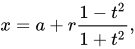
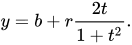
In this parameterisation, the ratio of t to r can be interpreted geometrically as the stereographic projection of the line passing through the centre parallel to the x axis (see Tangent half-angle substitution). However, this parameterisation works only if t is made to range not only through all reals but also to a point at infinity; otherwise, the leftmost point of the circle would be omitted.
Resourcs
- Circle Equation Review, Khan Academy
- Standard Form of Circle Equation, Khan Academy
- Circle, Wikipedia

