Difference between revisions of "Sequences and Their Limits"
| Line 50: | Line 50: | ||
*'''Law 1 (Addition Law of Convergent Sequences):''' If the limits of the sequences <math>\{ a_n \}</math> and <math>\{ b_n \}</math> are convergent, that is <math>\lim_{n \to \infty} a_n = A</math> and <math>\lim_{n \to \infty} b_n = B</math> then <math>\lim_{n \to \infty} (a_n + b_n) = \lim_{n \to \infty} a_n + \lim_{n \to \infty} b_n = A + B</math>. | *'''Law 1 (Addition Law of Convergent Sequences):''' If the limits of the sequences <math>\{ a_n \}</math> and <math>\{ b_n \}</math> are convergent, that is <math>\lim_{n \to \infty} a_n = A</math> and <math>\lim_{n \to \infty} b_n = B</math> then <math>\lim_{n \to \infty} (a_n + b_n) = \lim_{n \to \infty} a_n + \lim_{n \to \infty} b_n = A + B</math>. | ||
| + | |||
| + | |||
| + | :*'''Proof of Law 1:''' Let <math>\{ a_n \}</math> and <math>\{ b_n \}</math> be convergent sequences. By the definition of a sequence being convergent, we know that <math>\lim_{n \to \infty} a_n = A</math> and <math>\lim_{n \to \infty} b_n = B</math> for some <math>A, B \in \mathbb{R}</math>. | ||
| + | |||
| + | |||
| + | :*Now let <math>\epsilon > 0</math> be given, and recall that <math>\lim_{n \to \infty} a_n = A</math> implies that <math>\forall \epsilon \exists N_1 \in \mathbb{N}</math> such that if <math>n \geq N_1</math> then <math>\mid a_n - A \mid < \frac{\epsilon}{2}</math>. Similarly, <math>\lim_{n \to \infty} b_n = B</math> implies that <math>\forall \epsilon \exists N_2 \in \mathbb{N}</math> such that if <math>n \geq N_2</math> then <math>\mid b_n - B \mid < \frac{\epsilon}{2}</math>. | ||
| + | |||
| + | |||
| + | :*We will choose <math>N = \mathrm{max} \{ N_1, N_2 \}</math>. By choosing the larger of <math>N_1</math> and <math>N_2</math>, we ensure that the if <math>n \geq \mathrm{max} \{ N_1, N_2 \}</math>, then <math>\mid a_n - A \mid < \frac{\epsilon}{2}</math> and <math>\mid b_n - B \mid < \frac{\epsilon}{2}</math>. We now want to show that if <math>n \geq N</math>, then <math>\mid (a_n + b_n) - (A + B) \mid < \epsilon</math>. By the triangle inequality we obtain that: | ||
| + | |||
| + | |||
| + | <div style="text-align: center;"><math>\begin{align} \quad \quad \mid (a_n + b_n) - (A + B) \mid = \mid (a_n - A) + (b_n - B) \mid \leq \mid a_n + A \mid + \mid b_n + B \mid < \frac{\epsilon}{2} + \frac{\epsilon}{2} = \epsilon \end{align}</math></div> | ||
| + | |||
| + | |||
| + | :*Therefore <math>\lim_{n \to \infty} (a_n + b_n) = A + B</math>. <math>\blacksquare</math> | ||
| + | |||
| Line 74: | Line 90: | ||
Let <math>f(n) = \frac{n^2 - 1}{n + 1}</math> be a function analogous to our sequence. When we factor the numerator and cancel like-terms, we get that <math>\lim_{n \to \infty} f(n) = \lim_{n \to \infty} \frac{n^2 - 1}{n + 1} = \lim_{n \to \infty} \frac{(n +1)(n - 1)}{n + 1} = \lim_{n \to \infty} n - 1 = \infty</math>. Therefore the sequence <math>\left \{ \frac{x^2 - 1}{x + 1} \right \}_{n=1}^{\infty}</math> is divergent. | Let <math>f(n) = \frac{n^2 - 1}{n + 1}</math> be a function analogous to our sequence. When we factor the numerator and cancel like-terms, we get that <math>\lim_{n \to \infty} f(n) = \lim_{n \to \infty} \frac{n^2 - 1}{n + 1} = \lim_{n \to \infty} \frac{(n +1)(n - 1)}{n + 1} = \lim_{n \to \infty} n - 1 = \infty</math>. Therefore the sequence <math>\left \{ \frac{x^2 - 1}{x + 1} \right \}_{n=1}^{\infty}</math> is divergent. | ||
| + | |||
| + | == Licensing == | ||
| + | Content obtained and/or adapted from: | ||
| + | * [http://mathonline.wikidot.com/limit-of-a-sequence Limit of a Sequence, mathonline.wikidot.com] under a CC BY-SA license | ||
Revision as of 16:30, 21 November 2021
Consider the sequence Failed to parse (MathML with SVG or PNG fallback (recommended for modern browsers and accessibility tools): Invalid response ("Math extension cannot connect to Restbase.") from server "https://wikimedia.org/api/rest_v1/":): {\displaystyle \left \{ \frac{1}{n} \right \}_{n=1}^{\infty} = \left \{ 1, \frac{1}{2}, \frac{1}{3}, \frac{1}{4}, ... \right \}} . As Failed to parse (MathML with SVG or PNG fallback (recommended for modern browsers and accessibility tools): Invalid response ("Math extension cannot connect to Restbase.") from server "https://wikimedia.org/api/rest_v1/":): {\displaystyle n \to \infty} , it appears as though . In fact, we know that this is true since . We will now formalize the definition of a limit with regards to sequences.


- Definition: If is a sequence, then means that for every there exists a corresponding such that if , then . If this limit exists, then we say that the sequence Converges, and if this limit doesn't exist then we say say the sequence Diverges.


We note that our definition of the limit of a sequence is very similar to the limit of a function, in fact, we can think of a sequence as a function whose domain is the set of natural numbers . From this notion, we obtain the very important theorem:

- Theorem 1: If is a sequence and a function , then if where and , then .


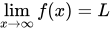

- Proof of Theorem 1: Let be given. We know that which implies that such that if then Failed to parse (MathML with SVG or PNG fallback (recommended for modern browsers and accessibility tools): Invalid response ("Math extension cannot connect to Restbase.") from server "https://wikimedia.org/api/rest_v1/":): {\displaystyle \mid f(x) - L \mid < \epsilon} .


- Now we want to show that Failed to parse (MathML with SVG or PNG fallback (recommended for modern browsers and accessibility tools): Invalid response ("Math extension cannot connect to Restbase.") from server "https://wikimedia.org/api/rest_v1/":): {\displaystyle \forall \epsilon > 0 \exists N \in \mathbb{N}} such that if Failed to parse (MathML with SVG or PNG fallback (recommended for modern browsers and accessibility tools): Invalid response ("Math extension cannot connect to Restbase.") from server "https://wikimedia.org/api/rest_v1/":): {\displaystyle n \geq N} then Failed to parse (MathML with SVG or PNG fallback (recommended for modern browsers and accessibility tools): Invalid response ("Math extension cannot connect to Restbase.") from server "https://wikimedia.org/api/rest_v1/":): {\displaystyle \mid a_n - L \mid < \epsilon} . We will choose Failed to parse (MathML with SVG or PNG fallback (recommended for modern browsers and accessibility tools): Invalid response ("Math extension cannot connect to Restbase.") from server "https://wikimedia.org/api/rest_v1/":): {\displaystyle N = \mathrm{max} \{ 1, \lceil k \rceil \}} . This ensures that Failed to parse (MathML with SVG or PNG fallback (recommended for modern browsers and accessibility tools): Invalid response ("Math extension cannot connect to Restbase.") from server "https://wikimedia.org/api/rest_v1/":): {\displaystyle N} is an integer.
- Now since Failed to parse (MathML with SVG or PNG fallback (recommended for modern browsers and accessibility tools): Invalid response ("Math extension cannot connect to Restbase.") from server "https://wikimedia.org/api/rest_v1/":): {\displaystyle N \geq k} then it follows that if Failed to parse (MathML with SVG or PNG fallback (recommended for modern browsers and accessibility tools): Invalid response ("Math extension cannot connect to Restbase.") from server "https://wikimedia.org/api/rest_v1/":): {\displaystyle \forall n \geq N} then Failed to parse (MathML with SVG or PNG fallback (recommended for modern browsers and accessibility tools): Invalid response ("Math extension cannot connect to Restbase.") from server "https://wikimedia.org/api/rest_v1/":): {\displaystyle \mid f(n) - L \mid < \epsilon} . But Failed to parse (MathML with SVG or PNG fallback (recommended for modern browsers and accessibility tools): Invalid response ("Math extension cannot connect to Restbase.") from server "https://wikimedia.org/api/rest_v1/":): {\displaystyle f(n) = a_n} and so Failed to parse (MathML with SVG or PNG fallback (recommended for modern browsers and accessibility tools): Invalid response ("Math extension cannot connect to Restbase.") from server "https://wikimedia.org/api/rest_v1/":): {\displaystyle \mid a_n - L \mid < \epsilon} so Failed to parse (MathML with SVG or PNG fallback (recommended for modern browsers and accessibility tools): Invalid response ("Math extension cannot connect to Restbase.") from server "https://wikimedia.org/api/rest_v1/":): {\displaystyle \lim_{n \to \infty} a_n = L} . Failed to parse (MathML with SVG or PNG fallback (recommended for modern browsers and accessibility tools): Invalid response ("Math extension cannot connect to Restbase.") from server "https://wikimedia.org/api/rest_v1/":): {\displaystyle \blacksquare}
- Important Note: The converse of this theorem is not implied to be true! That is if Failed to parse (MathML with SVG or PNG fallback (recommended for modern browsers and accessibility tools): Invalid response ("Math extension cannot connect to Restbase.") from server "https://wikimedia.org/api/rest_v1/":): {\displaystyle f(n) = a_n} and Failed to parse (MathML with SVG or PNG fallback (recommended for modern browsers and accessibility tools): Invalid response ("Math extension cannot connect to Restbase.") from server "https://wikimedia.org/api/rest_v1/":): {\displaystyle \lim_{n \to \infty} f(n) = L} , then this does NOT imply that Failed to parse (MathML with SVG or PNG fallback (recommended for modern browsers and accessibility tools): Invalid response ("Math extension cannot connect to Restbase.") from server "https://wikimedia.org/api/rest_v1/":): {\displaystyle \lim_{x \to \infty} f(x) = L} . For example, consider the sequence Failed to parse (MathML with SVG or PNG fallback (recommended for modern browsers and accessibility tools): Invalid response ("Math extension cannot connect to Restbase.") from server "https://wikimedia.org/api/rest_v1/":): {\displaystyle \{ \sin (2\pi n) \} = \{ 0, 0, 0, ... \}} . Clearly this sequence converges at 0. However, the function Failed to parse (MathML with SVG or PNG fallback (recommended for modern browsers and accessibility tools): Invalid response ("Math extension cannot connect to Restbase.") from server "https://wikimedia.org/api/rest_v1/":): {\displaystyle f(x) = \sin (2\pi x)} does not converge, instead, it diverges as it oscillates between Failed to parse (MathML with SVG or PNG fallback (recommended for modern browsers and accessibility tools): Invalid response ("Math extension cannot connect to Restbase.") from server "https://wikimedia.org/api/rest_v1/":): {\displaystyle -1} and Failed to parse (MathML with SVG or PNG fallback (recommended for modern browsers and accessibility tools): Invalid response ("Math extension cannot connect to Restbase.") from server "https://wikimedia.org/api/rest_v1/":): {\displaystyle 1} .
For example, consider the sequence Failed to parse (MathML with SVG or PNG fallback (recommended for modern browsers and accessibility tools): Invalid response ("Math extension cannot connect to Restbase.") from server "https://wikimedia.org/api/rest_v1/":): {\displaystyle \left \{ \frac{n + 2}{n} \right \}_{n=1}^{\infty}} . If we let Failed to parse (MathML with SVG or PNG fallback (recommended for modern browsers and accessibility tools): Invalid response ("Math extension cannot connect to Restbase.") from server "https://wikimedia.org/api/rest_v1/":): {\displaystyle f(n) = \frac{n + 2}{n}} be a function whose domain is the natural numbers, then we calculate the limit of this function like we have in the past, namely:
Therefore the limit of our sequence Failed to parse (MathML with SVG or PNG fallback (recommended for modern browsers and accessibility tools): Invalid response ("Math extension cannot connect to Restbase.") from server "https://wikimedia.org/api/rest_v1/":): {\displaystyle f(n) = a_n}
is 1, that is, Failed to parse (MathML with SVG or PNG fallback (recommended for modern browsers and accessibility tools): Invalid response ("Math extension cannot connect to Restbase.") from server "https://wikimedia.org/api/rest_v1/":): {\displaystyle \left \{ \frac{n + 2}{n} \right \}_{n=1}^{\infty}}
converges to 1 as Failed to parse (MathML with SVG or PNG fallback (recommended for modern browsers and accessibility tools): Invalid response ("Math extension cannot connect to Restbase.") from server "https://wikimedia.org/api/rest_v1/":): {\displaystyle n \to \infty}
.
Now let's look at another major theorem.
- Theorem 2: If Failed to parse (MathML with SVG or PNG fallback (recommended for modern browsers and accessibility tools): Invalid response ("Math extension cannot connect to Restbase.") from server "https://wikimedia.org/api/rest_v1/":): {\displaystyle \lim_{n \to \infty} a_n = L} and a function Failed to parse (MathML with SVG or PNG fallback (recommended for modern browsers and accessibility tools): Invalid response ("Math extension cannot connect to Restbase.") from server "https://wikimedia.org/api/rest_v1/":): {\displaystyle f} is continuous at , then .


- Proof of Theorem 2: If is a continuous function at Failed to parse (MathML with SVG or PNG fallback (recommended for modern browsers and accessibility tools): Invalid response ("Math extension cannot connect to Restbase.") from server "https://wikimedia.org/api/rest_v1/":): {\displaystyle x = L} , then we know that Failed to parse (MathML with SVG or PNG fallback (recommended for modern browsers and accessibility tools): Invalid response ("Math extension cannot connect to Restbase.") from server "https://wikimedia.org/api/rest_v1/":): {\displaystyle f(L)} is defined and that Failed to parse (MathML with SVG or PNG fallback (recommended for modern browsers and accessibility tools): Invalid response ("Math extension cannot connect to Restbase.") from server "https://wikimedia.org/api/rest_v1/":): {\displaystyle \lim_{x \to L} f(x) = f(L)} . By the definition of a limit, Failed to parse (MathML with SVG or PNG fallback (recommended for modern browsers and accessibility tools): Invalid response ("Math extension cannot connect to Restbase.") from server "https://wikimedia.org/api/rest_v1/":): {\displaystyle \forall \epsilon > 0 \exists \delta > 0} such that if Failed to parse (MathML with SVG or PNG fallback (recommended for modern browsers and accessibility tools): Invalid response ("Math extension cannot connect to Restbase.") from server "https://wikimedia.org/api/rest_v1/":): {\displaystyle 0 < \mid x - L \mid < \delta} then Failed to parse (MathML with SVG or PNG fallback (recommended for modern browsers and accessibility tools): Invalid response ("Math extension cannot connect to Restbase.") from server "https://wikimedia.org/api/rest_v1/":): {\displaystyle \mid f(x) - f(L) \mid < \epsilon} . Let Failed to parse (MathML with SVG or PNG fallback (recommended for modern browsers and accessibility tools): Invalid response ("Math extension cannot connect to Restbase.") from server "https://wikimedia.org/api/rest_v1/":): {\displaystyle x = a_n} so then if Failed to parse (MathML with SVG or PNG fallback (recommended for modern browsers and accessibility tools): Invalid response ("Math extension cannot connect to Restbase.") from server "https://wikimedia.org/api/rest_v1/":): {\displaystyle 0 < \mid a_n - L \mid < \delta} then Failed to parse (MathML with SVG or PNG fallback (recommended for modern browsers and accessibility tools): Invalid response ("Math extension cannot connect to Restbase.") from server "https://wikimedia.org/api/rest_v1/":): {\displaystyle \mid f(a_n) - f(L) \mid < \epsilon} .

- We want to show that Failed to parse (MathML with SVG or PNG fallback (recommended for modern browsers and accessibility tools): Invalid response ("Math extension cannot connect to Restbase.") from server "https://wikimedia.org/api/rest_v1/":): {\displaystyle \lim_{n \to \infty} f(a_n) = f(L)} , that is Failed to parse (MathML with SVG or PNG fallback (recommended for modern browsers and accessibility tools): Invalid response ("Math extension cannot connect to Restbase.") from server "https://wikimedia.org/api/rest_v1/":): {\displaystyle \forall \epsilon > 0 \exists N \in \mathbb{N}} such that if Failed to parse (MathML with SVG or PNG fallback (recommended for modern browsers and accessibility tools): Invalid response ("Math extension cannot connect to Restbase.") from server "https://wikimedia.org/api/rest_v1/":): {\displaystyle n \geq N} then Failed to parse (MathML with SVG or PNG fallback (recommended for modern browsers and accessibility tools): Invalid response ("Math extension cannot connect to Restbase.") from server "https://wikimedia.org/api/rest_v1/":): {\displaystyle \mid f(a_n) - f(L) \mid < \epsilon} , which is what we showed above.
We will now look at some important limit laws regarding sequences
Limit Laws of Convergent Sequences
We will now look at some very important limit laws regarding convergent sequences, all of which are analogous to the limit laws for functions that we already know of.
- Law 1 (Addition Law of Convergent Sequences): If the limits of the sequences Failed to parse (MathML with SVG or PNG fallback (recommended for modern browsers and accessibility tools): Invalid response ("Math extension cannot connect to Restbase.") from server "https://wikimedia.org/api/rest_v1/":): {\displaystyle \{ a_n \}} and Failed to parse (MathML with SVG or PNG fallback (recommended for modern browsers and accessibility tools): Invalid response ("Math extension cannot connect to Restbase.") from server "https://wikimedia.org/api/rest_v1/":): {\displaystyle \{ b_n \}} are convergent, that is Failed to parse (MathML with SVG or PNG fallback (recommended for modern browsers and accessibility tools): Invalid response ("Math extension cannot connect to Restbase.") from server "https://wikimedia.org/api/rest_v1/":): {\displaystyle \lim_{n \to \infty} a_n = A} and Failed to parse (MathML with SVG or PNG fallback (recommended for modern browsers and accessibility tools): Invalid response ("Math extension cannot connect to Restbase.") from server "https://wikimedia.org/api/rest_v1/":): {\displaystyle \lim_{n \to \infty} b_n = B} then Failed to parse (MathML with SVG or PNG fallback (recommended for modern browsers and accessibility tools): Invalid response ("Math extension cannot connect to Restbase.") from server "https://wikimedia.org/api/rest_v1/":): {\displaystyle \lim_{n \to \infty} (a_n + b_n) = \lim_{n \to \infty} a_n + \lim_{n \to \infty} b_n = A + B} .
- Proof of Law 1: Let Failed to parse (MathML with SVG or PNG fallback (recommended for modern browsers and accessibility tools): Invalid response ("Math extension cannot connect to Restbase.") from server "https://wikimedia.org/api/rest_v1/":): {\displaystyle \{ a_n \}} and Failed to parse (MathML with SVG or PNG fallback (recommended for modern browsers and accessibility tools): Invalid response ("Math extension cannot connect to Restbase.") from server "https://wikimedia.org/api/rest_v1/":): {\displaystyle \{ b_n \}} be convergent sequences. By the definition of a sequence being convergent, we know that Failed to parse (MathML with SVG or PNG fallback (recommended for modern browsers and accessibility tools): Invalid response ("Math extension cannot connect to Restbase.") from server "https://wikimedia.org/api/rest_v1/":): {\displaystyle \lim_{n \to \infty} a_n = A} and Failed to parse (MathML with SVG or PNG fallback (recommended for modern browsers and accessibility tools): Invalid response ("Math extension cannot connect to Restbase.") from server "https://wikimedia.org/api/rest_v1/":): {\displaystyle \lim_{n \to \infty} b_n = B} for some Failed to parse (MathML with SVG or PNG fallback (recommended for modern browsers and accessibility tools): Invalid response ("Math extension cannot connect to Restbase.") from server "https://wikimedia.org/api/rest_v1/":): {\displaystyle A, B \in \mathbb{R}} .
- Now let Failed to parse (MathML with SVG or PNG fallback (recommended for modern browsers and accessibility tools): Invalid response ("Math extension cannot connect to Restbase.") from server "https://wikimedia.org/api/rest_v1/":): {\displaystyle \epsilon > 0} be given, and recall that Failed to parse (MathML with SVG or PNG fallback (recommended for modern browsers and accessibility tools): Invalid response ("Math extension cannot connect to Restbase.") from server "https://wikimedia.org/api/rest_v1/":): {\displaystyle \lim_{n \to \infty} a_n = A} implies that Failed to parse (MathML with SVG or PNG fallback (recommended for modern browsers and accessibility tools): Invalid response ("Math extension cannot connect to Restbase.") from server "https://wikimedia.org/api/rest_v1/":): {\displaystyle \forall \epsilon \exists N_1 \in \mathbb{N}} such that if Failed to parse (MathML with SVG or PNG fallback (recommended for modern browsers and accessibility tools): Invalid response ("Math extension cannot connect to Restbase.") from server "https://wikimedia.org/api/rest_v1/":): {\displaystyle n \geq N_1} then Failed to parse (MathML with SVG or PNG fallback (recommended for modern browsers and accessibility tools): Invalid response ("Math extension cannot connect to Restbase.") from server "https://wikimedia.org/api/rest_v1/":): {\displaystyle \mid a_n - A \mid < \frac{\epsilon}{2}} . Similarly, Failed to parse (MathML with SVG or PNG fallback (recommended for modern browsers and accessibility tools): Invalid response ("Math extension cannot connect to Restbase.") from server "https://wikimedia.org/api/rest_v1/":): {\displaystyle \lim_{n \to \infty} b_n = B} implies that Failed to parse (MathML with SVG or PNG fallback (recommended for modern browsers and accessibility tools): Invalid response ("Math extension cannot connect to Restbase.") from server "https://wikimedia.org/api/rest_v1/":): {\displaystyle \forall \epsilon \exists N_2 \in \mathbb{N}} such that if Failed to parse (MathML with SVG or PNG fallback (recommended for modern browsers and accessibility tools): Invalid response ("Math extension cannot connect to Restbase.") from server "https://wikimedia.org/api/rest_v1/":): {\displaystyle n \geq N_2} then Failed to parse (MathML with SVG or PNG fallback (recommended for modern browsers and accessibility tools): Invalid response ("Math extension cannot connect to Restbase.") from server "https://wikimedia.org/api/rest_v1/":): {\displaystyle \mid b_n - B \mid < \frac{\epsilon}{2}} .
- We will choose Failed to parse (MathML with SVG or PNG fallback (recommended for modern browsers and accessibility tools): Invalid response ("Math extension cannot connect to Restbase.") from server "https://wikimedia.org/api/rest_v1/":): {\displaystyle N = \mathrm{max} \{ N_1, N_2 \}} . By choosing the larger of Failed to parse (MathML with SVG or PNG fallback (recommended for modern browsers and accessibility tools): Invalid response ("Math extension cannot connect to Restbase.") from server "https://wikimedia.org/api/rest_v1/":): {\displaystyle N_1} and Failed to parse (MathML with SVG or PNG fallback (recommended for modern browsers and accessibility tools): Invalid response ("Math extension cannot connect to Restbase.") from server "https://wikimedia.org/api/rest_v1/":): {\displaystyle N_2} , we ensure that the if Failed to parse (MathML with SVG or PNG fallback (recommended for modern browsers and accessibility tools): Invalid response ("Math extension cannot connect to Restbase.") from server "https://wikimedia.org/api/rest_v1/":): {\displaystyle n \geq \mathrm{max} \{ N_1, N_2 \}} , then Failed to parse (MathML with SVG or PNG fallback (recommended for modern browsers and accessibility tools): Invalid response ("Math extension cannot connect to Restbase.") from server "https://wikimedia.org/api/rest_v1/":): {\displaystyle \mid a_n - A \mid < \frac{\epsilon}{2}} and Failed to parse (MathML with SVG or PNG fallback (recommended for modern browsers and accessibility tools): Invalid response ("Math extension cannot connect to Restbase.") from server "https://wikimedia.org/api/rest_v1/":): {\displaystyle \mid b_n - B \mid < \frac{\epsilon}{2}} . We now want to show that if Failed to parse (MathML with SVG or PNG fallback (recommended for modern browsers and accessibility tools): Invalid response ("Math extension cannot connect to Restbase.") from server "https://wikimedia.org/api/rest_v1/":): {\displaystyle n \geq N} , then Failed to parse (MathML with SVG or PNG fallback (recommended for modern browsers and accessibility tools): Invalid response ("Math extension cannot connect to Restbase.") from server "https://wikimedia.org/api/rest_v1/":): {\displaystyle \mid (a_n + b_n) - (A + B) \mid < \epsilon} . By the triangle inequality we obtain that:
- Therefore Failed to parse (MathML with SVG or PNG fallback (recommended for modern browsers and accessibility tools): Invalid response ("Math extension cannot connect to Restbase.") from server "https://wikimedia.org/api/rest_v1/":): {\displaystyle \lim_{n \to \infty} (a_n + b_n) = A + B} . Failed to parse (MathML with SVG or PNG fallback (recommended for modern browsers and accessibility tools): Invalid response ("Math extension cannot connect to Restbase.") from server "https://wikimedia.org/api/rest_v1/":): {\displaystyle \blacksquare}
- Law 2 (Difference Law of Convergent Sequences): If the limits of the sequences Failed to parse (MathML with SVG or PNG fallback (recommended for modern browsers and accessibility tools): Invalid response ("Math extension cannot connect to Restbase.") from server "https://wikimedia.org/api/rest_v1/":): {\displaystyle \{ a_n \}} and Failed to parse (MathML with SVG or PNG fallback (recommended for modern browsers and accessibility tools): Invalid response ("Math extension cannot connect to Restbase.") from server "https://wikimedia.org/api/rest_v1/":): {\displaystyle \{ b_n \}} are convergent, that is Failed to parse (MathML with SVG or PNG fallback (recommended for modern browsers and accessibility tools): Invalid response ("Math extension cannot connect to Restbase.") from server "https://wikimedia.org/api/rest_v1/":): {\displaystyle \lim_{n \to \infty} a_n = A} and then .


- Law 3 (Product Law of Convergent Sequences): If the limits of the sequences Failed to parse (MathML with SVG or PNG fallback (recommended for modern browsers and accessibility tools): Invalid response ("Math extension cannot connect to Restbase.") from server "https://wikimedia.org/api/rest_v1/":): {\displaystyle \{ a_n \}} and Failed to parse (MathML with SVG or PNG fallback (recommended for modern browsers and accessibility tools): Invalid response ("Math extension cannot connect to Restbase.") from server "https://wikimedia.org/api/rest_v1/":): {\displaystyle \{ b_n \}} are convergent, that is Failed to parse (MathML with SVG or PNG fallback (recommended for modern browsers and accessibility tools): Invalid response ("Math extension cannot connect to Restbase.") from server "https://wikimedia.org/api/rest_v1/":): {\displaystyle \lim_{n \to \infty} a_n = A} and Failed to parse (MathML with SVG or PNG fallback (recommended for modern browsers and accessibility tools): Invalid response ("Math extension cannot connect to Restbase.") from server "https://wikimedia.org/api/rest_v1/":): {\displaystyle \lim_{n \to \infty} b_n = B} , then Failed to parse (MathML with SVG or PNG fallback (recommended for modern browsers and accessibility tools): Invalid response ("Math extension cannot connect to Restbase.") from server "https://wikimedia.org/api/rest_v1/":): {\displaystyle \lim_{n \to \infty} (a_nb_n) = \lim_{n \to \infty} a_n \cdot \lim_{n \to \infty} b_n = AB} .
- Law 4 (Quotient Law of Convergent Sequences): If the limits of the sequences Failed to parse (MathML with SVG or PNG fallback (recommended for modern browsers and accessibility tools): Invalid response ("Math extension cannot connect to Restbase.") from server "https://wikimedia.org/api/rest_v1/":): {\displaystyle \{ a_n \}} and Failed to parse (MathML with SVG or PNG fallback (recommended for modern browsers and accessibility tools): Invalid response ("Math extension cannot connect to Restbase.") from server "https://wikimedia.org/api/rest_v1/":): {\displaystyle \{ b_n \}} are convergent, that is Failed to parse (MathML with SVG or PNG fallback (recommended for modern browsers and accessibility tools): Invalid response ("Math extension cannot connect to Restbase.") from server "https://wikimedia.org/api/rest_v1/":): {\displaystyle \lim_{n \to \infty} a_n = A} and Failed to parse (MathML with SVG or PNG fallback (recommended for modern browsers and accessibility tools): Invalid response ("Math extension cannot connect to Restbase.") from server "https://wikimedia.org/api/rest_v1/":): {\displaystyle \lim_{n \to \infty} b_n = B} , then Failed to parse (MathML with SVG or PNG fallback (recommended for modern browsers and accessibility tools): Invalid response ("Math extension cannot connect to Restbase.") from server "https://wikimedia.org/api/rest_v1/":): {\displaystyle \lim_{n \to \infty} \frac{a_n}{b_n} = \frac{\lim_{n \to \infty} a_n}{\lim_{n \to \infty} b_n} = \frac{A}{B}} provided that Failed to parse (MathML with SVG or PNG fallback (recommended for modern browsers and accessibility tools): Invalid response ("Math extension cannot connect to Restbase.") from server "https://wikimedia.org/api/rest_v1/":): {\displaystyle \lim_{n \to \infty} b_n \neq 0} .
- Law 5 (Constant Multiple Law of Convergent Sequences): If the limit of the sequence Failed to parse (MathML with SVG or PNG fallback (recommended for modern browsers and accessibility tools): Invalid response ("Math extension cannot connect to Restbase.") from server "https://wikimedia.org/api/rest_v1/":): {\displaystyle \{ a_n \}} is convergent, that is Failed to parse (MathML with SVG or PNG fallback (recommended for modern browsers and accessibility tools): Invalid response ("Math extension cannot connect to Restbase.") from server "https://wikimedia.org/api/rest_v1/":): {\displaystyle \lim_{n \to \infty} a_n = A} , and Failed to parse (MathML with SVG or PNG fallback (recommended for modern browsers and accessibility tools): Invalid response ("Math extension cannot connect to Restbase.") from server "https://wikimedia.org/api/rest_v1/":): {\displaystyle k} is a constant, then Failed to parse (MathML with SVG or PNG fallback (recommended for modern browsers and accessibility tools): Invalid response ("Math extension cannot connect to Restbase.") from server "https://wikimedia.org/api/rest_v1/":): {\displaystyle \lim_{n \to \infty} ka_n = k \lim_{n \to \infty} a_n = kA} .
- Law 6 (Power Law of Convergent Sequences): If the limit of the sequence Failed to parse (MathML with SVG or PNG fallback (recommended for modern browsers and accessibility tools): Invalid response ("Math extension cannot connect to Restbase.") from server "https://wikimedia.org/api/rest_v1/":): {\displaystyle \{ a_n \}} is convergent, that is Failed to parse (MathML with SVG or PNG fallback (recommended for modern browsers and accessibility tools): Invalid response ("Math extension cannot connect to Restbase.") from server "https://wikimedia.org/api/rest_v1/":): {\displaystyle \lim_{n \to \infty} a_n = A} and Failed to parse (MathML with SVG or PNG fallback (recommended for modern browsers and accessibility tools): Invalid response ("Math extension cannot connect to Restbase.") from server "https://wikimedia.org/api/rest_v1/":): {\displaystyle k} is a non-negative integer, then Failed to parse (MathML with SVG or PNG fallback (recommended for modern browsers and accessibility tools): Invalid response ("Math extension cannot connect to Restbase.") from server "https://wikimedia.org/api/rest_v1/":): {\displaystyle \lim_{n \to \infty} (a_n)^k = \left ( \lim_{n \to \infty} a_n \right )^k = (A)^k} provided that Failed to parse (MathML with SVG or PNG fallback (recommended for modern browsers and accessibility tools): Invalid response ("Math extension cannot connect to Restbase.") from server "https://wikimedia.org/api/rest_v1/":): {\displaystyle k \in \mathbb{N}} .
- Law 7 (Squeeze Theorem for Convergent Sequences): If the limits of the sequences Failed to parse (MathML with SVG or PNG fallback (recommended for modern browsers and accessibility tools): Invalid response ("Math extension cannot connect to Restbase.") from server "https://wikimedia.org/api/rest_v1/":): {\displaystyle \{ a_n \}} , Failed to parse (MathML with SVG or PNG fallback (recommended for modern browsers and accessibility tools): Invalid response ("Math extension cannot connect to Restbase.") from server "https://wikimedia.org/api/rest_v1/":): {\displaystyle \{ b_n \}} , and Failed to parse (MathML with SVG or PNG fallback (recommended for modern browsers and accessibility tools): Invalid response ("Math extension cannot connect to Restbase.") from server "https://wikimedia.org/api/rest_v1/":): {\displaystyle \{ c_n \}} are convergent and Failed to parse (MathML with SVG or PNG fallback (recommended for modern browsers and accessibility tools): Invalid response ("Math extension cannot connect to Restbase.") from server "https://wikimedia.org/api/rest_v1/":): {\displaystyle a_n \leq b_n \leq c_n} is true always after some Failed to parse (MathML with SVG or PNG fallback (recommended for modern browsers and accessibility tools): Invalid response ("Math extension cannot connect to Restbase.") from server "https://wikimedia.org/api/rest_v1/":): {\displaystyle n^{\mathrm{th}}} term, if Failed to parse (MathML with SVG or PNG fallback (recommended for modern browsers and accessibility tools): Invalid response ("Math extension cannot connect to Restbase.") from server "https://wikimedia.org/api/rest_v1/":): {\displaystyle \lim_{n \to \infty} a_n = \lim_{n \to \infty} c_n = L} , then Failed to parse (MathML with SVG or PNG fallback (recommended for modern browsers and accessibility tools): Invalid response ("Math extension cannot connect to Restbase.") from server "https://wikimedia.org/api/rest_v1/":): {\displaystyle \lim_{n \to \infty} b_n = L} .
Example 1
Determine whether the sequence Failed to parse (MathML with SVG or PNG fallback (recommended for modern browsers and accessibility tools): Invalid response ("Math extension cannot connect to Restbase.") from server "https://wikimedia.org/api/rest_v1/":): {\displaystyle \left \{ \frac{x^2 - 1}{x + 1} \right \}_{n=1}^{\infty}} is convergent or divergent.
Let Failed to parse (MathML with SVG or PNG fallback (recommended for modern browsers and accessibility tools): Invalid response ("Math extension cannot connect to Restbase.") from server "https://wikimedia.org/api/rest_v1/":): {\displaystyle f(n) = \frac{n^2 - 1}{n + 1}} be a function analogous to our sequence. When we factor the numerator and cancel like-terms, we get that Failed to parse (MathML with SVG or PNG fallback (recommended for modern browsers and accessibility tools): Invalid response ("Math extension cannot connect to Restbase.") from server "https://wikimedia.org/api/rest_v1/":): {\displaystyle \lim_{n \to \infty} f(n) = \lim_{n \to \infty} \frac{n^2 - 1}{n + 1} = \lim_{n \to \infty} \frac{(n +1)(n - 1)}{n + 1} = \lim_{n \to \infty} n - 1 = \infty} . Therefore the sequence Failed to parse (MathML with SVG or PNG fallback (recommended for modern browsers and accessibility tools): Invalid response ("Math extension cannot connect to Restbase.") from server "https://wikimedia.org/api/rest_v1/":): {\displaystyle \left \{ \frac{x^2 - 1}{x + 1} \right \}_{n=1}^{\infty}} is divergent.
Licensing
Content obtained and/or adapted from:
- Limit of a Sequence, mathonline.wikidot.com under a CC BY-SA license

