Difference between revisions of "Range"
Jump to navigation
Jump to search
(Added Links to materials) |
|||
| Line 1: | Line 1: | ||
| + | ==Definition== | ||
| + | In mathematics, the range of a function may refer to either of two closely related concepts: | ||
| + | * The codomain of the function | ||
| + | * The image of the function | ||
| + | Given two sets X and Y, a binary relation f between X and Y is a (total) function (from X to Y) if for every x in X there is exactly one y in Y such that f relates x to y. The sets X and Y are called domain and codomain of f, respectively. The image of f is then the subset of Y consisting of only those elements y of Y such that there is at least one x in X with f(x) = y. | ||
| + | |||
| + | In algebra, the range (or codomain) of a function is all of the possible outputs of the function. That is, if x is any element of the domain of some function f, then f(x) is in the range of the function f. | ||
| + | |||
| + | Examples: | ||
| + | * Let <math>S</math> be a set of ordered pairs such that <math> S = \{(1,2), (2,3), (4, 7), (13, 9), (-20, 0)\}</math>. The range is the set of all y values of <math>S</math>, so the range is <math>\{0, 2, 3, 7, 9\}</math>. | ||
| + | * The range of <math> g(x) = 1/x </math> is all real numbers EXCEPT for 0. We know this because for all nonzero real numbers M, 1/M is a nonzero number and is in the domain of <math> g(x) </math> (since the domain of this function is all nonzero numbers). So, we know that <math> 1/(1/M) = M </math> is in the range, where M is all nonzero numbers. There is no real number M such that <math> 1/M = 0 </math> though, which is why 0 is not in the range of <math> g(x) </math>. | ||
| + | * The range of <math> h(x) = x^2 + 2 </math> is <math> [2,\inf) </math>. We can see this on the graph of <math> h(x) </math> easily: the lowest point, or vertex, of the parabola is at (0, 2), so 2 is in the range. The parabola extends up to infinity on either side of the vertex, so we know that the range must be all numbers from 2 to infinity. | ||
| + | |||
| + | ==Resources== | ||
* [https://mathresearch.utsa.edu/wikiFiles/MAT1053/Domain_Range_and_Toolkit_Functions/MAT1053_M1.2Domain_Range_and_Toolkit_Functions.pdf Domain Range and Toolkit Functions], Book Chapter | * [https://mathresearch.utsa.edu/wikiFiles/MAT1053/Domain_Range_and_Toolkit_Functions/MAT1053_M1.2Domain_Range_and_Toolkit_Functions.pdf Domain Range and Toolkit Functions], Book Chapter | ||
* [https://mathresearch.utsa.edu/wikiFiles/MAT1053/Domain_Range_and_Toolkit_Functions/MAT1053_M1.2Domain_Range_and_Toolkit_FunctionsGN.pdf Guided Notes] | * [https://mathresearch.utsa.edu/wikiFiles/MAT1053/Domain_Range_and_Toolkit_Functions/MAT1053_M1.2Domain_Range_and_Toolkit_FunctionsGN.pdf Guided Notes] | ||
| + | |||
| + | == Licensing == | ||
| + | Content obtained and/or adapted from: | ||
| + | * [https://en.wikipedia.org/wiki/Range_of_a_function Range of a function, Wikipedia] under a CC BY-SA license | ||
Latest revision as of 22:07, 13 November 2021
Definition
In mathematics, the range of a function may refer to either of two closely related concepts:
- The codomain of the function
- The image of the function
Given two sets X and Y, a binary relation f between X and Y is a (total) function (from X to Y) if for every x in X there is exactly one y in Y such that f relates x to y. The sets X and Y are called domain and codomain of f, respectively. The image of f is then the subset of Y consisting of only those elements y of Y such that there is at least one x in X with f(x) = y.
In algebra, the range (or codomain) of a function is all of the possible outputs of the function. That is, if x is any element of the domain of some function f, then f(x) is in the range of the function f.
Examples:
- Let be a set of ordered pairs such that . The range is the set of all y values of , so the range is .
- The range of is all real numbers EXCEPT for 0. We know this because for all nonzero real numbers M, 1/M is a nonzero number and is in the domain of (since the domain of this function is all nonzero numbers). So, we know that is in the range, where M is all nonzero numbers. There is no real number M such that though, which is why 0 is not in the range of .
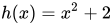
- The range of is . We can see this on the graph of easily: the lowest point, or vertex, of the parabola is at (0, 2), so 2 is in the range. The parabola extends up to infinity on either side of the vertex, so we know that the range must be all numbers from 2 to infinity.






Resources
- Domain Range and Toolkit Functions, Book Chapter
- Guided Notes
Licensing
Content obtained and/or adapted from:
- Range of a function, Wikipedia under a CC BY-SA license

