Difference between revisions of "Integrating Factor"
Jump to navigation
Jump to search
| Line 1: | Line 1: | ||
| − | When solving first order linear differential equations of the form <math> \frac{dy}{dx} + p(x)y = g(x) </math>, | + | When solving first order linear differential equations of the form <math> y' + p(x)y = g(x) </math>, we can utilize the "integrating factor" <math> \mu (x) = e^{\int p(x)dx}</math>. |
| + | |||
| + | Steps to solving an equation of the form \frac{dy}{dx} + p(x)y = g(x): | ||
| + | # Find the integrating factor <math> \mu (x) = e^{\int p(x)dx}</math>, and note that <math> \mu '(x) = p(x)e^{\int p(x)dx} = p(x)\mu (x)</math>, | ||
| + | # Multiply both sides of the equation by the integrating factor. | ||
| + | # The left side of the equation, <math> y'\mu (x) + p(x)\mu (x)y </math>, can now be rewritten as <math> (\mu (x)y)' </math> since <math> y'\mu (x) + p(x)\mu (x)y = y'\mu (x) + \mu '(x)y</math>. Verify by taking the derivative of <math> \mu (x)y </math> with respect to x with the product rule. | ||
| + | # Now, integrate <math> (\mu (x)y)' = g(x)\mu (x)</math> to get <math> \mu (x)y = \int g(x)\mu (x)dx </math>. | ||
| + | # Solve for y. | ||
==Resources== | ==Resources== | ||
* [https://tutorial.math.lamar.edu/classes/de/linear.aspx Solving Linear Equations], Paul's Online Notes | * [https://tutorial.math.lamar.edu/classes/de/linear.aspx Solving Linear Equations], Paul's Online Notes | ||
Revision as of 11:50, 22 September 2021
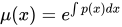
When solving first order linear differential equations of the form Failed to parse (MathML with SVG or PNG fallback (recommended for modern browsers and accessibility tools): Invalid response ("Math extension cannot connect to Restbase.") from server "https://wikimedia.org/api/rest_v1/":): {\displaystyle y' + p(x)y = g(x) } , we can utilize the "integrating factor" Failed to parse (MathML with SVG or PNG fallback (recommended for modern browsers and accessibility tools): Invalid response ("Math extension cannot connect to Restbase.") from server "https://wikimedia.org/api/rest_v1/":): {\displaystyle \mu (x) = e^{\int p(x)dx}} .
Steps to solving an equation of the form \frac{dy}{dx} + p(x)y = g(x):
- Find the integrating factor , and note that ,
- Multiply both sides of the equation by the integrating factor.
- The left side of the equation, , can now be rewritten as Failed to parse (MathML with SVG or PNG fallback (recommended for modern browsers and accessibility tools): Invalid response ("Math extension cannot connect to Restbase.") from server "https://wikimedia.org/api/rest_v1/":): {\displaystyle (\mu (x)y)' } since Failed to parse (MathML with SVG or PNG fallback (recommended for modern browsers and accessibility tools): Invalid response ("Math extension cannot connect to Restbase.") from server "https://wikimedia.org/api/rest_v1/":): {\displaystyle y'\mu (x) + p(x)\mu (x)y = y'\mu (x) + \mu '(x)y} . Verify by taking the derivative of Failed to parse (MathML with SVG or PNG fallback (recommended for modern browsers and accessibility tools): Invalid response ("Math extension cannot connect to Restbase.") from server "https://wikimedia.org/api/rest_v1/":): {\displaystyle \mu (x)y } with respect to x with the product rule.
- Now, integrate Failed to parse (MathML with SVG or PNG fallback (recommended for modern browsers and accessibility tools): Invalid response ("Math extension cannot connect to Restbase.") from server "https://wikimedia.org/api/rest_v1/":): {\displaystyle (\mu (x)y)' = g(x)\mu (x)} to get Failed to parse (MathML with SVG or PNG fallback (recommended for modern browsers and accessibility tools): Invalid response ("Math extension cannot connect to Restbase.") from server "https://wikimedia.org/api/rest_v1/":): {\displaystyle \mu (x)y = \int g(x)\mu (x)dx } .
- Solve for y.


Resources
- Solving Linear Equations, Paul's Online Notes

