Difference between revisions of "Subspaces of Rn and Linear Independence"
(Created page with "One of the examples that led us to introduce the idea of a vector space was the solution set of a homogeneous system. For instance, we've seen in Linear Algebra/Definition a...") |
|||
| Line 6: | Line 6: | ||
vector space, the plane. | vector space, the plane. | ||
| − | |||
| − | |||
| − | |||
| − | |||
| − | + | Definition of a subspace: | |
| − | + | : For any vector space, a '''subspace''' is a subset that is itself a vector space, under the inherited operations. | |
| − | |||
| − | :<math> | + | ==Examples== |
| − | P=\{\begin{pmatrix} x \\ y \\ z \end{pmatrix}\,\big|\, x+y+z=0\} | + | ===Example 1=== |
| − | </math> | + | : The plane <math> P=\{\begin{pmatrix} x \\ y \\ z \end{pmatrix}\,\big|\, x+y+z=0\} </math> is a subspace of <math> \mathbb{R}^3 </math>. As specified in the definition, the operations are the ones inherited from the larger space, that is, vectors add in <math>P</math> as they add in <math>\mathbb{R}^3</math> |
| − | + | :: <math> | |
| − | |||
| − | |||
| − | |||
| − | |||
| − | :<math> | ||
\begin{pmatrix} x_1 \\ y_1 \\ z_1 \end{pmatrix}+\begin{pmatrix} x_2 \\ y_2 \\ z_2 \end{pmatrix} | \begin{pmatrix} x_1 \\ y_1 \\ z_1 \end{pmatrix}+\begin{pmatrix} x_2 \\ y_2 \\ z_2 \end{pmatrix} | ||
=\begin{pmatrix} x_1+x_2 \\ y_1+y_2 \\ z_1+z_2 \end{pmatrix} | =\begin{pmatrix} x_1+x_2 \\ y_1+y_2 \\ z_1+z_2 \end{pmatrix} | ||
</math> | </math> | ||
| − | and scalar multiplication is also the same as it is in <math>\mathbb{R}^3</math>. To show that <math>P</math> is a subspace, we need only note that it is a subset and then verify that it is a space. Checking that <math>P</math> satisfies the conditions in the definition of a vector space is routine. For instance, for closure under addition, just note that if the summands satisfy that <math>x_1+y_1+z_1=0</math> and <math>x_2+y_2+z_2=0</math> then the sum satisfies that <math>(x_1+x_2)+(y_1+y_2)+(z_1+z_2)=(x_1+y_1+z_1)+(x_2+y_2+z_2)=0</math>. | + | : and scalar multiplication is also the same as it is in <math>\mathbb{R}^3</math>. To show that <math>P</math> is a subspace, we need only note that it is a subset and then verify that it is a space. Checking that <math>P</math> satisfies the conditions in the definition of a vector space is routine. For instance, for closure under addition, just note that if the summands satisfy that <math>x_1+y_1+z_1=0</math> and <math>x_2+y_2+z_2=0</math> then the sum satisfies that <math>(x_1+x_2)+(y_1+y_2)+(z_1+z_2)=(x_1+y_1+z_1)+(x_2+y_2+z_2)=0</math>. |
| − | |||
| − | + | ===Example 2=== | |
| − | |||
| − | |||
| − | |||
| − | |||
| − | |||
| − | :<math> | + | : The <math> x </math>-axis in <math> \mathbb{R}^2 </math> is a subspace where the addition and scalar multiplication operations are the inherited ones. |
| + | :: <math> | ||
\begin{pmatrix} x_1 \\ 0 \end{pmatrix} | \begin{pmatrix} x_1 \\ 0 \end{pmatrix} | ||
+ | + | ||
| Line 50: | Line 35: | ||
</math> | </math> | ||
| − | As above, to verify that this is a subspace, we simply note that it is a subset and then check that it satisfies the conditions in definition of a vector space. For instance, the two closure conditions are satisfied: (1) adding two vectors with a second component of zero results in a vector with a second component of zero, and (2) multiplying a scalar times a vector with a second component of zero results in a vector with a second component of zero. | + | : As above, to verify that this is a subspace, we simply note that it is a subset and then check that it satisfies the conditions in definition of a vector space. For instance, the two closure conditions are satisfied: (1) adding two vectors with a second component of zero results in a vector with a second component of zero, and (2) multiplying a scalar times a vector with a second component of zero results in a vector with a second component of zero. |
| − | |||
| − | + | ===Example 3=== | |
| − | + | : Another subspace of <math>\mathbb{R}^2</math> is | |
| − | Another subspace of <math>\mathbb{R}^2</math> is | ||
| − | :<math> | + | :: <math> |
\{\begin{pmatrix} 0 \\ 0 \end{pmatrix}\} | \{\begin{pmatrix} 0 \\ 0 \end{pmatrix}\} | ||
</math> | </math> | ||
| − | its trivial subspace. | + | : which is its '''trivial subspace'''. |
| − | |||
| − | Any vector space has a trivial subspace <math> \{\vec{0}\,\} </math>. | + | : Any vector space has a trivial subspace <math> \{\vec{0}\,\} </math>. |
At the opposite extreme, any vector space has itself for a subspace. | At the opposite extreme, any vector space has itself for a subspace. | ||
{{anchor|improper}}These two are the '''improper''' subspaces. | {{anchor|improper}}These two are the '''improper''' subspaces. | ||
{{anchor|proper}}Other subspaces are '''proper'''. | {{anchor|proper}}Other subspaces are '''proper'''. | ||
| − | + | ===Example 4=== | |
| − | |||
The condition in the definition requiring that the addition and scalar multiplication operations must be the ones inherited from the larger space is important. Consider the subset <math> \{1\} </math> of the vector space <math> \mathbb{R}^1 </math>. Under the operations <math>1+1=1</math> and <math>r\cdot 1=1</math> that set is a vector space, specifically, a trivial space. But it is not a subspace of <math> \mathbb{R}^1 </math> because those aren't the inherited operations, since of course <math> \mathbb{R}^1 </math> has <math> 1+1=2 </math>. | The condition in the definition requiring that the addition and scalar multiplication operations must be the ones inherited from the larger space is important. Consider the subset <math> \{1\} </math> of the vector space <math> \mathbb{R}^1 </math>. Under the operations <math>1+1=1</math> and <math>r\cdot 1=1</math> that set is a vector space, specifically, a trivial space. But it is not a subspace of <math> \mathbb{R}^1 </math> because those aren't the inherited operations, since of course <math> \mathbb{R}^1 </math> has <math> 1+1=2 </math>. | ||
| − | |||
| − | + | ===Example 5=== | |
| − | + | : All kinds of vector spaces, not just <math>\mathbb{R}^n</math>'s, have subspaces. The vector space of cubic polynomials <math> \{a+bx+cx^2+dx^3\,\big|\, a,b,c,d\in\mathbb{R}\} </math> has a subspace comprised of all linear polynomials <math> \{m+nx\,\big|\, m,n\in\mathbb{R}\} </math>. | |
| − | All kinds of vector spaces, not just <math>\mathbb{R}^n</math>'s, have subspaces. The vector space of cubic polynomials <math> \{a+bx+cx^2+dx^3\,\big|\, a,b,c,d\in\mathbb{R}\} </math> has a subspace comprised of all linear polynomials <math> \{m+nx\,\big|\, m,n\in\mathbb{R}\} </math>. | ||
| − | |||
| − | + | ===Example 6=== | |
| − | + | : This is a subspace of the <math> 2 \! \times \! 2 </math> matrices | |
| − | |||
| − | |||
| − | + | ::<math> | |
| − | |||
| − | |||
| − | |||
| − | |||
| − | |||
| − | |||
| − | |||
| − | |||
| − | |||
| − | |||
| − | |||
| − | |||
| − | |||
| − | |||
| − | |||
| − | |||
| − | |||
| − | |||
| − | |||
| − | |||
| − | |||
| − | |||
| − | |||
| − | |||
| − | |||
| − | |||
| − | |||
| − | |||
| − | |||
| − | |||
| − | |||
| − | |||
| − | |||
| − | |||
| − | |||
| − | |||
| − | |||
| − | |||
| − | |||
| − | |||
| − | |||
| − | |||
| − | |||
| − | |||
| − | |||
| − | |||
| − | |||
| − | |||
| − | |||
| − | |||
| − | |||
| − | |||
| − | |||
| − | |||
| − | |||
| − | |||
| − | |||
| − | |||
| − | |||
| − | |||
| − | |||
| − | |||
| − | |||
| − | |||
| − | |||
| − | |||
| − | |||
| − | |||
| − | |||
| − | |||
| − | |||
| − | |||
| − | |||
| − | |||
| − | |||
| − | |||
| − | |||
| − | |||
| − | |||
| − | |||
| − | |||
| − | |||
| − | |||
| − | |||
| − | |||
| − | |||
| − | |||
| − | |||
| − | |||
| − | |||
| − | |||
| − | |||
| − | |||
| − | |||
| − | |||
| − | |||
| − | |||
| − | |||
| − | |||
| − | |||
| − | |||
| − | |||
| − | |||
| − | |||
| − | |||
| − | |||
| − | |||
| − | |||
| − | |||
| − | |||
| − | |||
| − | |||
| − | |||
| − | |||
| − | |||
| − | |||
| − | |||
| − | |||
| − | |||
| − | |||
| − | |||
| − | |||
| − | |||
| − | |||
| − | |||
| − | |||
| − | |||
| − | |||
| − | |||
| − | |||
| − | |||
| − | |||
| − | |||
| − | |||
| − | |||
| − | |||
| − | |||
| − | |||
| − | |||
| − | |||
| − | |||
| − | |||
| − | :<math> | ||
L=\{\begin{pmatrix} | L=\{\begin{pmatrix} | ||
a &0 \\ | a &0 \\ | ||
| Line 235: | Line 68: | ||
</math> | </math> | ||
| − | (checking that it is nonempty and closed under linear combinations is easy). | + | : (checking that it is nonempty and closed under linear combinations is easy). |
| − | To parametrize, express the condition as <math>a=-b-c</math>. | + | : To parametrize, express the condition as <math>a=-b-c</math>. |
| − | :<math> | + | ::<math> |
L | L | ||
=\{\begin{pmatrix} | =\{\begin{pmatrix} | ||
| Line 256: | Line 89: | ||
</math> | </math> | ||
| − | As above, we've described the subspace as a collection of unrestricted linear combinations (by coincidence, also of two elements). | + | : As above, we've described the subspace as a collection of unrestricted linear combinations (by coincidence, also of two elements). |
| − | |||
| − | + | ==Lemma on Subspaces== | |
| − | + | For a nonempty subset <math> S </math> of a vector space, under the inherited | |
| + | operations, the following are equivalent statements. | ||
| − | + | # <math> S </math> is a subspace of that vector space | |
| − | + | # <math> S </math> is closed under linear combinations of pairs of vectors: for any vectors <math> \vec{s}_1,\vec{s}_2\in S </math> and scalars <math> r_1,r_2 </math> the vector <math> r_1\vec{s}_1+r_2\vec{s}_2 </math> is in <math> S </math> | |
| − | + | # <math> S </math> is closed under linear combinations of any number of vectors: for any vectors <math> \vec{s}_1,\ldots,\vec{s}_n\in S </math> and scalars <math> r_1, \ldots,r_n </math> the vector <math> r_1\vec{s}_1+\cdots+r_n\vec{s}_n </math> is in <math> S </math>. | |
| − | |||
| − | |||
| − | + | Briefly, the way that a subset gets to be a | |
| − | + | subspace is by being closed under linear combinations. | |
| − | |||
| − | |||
| − | |||
| − | + | : Proof: | |
| − | + | :: "The following are equivalent" means that each pair of statements are equivalent. | |
| − | |||
| − | The | ||
| − | |||
| − | + | :::<math> | |
| − | + | (1)\!\iff\!(2) | |
| − | + | \qquad | |
| − | + | (2)\!\iff\!(3) | |
| − | <math> | + | \qquad |
| − | + | (3)\!\iff\!(1) | |
| − | |||
| − | |||
| − | |||
| − | |||
| − | |||
| − | |||
| − | |||
| − | |||
| − | |||
| − | |||
| − | |||
| − | |||
| − | |||
| − | |||
| − | |||
| − | |||
| − | |||
| − | |||
| − | |||
| − | |||
| − | |||
| − | |||
| − | |||
| − | |||
| − | |||
| − | |||
| − | |||
| − | |||
| − | |||
| − | |||
</math> | </math> | ||
| − | |||
| − | |||
| − | + | :: We will show this equivalence by establishing that <math> (1)\implies (3)\implies (2)\implies (1)</math>. This strategy is suggested by noticing that <math> (1)\implies (3) </math> and <math> (3)\implies (2) </math> are easy and so we need only argue the single implication <math> (2)\implies (1) </math>. | |
| − | |||
| − | |||
| − | |||
| − | |||
| − | |||
| − | |||
| − | + | :: For that argument, assume that <math> S </math> is a nonempty subset of a vector space <math>V</math> and that <math>S</math> is closed under combinations of pairs of vectors. We will show that <math>S</math> is a vector space by checking the conditions. | |
| − | |||
| − | |||
| − | + | :: The first item in the vector space definition has five conditions. First, for closure under addition, if <math> \vec{s}_1,\vec{s}_2\in S </math> then <math> \vec{s}_1+\vec{s}_2\in S </math>, as <math> \vec{s}_1+\vec{s}_2=1\cdot\vec{s}_1+1\cdot\vec{s}_2 </math>. | |
| − | + | :: Second, for any <math> \vec{s}_1,\vec{s}_2\in S </math>, because addition is inherited from <math> V </math>, the sum <math> \vec{s}_1+\vec{s}_2 </math> in <math> S </math> equals the sum <math> \vec{s}_1+\vec{s}_2 </math> in <math> V </math>, and that equals the sum <math> \vec{s}_2+\vec{s}_1 </math> in <math> V </math> (because <math>V</math> is a vector space, its addition is commutative), and that in turn equals the sum <math> \vec{s}_2+\vec{s}_1 </math> in <math> S </math>. The argument for the third condition is similar to that for the second. | |
| − | + | :: For the fourth, consider the zero vector of <math> V </math> and note that closure of <math>S</math> under linear combinations of pairs of vectors gives that (where <math> \vec{s} </math> is any member of the nonempty set <math> S </math>) <math> 0\cdot\vec{s}+0\cdot\vec{s}=\vec{0} </math> is in <math>S</math>; showing that <math> \vec{0} </math> acts under the inherited operations as the additive identity of <math> S </math> is easy. | |
| − | + | :: The fifth condition is satisfied because for any <math> \vec{s}\in S </math>, closure under linear combinations shows that the vector <math> 0\cdot\vec{0}+(-1)\cdot\vec{s} </math> is in <math> S </math>; showing that it is the additive inverse of <math> \vec{s} </math> under the inherited operations is routine. | |
| − | |||
| − | |||
| − | |||
| − | |||
| − | + | We usually show that a subset is a subspace with <math> (2)\implies (1) </math>. | |
| − | |||
| − | |||
| − | |||
| − | |||
| − | |||
| − | |||
| − | |||
| − | |||
| − | |||
| − | |||
| − | |||
| − | |||
| − | |||
| − | |||
| − | |||
| − | |||
| − | |||
| − | |||
| − | |||
| − | |||
| − | |||
| − | |||
| − | |||
| − | |||
| − | |||
| − | |||
| − | |||
| − | |||
| − | |||
| − | |||
| − | |||
| − | |||
| − | |||
| − | |||
| − | |||
| − | |||
| − | |||
| − | |||
| − | |||
| − | |||
| − | |||
| − | |||
| − | |||
| − | |||
| − | |||
| − | |||
| − | |||
| − | |||
| − | |||
| − | |||
| − | |||
| − | |||
| − | |||
| − | |||
| − | |||
| − | |||
| − | |||
| − | |||
| − | |||
| − | <math> | ||
| − | |||
| − | |||
| − | |||
| − | |||
| − | |||
| − | |||
| − | |||
| − | |||
| − | |||
| − | |||
| − | |||
| − | |||
| − | |||
| − | |||
| − | |||
| − | |||
| − | |||
| − | |||
| − | |||
| − | |||
| − | |||
| − | |||
| − | |||
| − | |||
| − | |||
| − | |||
| − | |||
| − | |||
| − | |||
| − | |||
| − | |||
| − | |||
| − | |||
| − | |||
| − | |||
| − | |||
| − | |||
| − | |||
Revision as of 14:33, 29 September 2021
One of the examples that led us to introduce the idea of a vector space was the solution set of a homogeneous system. For instance, we've seen in Example 1.4 such a space that is a planar subset of . There, the vector space contains inside it another vector space, the plane.

Definition of a subspace:
- For any vector space, a subspace is a subset that is itself a vector space, under the inherited operations.
Contents
Examples
Example 1
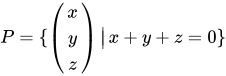
- The plane is a subspace of . As specified in the definition, the operations are the ones inherited from the larger space, that is, vectors add in as they add in

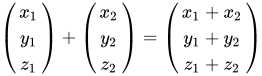
- and scalar multiplication is also the same as it is in . To show that Failed to parse (MathML with SVG or PNG fallback (recommended for modern browsers and accessibility tools): Invalid response ("Math extension cannot connect to Restbase.") from server "https://wikimedia.org/api/rest_v1/":): {\displaystyle P} is a subspace, we need only note that it is a subset and then verify that it is a space. Checking that Failed to parse (MathML with SVG or PNG fallback (recommended for modern browsers and accessibility tools): Invalid response ("Math extension cannot connect to Restbase.") from server "https://wikimedia.org/api/rest_v1/":): {\displaystyle P} satisfies the conditions in the definition of a vector space is routine. For instance, for closure under addition, just note that if the summands satisfy that Failed to parse (MathML with SVG or PNG fallback (recommended for modern browsers and accessibility tools): Invalid response ("Math extension cannot connect to Restbase.") from server "https://wikimedia.org/api/rest_v1/":): {\displaystyle x_1+y_1+z_1=0} and Failed to parse (MathML with SVG or PNG fallback (recommended for modern browsers and accessibility tools): Invalid response ("Math extension cannot connect to Restbase.") from server "https://wikimedia.org/api/rest_v1/":): {\displaystyle x_2+y_2+z_2=0} then the sum satisfies that Failed to parse (MathML with SVG or PNG fallback (recommended for modern browsers and accessibility tools): Invalid response ("Math extension cannot connect to Restbase.") from server "https://wikimedia.org/api/rest_v1/":): {\displaystyle (x_1+x_2)+(y_1+y_2)+(z_1+z_2)=(x_1+y_1+z_1)+(x_2+y_2+z_2)=0} .
Example 2
- The Failed to parse (MathML with SVG or PNG fallback (recommended for modern browsers and accessibility tools): Invalid response ("Math extension cannot connect to Restbase.") from server "https://wikimedia.org/api/rest_v1/":): {\displaystyle x }
-axis in Failed to parse (MathML with SVG or PNG fallback (recommended for modern browsers and accessibility tools): Invalid response ("Math extension cannot connect to Restbase.") from server "https://wikimedia.org/api/rest_v1/":): {\displaystyle \mathbb{R}^2 }
is a subspace where the addition and scalar multiplication operations are the inherited ones.
- Failed to parse (MathML with SVG or PNG fallback (recommended for modern browsers and accessibility tools): Invalid response ("Math extension cannot connect to Restbase.") from server "https://wikimedia.org/api/rest_v1/":): {\displaystyle \begin{pmatrix} x_1 \\ 0 \end{pmatrix} + \begin{pmatrix} x_2 \\ 0 \end{pmatrix} = \begin{pmatrix} x_1+x_2 \\ 0 \end{pmatrix} \qquad r\cdot\begin{pmatrix} x \\ 0 \end{pmatrix} =\begin{pmatrix} rx \\ 0 \end{pmatrix} }
- As above, to verify that this is a subspace, we simply note that it is a subset and then check that it satisfies the conditions in definition of a vector space. For instance, the two closure conditions are satisfied: (1) adding two vectors with a second component of zero results in a vector with a second component of zero, and (2) multiplying a scalar times a vector with a second component of zero results in a vector with a second component of zero.
Example 3
- Another subspace of Failed to parse (MathML with SVG or PNG fallback (recommended for modern browsers and accessibility tools): Invalid response ("Math extension cannot connect to Restbase.") from server "https://wikimedia.org/api/rest_v1/":): {\displaystyle \mathbb{R}^2} is
- Failed to parse (MathML with SVG or PNG fallback (recommended for modern browsers and accessibility tools): Invalid response ("Math extension cannot connect to Restbase.") from server "https://wikimedia.org/api/rest_v1/":): {\displaystyle \{\begin{pmatrix} 0 \\ 0 \end{pmatrix}\} }
- which is its trivial subspace.
- Any vector space has a trivial subspace Failed to parse (MathML with SVG or PNG fallback (recommended for modern browsers and accessibility tools): Invalid response ("Math extension cannot connect to Restbase.") from server "https://wikimedia.org/api/rest_v1/":): {\displaystyle \{\vec{0}\,\} } .
At the opposite extreme, any vector space has itself for a subspace. Template:AnchorThese two are the improper subspaces. Template:AnchorOther subspaces are proper.
Example 4
The condition in the definition requiring that the addition and scalar multiplication operations must be the ones inherited from the larger space is important. Consider the subset Failed to parse (MathML with SVG or PNG fallback (recommended for modern browsers and accessibility tools): Invalid response ("Math extension cannot connect to Restbase.") from server "https://wikimedia.org/api/rest_v1/":): {\displaystyle \{1\} } of the vector space Failed to parse (MathML with SVG or PNG fallback (recommended for modern browsers and accessibility tools): Invalid response ("Math extension cannot connect to Restbase.") from server "https://wikimedia.org/api/rest_v1/":): {\displaystyle \mathbb{R}^1 } . Under the operations Failed to parse (MathML with SVG or PNG fallback (recommended for modern browsers and accessibility tools): Invalid response ("Math extension cannot connect to Restbase.") from server "https://wikimedia.org/api/rest_v1/":): {\displaystyle 1+1=1} and Failed to parse (MathML with SVG or PNG fallback (recommended for modern browsers and accessibility tools): Invalid response ("Math extension cannot connect to Restbase.") from server "https://wikimedia.org/api/rest_v1/":): {\displaystyle r\cdot 1=1} that set is a vector space, specifically, a trivial space. But it is not a subspace of Failed to parse (MathML with SVG or PNG fallback (recommended for modern browsers and accessibility tools): Invalid response ("Math extension cannot connect to Restbase.") from server "https://wikimedia.org/api/rest_v1/":): {\displaystyle \mathbb{R}^1 } because those aren't the inherited operations, since of course Failed to parse (MathML with SVG or PNG fallback (recommended for modern browsers and accessibility tools): Invalid response ("Math extension cannot connect to Restbase.") from server "https://wikimedia.org/api/rest_v1/":): {\displaystyle \mathbb{R}^1 } has Failed to parse (MathML with SVG or PNG fallback (recommended for modern browsers and accessibility tools): Invalid response ("Math extension cannot connect to Restbase.") from server "https://wikimedia.org/api/rest_v1/":): {\displaystyle 1+1=2 } .
Example 5
- All kinds of vector spaces, not just Failed to parse (MathML with SVG or PNG fallback (recommended for modern browsers and accessibility tools): Invalid response ("Math extension cannot connect to Restbase.") from server "https://wikimedia.org/api/rest_v1/":): {\displaystyle \mathbb{R}^n} 's, have subspaces. The vector space of cubic polynomials Failed to parse (MathML with SVG or PNG fallback (recommended for modern browsers and accessibility tools): Invalid response ("Math extension cannot connect to Restbase.") from server "https://wikimedia.org/api/rest_v1/":): {\displaystyle \{a+bx+cx^2+dx^3\,\big|\, a,b,c,d\in\mathbb{R}\} } has a subspace comprised of all linear polynomials Failed to parse (MathML with SVG or PNG fallback (recommended for modern browsers and accessibility tools): Invalid response ("Math extension cannot connect to Restbase.") from server "https://wikimedia.org/api/rest_v1/":): {\displaystyle \{m+nx\,\big|\, m,n\in\mathbb{R}\} } .
Example 6
- This is a subspace of the Failed to parse (MathML with SVG or PNG fallback (recommended for modern browsers and accessibility tools): Invalid response ("Math extension cannot connect to Restbase.") from server "https://wikimedia.org/api/rest_v1/":): {\displaystyle 2 \! \times \! 2 } matrices
- Failed to parse (MathML with SVG or PNG fallback (recommended for modern browsers and accessibility tools): Invalid response ("Math extension cannot connect to Restbase.") from server "https://wikimedia.org/api/rest_v1/":): {\displaystyle L=\{\begin{pmatrix} a &0 \\ b &c \end{pmatrix} \,\big|\, a+b+c=0\} }
- (checking that it is nonempty and closed under linear combinations is easy).
- To parametrize, express the condition as Failed to parse (MathML with SVG or PNG fallback (recommended for modern browsers and accessibility tools): Invalid response ("Math extension cannot connect to Restbase.") from server "https://wikimedia.org/api/rest_v1/":): {\displaystyle a=-b-c} .
- Failed to parse (MathML with SVG or PNG fallback (recommended for modern browsers and accessibility tools): Invalid response ("Math extension cannot connect to Restbase.") from server "https://wikimedia.org/api/rest_v1/":): {\displaystyle L =\{\begin{pmatrix} -b-c &0 \\ b &c \end{pmatrix} \,\big|\, b,c\in\mathbb{R}\} =\{b\begin{pmatrix} -1 &0 \\ 1 &0 \end{pmatrix} +c\begin{pmatrix} -1 &0 \\ 0 &1 \end{pmatrix} \,\big|\, b,c\in\mathbb{R}\} }
- As above, we've described the subspace as a collection of unrestricted linear combinations (by coincidence, also of two elements).
Lemma on Subspaces
For a nonempty subset Failed to parse (MathML with SVG or PNG fallback (recommended for modern browsers and accessibility tools): Invalid response ("Math extension cannot connect to Restbase.") from server "https://wikimedia.org/api/rest_v1/":): {\displaystyle S } of a vector space, under the inherited operations, the following are equivalent statements.
- Failed to parse (MathML with SVG or PNG fallback (recommended for modern browsers and accessibility tools): Invalid response ("Math extension cannot connect to Restbase.") from server "https://wikimedia.org/api/rest_v1/":): {\displaystyle S } is a subspace of that vector space
- Failed to parse (MathML with SVG or PNG fallback (recommended for modern browsers and accessibility tools): Invalid response ("Math extension cannot connect to Restbase.") from server "https://wikimedia.org/api/rest_v1/":): {\displaystyle S } is closed under linear combinations of pairs of vectors: for any vectors Failed to parse (MathML with SVG or PNG fallback (recommended for modern browsers and accessibility tools): Invalid response ("Math extension cannot connect to Restbase.") from server "https://wikimedia.org/api/rest_v1/":): {\displaystyle \vec{s}_1,\vec{s}_2\in S } and scalars Failed to parse (MathML with SVG or PNG fallback (recommended for modern browsers and accessibility tools): Invalid response ("Math extension cannot connect to Restbase.") from server "https://wikimedia.org/api/rest_v1/":): {\displaystyle r_1,r_2 } the vector Failed to parse (MathML with SVG or PNG fallback (recommended for modern browsers and accessibility tools): Invalid response ("Math extension cannot connect to Restbase.") from server "https://wikimedia.org/api/rest_v1/":): {\displaystyle r_1\vec{s}_1+r_2\vec{s}_2 } is in Failed to parse (MathML with SVG or PNG fallback (recommended for modern browsers and accessibility tools): Invalid response ("Math extension cannot connect to Restbase.") from server "https://wikimedia.org/api/rest_v1/":): {\displaystyle S }
- Failed to parse (MathML with SVG or PNG fallback (recommended for modern browsers and accessibility tools): Invalid response ("Math extension cannot connect to Restbase.") from server "https://wikimedia.org/api/rest_v1/":): {\displaystyle S } is closed under linear combinations of any number of vectors: for any vectors Failed to parse (MathML with SVG or PNG fallback (recommended for modern browsers and accessibility tools): Invalid response ("Math extension cannot connect to Restbase.") from server "https://wikimedia.org/api/rest_v1/":): {\displaystyle \vec{s}_1,\ldots,\vec{s}_n\in S } and scalars Failed to parse (MathML with SVG or PNG fallback (recommended for modern browsers and accessibility tools): Invalid response ("Math extension cannot connect to Restbase.") from server "https://wikimedia.org/api/rest_v1/":): {\displaystyle r_1, \ldots,r_n } the vector Failed to parse (MathML with SVG or PNG fallback (recommended for modern browsers and accessibility tools): Invalid response ("Math extension cannot connect to Restbase.") from server "https://wikimedia.org/api/rest_v1/":): {\displaystyle r_1\vec{s}_1+\cdots+r_n\vec{s}_n } is in Failed to parse (MathML with SVG or PNG fallback (recommended for modern browsers and accessibility tools): Invalid response ("Math extension cannot connect to Restbase.") from server "https://wikimedia.org/api/rest_v1/":): {\displaystyle S } .
Briefly, the way that a subset gets to be a subspace is by being closed under linear combinations.
- Proof:
- "The following are equivalent" means that each pair of statements are equivalent.
- Failed to parse (MathML with SVG or PNG fallback (recommended for modern browsers and accessibility tools): Invalid response ("Math extension cannot connect to Restbase.") from server "https://wikimedia.org/api/rest_v1/":): {\displaystyle (1)\!\iff\!(2) \qquad (2)\!\iff\!(3) \qquad (3)\!\iff\!(1) }
- We will show this equivalence by establishing that Failed to parse (MathML with SVG or PNG fallback (recommended for modern browsers and accessibility tools): Invalid response ("Math extension cannot connect to Restbase.") from server "https://wikimedia.org/api/rest_v1/":): {\displaystyle (1)\implies (3)\implies (2)\implies (1)} . This strategy is suggested by noticing that Failed to parse (MathML with SVG or PNG fallback (recommended for modern browsers and accessibility tools): Invalid response ("Math extension cannot connect to Restbase.") from server "https://wikimedia.org/api/rest_v1/":): {\displaystyle (1)\implies (3) } and Failed to parse (MathML with SVG or PNG fallback (recommended for modern browsers and accessibility tools): Invalid response ("Math extension cannot connect to Restbase.") from server "https://wikimedia.org/api/rest_v1/":): {\displaystyle (3)\implies (2) } are easy and so we need only argue the single implication Failed to parse (MathML with SVG or PNG fallback (recommended for modern browsers and accessibility tools): Invalid response ("Math extension cannot connect to Restbase.") from server "https://wikimedia.org/api/rest_v1/":): {\displaystyle (2)\implies (1) } .
- For that argument, assume that Failed to parse (MathML with SVG or PNG fallback (recommended for modern browsers and accessibility tools): Invalid response ("Math extension cannot connect to Restbase.") from server "https://wikimedia.org/api/rest_v1/":): {\displaystyle S } is a nonempty subset of a vector space and that is closed under combinations of pairs of vectors. We will show that Failed to parse (MathML with SVG or PNG fallback (recommended for modern browsers and accessibility tools): Invalid response ("Math extension cannot connect to Restbase.") from server "https://wikimedia.org/api/rest_v1/":): {\displaystyle S} is a vector space by checking the conditions.


- The first item in the vector space definition has five conditions. First, for closure under addition, if Failed to parse (MathML with SVG or PNG fallback (recommended for modern browsers and accessibility tools): Invalid response ("Math extension cannot connect to Restbase.") from server "https://wikimedia.org/api/rest_v1/":): {\displaystyle \vec{s}_1,\vec{s}_2\in S } then Failed to parse (MathML with SVG or PNG fallback (recommended for modern browsers and accessibility tools): Invalid response ("Math extension cannot connect to Restbase.") from server "https://wikimedia.org/api/rest_v1/":): {\displaystyle \vec{s}_1+\vec{s}_2\in S } , as Failed to parse (MathML with SVG or PNG fallback (recommended for modern browsers and accessibility tools): Invalid response ("Math extension cannot connect to Restbase.") from server "https://wikimedia.org/api/rest_v1/":): {\displaystyle \vec{s}_1+\vec{s}_2=1\cdot\vec{s}_1+1\cdot\vec{s}_2 } .
- Second, for any Failed to parse (MathML with SVG or PNG fallback (recommended for modern browsers and accessibility tools): Invalid response ("Math extension cannot connect to Restbase.") from server "https://wikimedia.org/api/rest_v1/":): {\displaystyle \vec{s}_1,\vec{s}_2\in S } , because addition is inherited from Failed to parse (MathML with SVG or PNG fallback (recommended for modern browsers and accessibility tools): Invalid response ("Math extension cannot connect to Restbase.") from server "https://wikimedia.org/api/rest_v1/":): {\displaystyle V } , the sum Failed to parse (MathML with SVG or PNG fallback (recommended for modern browsers and accessibility tools): Invalid response ("Math extension cannot connect to Restbase.") from server "https://wikimedia.org/api/rest_v1/":): {\displaystyle \vec{s}_1+\vec{s}_2 } in Failed to parse (MathML with SVG or PNG fallback (recommended for modern browsers and accessibility tools): Invalid response ("Math extension cannot connect to Restbase.") from server "https://wikimedia.org/api/rest_v1/":): {\displaystyle S } equals the sum Failed to parse (MathML with SVG or PNG fallback (recommended for modern browsers and accessibility tools): Invalid response ("Math extension cannot connect to Restbase.") from server "https://wikimedia.org/api/rest_v1/":): {\displaystyle \vec{s}_1+\vec{s}_2 } in Failed to parse (MathML with SVG or PNG fallback (recommended for modern browsers and accessibility tools): Invalid response ("Math extension cannot connect to Restbase.") from server "https://wikimedia.org/api/rest_v1/":): {\displaystyle V } , and that equals the sum Failed to parse (MathML with SVG or PNG fallback (recommended for modern browsers and accessibility tools): Invalid response ("Math extension cannot connect to Restbase.") from server "https://wikimedia.org/api/rest_v1/":): {\displaystyle \vec{s}_2+\vec{s}_1 } in Failed to parse (MathML with SVG or PNG fallback (recommended for modern browsers and accessibility tools): Invalid response ("Math extension cannot connect to Restbase.") from server "https://wikimedia.org/api/rest_v1/":): {\displaystyle V } (because Failed to parse (MathML with SVG or PNG fallback (recommended for modern browsers and accessibility tools): Invalid response ("Math extension cannot connect to Restbase.") from server "https://wikimedia.org/api/rest_v1/":): {\displaystyle V} is a vector space, its addition is commutative), and that in turn equals the sum Failed to parse (MathML with SVG or PNG fallback (recommended for modern browsers and accessibility tools): Invalid response ("Math extension cannot connect to Restbase.") from server "https://wikimedia.org/api/rest_v1/":): {\displaystyle \vec{s}_2+\vec{s}_1 } in Failed to parse (MathML with SVG or PNG fallback (recommended for modern browsers and accessibility tools): Invalid response ("Math extension cannot connect to Restbase.") from server "https://wikimedia.org/api/rest_v1/":): {\displaystyle S } . The argument for the third condition is similar to that for the second.
- For the fourth, consider the zero vector of Failed to parse (MathML with SVG or PNG fallback (recommended for modern browsers and accessibility tools): Invalid response ("Math extension cannot connect to Restbase.") from server "https://wikimedia.org/api/rest_v1/":): {\displaystyle V } and note that closure of Failed to parse (MathML with SVG or PNG fallback (recommended for modern browsers and accessibility tools): Invalid response ("Math extension cannot connect to Restbase.") from server "https://wikimedia.org/api/rest_v1/":): {\displaystyle S} under linear combinations of pairs of vectors gives that (where Failed to parse (MathML with SVG or PNG fallback (recommended for modern browsers and accessibility tools): Invalid response ("Math extension cannot connect to Restbase.") from server "https://wikimedia.org/api/rest_v1/":): {\displaystyle \vec{s} } is any member of the nonempty set Failed to parse (MathML with SVG or PNG fallback (recommended for modern browsers and accessibility tools): Invalid response ("Math extension cannot connect to Restbase.") from server "https://wikimedia.org/api/rest_v1/":): {\displaystyle S } ) Failed to parse (MathML with SVG or PNG fallback (recommended for modern browsers and accessibility tools): Invalid response ("Math extension cannot connect to Restbase.") from server "https://wikimedia.org/api/rest_v1/":): {\displaystyle 0\cdot\vec{s}+0\cdot\vec{s}=\vec{0} } is in Failed to parse (MathML with SVG or PNG fallback (recommended for modern browsers and accessibility tools): Invalid response ("Math extension cannot connect to Restbase.") from server "https://wikimedia.org/api/rest_v1/":): {\displaystyle S} ; showing that Failed to parse (MathML with SVG or PNG fallback (recommended for modern browsers and accessibility tools): Invalid response ("Math extension cannot connect to Restbase.") from server "https://wikimedia.org/api/rest_v1/":): {\displaystyle \vec{0} } acts under the inherited operations as the additive identity of Failed to parse (MathML with SVG or PNG fallback (recommended for modern browsers and accessibility tools): Invalid response ("Math extension cannot connect to Restbase.") from server "https://wikimedia.org/api/rest_v1/":): {\displaystyle S } is easy.
- The fifth condition is satisfied because for any Failed to parse (MathML with SVG or PNG fallback (recommended for modern browsers and accessibility tools): Invalid response ("Math extension cannot connect to Restbase.") from server "https://wikimedia.org/api/rest_v1/":): {\displaystyle \vec{s}\in S } , closure under linear combinations shows that the vector Failed to parse (MathML with SVG or PNG fallback (recommended for modern browsers and accessibility tools): Invalid response ("Math extension cannot connect to Restbase.") from server "https://wikimedia.org/api/rest_v1/":): {\displaystyle 0\cdot\vec{0}+(-1)\cdot\vec{s} } is in Failed to parse (MathML with SVG or PNG fallback (recommended for modern browsers and accessibility tools): Invalid response ("Math extension cannot connect to Restbase.") from server "https://wikimedia.org/api/rest_v1/":): {\displaystyle S } ; showing that it is the additive inverse of Failed to parse (MathML with SVG or PNG fallback (recommended for modern browsers and accessibility tools): Invalid response ("Math extension cannot connect to Restbase.") from server "https://wikimedia.org/api/rest_v1/":): {\displaystyle \vec{s} } under the inherited operations is routine.
We usually show that a subset is a subspace with Failed to parse (MathML with SVG or PNG fallback (recommended for modern browsers and accessibility tools): Invalid response ("Math extension cannot connect to Restbase.") from server "https://wikimedia.org/api/rest_v1/":): {\displaystyle (2)\implies (1) }
.

