Difference between revisions of "Comparison Tests"
| Line 1: | Line 1: | ||
| − | < | + | ==Comparison Test== |
| + | |||
| + | The first real determiner of convergence is the '''comparison test'''. This test is very basic and intuitive. | ||
| + | |||
| + | <blockquote style="background: white; border: 1px solid black; padding: 1em;"> | ||
| + | :'''Comparison for Convergence and Divergence''' | ||
| + | :If two series, <math>S= \sum_{n=j}^{\infty}{s_n}</math> and <math>Z= \sum_{n=j}^{\infty}{z_n}</math>, and if <math>0 \leq z_n \leq s_n</math> in the interval <math>[j, \infty)</math>, then if | ||
| + | # <math>Z</math> is divergent, so is <math>S</math> | ||
| + | # <math>S</math> is convergent, so is <math>Z</math> | ||
| + | </blockquote> | ||
| + | |||
| + | First, a few words about this test. Notice that this test applies even if the two series' summands are ''equal''. This is because if summands are the same, this means that the series must also be the same, and so if one of them converges or diverges by the equality property they must both converge or diverge. However, if the starting point <math>j</math> is different from series to series, then they ''will not converge to the same value'', that is to say <math>Z \neq S</math>, but this test will still apply. | ||
| + | |||
| + | The test itself follows from the fact that if we know that <math>S</math> converges to some finite number, and we know that <math>z_n</math> is less than (or equal to) <math>s_n</math> for all <math>n</math> then it follows that <math>Z</math> should also converge to some finite number greater than zero. i.e., if there is a sum <math>1+2+3+4</math> and a sum <math>2+3+4+5</math> then we know that the first sum will be smaller because it has smaller numbers; the only thing smaller than a finite number is another finite number. The same is true for the divergence portion of this test. If <math>Z</math> diverges and <math>z_n</math> is less than or equal to <math>s_n</math> for all <math>n</math> then <math>S</math> will diverge for essentially the same reason: the summand is bigger, and the sum of a set of numbers greater than the sum of numbers that is infinite must also be infinite as there is no finite number larger than an infinite number. | ||
| + | |||
| + | One last key note is that all the terms <math>z_n</math> and <math>s_n</math> must be larger than zero in order for this test to be conclusive. The series <math>\sum_{n=1}^{\infty}{\frac{(-1)^n}{n}}</math> cannot be tested with the comparison test because it is alternating and half the terms are less than zero. | ||
| + | |||
| + | ===Example 1=== | ||
| + | Use the divergent and monotonic harmonic series <math>\sum_{n=1}^{\infty}{\frac{1}{n}}</math> to determine if the following series are divergent or if the test is inconclusive. | ||
| + | |||
| + | # <math>\sum_{n=1}^{\infty}{\frac{1}{n+1}}</math> | ||
| + | # <math>\sum_{n=2}^{\infty}{\frac{1}{n-1}}</math> | ||
| + | # <math>\sum_{n=1}^{\infty}{\frac{3}{n}}</math> | ||
| + | # <math>\sum_{n=1}^{\infty}{\frac{1}{\sqrt{n}}}</math> | ||
| + | # <math>\sum_{n=1}^{\infty}{\frac{1}{n^2}}</math> | ||
| + | |||
| + | ===Solutions=== | ||
| + | |||
| + | # Notice that this sum can be rewritten as <math>\sum_{n=2}^{\infty}{\frac{1}{n}}</math>, making it have the same summand as the harmonic series which is divergent; therefore, this series is divergent. | ||
| + | # This series is similar: it can be rewritten as <math>\sum_{n=1}^{\infty}{\frac{1}{n}}</math> which is the harmonic series and so it is divergent. | ||
| + | # For each <math>n</math>, this series is larger because <math>3</math> divided by any integer is larger than <math>1</math> divided by any integer. This can also be seen as <math>3 \times \sum_{n=1}^{\infty}{\frac{1}{n}}</math>, which is essentially <math>3 \times \infty </math> and so this series is divergent. | ||
| + | # For every <math>n</math> in this series, the summand of <math>\sum_{n=1}^{\infty}{\frac{1}{\sqrt{n}}}</math> is larger than the summand of the harmonic series and so this series is divergent. This can be seen by simply plotting the graph of <math>f(n)=\frac{1}{\sqrt{n}}</math>. Something interesting to note is that when <math>n < 1</math>, the summand of the harmonic series is actually larger. | ||
| + | # Via plotting/plugging in values of <math>n</math>, we see that for every <math>n</math> in the series, the summand of the harmonic series is larger and so the test fails and is inconclusive. | ||
| + | |||
| + | ===Example 2=== | ||
| + | |||
| + | Use the convergent and monotonic series <math>\sum_{n=1}^{\infty}{\frac{1}{2^n}}</math> to determine whether the following series are convergent or if the test is inconclusive. | ||
| + | |||
| + | # <math>\sum_{n=1}^{\infty}{\frac{1}{n^2}}</math> | ||
| + | # <math>\sum_{n=1}^{\infty}{e^{-x}}</math> | ||
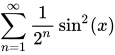
| + | # <math>\sum_{n=1}^{\infty}{\frac{1}{2^n} \sin^2(x)}</math> | ||
| + | # <math>\sum_{n=1}^{\infty}{\frac{2}{2^n}}</math> | ||
| + | # <math>\sum_{n=1}^{\infty}{\frac{1}{1.5^n}}</math> | ||
| + | # <math>\sum_{n=1}^{\infty}{\frac{(-1)^n}{2^n}}</math> | ||
| + | |||
| + | ===Solutions=== | ||
| + | |||
| + | # <math>n^{-2}</math> decreases at a faster rate than <math>2^{-n}</math>. However, these series do not satisfy the <math>0 \leq z_n \leq s_n</math> requirement, because <math>\sum_{n=1}^{\infty}{\frac{1}{n^2}}</math> is larger than <math>\sum_{n=1}^{\infty}{\frac{1}{2^n}}</math> when <math> n < 2 </math>. We can solve this issue by taking removing the first term from the both series to obtain <math>1 + \sum_{n=2}^{\infty}{\frac{1}{n^2}}</math> and <math>2 + \sum_{n=2}^{\infty}{\frac{1}{2^n}}</math>. Now, comparing <math>\sum_{n=2}^{\infty}{\frac{1}{n^2}}</math> with <math>\sum_{n=2}^{\infty}{\frac{1}{2^n}}</math> shows that <math>\sum_{n=2}^{\infty}{\frac{1}{n^2}}</math> is indeed convergent. Because this is convergent, adding the original <math>1</math> will not change whether it is convergent or not, it will add <math>1</math> to the value of convergence. | ||
| + | # <math>\sum_{n=1}^{\infty}{e^{-x}}</math> is smaller <math>\sum_{n=1}^{\infty}{\frac{1}{2^n}}</math> for every <math>n</math>, so this series is convergent. | ||
| + | # <math>\sum_{n=1}^{\infty}{\frac{1}{2^n} \sin^2(x)}</math> is less than or equal to <math>\sum_{n=1}^{\infty}{\frac{1}{2^n}}</math> and is greater than <math>0</math> for every <math>n</math> in the domain; this is because <math>\sin^2(x)</math> conforms to </math>\frac{1}{2^n}</math>, and the fact that <math>\sin(x)</math> is squared implies that it will never be less than zero. | ||
| + | # <math>\sum_{n=1}^{\infty}{\frac{2}{2^n}}</math> is convergent. Notice that this is just <math>2 \times \sum_{n=1}^{\infty}{\frac{1}{2^n}}</math>, which is just <math>2</math> multiplied by some finite number. | ||
| + | # <math>\sum_{n=1}^{\infty}{\frac{1}{1.5^n}}</math> is greater than <math>\sum_{n=1}^{\infty}{\frac{1}{2^n}}</math> for an infinite amount of <math>n</math> so the test in inconclusive. | ||
| + | # This series is not greater than or equal to zero for an infinite amount of <math>n</math>'s, so this test is inconclusive. | ||
| + | |||
| + | ==Resources== | ||
| + | ===The Direct Comparison Test=== | ||
* [https://www.youtube.com/watch?v=2J9vhLkA1Xo The Direct Comparison Test] Video by James Sousa, Math is Power 4U | * [https://www.youtube.com/watch?v=2J9vhLkA1Xo The Direct Comparison Test] Video by James Sousa, Math is Power 4U | ||
| Line 18: | Line 73: | ||
| − | + | ===The Limit Comparison Test=== | |
* [https://www.youtube.com/watch?v=LQ_ktobTEp0 The Limit Comparison Test] Video by James Sousa, Math is Power 4U | * [https://www.youtube.com/watch?v=LQ_ktobTEp0 The Limit Comparison Test] Video by James Sousa, Math is Power 4U | ||
Revision as of 12:18, 10 October 2021
Contents
Comparison Test
The first real determiner of convergence is the comparison test. This test is very basic and intuitive.
- Comparison for Convergence and Divergence
- If two series, Failed to parse (MathML with SVG or PNG fallback (recommended for modern browsers and accessibility tools): Invalid response ("Math extension cannot connect to Restbase.") from server "https://wikimedia.org/api/rest_v1/":): {\displaystyle S= \sum_{n=j}^{\infty}{s_n}} and Failed to parse (MathML with SVG or PNG fallback (recommended for modern browsers and accessibility tools): Invalid response ("Math extension cannot connect to Restbase.") from server "https://wikimedia.org/api/rest_v1/":): {\displaystyle Z= \sum_{n=j}^{\infty}{z_n}} , and if Failed to parse (MathML with SVG or PNG fallback (recommended for modern browsers and accessibility tools): Invalid response ("Math extension cannot connect to Restbase.") from server "https://wikimedia.org/api/rest_v1/":): {\displaystyle 0 \leq z_n \leq s_n} in the interval Failed to parse (MathML with SVG or PNG fallback (recommended for modern browsers and accessibility tools): Invalid response ("Math extension cannot connect to Restbase.") from server "https://wikimedia.org/api/rest_v1/":): {\displaystyle [j, \infty)} , then if
- Failed to parse (MathML with SVG or PNG fallback (recommended for modern browsers and accessibility tools): Invalid response ("Math extension cannot connect to Restbase.") from server "https://wikimedia.org/api/rest_v1/":): {\displaystyle Z} is divergent, so is Failed to parse (MathML with SVG or PNG fallback (recommended for modern browsers and accessibility tools): Invalid response ("Math extension cannot connect to Restbase.") from server "https://wikimedia.org/api/rest_v1/":): {\displaystyle S}
- Failed to parse (MathML with SVG or PNG fallback (recommended for modern browsers and accessibility tools): Invalid response ("Math extension cannot connect to Restbase.") from server "https://wikimedia.org/api/rest_v1/":): {\displaystyle S} is convergent, so is Failed to parse (MathML with SVG or PNG fallback (recommended for modern browsers and accessibility tools): Invalid response ("Math extension cannot connect to Restbase.") from server "https://wikimedia.org/api/rest_v1/":): {\displaystyle Z}
First, a few words about this test. Notice that this test applies even if the two series' summands are equal. This is because if summands are the same, this means that the series must also be the same, and so if one of them converges or diverges by the equality property they must both converge or diverge. However, if the starting point Failed to parse (MathML with SVG or PNG fallback (recommended for modern browsers and accessibility tools): Invalid response ("Math extension cannot connect to Restbase.") from server "https://wikimedia.org/api/rest_v1/":): {\displaystyle j} is different from series to series, then they will not converge to the same value, that is to say Failed to parse (MathML with SVG or PNG fallback (recommended for modern browsers and accessibility tools): Invalid response ("Math extension cannot connect to Restbase.") from server "https://wikimedia.org/api/rest_v1/":): {\displaystyle Z \neq S} , but this test will still apply.
The test itself follows from the fact that if we know that Failed to parse (MathML with SVG or PNG fallback (recommended for modern browsers and accessibility tools): Invalid response ("Math extension cannot connect to Restbase.") from server "https://wikimedia.org/api/rest_v1/":): {\displaystyle S} converges to some finite number, and we know that Failed to parse (MathML with SVG or PNG fallback (recommended for modern browsers and accessibility tools): Invalid response ("Math extension cannot connect to Restbase.") from server "https://wikimedia.org/api/rest_v1/":): {\displaystyle z_n} is less than (or equal to) Failed to parse (MathML with SVG or PNG fallback (recommended for modern browsers and accessibility tools): Invalid response ("Math extension cannot connect to Restbase.") from server "https://wikimedia.org/api/rest_v1/":): {\displaystyle s_n} for all Failed to parse (MathML with SVG or PNG fallback (recommended for modern browsers and accessibility tools): Invalid response ("Math extension cannot connect to Restbase.") from server "https://wikimedia.org/api/rest_v1/":): {\displaystyle n} then it follows that Failed to parse (MathML with SVG or PNG fallback (recommended for modern browsers and accessibility tools): Invalid response ("Math extension cannot connect to Restbase.") from server "https://wikimedia.org/api/rest_v1/":): {\displaystyle Z} should also converge to some finite number greater than zero. i.e., if there is a sum Failed to parse (MathML with SVG or PNG fallback (recommended for modern browsers and accessibility tools): Invalid response ("Math extension cannot connect to Restbase.") from server "https://wikimedia.org/api/rest_v1/":): {\displaystyle 1+2+3+4} and a sum Failed to parse (MathML with SVG or PNG fallback (recommended for modern browsers and accessibility tools): Invalid response ("Math extension cannot connect to Restbase.") from server "https://wikimedia.org/api/rest_v1/":): {\displaystyle 2+3+4+5} then we know that the first sum will be smaller because it has smaller numbers; the only thing smaller than a finite number is another finite number. The same is true for the divergence portion of this test. If Failed to parse (MathML with SVG or PNG fallback (recommended for modern browsers and accessibility tools): Invalid response ("Math extension cannot connect to Restbase.") from server "https://wikimedia.org/api/rest_v1/":): {\displaystyle Z} diverges and Failed to parse (MathML with SVG or PNG fallback (recommended for modern browsers and accessibility tools): Invalid response ("Math extension cannot connect to Restbase.") from server "https://wikimedia.org/api/rest_v1/":): {\displaystyle z_n} is less than or equal to Failed to parse (MathML with SVG or PNG fallback (recommended for modern browsers and accessibility tools): Invalid response ("Math extension cannot connect to Restbase.") from server "https://wikimedia.org/api/rest_v1/":): {\displaystyle s_n} for all Failed to parse (MathML with SVG or PNG fallback (recommended for modern browsers and accessibility tools): Invalid response ("Math extension cannot connect to Restbase.") from server "https://wikimedia.org/api/rest_v1/":): {\displaystyle n} then Failed to parse (MathML with SVG or PNG fallback (recommended for modern browsers and accessibility tools): Invalid response ("Math extension cannot connect to Restbase.") from server "https://wikimedia.org/api/rest_v1/":): {\displaystyle S} will diverge for essentially the same reason: the summand is bigger, and the sum of a set of numbers greater than the sum of numbers that is infinite must also be infinite as there is no finite number larger than an infinite number.
One last key note is that all the terms Failed to parse (MathML with SVG or PNG fallback (recommended for modern browsers and accessibility tools): Invalid response ("Math extension cannot connect to Restbase.") from server "https://wikimedia.org/api/rest_v1/":): {\displaystyle z_n} and Failed to parse (MathML with SVG or PNG fallback (recommended for modern browsers and accessibility tools): Invalid response ("Math extension cannot connect to Restbase.") from server "https://wikimedia.org/api/rest_v1/":): {\displaystyle s_n} must be larger than zero in order for this test to be conclusive. The series Failed to parse (MathML with SVG or PNG fallback (recommended for modern browsers and accessibility tools): Invalid response ("Math extension cannot connect to Restbase.") from server "https://wikimedia.org/api/rest_v1/":): {\displaystyle \sum_{n=1}^{\infty}{\frac{(-1)^n}{n}}} cannot be tested with the comparison test because it is alternating and half the terms are less than zero.
Example 1
Use the divergent and monotonic harmonic series Failed to parse (MathML with SVG or PNG fallback (recommended for modern browsers and accessibility tools): Invalid response ("Math extension cannot connect to Restbase.") from server "https://wikimedia.org/api/rest_v1/":): {\displaystyle \sum_{n=1}^{\infty}{\frac{1}{n}}} to determine if the following series are divergent or if the test is inconclusive.
- Failed to parse (MathML with SVG or PNG fallback (recommended for modern browsers and accessibility tools): Invalid response ("Math extension cannot connect to Restbase.") from server "https://wikimedia.org/api/rest_v1/":): {\displaystyle \sum_{n=1}^{\infty}{\frac{1}{n+1}}}
- Failed to parse (MathML with SVG or PNG fallback (recommended for modern browsers and accessibility tools): Invalid response ("Math extension cannot connect to Restbase.") from server "https://wikimedia.org/api/rest_v1/":): {\displaystyle \sum_{n=2}^{\infty}{\frac{1}{n-1}}}
- Failed to parse (MathML with SVG or PNG fallback (recommended for modern browsers and accessibility tools): Invalid response ("Math extension cannot connect to Restbase.") from server "https://wikimedia.org/api/rest_v1/":): {\displaystyle \sum_{n=1}^{\infty}{\frac{3}{n}}}
- Failed to parse (MathML with SVG or PNG fallback (recommended for modern browsers and accessibility tools): Invalid response ("Math extension cannot connect to Restbase.") from server "https://wikimedia.org/api/rest_v1/":): {\displaystyle \sum_{n=1}^{\infty}{\frac{1}{\sqrt{n}}}}
- Failed to parse (MathML with SVG or PNG fallback (recommended for modern browsers and accessibility tools): Invalid response ("Math extension cannot connect to Restbase.") from server "https://wikimedia.org/api/rest_v1/":): {\displaystyle \sum_{n=1}^{\infty}{\frac{1}{n^2}}}
Solutions
- Notice that this sum can be rewritten as Failed to parse (MathML with SVG or PNG fallback (recommended for modern browsers and accessibility tools): Invalid response ("Math extension cannot connect to Restbase.") from server "https://wikimedia.org/api/rest_v1/":): {\displaystyle \sum_{n=2}^{\infty}{\frac{1}{n}}} , making it have the same summand as the harmonic series which is divergent; therefore, this series is divergent.
- This series is similar: it can be rewritten as Failed to parse (MathML with SVG or PNG fallback (recommended for modern browsers and accessibility tools): Invalid response ("Math extension cannot connect to Restbase.") from server "https://wikimedia.org/api/rest_v1/":): {\displaystyle \sum_{n=1}^{\infty}{\frac{1}{n}}} which is the harmonic series and so it is divergent.
- For each Failed to parse (MathML with SVG or PNG fallback (recommended for modern browsers and accessibility tools): Invalid response ("Math extension cannot connect to Restbase.") from server "https://wikimedia.org/api/rest_v1/":): {\displaystyle n} , this series is larger because Failed to parse (MathML with SVG or PNG fallback (recommended for modern browsers and accessibility tools): Invalid response ("Math extension cannot connect to Restbase.") from server "https://wikimedia.org/api/rest_v1/":): {\displaystyle 3} divided by any integer is larger than Failed to parse (MathML with SVG or PNG fallback (recommended for modern browsers and accessibility tools): Invalid response ("Math extension cannot connect to Restbase.") from server "https://wikimedia.org/api/rest_v1/":): {\displaystyle 1} divided by any integer. This can also be seen as Failed to parse (MathML with SVG or PNG fallback (recommended for modern browsers and accessibility tools): Invalid response ("Math extension cannot connect to Restbase.") from server "https://wikimedia.org/api/rest_v1/":): {\displaystyle 3 \times \sum_{n=1}^{\infty}{\frac{1}{n}}} , which is essentially Failed to parse (MathML with SVG or PNG fallback (recommended for modern browsers and accessibility tools): Invalid response ("Math extension cannot connect to Restbase.") from server "https://wikimedia.org/api/rest_v1/":): {\displaystyle 3 \times \infty } and so this series is divergent.
- For every Failed to parse (MathML with SVG or PNG fallback (recommended for modern browsers and accessibility tools): Invalid response ("Math extension cannot connect to Restbase.") from server "https://wikimedia.org/api/rest_v1/":): {\displaystyle n} in this series, the summand of Failed to parse (MathML with SVG or PNG fallback (recommended for modern browsers and accessibility tools): Invalid response ("Math extension cannot connect to Restbase.") from server "https://wikimedia.org/api/rest_v1/":): {\displaystyle \sum_{n=1}^{\infty}{\frac{1}{\sqrt{n}}}} is larger than the summand of the harmonic series and so this series is divergent. This can be seen by simply plotting the graph of Failed to parse (MathML with SVG or PNG fallback (recommended for modern browsers and accessibility tools): Invalid response ("Math extension cannot connect to Restbase.") from server "https://wikimedia.org/api/rest_v1/":): {\displaystyle f(n)=\frac{1}{\sqrt{n}}} . Something interesting to note is that when Failed to parse (MathML with SVG or PNG fallback (recommended for modern browsers and accessibility tools): Invalid response ("Math extension cannot connect to Restbase.") from server "https://wikimedia.org/api/rest_v1/":): {\displaystyle n < 1} , the summand of the harmonic series is actually larger.
- Via plotting/plugging in values of Failed to parse (MathML with SVG or PNG fallback (recommended for modern browsers and accessibility tools): Invalid response ("Math extension cannot connect to Restbase.") from server "https://wikimedia.org/api/rest_v1/":): {\displaystyle n} , we see that for every Failed to parse (MathML with SVG or PNG fallback (recommended for modern browsers and accessibility tools): Invalid response ("Math extension cannot connect to Restbase.") from server "https://wikimedia.org/api/rest_v1/":): {\displaystyle n} in the series, the summand of the harmonic series is larger and so the test fails and is inconclusive.
Example 2
Use the convergent and monotonic series Failed to parse (MathML with SVG or PNG fallback (recommended for modern browsers and accessibility tools): Invalid response ("Math extension cannot connect to Restbase.") from server "https://wikimedia.org/api/rest_v1/":): {\displaystyle \sum_{n=1}^{\infty}{\frac{1}{2^n}}} to determine whether the following series are convergent or if the test is inconclusive.
- Failed to parse (MathML with SVG or PNG fallback (recommended for modern browsers and accessibility tools): Invalid response ("Math extension cannot connect to Restbase.") from server "https://wikimedia.org/api/rest_v1/":): {\displaystyle \sum_{n=1}^{\infty}{\frac{1}{n^2}}}
- Failed to parse (MathML with SVG or PNG fallback (recommended for modern browsers and accessibility tools): Invalid response ("Math extension cannot connect to Restbase.") from server "https://wikimedia.org/api/rest_v1/":): {\displaystyle \sum_{n=1}^{\infty}{e^{-x}}}
- Failed to parse (MathML with SVG or PNG fallback (recommended for modern browsers and accessibility tools): Invalid response ("Math extension cannot connect to Restbase.") from server "https://wikimedia.org/api/rest_v1/":): {\displaystyle \sum_{n=1}^{\infty}{\frac{1}{2^n} \sin^2(x)}}
- Failed to parse (MathML with SVG or PNG fallback (recommended for modern browsers and accessibility tools): Invalid response ("Math extension cannot connect to Restbase.") from server "https://wikimedia.org/api/rest_v1/":): {\displaystyle \sum_{n=1}^{\infty}{\frac{2}{2^n}}}
- Failed to parse (MathML with SVG or PNG fallback (recommended for modern browsers and accessibility tools): Invalid response ("Math extension cannot connect to Restbase.") from server "https://wikimedia.org/api/rest_v1/":): {\displaystyle \sum_{n=1}^{\infty}{\frac{1}{1.5^n}}}
Solutions
- Failed to parse (MathML with SVG or PNG fallback (recommended for modern browsers and accessibility tools): Invalid response ("Math extension cannot connect to Restbase.") from server "https://wikimedia.org/api/rest_v1/":): {\displaystyle n^{-2}} decreases at a faster rate than Failed to parse (MathML with SVG or PNG fallback (recommended for modern browsers and accessibility tools): Invalid response ("Math extension cannot connect to Restbase.") from server "https://wikimedia.org/api/rest_v1/":): {\displaystyle 2^{-n}} . However, these series do not satisfy the Failed to parse (MathML with SVG or PNG fallback (recommended for modern browsers and accessibility tools): Invalid response ("Math extension cannot connect to Restbase.") from server "https://wikimedia.org/api/rest_v1/":): {\displaystyle 0 \leq z_n \leq s_n} requirement, because Failed to parse (MathML with SVG or PNG fallback (recommended for modern browsers and accessibility tools): Invalid response ("Math extension cannot connect to Restbase.") from server "https://wikimedia.org/api/rest_v1/":): {\displaystyle \sum_{n=1}^{\infty}{\frac{1}{n^2}}} is larger than Failed to parse (MathML with SVG or PNG fallback (recommended for modern browsers and accessibility tools): Invalid response ("Math extension cannot connect to Restbase.") from server "https://wikimedia.org/api/rest_v1/":): {\displaystyle \sum_{n=1}^{\infty}{\frac{1}{2^n}}} when Failed to parse (MathML with SVG or PNG fallback (recommended for modern browsers and accessibility tools): Invalid response ("Math extension cannot connect to Restbase.") from server "https://wikimedia.org/api/rest_v1/":): {\displaystyle n < 2 } . We can solve this issue by taking removing the first term from the both series to obtain Failed to parse (MathML with SVG or PNG fallback (recommended for modern browsers and accessibility tools): Invalid response ("Math extension cannot connect to Restbase.") from server "https://wikimedia.org/api/rest_v1/":): {\displaystyle 1 + \sum_{n=2}^{\infty}{\frac{1}{n^2}}} and Failed to parse (MathML with SVG or PNG fallback (recommended for modern browsers and accessibility tools): Invalid response ("Math extension cannot connect to Restbase.") from server "https://wikimedia.org/api/rest_v1/":): {\displaystyle 2 + \sum_{n=2}^{\infty}{\frac{1}{2^n}}} . Now, comparing Failed to parse (MathML with SVG or PNG fallback (recommended for modern browsers and accessibility tools): Invalid response ("Math extension cannot connect to Restbase.") from server "https://wikimedia.org/api/rest_v1/":): {\displaystyle \sum_{n=2}^{\infty}{\frac{1}{n^2}}} with Failed to parse (MathML with SVG or PNG fallback (recommended for modern browsers and accessibility tools): Invalid response ("Math extension cannot connect to Restbase.") from server "https://wikimedia.org/api/rest_v1/":): {\displaystyle \sum_{n=2}^{\infty}{\frac{1}{2^n}}} shows that Failed to parse (MathML with SVG or PNG fallback (recommended for modern browsers and accessibility tools): Invalid response ("Math extension cannot connect to Restbase.") from server "https://wikimedia.org/api/rest_v1/":): {\displaystyle \sum_{n=2}^{\infty}{\frac{1}{n^2}}} is indeed convergent. Because this is convergent, adding the original Failed to parse (MathML with SVG or PNG fallback (recommended for modern browsers and accessibility tools): Invalid response ("Math extension cannot connect to Restbase.") from server "https://wikimedia.org/api/rest_v1/":): {\displaystyle 1} will not change whether it is convergent or not, it will add Failed to parse (MathML with SVG or PNG fallback (recommended for modern browsers and accessibility tools): Invalid response ("Math extension cannot connect to Restbase.") from server "https://wikimedia.org/api/rest_v1/":): {\displaystyle 1} to the value of convergence.
- Failed to parse (MathML with SVG or PNG fallback (recommended for modern browsers and accessibility tools): Invalid response ("Math extension cannot connect to Restbase.") from server "https://wikimedia.org/api/rest_v1/":): {\displaystyle \sum_{n=1}^{\infty}{e^{-x}}} is smaller Failed to parse (MathML with SVG or PNG fallback (recommended for modern browsers and accessibility tools): Invalid response ("Math extension cannot connect to Restbase.") from server "https://wikimedia.org/api/rest_v1/":): {\displaystyle \sum_{n=1}^{\infty}{\frac{1}{2^n}}} for every Failed to parse (MathML with SVG or PNG fallback (recommended for modern browsers and accessibility tools): Invalid response ("Math extension cannot connect to Restbase.") from server "https://wikimedia.org/api/rest_v1/":): {\displaystyle n} , so this series is convergent.
- Failed to parse (MathML with SVG or PNG fallback (recommended for modern browsers and accessibility tools): Invalid response ("Math extension cannot connect to Restbase.") from server "https://wikimedia.org/api/rest_v1/":): {\displaystyle \sum_{n=1}^{\infty}{\frac{1}{2^n} \sin^2(x)}} is less than or equal to Failed to parse (MathML with SVG or PNG fallback (recommended for modern browsers and accessibility tools): Invalid response ("Math extension cannot connect to Restbase.") from server "https://wikimedia.org/api/rest_v1/":): {\displaystyle \sum_{n=1}^{\infty}{\frac{1}{2^n}}} and is greater than Failed to parse (MathML with SVG or PNG fallback (recommended for modern browsers and accessibility tools): Invalid response ("Math extension cannot connect to Restbase.") from server "https://wikimedia.org/api/rest_v1/":): {\displaystyle 0} for every Failed to parse (MathML with SVG or PNG fallback (recommended for modern browsers and accessibility tools): Invalid response ("Math extension cannot connect to Restbase.") from server "https://wikimedia.org/api/rest_v1/":): {\displaystyle n} in the domain; this is because Failed to parse (MathML with SVG or PNG fallback (recommended for modern browsers and accessibility tools): Invalid response ("Math extension cannot connect to Restbase.") from server "https://wikimedia.org/api/rest_v1/":): {\displaystyle \sin^2(x)} conforms to </math>\frac{1}{2^n}</math>, and the fact that Failed to parse (MathML with SVG or PNG fallback (recommended for modern browsers and accessibility tools): Invalid response ("Math extension cannot connect to Restbase.") from server "https://wikimedia.org/api/rest_v1/":): {\displaystyle \sin(x)} is squared implies that it will never be less than zero.
- Failed to parse (MathML with SVG or PNG fallback (recommended for modern browsers and accessibility tools): Invalid response ("Math extension cannot connect to Restbase.") from server "https://wikimedia.org/api/rest_v1/":): {\displaystyle \sum_{n=1}^{\infty}{\frac{2}{2^n}}} is convergent. Notice that this is just Failed to parse (MathML with SVG or PNG fallback (recommended for modern browsers and accessibility tools): Invalid response ("Math extension cannot connect to Restbase.") from server "https://wikimedia.org/api/rest_v1/":): {\displaystyle 2 \times \sum_{n=1}^{\infty}{\frac{1}{2^n}}} , which is just Failed to parse (MathML with SVG or PNG fallback (recommended for modern browsers and accessibility tools): Invalid response ("Math extension cannot connect to Restbase.") from server "https://wikimedia.org/api/rest_v1/":): {\displaystyle 2} multiplied by some finite number.
- Failed to parse (MathML with SVG or PNG fallback (recommended for modern browsers and accessibility tools): Invalid response ("Math extension cannot connect to Restbase.") from server "https://wikimedia.org/api/rest_v1/":): {\displaystyle \sum_{n=1}^{\infty}{\frac{1}{1.5^n}}} is greater than Failed to parse (MathML with SVG or PNG fallback (recommended for modern browsers and accessibility tools): Invalid response ("Math extension cannot connect to Restbase.") from server "https://wikimedia.org/api/rest_v1/":): {\displaystyle \sum_{n=1}^{\infty}{\frac{1}{2^n}}} for an infinite amount of Failed to parse (MathML with SVG or PNG fallback (recommended for modern browsers and accessibility tools): Invalid response ("Math extension cannot connect to Restbase.") from server "https://wikimedia.org/api/rest_v1/":): {\displaystyle n} so the test in inconclusive.
- This series is not greater than or equal to zero for an infinite amount of Failed to parse (MathML with SVG or PNG fallback (recommended for modern browsers and accessibility tools): Invalid response ("Math extension cannot connect to Restbase.") from server "https://wikimedia.org/api/rest_v1/":): {\displaystyle n} 's, so this test is inconclusive.
Resources
The Direct Comparison Test
- The Direct Comparison Test Video by James Sousa, Math is Power 4U
- Infinite Series - The Direct Comparison Test Video by James Sousa, Math is Power 4U
- Ex - Direct Comparison Test (Convergent) Video by James Sousa, Math is Power 4U
- Ex - Direct Comparison Test (Divergent) Video by James Sousa, Math is Power 4U
- Ex - Direct Comparison Test (Inconclusive) Video by James Sousa, Math is Power 4U
- Direct Comparison Test - Another Example 1 Video by Patrick JMT
- Direct Comparison Test - Another Example 2 Video by Patrick JMT
- Direct Comparison Test - Another Example 3 Video by Patrick JMT
- Direct Comparison Test - Another Example 4 Video by Patrick JMT
- Direct Comparison Test - Another Example 5 Video by Patrick JMT
- Direct Comparison Test Video by Krista King
- Direct Comparison Test Video by The Organic Chemistry Tutor
The Limit Comparison Test
- The Limit Comparison Test Video by James Sousa, Math is Power 4U
- Ex - Limit Comparison Test (Convergent) Video by James Sousa, Math is Power 4U
- Ex - Limit Comparison Test (Divergent) Video by James Sousa, Math is Power 4U
- Limit Comparison Test - Another Example 1 Video by Patrick JMT
- Limit Comparison Test - Another Example 2 Video by Patrick JMT
- Limit Comparison Test - Another Example 3 Video by Patrick JMT
- Limit Comparison Test - Another Example 5 Video by Patrick JMT
- Limit Comparison Test - Another Example 6 Video by Patrick JMT
- Limit Comparison Test - Another Example 7 Video by Patrick JMT
- Limit Comparison Test - Another Example 8 Video by Patrick JMT
- Limit Comparison Test Video by Krista King
- Limit Comparison Test Video by The Organic Chemistry Tutor