Difference between revisions of "Integration Formulas and the Net Change Theorem"
| Line 54: | Line 54: | ||
<math>\int\cos(x)dx=\sin(x)+C</math></br><math>\int\sin(x)dx=-\cos(x)+C</math> | <math>\int\cos(x)dx=\sin(x)+C</math></br><math>\int\sin(x)dx=-\cos(x)+C</math> | ||
</blockquote> | </blockquote> | ||
| − | |||
| − | |||
'''Example''' | '''Example''' | ||
| Line 70: | Line 68: | ||
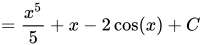
|<math>=\frac{x^5}{5}+x-2\cos(x)+C</math> . | |<math>=\frac{x^5}{5}+x-2\cos(x)+C</math> . | ||
|} | |} | ||
| + | |||
| + | ==Recognizing Derivatives and Reversing Derivative Rules== | ||
| + | If we recognize a function <math>g(x)</math> as being the derivative of a function <math>f(x)</math> , then we can easily express the antiderivative of <math>g(x)</math> : | ||
| + | |||
| + | <math>\int g(x)dx=f(x)+C</math> | ||
| + | |||
| + | For example, since | ||
| + | |||
| + | <math>\frac{d}{dx}\sin(x)=\cos(x)</math> | ||
| + | |||
| + | we can conclude that | ||
| + | |||
| + | <math>\int\cos(x)dx=\sin(x)+C</math> | ||
| + | |||
| + | Similarly, since we know <math>e^x</math> is its own derivative, | ||
| + | |||
| + | <math>\int e^xdx=e^x+C</math> | ||
| + | |||
| + | |||
| + | The power rule for derivatives can be reversed to give us a way to handle integrals of powers of <math>x</math> . Since | ||
| + | |||
| + | <math>\frac{d}{dx}x^n=nx^{n-1}</math> | ||
| + | |||
| + | we can conclude that | ||
| + | |||
| + | <math>\int nx^{n-1}dx=x^n+C</math> | ||
| + | |||
| + | or, a little more usefully, | ||
| + | |||
| + | <math>\int x^ndx=\frac{x^{n+1}}{n+1}+C</math> | ||
==Resources== | ==Resources== | ||
* [https://en.wikibooks.org/wiki/Calculus/Indefinite_integral Indefinite Integral], Wikibooks: Calculus | * [https://en.wikibooks.org/wiki/Calculus/Indefinite_integral Indefinite Integral], Wikibooks: Calculus | ||
* [https://youtu.be/df1Qr8pepx0 Net Change Theorem, Definite Integral & Rates of Change Word Problems, Calculus] by the Organic Chemistry Tutor | * [https://youtu.be/df1Qr8pepx0 Net Change Theorem, Definite Integral & Rates of Change Word Problems, Calculus] by the Organic Chemistry Tutor | ||
Revision as of 19:44, 10 October 2021
Contents
Indefinite integral identities
Basic Properties of Indefinite Integrals
Constant Rule for indefinite integrals
- If Failed to parse (MathML with SVG or PNG fallback (recommended for modern browsers and accessibility tools): Invalid response ("Math extension cannot connect to Restbase.") from server "https://wikimedia.org/api/rest_v1/":): {\displaystyle c} is a constant then Failed to parse (MathML with SVG or PNG fallback (recommended for modern browsers and accessibility tools): Invalid response ("Math extension cannot connect to Restbase.") from server "https://wikimedia.org/api/rest_v1/":): {\displaystyle \int c\cdot f(x)dx=c\int f(x)dx} }}
Sum/Difference Rule for indefinite integrals
- Failed to parse (MathML with SVG or PNG fallback (recommended for modern browsers and accessibility tools): Invalid response ("Math extension cannot connect to Restbase.") from server "https://wikimedia.org/api/rest_v1/":): {\displaystyle \int\Big(f(x)+g(x)\Big)dx=\int f(x)dx+\int g(x)dx}
- Failed to parse (MathML with SVG or PNG fallback (recommended for modern browsers and accessibility tools): Invalid response ("Math extension cannot connect to Restbase.") from server "https://wikimedia.org/api/rest_v1/":): {\displaystyle \int\Big(f(x)-g(x)\Big)dx=\int f(x)dx-\int g(x)dx} }}
Indefinite integrals of Polynomials
Say we are given a function of the form, Failed to parse (MathML with SVG or PNG fallback (recommended for modern browsers and accessibility tools): Invalid response ("Math extension cannot connect to Restbase.") from server "https://wikimedia.org/api/rest_v1/":): {\displaystyle f(x)=x^n} , and would like to determine the antiderivative of Failed to parse (MathML with SVG or PNG fallback (recommended for modern browsers and accessibility tools): Invalid response ("Math extension cannot connect to Restbase.") from server "https://wikimedia.org/api/rest_v1/":): {\displaystyle f} . Considering that
- Failed to parse (MathML with SVG or PNG fallback (recommended for modern browsers and accessibility tools): Invalid response ("Math extension cannot connect to Restbase.") from server "https://wikimedia.org/api/rest_v1/":): {\displaystyle \frac{d}{dx}\frac{1}{n+1}x^{n+1}=x^n}
we have the following rule for indefinite integrals:
Power rule for indefinite integrals
- Failed to parse (MathML with SVG or PNG fallback (recommended for modern browsers and accessibility tools): Invalid response ("Math extension cannot connect to Restbase.") from server "https://wikimedia.org/api/rest_v1/":): {\displaystyle \int x^ndx=\frac{x^{n+1}}{n+1}+C} for all Failed to parse (MathML with SVG or PNG fallback (recommended for modern browsers and accessibility tools): Invalid response ("Math extension cannot connect to Restbase.") from server "https://wikimedia.org/api/rest_v1/":): {\displaystyle n\ne -1}
Integral of the Inverse function
To integrate Failed to parse (MathML with SVG or PNG fallback (recommended for modern browsers and accessibility tools): Invalid response ("Math extension cannot connect to Restbase.") from server "https://wikimedia.org/api/rest_v1/":): {\displaystyle f(x)=\frac{1}{x}} , we should first remember
- Failed to parse (MathML with SVG or PNG fallback (recommended for modern browsers and accessibility tools): Invalid response ("Math extension cannot connect to Restbase.") from server "https://wikimedia.org/api/rest_v1/":): {\displaystyle \frac{d}{dx}\ln(x)=\frac{1}{x}}
Therefore, since Failed to parse (MathML with SVG or PNG fallback (recommended for modern browsers and accessibility tools): Invalid response ("Math extension cannot connect to Restbase.") from server "https://wikimedia.org/api/rest_v1/":): {\displaystyle \frac{1}{x}} is the derivative of Failed to parse (MathML with SVG or PNG fallback (recommended for modern browsers and accessibility tools): Invalid response ("Math extension cannot connect to Restbase.") from server "https://wikimedia.org/api/rest_v1/":): {\displaystyle \ln(x)} we can conclude that
Failed to parse (MathML with SVG or PNG fallback (recommended for modern browsers and accessibility tools): Invalid response ("Math extension cannot connect to Restbase.") from server "https://wikimedia.org/api/rest_v1/":): {\displaystyle \int\frac{dx}{x}=\ln|x|+C}
Note that the polynomial integration rule does not apply when the exponent is Failed to parse (MathML with SVG or PNG fallback (recommended for modern browsers and accessibility tools): Invalid response ("Math extension cannot connect to Restbase.") from server "https://wikimedia.org/api/rest_v1/":): {\displaystyle -1} . This technique of integration must be used instead. Since the argument of the natural logarithm function must be positive (on the real line), the absolute value signs are added around its argument to ensure that the argument is positive.
Integral of the Exponential function
Since
- Failed to parse (MathML with SVG or PNG fallback (recommended for modern browsers and accessibility tools): Invalid response ("Math extension cannot connect to Restbase.") from server "https://wikimedia.org/api/rest_v1/":): {\displaystyle \frac{d}{dx}e^x=e^x}
we see that Failed to parse (MathML with SVG or PNG fallback (recommended for modern browsers and accessibility tools): Invalid response ("Math extension cannot connect to Restbase.") from server "https://wikimedia.org/api/rest_v1/":): {\displaystyle e^x} is its own antiderivative. This allows us to find the integral of an exponential function:
Failed to parse (MathML with SVG or PNG fallback (recommended for modern browsers and accessibility tools): Invalid response ("Math extension cannot connect to Restbase.") from server "https://wikimedia.org/api/rest_v1/":): {\displaystyle \int e^xdx=e^x+C}
Integral of Sine and Cosine
Recall that
- Failed to parse (MathML with SVG or PNG fallback (recommended for modern browsers and accessibility tools): Invalid response ("Math extension cannot connect to Restbase.") from server "https://wikimedia.org/api/rest_v1/":): {\displaystyle \frac{d}{dx}\sin(x)=\cos(x)}
- Failed to parse (MathML with SVG or PNG fallback (recommended for modern browsers and accessibility tools): Invalid response ("Math extension cannot connect to Restbase.") from server "https://wikimedia.org/api/rest_v1/":): {\displaystyle \frac{d}{dx}\cos(x)=-\sin(x)}
So Failed to parse (MathML with SVG or PNG fallback (recommended for modern browsers and accessibility tools): Invalid response ("Math extension cannot connect to Restbase.") from server "https://wikimedia.org/api/rest_v1/":): {\displaystyle \sin(x)} is an antiderivative of Failed to parse (MathML with SVG or PNG fallback (recommended for modern browsers and accessibility tools): Invalid response ("Math extension cannot connect to Restbase.") from server "https://wikimedia.org/api/rest_v1/":): {\displaystyle \cos(x)} and Failed to parse (MathML with SVG or PNG fallback (recommended for modern browsers and accessibility tools): Invalid response ("Math extension cannot connect to Restbase.") from server "https://wikimedia.org/api/rest_v1/":): {\displaystyle -\cos(x)} is an antiderivative of Failed to parse (MathML with SVG or PNG fallback (recommended for modern browsers and accessibility tools): Invalid response ("Math extension cannot connect to Restbase.") from server "https://wikimedia.org/api/rest_v1/":): {\displaystyle \sin(x)} . Hence we get the following rules for integrating Failed to parse (MathML with SVG or PNG fallback (recommended for modern browsers and accessibility tools): Invalid response ("Math extension cannot connect to Restbase.") from server "https://wikimedia.org/api/rest_v1/":): {\displaystyle \sin(x)} and Failed to parse (MathML with SVG or PNG fallback (recommended for modern browsers and accessibility tools): Invalid response ("Math extension cannot connect to Restbase.") from server "https://wikimedia.org/api/rest_v1/":): {\displaystyle \cos(x)}
Failed to parse (MathML with SVG or PNG fallback (recommended for modern browsers and accessibility tools): Invalid response ("Math extension cannot connect to Restbase.") from server "https://wikimedia.org/api/rest_v1/":): {\displaystyle \int\cos(x)dx=\sin(x)+C}
Failed to parse (MathML with SVG or PNG fallback (recommended for modern browsers and accessibility tools): Invalid response ("Math extension cannot connect to Restbase.") from server "https://wikimedia.org/api/rest_v1/":): {\displaystyle \int\sin(x)dx=-\cos(x)+C}
Example
Suppose we want to integrate the function Failed to parse (MathML with SVG or PNG fallback (recommended for modern browsers and accessibility tools): Invalid response ("Math extension cannot connect to Restbase.") from server "https://wikimedia.org/api/rest_v1/":): {\displaystyle f(x)=x^4+1+2\sin(x)} . An application of the sum rule from above allows us to use the power rule and our rule for integrating Failed to parse (MathML with SVG or PNG fallback (recommended for modern browsers and accessibility tools): Invalid response ("Math extension cannot connect to Restbase.") from server "https://wikimedia.org/api/rest_v1/":): {\displaystyle \sin(x)} as follows,
Failed to parse (MathML with SVG or PNG fallback (recommended for modern browsers and accessibility tools): Invalid response ("Math extension cannot connect to Restbase.") from server "https://wikimedia.org/api/rest_v1/":): {\displaystyle \int f(x)dx} Failed to parse (MathML with SVG or PNG fallback (recommended for modern browsers and accessibility tools): Invalid response ("Math extension cannot connect to Restbase.") from server "https://wikimedia.org/api/rest_v1/":): {\displaystyle =\int\Big(x^4+1+2\sin(x)\Big)dx} Failed to parse (MathML with SVG or PNG fallback (recommended for modern browsers and accessibility tools): Invalid response ("Math extension cannot connect to Restbase.") from server "https://wikimedia.org/api/rest_v1/":): {\displaystyle =\int x^4dx+\int 1\,dx+\int 2\sin(x)dx} .
Recognizing Derivatives and Reversing Derivative Rules
If we recognize a function Failed to parse (MathML with SVG or PNG fallback (recommended for modern browsers and accessibility tools): Invalid response ("Math extension cannot connect to Restbase.") from server "https://wikimedia.org/api/rest_v1/":): {\displaystyle g(x)} as being the derivative of a function Failed to parse (MathML with SVG or PNG fallback (recommended for modern browsers and accessibility tools): Invalid response ("Math extension cannot connect to Restbase.") from server "https://wikimedia.org/api/rest_v1/":): {\displaystyle f(x)} , then we can easily express the antiderivative of Failed to parse (MathML with SVG or PNG fallback (recommended for modern browsers and accessibility tools): Invalid response ("Math extension cannot connect to Restbase.") from server "https://wikimedia.org/api/rest_v1/":): {\displaystyle g(x)} :
Failed to parse (MathML with SVG or PNG fallback (recommended for modern browsers and accessibility tools): Invalid response ("Math extension cannot connect to Restbase.") from server "https://wikimedia.org/api/rest_v1/":): {\displaystyle \int g(x)dx=f(x)+C}
For example, since
Failed to parse (MathML with SVG or PNG fallback (recommended for modern browsers and accessibility tools): Invalid response ("Math extension cannot connect to Restbase.") from server "https://wikimedia.org/api/rest_v1/":): {\displaystyle \frac{d}{dx}\sin(x)=\cos(x)}
we can conclude that
Failed to parse (MathML with SVG or PNG fallback (recommended for modern browsers and accessibility tools): Invalid response ("Math extension cannot connect to Restbase.") from server "https://wikimedia.org/api/rest_v1/":): {\displaystyle \int\cos(x)dx=\sin(x)+C}
Similarly, since we know Failed to parse (MathML with SVG or PNG fallback (recommended for modern browsers and accessibility tools): Invalid response ("Math extension cannot connect to Restbase.") from server "https://wikimedia.org/api/rest_v1/":): {\displaystyle e^x} is its own derivative,
Failed to parse (MathML with SVG or PNG fallback (recommended for modern browsers and accessibility tools): Invalid response ("Math extension cannot connect to Restbase.") from server "https://wikimedia.org/api/rest_v1/":): {\displaystyle \int e^xdx=e^x+C}
The power rule for derivatives can be reversed to give us a way to handle integrals of powers of Failed to parse (MathML with SVG or PNG fallback (recommended for modern browsers and accessibility tools): Invalid response ("Math extension cannot connect to Restbase.") from server "https://wikimedia.org/api/rest_v1/":): {\displaystyle x}
. Since
Failed to parse (MathML with SVG or PNG fallback (recommended for modern browsers and accessibility tools): Invalid response ("Math extension cannot connect to Restbase.") from server "https://wikimedia.org/api/rest_v1/":): {\displaystyle \frac{d}{dx}x^n=nx^{n-1}}
we can conclude that
Failed to parse (MathML with SVG or PNG fallback (recommended for modern browsers and accessibility tools): Invalid response ("Math extension cannot connect to Restbase.") from server "https://wikimedia.org/api/rest_v1/":): {\displaystyle \int nx^{n-1}dx=x^n+C}
or, a little more usefully,
Failed to parse (MathML with SVG or PNG fallback (recommended for modern browsers and accessibility tools): Invalid response ("Math extension cannot connect to Restbase.") from server "https://wikimedia.org/api/rest_v1/":): {\displaystyle \int x^ndx=\frac{x^{n+1}}{n+1}+C}
Resources
- Indefinite Integral, Wikibooks: Calculus
- Net Change Theorem, Definite Integral & Rates of Change Word Problems, Calculus by the Organic Chemistry Tutor

