Difference between revisions of "The Limit Theorems for Functions"
(Created page with "<h1 id="toc0">The Uniqueness of Limits of a Function Theorem</h1> <p>Recall from <a href="/the-limit-of-a-function">The Limit of a Function</a> page that for a function <math>...") |
|||
| Line 15: | Line 15: | ||
<li>Similarly, since <math>\lim_{x \to c} f(x) = M</math> then for <math>\epsilon_2 = \frac{\epsilon}{2}</math> <math>\exists \delta_2 > 0</math> such that if <math>x \in A</math> and <math>0 < \mid x - c \mid < \delta_2</math> then <math>\mid f(x) - M \mid < \epsilon_2 = \frac{\epsilon}{2}</math>. Now let <math>\delta = \mathrm{min} \{ \delta_1, \delta_2 \}</math> and so we have that:</li> | <li>Similarly, since <math>\lim_{x \to c} f(x) = M</math> then for <math>\epsilon_2 = \frac{\epsilon}{2}</math> <math>\exists \delta_2 > 0</math> such that if <math>x \in A</math> and <math>0 < \mid x - c \mid < \delta_2</math> then <math>\mid f(x) - M \mid < \epsilon_2 = \frac{\epsilon}{2}</math>. Now let <math>\delta = \mathrm{min} \{ \delta_1, \delta_2 \}</math> and so we have that:</li> | ||
</ul> | </ul> | ||
| − | |||
<math>\begin{align} \quad \quad \mid L - M \mid = \mid L - f(x) + f(x) - M \mid ≤ \mid L - f(x) \mid + \mid f(x) - M \mid < \epsilon_1 + \epsilon_2 = \frac{\epsilon}{2} + \frac{\epsilon}{2} = \epsilon \end{align}</math> | <math>\begin{align} \quad \quad \mid L - M \mid = \mid L - f(x) + f(x) - M \mid ≤ \mid L - f(x) \mid + \mid f(x) - M \mid < \epsilon_1 + \epsilon_2 = \frac{\epsilon}{2} + \frac{\epsilon}{2} = \epsilon \end{align}</math> | ||
<ul> | <ul> | ||
<li>But <math>\epsilon > 0</math> is arbitrary, so this implies that <math>\mid L - M \mid = 0</math>, that is <math>L = M</math>, a contradiction. So our assumption that <math>L \neq M</math> was false, and so if <math>\lim_{x \to c} f(x) = L</math> then <math>L</math> is unique. <math>\blacksquare</math></li> | <li>But <math>\epsilon > 0</math> is arbitrary, so this implies that <math>\mid L - M \mid = 0</math>, that is <math>L = M</math>, a contradiction. So our assumption that <math>L \neq M</math> was false, and so if <math>\lim_{x \to c} f(x) = L</math> then <math>L</math> is unique. <math>\blacksquare</math></li> | ||
</ul> | </ul> | ||
Revision as of 15:12, 21 October 2021
The Uniqueness of Limits of a Function Theorem
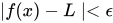
Recall from <a href="/the-limit-of-a-function">The Limit of a Function</a> page that for a function Failed to parse (MathML with SVG or PNG fallback (recommended for modern browsers and accessibility tools): Invalid response ("Math extension cannot connect to Restbase.") from server "https://wikimedia.org/api/rest_v1/":): {\displaystyle f : A \to \mathbb{R}} where Failed to parse (MathML with SVG or PNG fallback (recommended for modern browsers and accessibility tools): Invalid response ("Math extension cannot connect to Restbase.") from server "https://wikimedia.org/api/rest_v1/":): {\displaystyle c} is a cluster point of , then if such that if and then . We have not yet established that the limit is unique, so is it possible that and where ? The following theorem will show that this cannot happen.




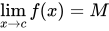

| Theorem (Uniqueness of Limits): Let be a function and let Failed to parse (MathML with SVG or PNG fallback (recommended for modern browsers and accessibility tools): Invalid response ("Math extension cannot connect to Restbase.") from server "https://wikimedia.org/api/rest_v1/":): {\displaystyle c} be a cluster point of Failed to parse (MathML with SVG or PNG fallback (recommended for modern browsers and accessibility tools): Invalid response ("Math extension cannot connect to Restbase.") from server "https://wikimedia.org/api/rest_v1/":): {\displaystyle A} . Then if Failed to parse (MathML with SVG or PNG fallback (recommended for modern browsers and accessibility tools): Invalid response ("Math extension cannot connect to Restbase.") from server "https://wikimedia.org/api/rest_v1/":): {\displaystyle L, M \in \mathbb{R}} are both limits of Failed to parse (MathML with SVG or PNG fallback (recommended for modern browsers and accessibility tools): Invalid response ("Math extension cannot connect to Restbase.") from server "https://wikimedia.org/api/rest_v1/":): {\displaystyle f} at Failed to parse (MathML with SVG or PNG fallback (recommended for modern browsers and accessibility tools): Invalid response ("Math extension cannot connect to Restbase.") from server "https://wikimedia.org/api/rest_v1/":): {\displaystyle c} , that is Failed to parse (MathML with SVG or PNG fallback (recommended for modern browsers and accessibility tools): Invalid response ("Math extension cannot connect to Restbase.") from server "https://wikimedia.org/api/rest_v1/":): {\displaystyle \lim_{x \to c} f(x) = L} and Failed to parse (MathML with SVG or PNG fallback (recommended for modern browsers and accessibility tools): Invalid response ("Math extension cannot connect to Restbase.") from server "https://wikimedia.org/api/rest_v1/":): {\displaystyle \lim_{x \to c} f(x) = M} , then Failed to parse (MathML with SVG or PNG fallback (recommended for modern browsers and accessibility tools): Invalid response ("Math extension cannot connect to Restbase.") from server "https://wikimedia.org/api/rest_v1/":): {\displaystyle L = M} . |

- Proof: Let Failed to parse (MathML with SVG or PNG fallback (recommended for modern browsers and accessibility tools): Invalid response ("Math extension cannot connect to Restbase.") from server "https://wikimedia.org/api/rest_v1/":): {\displaystyle f : A \to \mathbb{R}} be a function and let Failed to parse (MathML with SVG or PNG fallback (recommended for modern browsers and accessibility tools): Invalid response ("Math extension cannot connect to Restbase.") from server "https://wikimedia.org/api/rest_v1/":): {\displaystyle c} be a cluster point of Failed to parse (MathML with SVG or PNG fallback (recommended for modern browsers and accessibility tools): Invalid response ("Math extension cannot connect to Restbase.") from server "https://wikimedia.org/api/rest_v1/":): {\displaystyle A} . Also let Failed to parse (MathML with SVG or PNG fallback (recommended for modern browsers and accessibility tools): Invalid response ("Math extension cannot connect to Restbase.") from server "https://wikimedia.org/api/rest_v1/":): {\displaystyle \lim_{x \to c} f(x) = L} and Failed to parse (MathML with SVG or PNG fallback (recommended for modern browsers and accessibility tools): Invalid response ("Math extension cannot connect to Restbase.") from server "https://wikimedia.org/api/rest_v1/":): {\displaystyle \lim_{x \to c} f(x) = M} . Suppose that Failed to parse (MathML with SVG or PNG fallback (recommended for modern browsers and accessibility tools): Invalid response ("Math extension cannot connect to Restbase.") from server "https://wikimedia.org/api/rest_v1/":): {\displaystyle L \neq M} . We will show that this leads to a contradiction. Let Failed to parse (MathML with SVG or PNG fallback (recommended for modern browsers and accessibility tools): Invalid response ("Math extension cannot connect to Restbase.") from server "https://wikimedia.org/api/rest_v1/":): {\displaystyle \epsilon > 0} be given.
- Since Failed to parse (MathML with SVG or PNG fallback (recommended for modern browsers and accessibility tools): Invalid response ("Math extension cannot connect to Restbase.") from server "https://wikimedia.org/api/rest_v1/":): {\displaystyle \lim_{x \to c} f(x) = L} , then for Failed to parse (MathML with SVG or PNG fallback (recommended for modern browsers and accessibility tools): Invalid response ("Math extension cannot connect to Restbase.") from server "https://wikimedia.org/api/rest_v1/":): {\displaystyle \epsilon_1 = \frac{\epsilon}{2}} Failed to parse (MathML with SVG or PNG fallback (recommended for modern browsers and accessibility tools): Invalid response ("Math extension cannot connect to Restbase.") from server "https://wikimedia.org/api/rest_v1/":): {\displaystyle \exists \delta_1 > 0} such that if Failed to parse (MathML with SVG or PNG fallback (recommended for modern browsers and accessibility tools): Invalid response ("Math extension cannot connect to Restbase.") from server "https://wikimedia.org/api/rest_v1/":): {\displaystyle x \in A} and Failed to parse (MathML with SVG or PNG fallback (recommended for modern browsers and accessibility tools): Invalid response ("Math extension cannot connect to Restbase.") from server "https://wikimedia.org/api/rest_v1/":): {\displaystyle 0 < \mid x - c \mid < \delta_1} then Failed to parse (MathML with SVG or PNG fallback (recommended for modern browsers and accessibility tools): Invalid response ("Math extension cannot connect to Restbase.") from server "https://wikimedia.org/api/rest_v1/":): {\displaystyle \mid f(x) - L \mid < \epsilon_1 = \frac{\epsilon}{2}} .
- Similarly, since Failed to parse (MathML with SVG or PNG fallback (recommended for modern browsers and accessibility tools): Invalid response ("Math extension cannot connect to Restbase.") from server "https://wikimedia.org/api/rest_v1/":): {\displaystyle \lim_{x \to c} f(x) = M} then for Failed to parse (MathML with SVG or PNG fallback (recommended for modern browsers and accessibility tools): Invalid response ("Math extension cannot connect to Restbase.") from server "https://wikimedia.org/api/rest_v1/":): {\displaystyle \epsilon_2 = \frac{\epsilon}{2}} Failed to parse (MathML with SVG or PNG fallback (recommended for modern browsers and accessibility tools): Invalid response ("Math extension cannot connect to Restbase.") from server "https://wikimedia.org/api/rest_v1/":): {\displaystyle \exists \delta_2 > 0} such that if Failed to parse (MathML with SVG or PNG fallback (recommended for modern browsers and accessibility tools): Invalid response ("Math extension cannot connect to Restbase.") from server "https://wikimedia.org/api/rest_v1/":): {\displaystyle x \in A} and Failed to parse (MathML with SVG or PNG fallback (recommended for modern browsers and accessibility tools): Invalid response ("Math extension cannot connect to Restbase.") from server "https://wikimedia.org/api/rest_v1/":): {\displaystyle 0 < \mid x - c \mid < \delta_2} then Failed to parse (MathML with SVG or PNG fallback (recommended for modern browsers and accessibility tools): Invalid response ("Math extension cannot connect to Restbase.") from server "https://wikimedia.org/api/rest_v1/":): {\displaystyle \mid f(x) - M \mid < \epsilon_2 = \frac{\epsilon}{2}} . Now let Failed to parse (MathML with SVG or PNG fallback (recommended for modern browsers and accessibility tools): Invalid response ("Math extension cannot connect to Restbase.") from server "https://wikimedia.org/api/rest_v1/":): {\displaystyle \delta = \mathrm{min} \{ \delta_1, \delta_2 \}} and so we have that:
Failed to parse (MathML with SVG or PNG fallback (recommended for modern browsers and accessibility tools): Invalid response ("Math extension cannot connect to Restbase.") from server "https://wikimedia.org/api/rest_v1/":): {\displaystyle \begin{align} \quad \quad \mid L - M \mid = \mid L - f(x) + f(x) - M \mid ≤ \mid L - f(x) \mid + \mid f(x) - M \mid < \epsilon_1 + \epsilon_2 = \frac{\epsilon}{2} + \frac{\epsilon}{2} = \epsilon \end{align}}
- But Failed to parse (MathML with SVG or PNG fallback (recommended for modern browsers and accessibility tools): Invalid response ("Math extension cannot connect to Restbase.") from server "https://wikimedia.org/api/rest_v1/":): {\displaystyle \epsilon > 0} is arbitrary, so this implies that Failed to parse (MathML with SVG or PNG fallback (recommended for modern browsers and accessibility tools): Invalid response ("Math extension cannot connect to Restbase.") from server "https://wikimedia.org/api/rest_v1/":): {\displaystyle \mid L - M \mid = 0} , that is Failed to parse (MathML with SVG or PNG fallback (recommended for modern browsers and accessibility tools): Invalid response ("Math extension cannot connect to Restbase.") from server "https://wikimedia.org/api/rest_v1/":): {\displaystyle L = M} , a contradiction. So our assumption that Failed to parse (MathML with SVG or PNG fallback (recommended for modern browsers and accessibility tools): Invalid response ("Math extension cannot connect to Restbase.") from server "https://wikimedia.org/api/rest_v1/":): {\displaystyle L \neq M} was false, and so if Failed to parse (MathML with SVG or PNG fallback (recommended for modern browsers and accessibility tools): Invalid response ("Math extension cannot connect to Restbase.") from server "https://wikimedia.org/api/rest_v1/":): {\displaystyle \lim_{x \to c} f(x) = L} then Failed to parse (MathML with SVG or PNG fallback (recommended for modern browsers and accessibility tools): Invalid response ("Math extension cannot connect to Restbase.") from server "https://wikimedia.org/api/rest_v1/":): {\displaystyle L} is unique. Failed to parse (MathML with SVG or PNG fallback (recommended for modern browsers and accessibility tools): Invalid response ("Math extension cannot connect to Restbase.") from server "https://wikimedia.org/api/rest_v1/":): {\displaystyle \blacksquare}

