Difference between revisions of "Power Series and Analytic Functions"
(Created page with "==Power Series== http://mathonline.wikidot.com/power-series == Operations on power series == === Addition and subtraction === When two functions ''f'' and ''g'' are decompos...") |
|||
| Line 75: | Line 75: | ||
# ''Absolute convergence at every point of the boundary'': <math display="inline">\sum_{n=1}^{\infty}\frac{z^n}{n^2}</math> has radius of convergence <math>1</math>, while it converges absolutely, and uniformly, at every point of <math>|z|=1</math> due to [[Weierstrass M-test]] applied with the [[Harmonic series (mathematics)#p-series|hyper-harmonic convergent series]] <math display="inline">\sum_{n=1}^{\infty}\frac{1}{n^2}</math>. | # ''Absolute convergence at every point of the boundary'': <math display="inline">\sum_{n=1}^{\infty}\frac{z^n}{n^2}</math> has radius of convergence <math>1</math>, while it converges absolutely, and uniformly, at every point of <math>|z|=1</math> due to [[Weierstrass M-test]] applied with the [[Harmonic series (mathematics)#p-series|hyper-harmonic convergent series]] <math display="inline">\sum_{n=1}^{\infty}\frac{1}{n^2}</math>. | ||
# ''Convergent on the closure of the disc of convergence but not continuous sum'': [[Wacław Sierpiński|Sierpiński]] gave an example<ref>{{cite journal|author=Wacław Sierpiński|title=Sur une série potentielle qui, étant convergente en tout point de son cercle de convergence, représente sur ce cercle une fonction discontinue. (French)|journal=Rendiconti del Circolo Matematico di Palermo|url=https://zbmath.org/?q=an:46.1466.03|year=1916|volume=41|publisher=Palermo Rend.|pages=187–190|doi=10.1007/BF03018294|s2cid=121218640|author-link=Wacław Sierpiński}}</ref> of a power series with radius of convergence <math>1</math>, convergent at all points with <math>|z|=1</math>, but the sum is an unbounded function and, in particular, discontinuous. A sufficient condition for one-sided continuity at a boundary point is given by [[Abel's theorem]]. | # ''Convergent on the closure of the disc of convergence but not continuous sum'': [[Wacław Sierpiński|Sierpiński]] gave an example<ref>{{cite journal|author=Wacław Sierpiński|title=Sur une série potentielle qui, étant convergente en tout point de son cercle de convergence, représente sur ce cercle une fonction discontinue. (French)|journal=Rendiconti del Circolo Matematico di Palermo|url=https://zbmath.org/?q=an:46.1466.03|year=1916|volume=41|publisher=Palermo Rend.|pages=187–190|doi=10.1007/BF03018294|s2cid=121218640|author-link=Wacław Sierpiński}}</ref> of a power series with radius of convergence <math>1</math>, convergent at all points with <math>|z|=1</math>, but the sum is an unbounded function and, in particular, discontinuous. A sufficient condition for one-sided continuity at a boundary point is given by [[Abel's theorem]]. | ||
| + | |||
| + | ==Licensing== | ||
| + | Content obtained and/or adapted from: | ||
| + | * [https://en.wikipedia.org/wiki/Power_series Power series, Wikipedia] under a CC BY-SA license | ||
| + | * [http://mathonline.wikidot.com/power-series Power series, mathonline.wikidot.com] under a CC BY-SA license | ||
Revision as of 16:44, 28 October 2021
Contents
Power Series
http://mathonline.wikidot.com/power-series
Operations on power series
Addition and subtraction
When two functions f and g are decomposed into power series around the same center c, the power series of the sum or difference of the functions can be obtained by termwise addition and subtraction. That is, if
- and

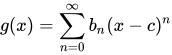
then

It is not true that if two power series and have the same radius of convergence, then also has this radius of convergence. If and , then both series have the same radius of convergence of 1, but the series has a radius of convergence of 3.






Multiplication and division
With the same definitions for and , the power series of the product and quotient of the functions can be obtained as follows:


The sequence is known as the convolution of the sequences and Template:Nowrap


For division, if one defines the sequence by


then

and one can solve recursively for the terms by comparing coefficients.
Solving the corresponding equations yields the formulae based on determinants of certain matrices of the coefficients of and
- Failed to parse (MathML with SVG or PNG fallback (recommended for modern browsers and accessibility tools): Invalid response ("Math extension cannot connect to Restbase.") from server "https://wikimedia.org/api/rest_v1/":): {\displaystyle d_0=\frac{a_0}{b_0}}
- Failed to parse (MathML with SVG or PNG fallback (recommended for modern browsers and accessibility tools): Invalid response ("Math extension cannot connect to Restbase.") from server "https://wikimedia.org/api/rest_v1/":): {\displaystyle d_n=\frac{1}{b_0^{n+1}} \begin{vmatrix} a_n &b_1 &b_2 &\cdots&b_n \\ a_{n-1}&b_0 &b_1 &\cdots&b_{n-1}\\ a_{n-2}&0 &b_0 &\cdots&b_{n-2}\\ \vdots &\vdots&\vdots&\ddots&\vdots \\ a_0 &0 &0 &\cdots&b_0\end{vmatrix}}
Differentiation and integration
Once a function Failed to parse (MathML with SVG or PNG fallback (recommended for modern browsers and accessibility tools): Invalid response ("Math extension cannot connect to Restbase.") from server "https://wikimedia.org/api/rest_v1/":): {\displaystyle f(x)} is given as a power series as above, it is differentiable on the interior of the domain of convergence. It can be differentiated and integrated quite easily, by treating every term separately:
- Failed to parse (MathML with SVG or PNG fallback (recommended for modern browsers and accessibility tools): Invalid response ("Math extension cannot connect to Restbase.") from server "https://wikimedia.org/api/rest_v1/":): {\displaystyle \begin{align} f'(x) &= \sum_{n=1}^\infty a_n n (x - c)^{n-1} = \sum_{n=0}^\infty a_{n+1} (n + 1) (x - c)^n, \\ \int f(x)\,dx &= \sum_{n=0}^\infty \frac{a_n (x - c)^{n+1}}{n + 1} + k = \sum_{n=1}^\infty \frac{a_{n-1} (x - c)^n}{n} + k. \end{align}}
Both of these series have the same radius of convergence as the original one.
Analytic Functions
Template:Main A function f defined on some open subset U of R or C is called analytic if it is locally given by a convergent power series. This means that every a ∈ U has an open neighborhood V ⊆ U, such that there exists a power series with center a that converges to f(x) for every x ∈ V.
Every power series with a positive radius of convergence is analytic on the interior of its region of convergence. All holomorphic functions are complex-analytic. Sums and products of analytic functions are analytic, as are quotients as long as the denominator is non-zero.
If a function is analytic, then it is infinitely differentiable, but in the real case the converse is not generally true. For an analytic function, the coefficients an can be computed as
- Failed to parse (MathML with SVG or PNG fallback (recommended for modern browsers and accessibility tools): Invalid response ("Math extension cannot connect to Restbase.") from server "https://wikimedia.org/api/rest_v1/":): {\displaystyle a_n = \frac{f^{\left( n \right)} \left( c \right)}{n!}}
where Failed to parse (MathML with SVG or PNG fallback (recommended for modern browsers and accessibility tools): Invalid response ("Math extension cannot connect to Restbase.") from server "https://wikimedia.org/api/rest_v1/":): {\displaystyle f^{(n)}(c)} denotes the nth derivative of f at c, and Failed to parse (MathML with SVG or PNG fallback (recommended for modern browsers and accessibility tools): Invalid response ("Math extension cannot connect to Restbase.") from server "https://wikimedia.org/api/rest_v1/":): {\displaystyle f^{(0)}(c) = f(c)} . This means that every analytic function is locally represented by its Taylor series.
The global form of an analytic function is completely determined by its local behavior in the following sense: if f and g are two analytic functions defined on the same connected open set U, and if there exists an element c∈U such that fTemplate:I sup(c) = gTemplate:I sup(c) for all n ≥ 0, then f(x) = g(x) for all x ∈ U.
If a power series with radius of convergence r is given, one can consider analytic continuations of the series, i.e. analytic functions f which are defined on larger sets than { x : |x − c| < r } and agree with the given power series on this set. The number r is maximal in the following sense: there always exists a complex number x with |x − c| = r such that no analytic continuation of the series can be defined at x.
The power series expansion of the inverse function of an analytic function can be determined using the Lagrange inversion theorem.
Behavior near the boundary
The sum of a power series with a positive radius of convergence is an analytic function at every point in the interior of the disc of convergence. However, different behavior can occur at points on the boundary of that disc. For example:
- Divergence while the sum extends to an analytic function: Failed to parse (MathML with SVG or PNG fallback (recommended for modern browsers and accessibility tools): Invalid response ("Math extension cannot connect to Restbase.") from server "https://wikimedia.org/api/rest_v1/":): {\textstyle \sum_{n=0}^{\infty}z^n} has radius of convergence equal to Failed to parse (MathML with SVG or PNG fallback (recommended for modern browsers and accessibility tools): Invalid response ("Math extension cannot connect to Restbase.") from server "https://wikimedia.org/api/rest_v1/":): {\displaystyle 1} and diverges at every point of Failed to parse (MathML with SVG or PNG fallback (recommended for modern browsers and accessibility tools): Invalid response ("Math extension cannot connect to Restbase.") from server "https://wikimedia.org/api/rest_v1/":): {\displaystyle |z|=1} . Nevertheless, the sum in Failed to parse (MathML with SVG or PNG fallback (recommended for modern browsers and accessibility tools): Invalid response ("Math extension cannot connect to Restbase.") from server "https://wikimedia.org/api/rest_v1/":): {\displaystyle |z|<1} is Failed to parse (MathML with SVG or PNG fallback (recommended for modern browsers and accessibility tools): Invalid response ("Math extension cannot connect to Restbase.") from server "https://wikimedia.org/api/rest_v1/":): {\textstyle \frac{1}{1-z}} , which is analytic at every point of the plane except for Failed to parse (MathML with SVG or PNG fallback (recommended for modern browsers and accessibility tools): Invalid response ("Math extension cannot connect to Restbase.") from server "https://wikimedia.org/api/rest_v1/":): {\displaystyle z=1} .
- Convergent at some points divergent at others: Failed to parse (MathML with SVG or PNG fallback (recommended for modern browsers and accessibility tools): Invalid response ("Math extension cannot connect to Restbase.") from server "https://wikimedia.org/api/rest_v1/":): {\textstyle \sum_{n=1}^{\infty}(-1)^{n+1}\frac{z^n}{n}} has radius of convergence Failed to parse (MathML with SVG or PNG fallback (recommended for modern browsers and accessibility tools): Invalid response ("Math extension cannot connect to Restbase.") from server "https://wikimedia.org/api/rest_v1/":): {\displaystyle 1} . It converges for Failed to parse (MathML with SVG or PNG fallback (recommended for modern browsers and accessibility tools): Invalid response ("Math extension cannot connect to Restbase.") from server "https://wikimedia.org/api/rest_v1/":): {\displaystyle z=1} , while it diverges for Failed to parse (MathML with SVG or PNG fallback (recommended for modern browsers and accessibility tools): Invalid response ("Math extension cannot connect to Restbase.") from server "https://wikimedia.org/api/rest_v1/":): {\displaystyle z=-1}
- Absolute convergence at every point of the boundary: Failed to parse (MathML with SVG or PNG fallback (recommended for modern browsers and accessibility tools): Invalid response ("Math extension cannot connect to Restbase.") from server "https://wikimedia.org/api/rest_v1/":): {\textstyle \sum_{n=1}^{\infty}\frac{z^n}{n^2}} has radius of convergence Failed to parse (MathML with SVG or PNG fallback (recommended for modern browsers and accessibility tools): Invalid response ("Math extension cannot connect to Restbase.") from server "https://wikimedia.org/api/rest_v1/":): {\displaystyle 1} , while it converges absolutely, and uniformly, at every point of Failed to parse (MathML with SVG or PNG fallback (recommended for modern browsers and accessibility tools): Invalid response ("Math extension cannot connect to Restbase.") from server "https://wikimedia.org/api/rest_v1/":): {\displaystyle |z|=1} due to Weierstrass M-test applied with the hyper-harmonic convergent series Failed to parse (MathML with SVG or PNG fallback (recommended for modern browsers and accessibility tools): Invalid response ("Math extension cannot connect to Restbase.") from server "https://wikimedia.org/api/rest_v1/":): {\textstyle \sum_{n=1}^{\infty}\frac{1}{n^2}} .
- Convergent on the closure of the disc of convergence but not continuous sum: Sierpiński gave an example[1] of a power series with radius of convergence Failed to parse (MathML with SVG or PNG fallback (recommended for modern browsers and accessibility tools): Invalid response ("Math extension cannot connect to Restbase.") from server "https://wikimedia.org/api/rest_v1/":): {\displaystyle 1} , convergent at all points with Failed to parse (MathML with SVG or PNG fallback (recommended for modern browsers and accessibility tools): Invalid response ("Math extension cannot connect to Restbase.") from server "https://wikimedia.org/api/rest_v1/":): {\displaystyle |z|=1} , but the sum is an unbounded function and, in particular, discontinuous. A sufficient condition for one-sided continuity at a boundary point is given by Abel's theorem.
Licensing
Content obtained and/or adapted from:
- Power series, Wikipedia under a CC BY-SA license
- Power series, mathonline.wikidot.com under a CC BY-SA license

