Difference between revisions of "Laplace Transform to ODEs"
(Created page with "In mathematics, the Laplace transform is a powerful integral transform used to switch a function from the time domain to the Laplace transform#s-domain equiv...") |
|||
| Line 1: | Line 1: | ||
| − | + | The Laplace transform is a powerful integral transform used to switch a function from the time domain to the s-domain. The Laplace transform can be used in some cases to solve linear differential equations with given initial conditions. | |
First consider the following property of the Laplace transform: | First consider the following property of the Laplace transform: | ||
| Line 7: | Line 7: | ||
:<math>\mathcal{L}\{f''\}=s^2\mathcal{L}\{f\}-sf(0)-f'(0)</math> | :<math>\mathcal{L}\{f''\}=s^2\mathcal{L}\{f\}-sf(0)-f'(0)</math> | ||
| − | One can prove by | + | One can prove by induction that |
:<math>\mathcal{L}\{f^{(n)}\}=s^n\mathcal{L}\{f\}-\sum_{i=1}^{n}s^{n-i}f^{(i-1)}(0)</math> | :<math>\mathcal{L}\{f^{(n)}\}=s^n\mathcal{L}\{f\}-\sum_{i=1}^{n}s^{n-i}f^{(i-1)}(0)</math> | ||
| Line 19: | Line 19: | ||
:<math>f^{(i)}(0)=c_i</math> | :<math>f^{(i)}(0)=c_i</math> | ||
| − | Using the | + | Using the linearity of the Laplace transform it is equivalent to rewrite the equation as |
:<math>\sum_{i=0}^{n}a_i\mathcal{L}\{f^{(i)}(t)\}=\mathcal{L}\{\phi(t)\}</math> | :<math>\sum_{i=0}^{n}a_i\mathcal{L}\{f^{(i)}(t)\}=\mathcal{L}\{\phi(t)\}</math> | ||
| Line 31: | Line 31: | ||
:<math>\mathcal{L}\{f(t)\}=\frac{\mathcal{L}\{\phi(t)\}+\sum_{i=1}^{n}\sum_{j=1}^{i}a_is^{i-j}c_{j-1}}{\sum_{i=0}^{n}a_is^i}</math> | :<math>\mathcal{L}\{f(t)\}=\frac{\mathcal{L}\{\phi(t)\}+\sum_{i=1}^{n}\sum_{j=1}^{i}a_is^{i-j}c_{j-1}}{\sum_{i=0}^{n}a_is^i}</math> | ||
| − | The solution for ''f''(''t'') is obtained by applying the | + | The solution for ''f''(''t'') is obtained by applying the inverse Laplace transform to <math>\mathcal{L}\{f(t)\}.</math> |
Note that if the initial conditions are all zero, i.e. | Note that if the initial conditions are all zero, i.e. | ||
Revision as of 10:21, 29 October 2021
The Laplace transform is a powerful integral transform used to switch a function from the time domain to the s-domain. The Laplace transform can be used in some cases to solve linear differential equations with given initial conditions.
First consider the following property of the Laplace transform:
- Failed to parse (MathML with SVG or PNG fallback (recommended for modern browsers and accessibility tools): Invalid response ("Math extension cannot connect to Restbase.") from server "https://wikimedia.org/api/rest_v1/":): {\displaystyle \mathcal{L}\{f'\}=s\mathcal{L}\{f\}-f(0)}

One can prove by induction that

Now we consider the following differential equation:
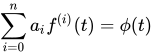
with given initial conditions

Using the linearity of the Laplace transform it is equivalent to rewrite the equation as
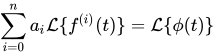
obtaining
- Failed to parse (MathML with SVG or PNG fallback (recommended for modern browsers and accessibility tools): Invalid response ("Math extension cannot connect to Restbase.") from server "https://wikimedia.org/api/rest_v1/":): {\displaystyle \mathcal{L}\{f(t)\}\sum_{i=0}^{n}a_is^i-\sum_{i=1}^{n}\sum_{j=1}^{i}a_is^{i-j}f^{(j-1)}(0)=\mathcal{L}\{\phi(t)\}}
Solving the equation for Failed to parse (MathML with SVG or PNG fallback (recommended for modern browsers and accessibility tools): Invalid response ("Math extension cannot connect to Restbase.") from server "https://wikimedia.org/api/rest_v1/":): {\displaystyle \mathcal{L}\{f(t)\}} and substituting Failed to parse (MathML with SVG or PNG fallback (recommended for modern browsers and accessibility tools): Invalid response ("Math extension cannot connect to Restbase.") from server "https://wikimedia.org/api/rest_v1/":): {\displaystyle f^{(i)}(0)} with Failed to parse (MathML with SVG or PNG fallback (recommended for modern browsers and accessibility tools): Invalid response ("Math extension cannot connect to Restbase.") from server "https://wikimedia.org/api/rest_v1/":): {\displaystyle c_i} one obtains
- Failed to parse (MathML with SVG or PNG fallback (recommended for modern browsers and accessibility tools): Invalid response ("Math extension cannot connect to Restbase.") from server "https://wikimedia.org/api/rest_v1/":): {\displaystyle \mathcal{L}\{f(t)\}=\frac{\mathcal{L}\{\phi(t)\}+\sum_{i=1}^{n}\sum_{j=1}^{i}a_is^{i-j}c_{j-1}}{\sum_{i=0}^{n}a_is^i}}
The solution for f(t) is obtained by applying the inverse Laplace transform to Failed to parse (MathML with SVG or PNG fallback (recommended for modern browsers and accessibility tools): Invalid response ("Math extension cannot connect to Restbase.") from server "https://wikimedia.org/api/rest_v1/":): {\displaystyle \mathcal{L}\{f(t)\}.}
Note that if the initial conditions are all zero, i.e.
- Failed to parse (MathML with SVG or PNG fallback (recommended for modern browsers and accessibility tools): Invalid response ("Math extension cannot connect to Restbase.") from server "https://wikimedia.org/api/rest_v1/":): {\displaystyle f^{(i)}(0)=c_i=0\quad\forall i\in\{0,1,2,...\ n\}}
then the formula simplifies to
- Failed to parse (MathML with SVG or PNG fallback (recommended for modern browsers and accessibility tools): Invalid response ("Math extension cannot connect to Restbase.") from server "https://wikimedia.org/api/rest_v1/":): {\displaystyle f(t)=\mathcal{L}^{-1}\left\{{\mathcal{L}\{\phi(t)\}\over\sum_{i=0}^{n}a_is^i}\right\}}
An example
We want to solve
- Failed to parse (MathML with SVG or PNG fallback (recommended for modern browsers and accessibility tools): Invalid response ("Math extension cannot connect to Restbase.") from server "https://wikimedia.org/api/rest_v1/":): {\displaystyle f''(t)+4f(t)=\sin(2t)}
with initial conditions f(0) = 0 and f′(0)=0.
We note that
- Failed to parse (MathML with SVG or PNG fallback (recommended for modern browsers and accessibility tools): Invalid response ("Math extension cannot connect to Restbase.") from server "https://wikimedia.org/api/rest_v1/":): {\displaystyle \phi(t)=\sin(2t)}
and we get
- Failed to parse (MathML with SVG or PNG fallback (recommended for modern browsers and accessibility tools): Invalid response ("Math extension cannot connect to Restbase.") from server "https://wikimedia.org/api/rest_v1/":): {\displaystyle \mathcal{L}\{\phi(t)\}=\frac{2}{s^2+4}}
The equation is then equivalent to
- Failed to parse (MathML with SVG or PNG fallback (recommended for modern browsers and accessibility tools): Invalid response ("Math extension cannot connect to Restbase.") from server "https://wikimedia.org/api/rest_v1/":): {\displaystyle s^2\mathcal{L}\{f(t)\}-sf(0)-f'(0)+4\mathcal{L}\{f(t)\}=\mathcal{L}\{\phi(t)\}}
We deduce
- Failed to parse (MathML with SVG or PNG fallback (recommended for modern browsers and accessibility tools): Invalid response ("Math extension cannot connect to Restbase.") from server "https://wikimedia.org/api/rest_v1/":): {\displaystyle \mathcal{L}\{f(t)\}=\frac{2}{(s^2+4)^2}}
Now we apply the Laplace inverse transform to get
- Failed to parse (MathML with SVG or PNG fallback (recommended for modern browsers and accessibility tools): Invalid response ("Math extension cannot connect to Restbase.") from server "https://wikimedia.org/api/rest_v1/":): {\displaystyle f(t)=\frac{1}{8}\sin(2t)-\frac{t}{4}\cos(2t)}
Licensing
Content obtained and/or adapted from:
- Laplace transform applied to ODEs, Wikipedia under a CC BY-SA license

