Difference between revisions of "Real Function Limits:Sequential Criterion"
| Line 1: | Line 1: | ||
| − | + | ||
| − | <p>We will now look at a very important theorem known as The Sequential Criterion for a Limit which merges the concept of the limit of a function <math>f</math> at a cluster point <math>c</math> from <math>A</math> with regards to sequences <math>(a_n)</math> from <math>A</math> that converge to <math>c</math>.</p> | + | <p>We will now look at a very important theorem known as '''The Sequential Criterion for a Limit''' which merges the concept of the limit of a function <math>f</math> at a cluster point <math>c</math> from <math>A</math> with regards to sequences <math>(a_n)</math> from <math>A</math> that converge to <math>c</math>.</p> |
<tr> | <tr> | ||
Latest revision as of 14:11, 7 November 2021
We will now look at a very important theorem known as The Sequential Criterion for a Limit which merges the concept of the limit of a function at a cluster point from with regards to sequences from that converge to .


Theorem 1 (The Sequential Criterion for a Limit of a Function): Let be a function and let be a cluster point of . Then if and only if for all sequences from the domain where and then .


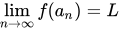
Consider a function that has a limit when is close to . Now consider all sequences from the domain where these sequences converge to , that is . The Sequential Criterion for a Limit of a Function says that then that as goes to infinity, the function evaluated at these will have its limit go to .


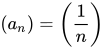
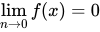
For example, consider the function defined by the equation , and suppose we wanted to compute . We should already know that this limit is zero, that is . Now consider the sequence . This sequence is clearly contained in the domain of . Furthermore, this sequence converges to 0, that is . If all such sequences that converge to have the property that converges to , then we can say that .




We will now look at the proof of The Sequential Criterion for a Limit of a Function.
- Proof: Suppose that , and let be a sequence in such that such that . We thus want to show that .

- Let . We are given that and so for there exists a such that if and then we have that . Now since , since we have that then there exists an such that if then . Therefore .



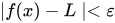



- Therefore it must be that , in other words, we have that and so .


- Suppose that for all in such that and , we have that . We want to show that .

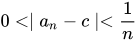
- Suppose not, in other words, suppose that such that then such that . Let . Then there exists , in other words, and Failed to parse (MathML with SVG or PNG fallback (recommended for modern browsers and accessibility tools): Invalid response ("Math extension cannot connect to Restbase.") from server "https://wikimedia.org/api/rest_v1/":): {\displaystyle \lim_{n \to \infty} a_n = c} . However, Failed to parse (MathML with SVG or PNG fallback (recommended for modern browsers and accessibility tools): Invalid response ("Math extension cannot connect to Restbase.") from server "https://wikimedia.org/api/rest_v1/":): {\displaystyle \mid f(a_n) - L \mid \geq \varepsilon_0} so Failed to parse (MathML with SVG or PNG fallback (recommended for modern browsers and accessibility tools): Invalid response ("Math extension cannot connect to Restbase.") from server "https://wikimedia.org/api/rest_v1/":): {\displaystyle \lim_{n \to \infty} f(a_n) \neq L} , a contradiction. Therefore Failed to parse (MathML with SVG or PNG fallback (recommended for modern browsers and accessibility tools): Invalid response ("Math extension cannot connect to Restbase.") from server "https://wikimedia.org/api/rest_v1/":): {\displaystyle \lim_{x \to c} f(x) = L} .






Licensing
Content obtained and/or adapted from:
- The Sequential Criterion for a Limit of a Function, mathonline.wikidot.com under a CC BY-SA license

