We will use the following conventions for simplifying expressions involving radicals:
- Given the expression
 , write this as
 ![{\displaystyle {\sqrt[{c}]{a^{b}}}}](https://wikimedia.org/api/rest_v1/media/math/render/svg/d5895c24b750d771f4ef3e0316fc03b4154c2e0f)
- No fractions under the radical sign
- No radicals in the denominator
- The radicand has no exponentiated factors with exponent greater than or equal to the index of the radical
Example: Simplify the expression  Using convention 1, we rewrite the given expression as
![{\displaystyle \left({\frac {1}{8}}\right)^{\frac {1}{2}}={\sqrt[{2}]{\left({\frac {1}{8}}\right)^{1}}}={\sqrt {\frac {1}{8}}}}](https://wikimedia.org/api/rest_v1/media/math/render/svg/94f5c23d51b8e943f8013a14e79bffef64aeed94)
The expression now violates convention 2. To get rid of the fraction in the radical, apply the rule
 and simplify the result:
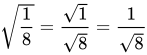
The resulting expression violates convention 3. To get rid of the radical in the denominator, multiply by  :
:
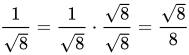
Notice that  . Since the index of the radical is 2, our expression violates convention 4. We can reduce the exponent of the expression under the radical as follows:

The Conjugate of a Radical Expression
The conjugate of the two term expression  is
is  (likewise, the conjugate of is ). The product of a two term expression and its conjugate, and , is
  . This property is useful for getting rid of square roots in two term expressions.
For example, consider the limit

If we plug in 0 for  , we get the indeterminate form
  . However, using the conjugate of the numerator (
 ) and multiplying by a clever form of 1 (the conjugate divided by itself), we can rewrite this limit in a way that allows us to evaluate it.


Now, setting  will not result in an indeterminate form, so we can evaluate the limit.

Resources

