Laplace Transform to ODEs

From Department of Mathematics at UTSA
Revision as of 12:25, 27 November 2021 by Khanh (talk | contribs)
(diff) ← Older revision | Latest revision (diff) | Newer revision → (diff)
Jump to navigation Jump to search

The Laplace transform is a powerful integral transform used to switch a function from the time domain to the s-domain. The Laplace transform can be used in some cases to solve linear differential equations with given initial conditions.

First consider the following property of the Laplace transform:

One can prove by induction that

Now we consider the following differential equation:
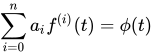
with given initial conditions

Using the linearity of the Laplace transform it is equivalent to rewrite the equation as
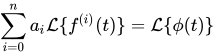
obtaining

Solving the equation for and substituting with one obtains

The solution for f(t) is obtained by applying the inverse Laplace transform to Failed to parse (MathML with SVG or PNG fallback (recommended for modern browsers and accessibility tools): Invalid response ("Math extension cannot connect to Restbase.") from server "https://wikimedia.org/api/rest_v1/":): {\displaystyle \mathcal{L}\{f(t)\}.}

Note that if the initial conditions are all zero, i.e.

Failed to parse (MathML with SVG or PNG fallback (recommended for modern browsers and accessibility tools): Invalid response ("Math extension cannot connect to Restbase.") from server "https://wikimedia.org/api/rest_v1/":): {\displaystyle f^{(i)}(0)=c_i=0\quad\forall i\in\{0,1,2,...\ n\}}

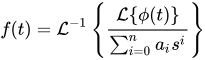
then the formula simplifies to

Failed to parse (MathML with SVG or PNG fallback (recommended for modern browsers and accessibility tools): Invalid response ("Math extension cannot connect to Restbase.") from server "https://wikimedia.org/api/rest_v1/":): {\displaystyle f(t)=\mathcal{L}^{-1}\left\{{\mathcal{L}\{\phi(t)\}\over\sum_{i=0}^{n}a_is^i}\right\}}

An example

We want to solve

Failed to parse (MathML with SVG or PNG fallback (recommended for modern browsers and accessibility tools): Invalid response ("Math extension cannot connect to Restbase.") from server "https://wikimedia.org/api/rest_v1/":): {\displaystyle f''(t)+4f(t)=\sin(2t)}


with initial conditions f(0) = 0 and f′(0)=0.

We note that
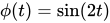
Failed to parse (MathML with SVG or PNG fallback (recommended for modern browsers and accessibility tools): Invalid response ("Math extension cannot connect to Restbase.") from server "https://wikimedia.org/api/rest_v1/":): {\displaystyle \phi(t)=\sin(2t)}

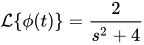
and we get

Failed to parse (MathML with SVG or PNG fallback (recommended for modern browsers and accessibility tools): Invalid response ("Math extension cannot connect to Restbase.") from server "https://wikimedia.org/api/rest_v1/":): {\displaystyle \mathcal{L}\{\phi(t)\}=\frac{2}{s^2+4}}

The equation is then equivalent to

Failed to parse (MathML with SVG or PNG fallback (recommended for modern browsers and accessibility tools): Invalid response ("Math extension cannot connect to Restbase.") from server "https://wikimedia.org/api/rest_v1/":): {\displaystyle s^2\mathcal{L}\{f(t)\}-sf(0)-f'(0)+4\mathcal{L}\{f(t)\}=\mathcal{L}\{\phi(t)\}}

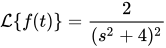
We deduce

Failed to parse (MathML with SVG or PNG fallback (recommended for modern browsers and accessibility tools): Invalid response ("Math extension cannot connect to Restbase.") from server "https://wikimedia.org/api/rest_v1/":): {\displaystyle \mathcal{L}\{f(t)\}=\frac{2}{(s^2+4)^2}}

Now we apply the Laplace inverse transform to get

Failed to parse (MathML with SVG or PNG fallback (recommended for modern browsers and accessibility tools): Invalid response ("Math extension cannot connect to Restbase.") from server "https://wikimedia.org/api/rest_v1/":): {\displaystyle f(t)=\frac{1}{8}\sin(2t)-\frac{t}{4}\cos(2t)}

Laplace Transform to Systems of ODEs

View an example from Laplace Transforms, Paul's Online Notes

Licensing

Content obtained and/or adapted from: