The Inverse of a Linear Transformation
Inverse of an n-by-n matrix
An n-by-n matrix A is the inverse of n-by-n matrix B (and B the inverse of A) if BA = AB = I, where I is an identity matrix.
The inverse of an n-by-n matrix can be calculated by creating an n-by-2n matrix which has the original matrix on the left and the identity matrix on the right. Row reduce this matrix and the right half will be the inverse. If the matrix does not row reduce completely (i.e., a row is formed with all zeroes as its entries), it does not have an inverse.
Example
Let Failed to parse (MathML with SVG or PNG fallback (recommended for modern browsers and accessibility tools): Invalid response ("Math extension cannot connect to Restbase.") from server "https://wikimedia.org/api/rest_v1/":): {\displaystyle \mathrm{A} = \begin{bmatrix} 1 & 4 & 4\\ 2 & 5 & 8\\ 3 & 6 & 9 \end{bmatrix}}
We begin by expanding and partitioning A to include the identity matrix, and then proceed to row reduce A until we reach the identity matrix on the left-hand side.


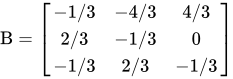
The matrix is then the inverse of the original matrix A.
Inverse of a Linear Transformation
We now consider how to represent the inverse of a linear map. We start by recalling some facts about function inverses. Some functions have no inverse, or have an inverse on the left side or right side only.
Example: Where is the projection map

- Failed to parse (MathML with SVG or PNG fallback (recommended for modern browsers and accessibility tools): Invalid response ("Math extension cannot connect to Restbase.") from server "https://wikimedia.org/api/rest_v1/":): {\displaystyle \begin{pmatrix} x \\ y \\ z \end{pmatrix} \mapsto \begin{pmatrix} x \\ y \end{pmatrix} }
and Failed to parse (MathML with SVG or PNG fallback (recommended for modern browsers and accessibility tools): Invalid response ("Math extension cannot connect to Restbase.") from server "https://wikimedia.org/api/rest_v1/":): {\displaystyle \eta:\mathbb{R}^2\to \mathbb{R}^3 } is the embedding
- Failed to parse (MathML with SVG or PNG fallback (recommended for modern browsers and accessibility tools): Invalid response ("Math extension cannot connect to Restbase.") from server "https://wikimedia.org/api/rest_v1/":): {\displaystyle \begin{pmatrix} x \\ y \end{pmatrix} \mapsto \begin{pmatrix} x \\ y \\ 0 \end{pmatrix} }
the composition Failed to parse (MathML with SVG or PNG fallback (recommended for modern browsers and accessibility tools): Invalid response ("Math extension cannot connect to Restbase.") from server "https://wikimedia.org/api/rest_v1/":): {\displaystyle \pi\circ \eta} is the identity map on Failed to parse (MathML with SVG or PNG fallback (recommended for modern browsers and accessibility tools): Invalid response ("Math extension cannot connect to Restbase.") from server "https://wikimedia.org/api/rest_v1/":): {\displaystyle \mathbb{R}^2} .
- Failed to parse (MathML with SVG or PNG fallback (recommended for modern browsers and accessibility tools): Invalid response ("Math extension cannot connect to Restbase.") from server "https://wikimedia.org/api/rest_v1/":): {\displaystyle \begin{pmatrix} x \\ y \end{pmatrix} \stackrel{\eta}{\longmapsto} \begin{pmatrix} x \\ y \\ 0 \end{pmatrix} \stackrel{\pi}{\longmapsto} \begin{pmatrix} x \\ y \end{pmatrix} }
We say Failed to parse (MathML with SVG or PNG fallback (recommended for modern browsers and accessibility tools): Invalid response ("Math extension cannot connect to Restbase.") from server "https://wikimedia.org/api/rest_v1/":): {\displaystyle \pi} is a left inverse map of Failed to parse (MathML with SVG or PNG fallback (recommended for modern browsers and accessibility tools): Invalid response ("Math extension cannot connect to Restbase.") from server "https://wikimedia.org/api/rest_v1/":): {\displaystyle \eta} or, what is the same thing, that Failed to parse (MathML with SVG or PNG fallback (recommended for modern browsers and accessibility tools): Invalid response ("Math extension cannot connect to Restbase.") from server "https://wikimedia.org/api/rest_v1/":): {\displaystyle \eta} is a right inverse map of Failed to parse (MathML with SVG or PNG fallback (recommended for modern browsers and accessibility tools): Invalid response ("Math extension cannot connect to Restbase.") from server "https://wikimedia.org/api/rest_v1/":): {\displaystyle \pi} . However, composition in the other order Failed to parse (MathML with SVG or PNG fallback (recommended for modern browsers and accessibility tools): Invalid response ("Math extension cannot connect to Restbase.") from server "https://wikimedia.org/api/rest_v1/":): {\displaystyle \eta\circ \pi} doesn't give the identity map— here is a vector that is not sent to itself under Failed to parse (MathML with SVG or PNG fallback (recommended for modern browsers and accessibility tools): Invalid response ("Math extension cannot connect to Restbase.") from server "https://wikimedia.org/api/rest_v1/":): {\displaystyle \eta\circ \pi} .
- Failed to parse (MathML with SVG or PNG fallback (recommended for modern browsers and accessibility tools): Invalid response ("Math extension cannot connect to Restbase.") from server "https://wikimedia.org/api/rest_v1/":): {\displaystyle \begin{pmatrix} 0 \\ 0 \\ 1 \end{pmatrix} \stackrel{\pi}{\longmapsto} \begin{pmatrix} 0 \\ 0 \end{pmatrix} \stackrel{\eta}{\longmapsto} \begin{pmatrix} 0 \\ 0 \\ 0 \end{pmatrix} }
In fact, the projection Failed to parse (MathML with SVG or PNG fallback (recommended for modern browsers and accessibility tools): Invalid response ("Math extension cannot connect to Restbase.") from server "https://wikimedia.org/api/rest_v1/":): {\displaystyle \pi} has no left inverse at all. For, if Failed to parse (MathML with SVG or PNG fallback (recommended for modern browsers and accessibility tools): Invalid response ("Math extension cannot connect to Restbase.") from server "https://wikimedia.org/api/rest_v1/":): {\displaystyle f} were to be a left inverse of Failed to parse (MathML with SVG or PNG fallback (recommended for modern browsers and accessibility tools): Invalid response ("Math extension cannot connect to Restbase.") from server "https://wikimedia.org/api/rest_v1/":): {\displaystyle \pi} then we would have
- Failed to parse (MathML with SVG or PNG fallback (recommended for modern browsers and accessibility tools): Invalid response ("Math extension cannot connect to Restbase.") from server "https://wikimedia.org/api/rest_v1/":): {\displaystyle \begin{pmatrix} x \\ y \\ z \end{pmatrix} \stackrel{\pi}{\longmapsto} \begin{pmatrix} x \\ y \end{pmatrix} \stackrel{f}{\longmapsto} \begin{pmatrix} x \\ y \\ z \end{pmatrix} }
for all of the infinitely many Failed to parse (MathML with SVG or PNG fallback (recommended for modern browsers and accessibility tools): Invalid response ("Math extension cannot connect to Restbase.") from server "https://wikimedia.org/api/rest_v1/":): {\displaystyle z} 's. But no function Failed to parse (MathML with SVG or PNG fallback (recommended for modern browsers and accessibility tools): Invalid response ("Math extension cannot connect to Restbase.") from server "https://wikimedia.org/api/rest_v1/":): {\displaystyle f} can send a single argument to more than one value.
(An example of a function with no inverse on either side is the zero transformation on Failed to parse (MathML with SVG or PNG fallback (recommended for modern browsers and accessibility tools): Invalid response ("Math extension cannot connect to Restbase.") from server "https://wikimedia.org/api/rest_v1/":): {\displaystyle \mathbb{R}^2} .) Template:AnchorSome functions have a two-sided inverse map, another function that is the inverse of the first, both from the left and from the right. For instance, the map given by Failed to parse (MathML with SVG or PNG fallback (recommended for modern browsers and accessibility tools): Invalid response ("Math extension cannot connect to Restbase.") from server "https://wikimedia.org/api/rest_v1/":): {\displaystyle \vec{v}\mapsto 2\cdot \vec{v}} has the two-sided inverse Failed to parse (MathML with SVG or PNG fallback (recommended for modern browsers and accessibility tools): Invalid response ("Math extension cannot connect to Restbase.") from server "https://wikimedia.org/api/rest_v1/":): {\displaystyle \vec{v}\mapsto (1/2)\cdot\vec{v}} . In this subsection we will focus on two-sided inverses. The appendix shows that a function has a two-sided inverse if and only if it is both one-to-one and onto. Template:AnchorThe appendix also shows that if a function Failed to parse (MathML with SVG or PNG fallback (recommended for modern browsers and accessibility tools): Invalid response ("Math extension cannot connect to Restbase.") from server "https://wikimedia.org/api/rest_v1/":): {\displaystyle f} has a two-sided inverse then it is unique, and so it is called "the" inverse, and is denoted Failed to parse (MathML with SVG or PNG fallback (recommended for modern browsers and accessibility tools): Invalid response ("Math extension cannot connect to Restbase.") from server "https://wikimedia.org/api/rest_v1/":): {\displaystyle f^{-1}} . So our purpose in this subsection is, where a linear map Failed to parse (MathML with SVG or PNG fallback (recommended for modern browsers and accessibility tools): Invalid response ("Math extension cannot connect to Restbase.") from server "https://wikimedia.org/api/rest_v1/":): {\displaystyle h} has an inverse, to find the relationship between Failed to parse (MathML with SVG or PNG fallback (recommended for modern browsers and accessibility tools): Invalid response ("Math extension cannot connect to Restbase.") from server "https://wikimedia.org/api/rest_v1/":): {\displaystyle {\rm Rep}_{B,D}(h)} and Failed to parse (MathML with SVG or PNG fallback (recommended for modern browsers and accessibility tools): Invalid response ("Math extension cannot connect to Restbase.") from server "https://wikimedia.org/api/rest_v1/":): {\displaystyle {\rm Rep}_{D,B}(h^{-1})} (recall that we have shown, in Theorem II.2.21 of Section II of this chapter, that if a linear map has an inverse then the inverse is a linear map also).
Because of the correspondence between linear maps and matrices, statements about map inverses translate into statements about matrix inverses.
Template:AnchorHere is the arrow diagram giving the relationship between map inverses and matrix inverses. It is a special case of the diagram for function composition and matrix multiplication.

Beyond its place in our general program of seeing how to represent map operations, another reason for our interest in inverses comes from solving linear systems. A linear system is equivalent to a matrix equation, as here.
- Failed to parse (MathML with SVG or PNG fallback (recommended for modern browsers and accessibility tools): Invalid response ("Math extension cannot connect to Restbase.") from server "https://wikimedia.org/api/rest_v1/":): {\displaystyle \begin{array}{*{2}{rc}r} x_1 &+ &x_2 &= &3 \\ 2x_1 &- &x_2 &= &2 \end{array} \quad\Longleftrightarrow\quad \begin{pmatrix} 1 &1 \\ 2 &-1 \end{pmatrix} \begin{pmatrix} x_1 \\ x_2 \end{pmatrix} = \begin{pmatrix} 3 \\ 2 \end{pmatrix} \qquad\qquad (*)}
By fixing spaces and bases (e.g., Failed to parse (MathML with SVG or PNG fallback (recommended for modern browsers and accessibility tools): Invalid response ("Math extension cannot connect to Restbase.") from server "https://wikimedia.org/api/rest_v1/":): {\displaystyle \mathbb{R}^2,\mathbb{R}^2} and Failed to parse (MathML with SVG or PNG fallback (recommended for modern browsers and accessibility tools): Invalid response ("Math extension cannot connect to Restbase.") from server "https://wikimedia.org/api/rest_v1/":): {\displaystyle \mathcal{E}_2,\mathcal{E}_2} ), we take the matrix Failed to parse (MathML with SVG or PNG fallback (recommended for modern browsers and accessibility tools): Invalid response ("Math extension cannot connect to Restbase.") from server "https://wikimedia.org/api/rest_v1/":): {\displaystyle H} to represent some map Failed to parse (MathML with SVG or PNG fallback (recommended for modern browsers and accessibility tools): Invalid response ("Math extension cannot connect to Restbase.") from server "https://wikimedia.org/api/rest_v1/":): {\displaystyle h} . Then solving the system is the same as asking: what domain vector Failed to parse (MathML with SVG or PNG fallback (recommended for modern browsers and accessibility tools): Invalid response ("Math extension cannot connect to Restbase.") from server "https://wikimedia.org/api/rest_v1/":): {\displaystyle \vec{x}} is mapped by Failed to parse (MathML with SVG or PNG fallback (recommended for modern browsers and accessibility tools): Invalid response ("Math extension cannot connect to Restbase.") from server "https://wikimedia.org/api/rest_v1/":): {\displaystyle h} to the result Failed to parse (MathML with SVG or PNG fallback (recommended for modern browsers and accessibility tools): Invalid response ("Math extension cannot connect to Restbase.") from server "https://wikimedia.org/api/rest_v1/":): {\displaystyle \vec{d}\,} ? If we could invert Failed to parse (MathML with SVG or PNG fallback (recommended for modern browsers and accessibility tools): Invalid response ("Math extension cannot connect to Restbase.") from server "https://wikimedia.org/api/rest_v1/":): {\displaystyle h} then we could solve the system by multiplying Failed to parse (MathML with SVG or PNG fallback (recommended for modern browsers and accessibility tools): Invalid response ("Math extension cannot connect to Restbase.") from server "https://wikimedia.org/api/rest_v1/":): {\displaystyle {\rm Rep}_{D,B}(h^{-1})\cdot{\rm Rep}_{D}(\vec{d})} to get Failed to parse (MathML with SVG or PNG fallback (recommended for modern browsers and accessibility tools): Invalid response ("Math extension cannot connect to Restbase.") from server "https://wikimedia.org/api/rest_v1/":): {\displaystyle {\rm Rep}_{B}(\vec{x})} .
We finish by describing the computational procedure usually used to find the inverse matrix.
This procedure will find the inverse of a general Failed to parse (MathML with SVG or PNG fallback (recommended for modern browsers and accessibility tools): Invalid response ("Math extension cannot connect to Restbase.") from server "https://wikimedia.org/api/rest_v1/":): {\displaystyle n \! \times \! n} matrix. The Failed to parse (MathML with SVG or PNG fallback (recommended for modern browsers and accessibility tools): Invalid response ("Math extension cannot connect to Restbase.") from server "https://wikimedia.org/api/rest_v1/":): {\displaystyle 2 \! \times \! 2} case is handy.
Template:TextBox Template:TextBox
We have seen here, as in the Mechanics of Matrix Multiplication subsection, that we can exploit the correspondence between linear maps and matrices. So we can fruitfully study both maps and matrices, translating back and forth to whichever helps us the most.
Over the entire four subsections of this section we have developed an algebra system for matrices. We can compare it with the familiar algebra system for the real numbers. Here we are working not with numbers but with matrices. We have matrix addition and subtraction operations, and they work in much the same way as the real number operations, except that they only combine same-sized matrices. We also have a matrix multiplication operation and an operation inverse to multiplication. These are somewhat like the familiar real number operations (associativity, and distributivity over addition, for example), but there are differences (failure of commutativity, for example). And, we have scalar multiplication, which is in some ways another extension of real number multiplication. This matrix system provides an example that algebra systems other than the elementary one can be interesting and useful.

