Power Series and Functions
The study of power series is aimed at investigating series which can approximate some function over a certain interval.
Contents
Motivations
Elementary calculus (differentiation) is used to obtain information on a line which touches a curve at one point (i.e. a tangent). This is done by calculating the gradient, or slope of the curve, at a single point. However, this does not provide us with reliable information on the curve's actual value at given points in a wider interval. This is where the concept of power series becomes useful.
An example
Consider the curve of , about the point . A naïve approximation would be the line . However, for a more accurate approximation, observe that Failed to parse (MathML with SVG or PNG fallback (recommended for modern browsers and accessibility tools): Invalid response ("Math extension cannot connect to Restbase.") from server "https://wikimedia.org/api/rest_v1/":): {\displaystyle \cos(x)} looks like an inverted parabola around Failed to parse (MathML with SVG or PNG fallback (recommended for modern browsers and accessibility tools): Invalid response ("Math extension cannot connect to Restbase.") from server "https://wikimedia.org/api/rest_v1/":): {\displaystyle x=0} - therefore, we might think about which parabola could approximate the shape of Failed to parse (MathML with SVG or PNG fallback (recommended for modern browsers and accessibility tools): Invalid response ("Math extension cannot connect to Restbase.") from server "https://wikimedia.org/api/rest_v1/":): {\displaystyle \cos(x)} near this point. This curve might well come to mind:
- Failed to parse (MathML with SVG or PNG fallback (recommended for modern browsers and accessibility tools): Invalid response ("Math extension cannot connect to Restbase.") from server "https://wikimedia.org/api/rest_v1/":): {\displaystyle y=1-\frac{x^2}{2}}
In fact, this is the best estimate for Failed to parse (MathML with SVG or PNG fallback (recommended for modern browsers and accessibility tools): Invalid response ("Math extension cannot connect to Restbase.") from server "https://wikimedia.org/api/rest_v1/":): {\displaystyle \cos(x)} which uses polynomials of degree 2 (i.e. a highest term of Failed to parse (MathML with SVG or PNG fallback (recommended for modern browsers and accessibility tools): Invalid response ("Math extension cannot connect to Restbase.") from server "https://wikimedia.org/api/rest_v1/":): {\displaystyle x^2} ) - but how do we know this is true? This is the study of power series: finding optimal approximations to functions using polynomials.
Definition
A power series (in one variable) is a infinite series of the form
- Failed to parse (MathML with SVG or PNG fallback (recommended for modern browsers and accessibility tools): Invalid response ("Math extension cannot connect to Restbase.") from server "https://wikimedia.org/api/rest_v1/":): {\displaystyle f(x)=a_0(x-c)^0+a_1(x-c)^1+a_2(x-c)^2+\cdots} (where Failed to parse (MathML with SVG or PNG fallback (recommended for modern browsers and accessibility tools): Invalid response ("Math extension cannot connect to Restbase.") from server "https://wikimedia.org/api/rest_v1/":): {\displaystyle c} is a constant)
or, equivalently,
- Failed to parse (MathML with SVG or PNG fallback (recommended for modern browsers and accessibility tools): Invalid response ("Math extension cannot connect to Restbase.") from server "https://wikimedia.org/api/rest_v1/":): {\displaystyle f(x)=\sum_{n=0}^\infty a_n(x-c)^n}
Radius of convergence
When using a power series as an alternative method of calculating a function's value, the equation
- Failed to parse (MathML with SVG or PNG fallback (recommended for modern browsers and accessibility tools): Invalid response ("Math extension cannot connect to Restbase.") from server "https://wikimedia.org/api/rest_v1/":): {\displaystyle f(x)=\sum_{n=0}^\infty a_n(x-c)^n}
can only be used to study Failed to parse (MathML with SVG or PNG fallback (recommended for modern browsers and accessibility tools): Invalid response ("Math extension cannot connect to Restbase.") from server "https://wikimedia.org/api/rest_v1/":): {\displaystyle f(x)} where the power series converges - this may happen for a finite range, or for all real numbers.
The size of the interval (around its center) in which the power series converges to the function is known as the radius of convergence.
An example
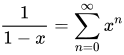
- Failed to parse (MathML with SVG or PNG fallback (recommended for modern browsers and accessibility tools): Invalid response ("Math extension cannot connect to Restbase.") from server "https://wikimedia.org/api/rest_v1/":): {\displaystyle \frac{1}{1-x}=\sum_{n=0}^\infty x^n} (a geometric series)
this converges when Failed to parse (MathML with SVG or PNG fallback (recommended for modern browsers and accessibility tools): Invalid response ("Math extension cannot connect to Restbase.") from server "https://wikimedia.org/api/rest_v1/":): {\displaystyle |x|<1} , the range Failed to parse (MathML with SVG or PNG fallback (recommended for modern browsers and accessibility tools): Invalid response ("Math extension cannot connect to Restbase.") from server "https://wikimedia.org/api/rest_v1/":): {\displaystyle f(x)-1<x<1} , so the radius of convergence - centered at 0 - is 1. It should also be observed that at the extremities of the radius, that is where Failed to parse (MathML with SVG or PNG fallback (recommended for modern browsers and accessibility tools): Invalid response ("Math extension cannot connect to Restbase.") from server "https://wikimedia.org/api/rest_v1/":): {\displaystyle x=1} and Failed to parse (MathML with SVG or PNG fallback (recommended for modern browsers and accessibility tools): Invalid response ("Math extension cannot connect to Restbase.") from server "https://wikimedia.org/api/rest_v1/":): {\displaystyle x=-1} , the power series does not converge.

Another example
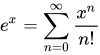
- Failed to parse (MathML with SVG or PNG fallback (recommended for modern browsers and accessibility tools): Invalid response ("Math extension cannot connect to Restbase.") from server "https://wikimedia.org/api/rest_v1/":): {\displaystyle e^x=\sum_{n=0}^\infty\frac{x^n}{n!}}
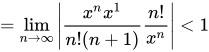
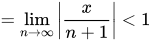
Using the ratio test, this series converges when the ratio of successive terms is less than one:
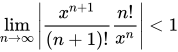
- Failed to parse (MathML with SVG or PNG fallback (recommended for modern browsers and accessibility tools): Invalid response ("Math extension cannot connect to Restbase.") from server "https://wikimedia.org/api/rest_v1/":): {\displaystyle \lim_{n\to\infty}\left|\frac{x^{n+1}}{(n+1)!}\frac{n!}{x^n}\right|<1}
- Failed to parse (MathML with SVG or PNG fallback (recommended for modern browsers and accessibility tools): Invalid response ("Math extension cannot connect to Restbase.") from server "https://wikimedia.org/api/rest_v1/":): {\displaystyle =\lim_{n\to\infty}\left|\frac{x^nx^1}{n!(n+1)}\frac{n!}{x^n}\right|<1}
- Failed to parse (MathML with SVG or PNG fallback (recommended for modern browsers and accessibility tools): Invalid response ("Math extension cannot connect to Restbase.") from server "https://wikimedia.org/api/rest_v1/":): {\displaystyle =\lim_{n\to\infty}\left|\frac{x}{n+1}\right|<1}
which is always true - therefore, this power series has an infinite radius of convergence. In effect, this means that the power series can always be used as a valid alternative to the original function, Failed to parse (MathML with SVG or PNG fallback (recommended for modern browsers and accessibility tools): Invalid response ("Math extension cannot connect to Restbase.") from server "https://wikimedia.org/api/rest_v1/":): {\displaystyle e^x} .
Abstraction
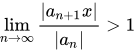
If we use the ratio test on an arbitrary power series, we find it converges when
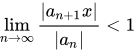
- Failed to parse (MathML with SVG or PNG fallback (recommended for modern browsers and accessibility tools): Invalid response ("Math extension cannot connect to Restbase.") from server "https://wikimedia.org/api/rest_v1/":): {\displaystyle \lim_{n\to\infty}\frac{|a_{n+1}x|}{|a_n|}<1}
and diverges when
- Failed to parse (MathML with SVG or PNG fallback (recommended for modern browsers and accessibility tools): Invalid response ("Math extension cannot connect to Restbase.") from server "https://wikimedia.org/api/rest_v1/":): {\displaystyle \lim_{n\to\infty}\frac{|a_{n+1}x|}{|a_n|}>1}
The radius of convergence is therefore
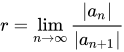
- Failed to parse (MathML with SVG or PNG fallback (recommended for modern browsers and accessibility tools): Invalid response ("Math extension cannot connect to Restbase.") from server "https://wikimedia.org/api/rest_v1/":): {\displaystyle r=\lim_{n\to\infty}\frac{|a_n|}{|a_{n+1}|}}
If this limit diverges to infinity, the series has an infinite radius of convergence.
Differentiation and Integration
Within its radius of convergence, a power series can be differentiated and integrated term by term.
- Failed to parse (MathML with SVG or PNG fallback (recommended for modern browsers and accessibility tools): Invalid response ("Math extension cannot connect to Restbase.") from server "https://wikimedia.org/api/rest_v1/":): {\displaystyle \frac{d}{dx}\left[\sum_{n=0}^\infty a_nx^n\right]=\sum_{n=0}^\infty a_{n+1}(n+1)(x-c)^n}
- Failed to parse (MathML with SVG or PNG fallback (recommended for modern browsers and accessibility tools): Invalid response ("Math extension cannot connect to Restbase.") from server "https://wikimedia.org/api/rest_v1/":): {\displaystyle \int\sum_{n=0}^\infty a_n(x-c)^ndx=\sum_{n=1}^\infty\frac{a_{n-1}(x-c)^n}{n}+k}
Both the differential and the integral have the same radius of convergence as the original series.
This allows us to sum exactly suitable power series. For example,

- Failed to parse (MathML with SVG or PNG fallback (recommended for modern browsers and accessibility tools): Invalid response ("Math extension cannot connect to Restbase.") from server "https://wikimedia.org/api/rest_v1/":): {\displaystyle \frac{1}{1+x}=1-x+x^2-x^3\pm\cdots}
This is a geometric series, which converges for Failed to parse (MathML with SVG or PNG fallback (recommended for modern browsers and accessibility tools): Invalid response ("Math extension cannot connect to Restbase.") from server "https://wikimedia.org/api/rest_v1/":): {\displaystyle |x|<1} . Integrating both sides, we get
- Failed to parse (MathML with SVG or PNG fallback (recommended for modern browsers and accessibility tools): Invalid response ("Math extension cannot connect to Restbase.") from server "https://wikimedia.org/api/rest_v1/":): {\displaystyle \ln(1+x)=x-\frac{x^2}{2}+\frac{x^3}{3}\pm\cdots}
which will also converge for Failed to parse (MathML with SVG or PNG fallback (recommended for modern browsers and accessibility tools): Invalid response ("Math extension cannot connect to Restbase.") from server "https://wikimedia.org/api/rest_v1/":): {\displaystyle |x|<1} . When Failed to parse (MathML with SVG or PNG fallback (recommended for modern browsers and accessibility tools): Invalid response ("Math extension cannot connect to Restbase.") from server "https://wikimedia.org/api/rest_v1/":): {\displaystyle x=-1} this is the harmonic series, which diverges; when Failed to parse (MathML with SVG or PNG fallback (recommended for modern browsers and accessibility tools): Invalid response ("Math extension cannot connect to Restbase.") from server "https://wikimedia.org/api/rest_v1/":): {\displaystyle x=1} this is an alternating series with diminishing terms, which converges to Failed to parse (MathML with SVG or PNG fallback (recommended for modern browsers and accessibility tools): Invalid response ("Math extension cannot connect to Restbase.") from server "https://wikimedia.org/api/rest_v1/":): {\displaystyle \ln(2)} - this is testing the extremities.
It also lets us write series for integrals we cannot do exactly such as the error function:
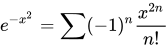
- Failed to parse (MathML with SVG or PNG fallback (recommended for modern browsers and accessibility tools): Invalid response ("Math extension cannot connect to Restbase.") from server "https://wikimedia.org/api/rest_v1/":): {\displaystyle e^{-x^2}=\sum(-1)^n\frac{x^{2n}}{n!}}
The left hand side can not be integrated exactly, but the right hand side can be.
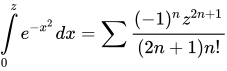
- Failed to parse (MathML with SVG or PNG fallback (recommended for modern browsers and accessibility tools): Invalid response ("Math extension cannot connect to Restbase.") from server "https://wikimedia.org/api/rest_v1/":): {\displaystyle \int\limits_0^z e^{-x^2}dx=\sum\frac{(-1)^n z^{2n+1}}{(2n+1)n!}}
This gives us a series for the sum, which has an infinite radius of convergence, letting us approximate the integral as closely as we like.
Note that this is not a power series, as the power of Failed to parse (MathML with SVG or PNG fallback (recommended for modern browsers and accessibility tools): Invalid response ("Math extension cannot connect to Restbase.") from server "https://wikimedia.org/api/rest_v1/":): {\displaystyle z} is not the index.
Resources
Interval and Radius of Convergence
- Power Series Part 1 Video by James Sousa, Math is Power 4U
- Power Series Part 2 Video by James Sousa, Math is Power 4U
- Ex 1: Interval of Convergence for a Power Series Video by James Sousa, Math is Power 4U
- Ex 2: Interval of Convergence for a Power Series Video by James Sousa, Math is Power 4U
- Ex 3: Interval of Convergence for a Power Series Video by James Sousa, Math is Power 4U
- Ex 4: Interval of Convergence for a Power Series Video by James Sousa, Math is Power 4U
- Ex 5: Interval of Convergence for a Power Series Video by James Sousa, Math is Power 4U
- Ex 6: Interval of Convergence for a Power Series Video by James Sousa, Math is Power 4U
- Interval and Radius of Convergence for a Series Ex 1 Video by Patrick JMT
- Interval and Radius of Convergence for a Series Ex 2 Video by Patrick JMT
- Interval and Radius of Convergence for a Series Ex 3 Video by Patrick JMT
- Interval and Radius of Convergence for a Series Ex 4 Video by Patrick JMT
- Interval and Radius of Convergence for a Series Ex 5 Video by Patrick JMT
- Interval and Radius of Convergence for a Series Ex 6 Video by Patrick JMT
- Interval and Radius of Convergence for a Series Ex 7 Video by Patrick JMT
- Interval and Radius of Convergence for a Series Ex 8 Video by Patrick JMT
- Interval and Radius of Convergence for a Series Ex 9 Video by Patrick JMT
- Radius of Convergence for a Power Series Video by Patrick JMT
- Radius of Convergence Video by Krista King
- Interval of Convergence Ex 1 Video by Krista King
- Interval of Convergence Ex 2 Video by Krista King
- Finding the Radius and Interval of Convergence Video by The Organic Chemistry Tutor
Representing Functions as Power Series
- Representing a Function as a Geometric Power Series (Part 1) Video by James Sousa, Math is Power 4U
- Representing a Function as a Geometric Power Series (Part 2) Video by James Sousa, Math is Power 4U
- Ex 1: Find a Power Series to Represent a Rational Function Video by James Sousa, Math is Power 4U
- Ex 2: Find a Power Series to Represent a Rational Function Video by James Sousa, Math is Power 4U
- Ex 3: Find a Power Series to Represent a Rational Function Video by James Sousa, Math is Power 4U
- Power Series Representation of Functions Video by Patrick JMT
- Power Series Representation, Radius and Interval of Convergence Video by Krista King
- Power Series Representation of Functions Video by The Organic Chemistry Tutor