Laplace Transform to Systems of ODEs
Jump to navigation
Jump to search
This is an example to illustrate how Laplace transforms can be used to solve systems of differential equations.
Solve the following system.
Failed to parse (MathML with SVG or PNG fallback (recommended for modern browsers and accessibility tools): Invalid response ("Math extension cannot connect to Restbase.") from server "https://wikimedia.org/api/rest_v1/":): {\displaystyle \begin{align}x'_1 & = 3x_1 - 3x_2 + 2 & x_1\left( 0 \right) & = 1\\ x'_2 & = - 6x_1 - t & x_2\left( 0 \right) & = - 1\end{align} }
Solution:
- First notice that the system is not given in matrix form. This is because the system won’t be solved in matrix form. Also note that the system is nonhomogeneous.
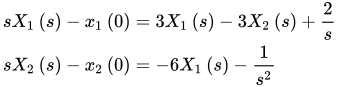
- We start just as we did when we used Laplace transforms to solve single differential equations. We take the transform of both differential equations.
- Now plug in the initial condition and simplify things a little.
Failed to parse (MathML with SVG or PNG fallback (recommended for modern browsers and accessibility tools): Invalid response ("Math extension cannot connect to Restbase.") from server "https://wikimedia.org/api/rest_v1/":): {\displaystyle \begin{align}\left( {s - 3} \right){X_1}\left( s \right) + 3{X_2}\left( s \right) & = \frac{2}{s} + 1 = \frac{{2 + s}}{s}\\ 6{X_1}\left( s \right) + s{X_2}\left( s \right) & = - \frac{1}{{{s^2}}} - 1 = - \frac{{{s^2} + 1}}{{{s^2}}}\end{align}}
- Now we need to solve this for one of the transforms. We’ll do this by multiplying the top equation by Failed to parse (MathML with SVG or PNG fallback (recommended for modern browsers and accessibility tools): Invalid response ("Math extension cannot connect to Restbase.") from server "https://wikimedia.org/api/rest_v1/":): {\displaystyle s} and the bottom by -3 and then adding. This gives,
Failed to parse (MathML with SVG or PNG fallback (recommended for modern browsers and accessibility tools): Invalid response ("Math extension cannot connect to Restbase.") from server "https://wikimedia.org/api/rest_v1/":): {\displaystyle \left( {{s^2} - 3s - 18} \right){X_1}\left( s \right) = 2 + s + \frac{{3{s^2} + 3}}{{{s^2}}} }
- Solving for \(X_{1}\) gives,
Failed to parse (MathML with SVG or PNG fallback (recommended for modern browsers and accessibility tools): Invalid response ("Math extension cannot connect to Restbase.") from server "https://wikimedia.org/api/rest_v1/":): {\displaystyle {X_1}\left( s \right) = \frac{{{s^3} + 5{s^2} + 3}}{{{s^2}\left( {s + 3} \right)\left( {s - 6} \right)}} }
- Partial fractioning gives,
Failed to parse (MathML with SVG or PNG fallback (recommended for modern browsers and accessibility tools): Invalid response ("Math extension cannot connect to Restbase.") from server "https://wikimedia.org/api/rest_v1/":): {\displaystyle {X_1}\left( s \right) = \frac{1}{{108}}\left( {\frac{{133}}{{s - 6}} - \frac{{28}}{{s + 3}} + \frac{3}{s} - \frac{{18}}{{{s^2}}}} \right) }
- Taking the inverse transform gives us the first solution,
Failed to parse (MathML with SVG or PNG fallback (recommended for modern browsers and accessibility tools): Invalid response ("Math extension cannot connect to Restbase.") from server "https://wikimedia.org/api/rest_v1/":): {\displaystyle {x_1}\left( t \right) = \frac{1}{{108}}\left( {133{{\bf{e}}^{6t}} - 28{{\bf{e}}^{ - 3t}} + 3 - 18t} \right)}
- Now to find the second solution we could go back up and eliminate Failed to parse (MathML with SVG or PNG fallback (recommended for modern browsers and accessibility tools): Invalid response ("Math extension cannot connect to Restbase.") from server "https://wikimedia.org/api/rest_v1/":): {\displaystyle X_1} to find the transform for Failed to parse (MathML with SVG or PNG fallback (recommended for modern browsers and accessibility tools): Invalid response ("Math extension cannot connect to Restbase.") from server "https://wikimedia.org/api/rest_v1/":): {\displaystyle X_2} and sometimes we would need to do that. However, in this case notice that the second differential equation is,
Failed to parse (MathML with SVG or PNG fallback (recommended for modern browsers and accessibility tools): Invalid response ("Math extension cannot connect to Restbase.") from server "https://wikimedia.org/api/rest_v1/":): {\displaystyle \begin{align}{x'_2} = - 6{x_1} - t & \Rightarrow & {x_2} = \int{{ - 6{x_1} - t}}\,dt \end{align}}
- So, plugging the first solution in and integrating gives,
Failed to parse (MathML with SVG or PNG fallback (recommended for modern browsers and accessibility tools): Invalid response ("Math extension cannot connect to Restbase.") from server "https://wikimedia.org/api/rest_v1/":): {\displaystyle \begin{align}{x_2}\left( t \right) & = - \frac{1}{{18}}\int{{133{{\bf{e}}^{6t}} - 28{{\bf{e}}^{ - 3t}} + 3}}\,dt\\ & = - \frac{1}{{108}}\left( {133{{\bf{e}}^{6t}} + 56{{\bf{e}}^{ - 3t}} + 18t} \right) + c\end{align} }
- Now, reapplying the second initial condition to get the constant of integration gives
Failed to parse (MathML with SVG or PNG fallback (recommended for modern browsers and accessibility tools): Invalid response ("Math extension cannot connect to Restbase.") from server "https://wikimedia.org/api/rest_v1/":): {\displaystyle \begin{align} - 1 = - \frac{1}{{108}}\left( {133 + 56} \right) + c & \Rightarrow & c = \frac{3}{4} \end{align}}
- The second solution is then,
Failed to parse (MathML with SVG or PNG fallback (recommended for modern browsers and accessibility tools): Invalid response ("Math extension cannot connect to Restbase.") from server "https://wikimedia.org/api/rest_v1/":): {\displaystyle {x_2}\left( t \right) = - \frac{1}{{108}}\left( {133{{\bf{e}}^{6t}} + 56{{\bf{e}}^{ - 3t}} + 18t - 81} \right) }
- So, putting all this together gives the solution to the system as,
Failed to parse (MathML with SVG or PNG fallback (recommended for modern browsers and accessibility tools): Invalid response ("Math extension cannot connect to Restbase.") from server "https://wikimedia.org/api/rest_v1/":): {\displaystyle \begin{align}{x_1}\left( t \right) & = \frac{1}{{108}}\left( {133{{\bf{e}}^{6t}} - 28{{\bf{e}}^{ - 3t}} + 3 - 18t} \right)\\ {x_2}\left( t \right) & = - \frac{1}{{108}}\left( {133{{\bf{e}}^{6t}} + 56{{\bf{e}}^{ - 3t}} + 18t - 81} \right)\end{align} }