The Cauchy Criterion for Convergence

From Department of Mathematics at UTSA
Revision as of 22:23, 21 November 2021 by Khanh (talk | contribs) (Created page with "Recall that a sequence of real numbers <math>(a_n)</math> is said to be a <strong>Cauchy Sequence</strong> if <math>\forall \epsilon > 0</math> there exists an <math>N \in \ma...")
(diff) ← Older revision | Latest revision (diff) | Newer revision → (diff)
Jump to navigation Jump to search

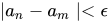
Recall that a sequence of real numbers Failed to parse (MathML with SVG or PNG fallback (recommended for modern browsers and accessibility tools): Invalid response ("Math extension cannot connect to Restbase.") from server "https://wikimedia.org/api/rest_v1/":): {\displaystyle (a_n)} is said to be a Cauchy Sequence if there exists an such that if then . We already noted that every convergent sequence of real numbers is Cauchy, and that every Cauchy sequence of real numbers is bounded. We will now look at another important theorem known as the Cauchy Convergence Criterion.


Theorem (Cauchy Convergence Criterion): If is a sequence of real numbers, then is convergent if and only if is a Cauchy sequence.


Note that the Cauchy Convergence Criterion will allow us to determine whether a sequence of real numbers is convergent whether or not we have a suspected limit in mind for a sequence.

  • Proof: Suppose that is a convergent sequence of real numbers.
  • Suppose that is a Cauchy sequence. We want to show that is thus convergent to some real number in . Now since is a Cauchy sequence it follows that is bounded. Since is bounded, it follows from <a href="/the-bolzano-weierstrass-theorem">The Bolzano-Weierstrass Theorem</a> that there exists a subsequence of , call it that converges to some real number .
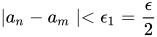
  • Since is a Cauchy sequence, then there exists an such that if then . Choose , and so there exists an Failed to parse (MathML with SVG or PNG fallback (recommended for modern browsers and accessibility tools): Invalid response ("Math extension cannot connect to Restbase.") from server "https://wikimedia.org/api/rest_v1/":): {\displaystyle N_1 \in \mathbb{N}} such that if Failed to parse (MathML with SVG or PNG fallback (recommended for modern browsers and accessibility tools): Invalid response ("Math extension cannot connect to Restbase.") from server "https://wikimedia.org/api/rest_v1/":): {\displaystyle m, n \geq N_1} then Failed to parse (MathML with SVG or PNG fallback (recommended for modern browsers and accessibility tools): Invalid response ("Math extension cannot connect to Restbase.") from server "https://wikimedia.org/api/rest_v1/":): {\displaystyle \mid a_n - a_m \mid < \epsilon_1 = \frac{\epsilon}{2}} .
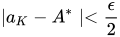
  • Now look at the subsequence Failed to parse (MathML with SVG or PNG fallback (recommended for modern browsers and accessibility tools): Invalid response ("Math extension cannot connect to Restbase.") from server "https://wikimedia.org/api/rest_v1/":): {\displaystyle (a_{n_k})} which converges to Failed to parse (MathML with SVG or PNG fallback (recommended for modern browsers and accessibility tools): Invalid response ("Math extension cannot connect to Restbase.") from server "https://wikimedia.org/api/rest_v1/":): {\displaystyle A^*} . There thus exists a natural number Failed to parse (MathML with SVG or PNG fallback (recommended for modern browsers and accessibility tools): Invalid response ("Math extension cannot connect to Restbase.") from server "https://wikimedia.org/api/rest_v1/":): {\displaystyle K \geq N_1} where Failed to parse (MathML with SVG or PNG fallback (recommended for modern browsers and accessibility tools): Invalid response ("Math extension cannot connect to Restbase.") from server "https://wikimedia.org/api/rest_v1/":): {\displaystyle K} belongs to the set of indices Failed to parse (MathML with SVG or PNG fallback (recommended for modern browsers and accessibility tools): Invalid response ("Math extension cannot connect to Restbase.") from server "https://wikimedia.org/api/rest_v1/":): {\displaystyle \{ n_1, n_2, ... \}} such that Failed to parse (MathML with SVG or PNG fallback (recommended for modern browsers and accessibility tools): Invalid response ("Math extension cannot connect to Restbase.") from server "https://wikimedia.org/api/rest_v1/":): {\displaystyle \mid a_{K} - A^* \mid < \frac{\epsilon}{2}} .
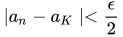
  • Since Failed to parse (MathML with SVG or PNG fallback (recommended for modern browsers and accessibility tools): Invalid response ("Math extension cannot connect to Restbase.") from server "https://wikimedia.org/api/rest_v1/":): {\displaystyle K \geq N_1} then if we substitute Failed to parse (MathML with SVG or PNG fallback (recommended for modern browsers and accessibility tools): Invalid response ("Math extension cannot connect to Restbase.") from server "https://wikimedia.org/api/rest_v1/":): {\displaystyle m = K} we have that for Failed to parse (MathML with SVG or PNG fallback (recommended for modern browsers and accessibility tools): Invalid response ("Math extension cannot connect to Restbase.") from server "https://wikimedia.org/api/rest_v1/":): {\displaystyle n \geq N_1} :
Failed to parse (MathML with SVG or PNG fallback (recommended for modern browsers and accessibility tools): Invalid response ("Math extension cannot connect to Restbase.") from server "https://wikimedia.org/api/rest_v1/":): {\displaystyle \begin{align} \mid a_n - a_K \mid < \frac{\epsilon}{2} \end{align}}
  • And so for Failed to parse (MathML with SVG or PNG fallback (recommended for modern browsers and accessibility tools): Invalid response ("Math extension cannot connect to Restbase.") from server "https://wikimedia.org/api/rest_v1/":): {\displaystyle n \geq N_1} we have that:
Failed to parse (MathML with SVG or PNG fallback (recommended for modern browsers and accessibility tools): Invalid response ("Math extension cannot connect to Restbase.") from server "https://wikimedia.org/api/rest_v1/":): {\displaystyle \begin{align} \quad \mid a_n - A^* \mid = \mid a_n - a_K + a_K - A^* \mid \leq \mid a_n - a_K \mid + \mid a_K - A^* \mid < \frac{\epsilon}{2} + \frac{\epsilon}{2} = \epsilon \end{align}}
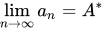
  • Therefore Failed to parse (MathML with SVG or PNG fallback (recommended for modern browsers and accessibility tools): Invalid response ("Math extension cannot connect to Restbase.") from server "https://wikimedia.org/api/rest_v1/":): {\displaystyle \lim_{n \to \infty} a_n = A^*} , and so Failed to parse (MathML with SVG or PNG fallback (recommended for modern browsers and accessibility tools): Invalid response ("Math extension cannot connect to Restbase.") from server "https://wikimedia.org/api/rest_v1/":): {\displaystyle (a_n)} is convergent to the real number Failed to parse (MathML with SVG or PNG fallback (recommended for modern browsers and accessibility tools): Invalid response ("Math extension cannot connect to Restbase.") from server "https://wikimedia.org/api/rest_v1/":): {\displaystyle A^*} . Failed to parse (MathML with SVG or PNG fallback (recommended for modern browsers and accessibility tools): Invalid response ("Math extension cannot connect to Restbase.") from server "https://wikimedia.org/api/rest_v1/":): {\displaystyle \blacksquare}


We will summarize the lemma from the Cauchy Sequences and the Cauchy Convergent Criterion as follows:

  • Any sequence of real numbers Failed to parse (MathML with SVG or PNG fallback (recommended for modern browsers and accessibility tools): Invalid response ("Math extension cannot connect to Restbase.") from server "https://wikimedia.org/api/rest_v1/":): {\displaystyle (a_n)} that is convergent is also a Cauchy sequence.
  • Any Cauchy sequence of real numbers Failed to parse (MathML with SVG or PNG fallback (recommended for modern browsers and accessibility tools): Invalid response ("Math extension cannot connect to Restbase.") from server "https://wikimedia.org/api/rest_v1/":): {\displaystyle (a_n)} is also a convergent sequence.