One-Sided Limits

From Department of Mathematics at UTSA
Revision as of 22:44, 17 September 2021 by Khanh (talk | contribs) (Created page with "File:X^2+sign(x).svg|thumb|350px|The function ''f''(''x'') = ''x''<sup>2</sup> + sign(''x'') has a left limit of -1, a right limit of +1, and a function value of 0 at the po...")
(diff) ← Older revision | Latest revision (diff) | Newer revision → (diff)
Jump to navigation Jump to search
The function f(x) = x2 + sign(x) has a left limit of -1, a right limit of +1, and a function value of 0 at the point x = 0.

In calculus, a one-sided limit is either of the two limits of a function f(x) of a real variable x as x approaches a specified point either from the left or from the right.

The limit as x decreases in value approaching a (x approaches a or "from above") can be denoted:

or or or

The limit as x increases in value approaching a (x approaches a or "from below") can be denoted:

or Failed to parse (MathML with SVG or PNG fallback (recommended for modern browsers and accessibility tools): Invalid response ("Math extension cannot connect to Restbase.") from server "https://wikimedia.org/api/rest_v1/":): {\displaystyle \lim_{x\,\uparrow\,a}\, f(x)} or Failed to parse (MathML with SVG or PNG fallback (recommended for modern browsers and accessibility tools): Invalid response ("Math extension cannot connect to Restbase.") from server "https://wikimedia.org/api/rest_v1/":): {\displaystyle \lim_{x \nearrow a}\,f(x)} or Failed to parse (MathML with SVG or PNG fallback (recommended for modern browsers and accessibility tools): Invalid response ("Math extension cannot connect to Restbase.") from server "https://wikimedia.org/api/rest_v1/":): {\displaystyle \lim_{x \underset{<}{\to} a}f(x)}

In probability theory it is common to use the short notation:

Failed to parse (MathML with SVG or PNG fallback (recommended for modern browsers and accessibility tools): Invalid response ("Math extension cannot connect to Restbase.") from server "https://wikimedia.org/api/rest_v1/":): {\displaystyle f(x-)} for the left limit and Failed to parse (MathML with SVG or PNG fallback (recommended for modern browsers and accessibility tools): Invalid response ("Math extension cannot connect to Restbase.") from server "https://wikimedia.org/api/rest_v1/":): {\displaystyle f(x+)} for the right limit.

The two one-sided limits exist and are equal if the limit of f(x) as x approaches a exists. In some cases in which the limit

Failed to parse (MathML with SVG or PNG fallback (recommended for modern browsers and accessibility tools): Invalid response ("Math extension cannot connect to Restbase.") from server "https://wikimedia.org/api/rest_v1/":): {\displaystyle \lim_{x\to a} f(x)\,}

does not exist, the two one-sided limits nonetheless exist. Consequently, the limit as x approaches a is sometimes called a "two-sided limit".

In some cases one of the two one-sided limits exists and the other does not, and in some cases neither exists. The right-sided limit can be rigorously defined as

Failed to parse (MathML with SVG or PNG fallback (recommended for modern browsers and accessibility tools): Invalid response ("Math extension cannot connect to Restbase.") from server "https://wikimedia.org/api/rest_v1/":): {\displaystyle \forall\varepsilon > 0\;\exists \delta >0 \;\forall x \in I \;(0 < x - a < \delta \Rightarrow |f(x) - L|<\varepsilon),}

and the left-sided limit can be rigorously defined as

Failed to parse (MathML with SVG or PNG fallback (recommended for modern browsers and accessibility tools): Invalid response ("Math extension cannot connect to Restbase.") from server "https://wikimedia.org/api/rest_v1/":): {\displaystyle \forall\varepsilon > 0\;\exists \delta >0 \;\forall x \in I \;(0 < a - x < \delta \Rightarrow |f(x) - L|<\varepsilon),}

where I represents some interval that is within the domain of f.[1]

Examples

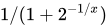
Plot of the function Failed to parse (MathML with SVG or PNG fallback (recommended for modern browsers and accessibility tools): Invalid response ("Math extension cannot connect to Restbase.") from server "https://wikimedia.org/api/rest_v1/":): {\displaystyle 1 / (1 + 2^{-1/x})}

One example of a function with different one-sided limits is the following (cf. picture):
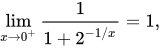
Failed to parse (MathML with SVG or PNG fallback (recommended for modern browsers and accessibility tools): Invalid response ("Math extension cannot connect to Restbase.") from server "https://wikimedia.org/api/rest_v1/":): {\displaystyle \lim_{x \to 0^+}{1 \over 1 + 2^{-1/x}} = 1,}

whereas

Failed to parse (MathML with SVG or PNG fallback (recommended for modern browsers and accessibility tools): Invalid response ("Math extension cannot connect to Restbase.") from server "https://wikimedia.org/api/rest_v1/":): {\displaystyle \lim_{x \to 0^-}{1 \over 1 + 2^{-1/x}} = 0.}

Relation to topological definition of limit

The one-sided limit to a point p corresponds to the general definition of limit, with the domain of the function restricted to one side, by either allowing that the function domain is a subset of the topological space, or by considering a one-sided subspace, including p. Alternatively, one may consider the domain with a half-open interval topology.

Abel's theorem

A noteworthy theorem treating one-sided limits of certain power series at the boundaries of their intervals of convergence is Abel's theorem.

References

  1. One-sided limit - Encyclopedia of Mathematics". encyclopediaofmath.org. Retrieved 7 August 2021.
  2. Fridy, J. A. (24 January 2020). Introductory Analysis: The Theory of Calculus. Gulf Professional Publishing. p. 48. ISBN 978-0-12-267655-0. Retrieved 7 August 2021.
  3. "one-sided limit". planetmath.org. 22 March 2013. Archived from the original on 26 January 2021. Retrieved 7 August 2021.
  4. Giv, Hossein Hosseini (28 September 2016). Mathematical Analysis and Its Inherent Nature. American Mathematical Soc. p. 130. ISBN 978-1-4704-2807-5. Retrieved 7 August 2021.
    1. Cite error: Invalid <ref> tag; no text was provided for refs named :2