Quantifiers
Jump to navigation
Jump to search
Quantifiers are words, expressions, or phrases that indicate the number of elements that a statement pertains to. In mathematical logic, there are two quantifiers: the universal quantifier ("for all") and the existential quantifier ("there exists").
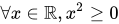
Universal quantifier: This quantifier is used to state a proposition that is true for all variables x of a given set. For example, the proposition "x^2 is a nonnegative number" is true for all real numbers, so we state "for all , is nonnegative". Symbolically, we write the universal quantifier as (ex. ).


Resources
- Quantifiers, Mathematics LibreTexts

