Vectors, Unit Vectors
In mathematics, a unit vector in a normed vector space is a vector (often a spatial vector) of length 1. A unit vector is often denoted by a lowercase letter with a circumflex, or "hat", as in (pronounced "v-hat").

The term direction vector is used to describe a unit vector being used to represent spatial direction, and such quantities are commonly denoted as d; 2D spatial directions represented this way are numerically equivalent to points on the unit circle. The same construct is used to specify spatial directions in 3D, which are equivalent to a point on the unit sphere.


The normalized vector û of a non-zero vector u is the unit vector in the direction of u, i.e.,

where |u| is the norm (or length) of u. The term normalized vector is sometimes used as a synonym for unit vector.
Unit vectors are often chosen to form the basis of a vector space, and every vector in the space may be written as a linear combination of unit vectors.
Contents
Orthogonal coordinates
Cartesian coordinates
Unit vectors may be used to represent the axes of a Cartesian coordinate system. For instance, the standard unit vectors in the direction of the x, y, and z axes of a three dimensional Cartesian coordinate system are
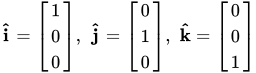
They form a set of mutually orthogonal unit vectors, typically referred to as a standard basis in linear algebra.
They are often denoted using common vector notation (e.g., i or Failed to parse (MathML with SVG or PNG fallback (recommended for modern browsers and accessibility tools): Invalid response ("Math extension cannot connect to Restbase.") from server "https://wikimedia.org/api/rest_v1/":): {\displaystyle \vec{\imath}} ) rather than standard unit vector notation (e.g., Failed to parse (MathML with SVG or PNG fallback (recommended for modern browsers and accessibility tools): Invalid response ("Math extension cannot connect to Restbase.") from server "https://wikimedia.org/api/rest_v1/":): {\displaystyle \mathbf{\hat{\imath}}} ). In most contexts it can be assumed that i, j, and k, (or Failed to parse (MathML with SVG or PNG fallback (recommended for modern browsers and accessibility tools): Invalid response ("Math extension cannot connect to Restbase.") from server "https://wikimedia.org/api/rest_v1/":): {\displaystyle \vec{\imath},} Failed to parse (MathML with SVG or PNG fallback (recommended for modern browsers and accessibility tools): Invalid response ("Math extension cannot connect to Restbase.") from server "https://wikimedia.org/api/rest_v1/":): {\displaystyle \vec{\jmath},} and Failed to parse (MathML with SVG or PNG fallback (recommended for modern browsers and accessibility tools): Invalid response ("Math extension cannot connect to Restbase.") from server "https://wikimedia.org/api/rest_v1/":): {\displaystyle \vec{k}} ) are versors of a 3-D Cartesian coordinate system. The notations Failed to parse (MathML with SVG or PNG fallback (recommended for modern browsers and accessibility tools): Invalid response ("Math extension cannot connect to Restbase.") from server "https://wikimedia.org/api/rest_v1/":): {\displaystyle (\mathbf{\hat{x}}, \mathbf{\hat{y}}, \mathbf{\hat{z}})} , Failed to parse (MathML with SVG or PNG fallback (recommended for modern browsers and accessibility tools): Invalid response ("Math extension cannot connect to Restbase.") from server "https://wikimedia.org/api/rest_v1/":): {\displaystyle (\mathbf{\hat{x}}_1, \mathbf{\hat{x}}_2, \mathbf{\hat{x}}_3)} , Failed to parse (MathML with SVG or PNG fallback (recommended for modern browsers and accessibility tools): Invalid response ("Math extension cannot connect to Restbase.") from server "https://wikimedia.org/api/rest_v1/":): {\displaystyle (\mathbf{\hat{e}}_x, \mathbf{\hat{e}}_y, \mathbf{\hat{e}}_z)} , or Failed to parse (MathML with SVG or PNG fallback (recommended for modern browsers and accessibility tools): Invalid response ("Math extension cannot connect to Restbase.") from server "https://wikimedia.org/api/rest_v1/":): {\displaystyle (\mathbf{\hat{e}}_1, \mathbf{\hat{e}}_2, \mathbf{\hat{e}}_3)} , with or without hat, are also used, particularly in contexts where i, j, k might lead to confusion with another quantity (for instance with index symbols such as i, j, k, which are used to identify an element of a set or array or sequence of variables).
When a unit vector in space is expressed in Cartesian notation as a linear combination of i, j, k, its three scalar components can be referred to as direction cosines. The value of each component is equal to the cosine of the angle formed by the unit vector with the respective basis vector. This is one of the methods used to describe the orientation (angular position) of a straight line, segment of straight line, oriented axis, or segment of oriented axis (vector).
Cylindrical coordinates
The three orthogonal unit vectors appropriate to cylindrical symmetry are:
- Failed to parse (MathML with SVG or PNG fallback (recommended for modern browsers and accessibility tools): Invalid response ("Math extension cannot connect to Restbase.") from server "https://wikimedia.org/api/rest_v1/":): {\displaystyle \boldsymbol{\hat{\rho}}} (also designated Failed to parse (MathML with SVG or PNG fallback (recommended for modern browsers and accessibility tools): Invalid response ("Math extension cannot connect to Restbase.") from server "https://wikimedia.org/api/rest_v1/":): {\displaystyle \mathbf{\hat{e}}} or Failed to parse (MathML with SVG or PNG fallback (recommended for modern browsers and accessibility tools): Invalid response ("Math extension cannot connect to Restbase.") from server "https://wikimedia.org/api/rest_v1/":): {\displaystyle \boldsymbol{\hat s}} ), representing the direction along which the distance of the point from the axis of symmetry is measured;
- Failed to parse (MathML with SVG or PNG fallback (recommended for modern browsers and accessibility tools): Invalid response ("Math extension cannot connect to Restbase.") from server "https://wikimedia.org/api/rest_v1/":): {\displaystyle \boldsymbol{\hat \varphi}} , representing the direction of the motion that would be observed if the point were rotating counterclockwise about the symmetry axis;
- Failed to parse (MathML with SVG or PNG fallback (recommended for modern browsers and accessibility tools): Invalid response ("Math extension cannot connect to Restbase.") from server "https://wikimedia.org/api/rest_v1/":): {\displaystyle \mathbf{\hat{z}}} , representing the direction of the symmetry axis;
They are related to the Cartesian basis Failed to parse (MathML with SVG or PNG fallback (recommended for modern browsers and accessibility tools): Invalid response ("Math extension cannot connect to Restbase.") from server "https://wikimedia.org/api/rest_v1/":): {\displaystyle \hat{x}} , Failed to parse (MathML with SVG or PNG fallback (recommended for modern browsers and accessibility tools): Invalid response ("Math extension cannot connect to Restbase.") from server "https://wikimedia.org/api/rest_v1/":): {\displaystyle \hat{y}} , Failed to parse (MathML with SVG or PNG fallback (recommended for modern browsers and accessibility tools): Invalid response ("Math extension cannot connect to Restbase.") from server "https://wikimedia.org/api/rest_v1/":): {\displaystyle \hat{z}} by:
- Failed to parse (MathML with SVG or PNG fallback (recommended for modern browsers and accessibility tools): Invalid response ("Math extension cannot connect to Restbase.") from server "https://wikimedia.org/api/rest_v1/":): {\displaystyle \boldsymbol{\hat{\rho}} = \cos(\varphi)\mathbf{\hat{x}} + \sin(\varphi)\mathbf{\hat{y}}}
- Failed to parse (MathML with SVG or PNG fallback (recommended for modern browsers and accessibility tools): Invalid response ("Math extension cannot connect to Restbase.") from server "https://wikimedia.org/api/rest_v1/":): {\displaystyle \boldsymbol{\hat \varphi} = -\sin(\varphi) \mathbf{\hat{x}} + \cos(\varphi) \mathbf{\hat{y}}}
- Failed to parse (MathML with SVG or PNG fallback (recommended for modern browsers and accessibility tools): Invalid response ("Math extension cannot connect to Restbase.") from server "https://wikimedia.org/api/rest_v1/":): {\displaystyle \mathbf{\hat{z}} = \mathbf{\hat{z}}.}
The vectors Failed to parse (MathML with SVG or PNG fallback (recommended for modern browsers and accessibility tools): Invalid response ("Math extension cannot connect to Restbase.") from server "https://wikimedia.org/api/rest_v1/":): {\displaystyle \boldsymbol{\hat{\rho}}} and Failed to parse (MathML with SVG or PNG fallback (recommended for modern browsers and accessibility tools): Invalid response ("Math extension cannot connect to Restbase.") from server "https://wikimedia.org/api/rest_v1/":): {\displaystyle \boldsymbol{\hat \varphi}} are functions of Failed to parse (MathML with SVG or PNG fallback (recommended for modern browsers and accessibility tools): Invalid response ("Math extension cannot connect to Restbase.") from server "https://wikimedia.org/api/rest_v1/":): {\displaystyle \varphi,} and are not constant in direction. When differentiating or integrating in cylindrical coordinates, these unit vectors themselves must also be operated on. The derivatives with respect to Failed to parse (MathML with SVG or PNG fallback (recommended for modern browsers and accessibility tools): Invalid response ("Math extension cannot connect to Restbase.") from server "https://wikimedia.org/api/rest_v1/":): {\displaystyle \varphi} are:
- Failed to parse (MathML with SVG or PNG fallback (recommended for modern browsers and accessibility tools): Invalid response ("Math extension cannot connect to Restbase.") from server "https://wikimedia.org/api/rest_v1/":): {\displaystyle \frac{\partial \boldsymbol{\hat{\rho}}} {\partial \varphi} = -\sin \varphi\mathbf{\hat{x}} + \cos \varphi\mathbf{\hat{y}} = \boldsymbol{\hat \varphi}}
- Failed to parse (MathML with SVG or PNG fallback (recommended for modern browsers and accessibility tools): Invalid response ("Math extension cannot connect to Restbase.") from server "https://wikimedia.org/api/rest_v1/":): {\displaystyle \frac{\partial \boldsymbol{\hat \varphi}} {\partial \varphi} = -\cos \varphi\mathbf{\hat{x}} - \sin \varphi\mathbf{\hat{y}} = -\boldsymbol{\hat{\rho}}}
- Failed to parse (MathML with SVG or PNG fallback (recommended for modern browsers and accessibility tools): Invalid response ("Math extension cannot connect to Restbase.") from server "https://wikimedia.org/api/rest_v1/":): {\displaystyle \frac{\partial \mathbf{\hat{z}}} {\partial \varphi} = \mathbf{0}.}
Spherical coordinates
The unit vectors appropriate to spherical symmetry are: Failed to parse (MathML with SVG or PNG fallback (recommended for modern browsers and accessibility tools): Invalid response ("Math extension cannot connect to Restbase.") from server "https://wikimedia.org/api/rest_v1/":): {\displaystyle \mathbf{\hat{r}}} , the direction in which the radial distance from the origin increases; Failed to parse (MathML with SVG or PNG fallback (recommended for modern browsers and accessibility tools): Invalid response ("Math extension cannot connect to Restbase.") from server "https://wikimedia.org/api/rest_v1/":): {\displaystyle \boldsymbol{\hat{\varphi}}} , the direction in which the angle in the x-y plane counterclockwise from the positive x-axis is increasing; and Failed to parse (MathML with SVG or PNG fallback (recommended for modern browsers and accessibility tools): Invalid response ("Math extension cannot connect to Restbase.") from server "https://wikimedia.org/api/rest_v1/":): {\displaystyle \boldsymbol{\hat \theta}} , the direction in which the angle from the positive z axis is increasing. To minimize redundancy of representations, the polar angle Failed to parse (MathML with SVG or PNG fallback (recommended for modern browsers and accessibility tools): Invalid response ("Math extension cannot connect to Restbase.") from server "https://wikimedia.org/api/rest_v1/":): {\displaystyle \theta} is usually taken to lie between zero and 180 degrees. It is especially important to note the context of any ordered triplet written in spherical coordinates, as the roles of Failed to parse (MathML with SVG or PNG fallback (recommended for modern browsers and accessibility tools): Invalid response ("Math extension cannot connect to Restbase.") from server "https://wikimedia.org/api/rest_v1/":): {\displaystyle \boldsymbol{\hat \varphi}} and Failed to parse (MathML with SVG or PNG fallback (recommended for modern browsers and accessibility tools): Invalid response ("Math extension cannot connect to Restbase.") from server "https://wikimedia.org/api/rest_v1/":): {\displaystyle \boldsymbol{\hat \theta}} are often reversed. Here, the American "physics" convention is used. This leaves the azimuthal angle Failed to parse (MathML with SVG or PNG fallback (recommended for modern browsers and accessibility tools): Invalid response ("Math extension cannot connect to Restbase.") from server "https://wikimedia.org/api/rest_v1/":): {\displaystyle \varphi} defined the same as in cylindrical coordinates. The Cartesian relations are:
- Failed to parse (MathML with SVG or PNG fallback (recommended for modern browsers and accessibility tools): Invalid response ("Math extension cannot connect to Restbase.") from server "https://wikimedia.org/api/rest_v1/":): {\displaystyle \mathbf{\hat{r}} = \sin \theta \cos \varphi\mathbf{\hat{x}} + \sin \theta \sin \varphi\mathbf{\hat{y}} + \cos \theta\mathbf{\hat{z}}}
- Failed to parse (MathML with SVG or PNG fallback (recommended for modern browsers and accessibility tools): Invalid response ("Math extension cannot connect to Restbase.") from server "https://wikimedia.org/api/rest_v1/":): {\displaystyle \boldsymbol{\hat \theta} = \cos \theta \cos \varphi\mathbf{\hat{x}} + \cos \theta \sin \varphi\mathbf{\hat{y}} - \sin \theta\mathbf{\hat{z}}}
- Failed to parse (MathML with SVG or PNG fallback (recommended for modern browsers and accessibility tools): Invalid response ("Math extension cannot connect to Restbase.") from server "https://wikimedia.org/api/rest_v1/":): {\displaystyle \boldsymbol{\hat \varphi} = - \sin \varphi\mathbf{\hat{x}} + \cos \varphi\mathbf{\hat{y}}}
The spherical unit vectors depend on both Failed to parse (MathML with SVG or PNG fallback (recommended for modern browsers and accessibility tools): Invalid response ("Math extension cannot connect to Restbase.") from server "https://wikimedia.org/api/rest_v1/":): {\displaystyle \varphi} and Failed to parse (MathML with SVG or PNG fallback (recommended for modern browsers and accessibility tools): Invalid response ("Math extension cannot connect to Restbase.") from server "https://wikimedia.org/api/rest_v1/":): {\displaystyle \theta} , and hence there are 5 possible non-zero derivatives. For a more complete description, see Jacobian matrix and determinant. The non-zero derivatives are:
- Failed to parse (MathML with SVG or PNG fallback (recommended for modern browsers and accessibility tools): Invalid response ("Math extension cannot connect to Restbase.") from server "https://wikimedia.org/api/rest_v1/":): {\displaystyle \frac{\partial \mathbf{\hat{r}}} {\partial \varphi} = -\sin \theta \sin \varphi\mathbf{\hat{x}} + \sin \theta \cos \varphi\mathbf{\hat{y}} = \sin \theta\boldsymbol{\hat \varphi}}
- Failed to parse (MathML with SVG or PNG fallback (recommended for modern browsers and accessibility tools): Invalid response ("Math extension cannot connect to Restbase.") from server "https://wikimedia.org/api/rest_v1/":): {\displaystyle \frac{\partial \mathbf{\hat{r}}} {\partial \theta} =\cos \theta \cos \varphi\mathbf{\hat{x}} + \cos \theta \sin \varphi\mathbf{\hat{y}} - \sin \theta\mathbf{\hat{z}}= \boldsymbol{\hat \theta}}
- Failed to parse (MathML with SVG or PNG fallback (recommended for modern browsers and accessibility tools): Invalid response ("Math extension cannot connect to Restbase.") from server "https://wikimedia.org/api/rest_v1/":): {\displaystyle \frac{\partial \boldsymbol{\hat{\theta}}} {\partial \varphi} =-\cos \theta \sin \varphi\mathbf{\hat{x}} + \cos \theta \cos \varphi\mathbf{\hat{y}} = \cos \theta\boldsymbol{\hat \varphi}}
- Failed to parse (MathML with SVG or PNG fallback (recommended for modern browsers and accessibility tools): Invalid response ("Math extension cannot connect to Restbase.") from server "https://wikimedia.org/api/rest_v1/":): {\displaystyle \frac{\partial \boldsymbol{\hat{\theta}}} {\partial \theta} = -\sin \theta \cos \varphi\mathbf{\hat{x}} - \sin \theta \sin \varphi\mathbf{\hat{y}} - \cos \theta\mathbf{\hat{z}} = -\mathbf{\hat{r}}}
- Failed to parse (MathML with SVG or PNG fallback (recommended for modern browsers and accessibility tools): Invalid response ("Math extension cannot connect to Restbase.") from server "https://wikimedia.org/api/rest_v1/":): {\displaystyle \frac{\partial \boldsymbol{\hat{\varphi}}} {\partial \varphi} = -\cos \varphi\mathbf{\hat{x}} - \sin \varphi\mathbf{\hat{y}} = -\sin \theta\mathbf{\hat{r}} -\cos \theta\boldsymbol{\hat{\theta}}}
General unit vectors
Common themes of unit vectors occur throughout physics and geometry:
| Unit vector | Nomenclature | Diagram |
|---|---|---|
| Tangent vector to a curve/flux line | Failed to parse (MathML with SVG or PNG fallback (recommended for modern browsers and accessibility tools): Invalid response ("Math extension cannot connect to Restbase.") from server "https://wikimedia.org/api/rest_v1/":): {\displaystyle \mathbf{\hat{t}}} |  
A normal vector Failed to parse (MathML with SVG or PNG fallback (recommended for modern browsers and accessibility tools): Invalid response ("Math extension cannot connect to Restbase.") from server "https://wikimedia.org/api/rest_v1/":): {\displaystyle \mathbf{\hat{n}} } to the plane containing and defined by the radial position vector Failed to parse (MathML with SVG or PNG fallback (recommended for modern browsers and accessibility tools): Invalid response ("Math extension cannot connect to Restbase.") from server "https://wikimedia.org/api/rest_v1/":): {\displaystyle r \mathbf{\hat{r}} } and angular tangential direction of rotation Failed to parse (MathML with SVG or PNG fallback (recommended for modern browsers and accessibility tools): Invalid response ("Math extension cannot connect to Restbase.") from server "https://wikimedia.org/api/rest_v1/":): {\displaystyle \theta \boldsymbol{\hat{\theta}} } is necessary so that the vector equations of angular motion hold. |
| Normal to a surface tangent plane/plane containing radial position component and angular tangential component |
In terms of polar coordinates; | |
| Binormal vector to tangent and normal | Failed to parse (MathML with SVG or PNG fallback (recommended for modern browsers and accessibility tools): Invalid response ("Math extension cannot connect to Restbase.") from server "https://wikimedia.org/api/rest_v1/":): {\displaystyle \mathbf{\hat{b}} = \mathbf{\hat{t}} \times \mathbf{\hat{n}} } | |
| Parallel to some axis/line | Failed to parse (MathML with SVG or PNG fallback (recommended for modern browsers and accessibility tools): Invalid response ("Math extension cannot connect to Restbase.") from server "https://wikimedia.org/api/rest_v1/":): {\displaystyle \mathbf{\hat{e}}_{\parallel} } | 
One unit vector Failed to parse (MathML with SVG or PNG fallback (recommended for modern browsers and accessibility tools): Invalid response ("Math extension cannot connect to Restbase.") from server "https://wikimedia.org/api/rest_v1/":): {\displaystyle \mathbf{\hat{e}}_{\parallel}} aligned parallel to a principal direction (red line), and a perpendicular unit vector Failed to parse (MathML with SVG or PNG fallback (recommended for modern browsers and accessibility tools): Invalid response ("Math extension cannot connect to Restbase.") from server "https://wikimedia.org/api/rest_v1/":): {\displaystyle \mathbf{\hat{e}}_{\bot}} is in any radial direction relative to the principal line. |
| Perpendicular to some axis/line in some radial direction | Failed to parse (MathML with SVG or PNG fallback (recommended for modern browsers and accessibility tools): Invalid response ("Math extension cannot connect to Restbase.") from server "https://wikimedia.org/api/rest_v1/":): {\displaystyle \mathbf{\hat{e}}_{\bot} } | |
| Possible angular deviation relative to some axis/line | Failed to parse (MathML with SVG or PNG fallback (recommended for modern browsers and accessibility tools): Invalid response ("Math extension cannot connect to Restbase.") from server "https://wikimedia.org/api/rest_v1/":): {\displaystyle \mathbf{\hat{e}}_{\angle} } | 
Unit vector at acute deviation angle φ (including 0 or π/2 rad) relative to a principal direction. |


Curvilinear coordinates
In general, a coordinate system may be uniquely specified using a number of linearly independent unit vectors Failed to parse (MathML with SVG or PNG fallback (recommended for modern browsers and accessibility tools): Invalid response ("Math extension cannot connect to Restbase.") from server "https://wikimedia.org/api/rest_v1/":): {\displaystyle \mathbf{\hat{e}}_n} (the actual number being equal to the degrees of freedom of the space). For ordinary 3-space, these vectors may be denoted Failed to parse (MathML with SVG or PNG fallback (recommended for modern browsers and accessibility tools): Invalid response ("Math extension cannot connect to Restbase.") from server "https://wikimedia.org/api/rest_v1/":): {\displaystyle \mathbf{\hat{e}}_1, \mathbf{\hat{e}}_2, \mathbf{\hat{e}}_3} . It is nearly always convenient to define the system to be orthonormal and right-handed:
- Failed to parse (MathML with SVG or PNG fallback (recommended for modern browsers and accessibility tools): Invalid response ("Math extension cannot connect to Restbase.") from server "https://wikimedia.org/api/rest_v1/":): {\displaystyle \mathbf{\hat{e}}_i \cdot \mathbf{\hat{e}}_j = \delta_{ij} }
- Failed to parse (MathML with SVG or PNG fallback (recommended for modern browsers and accessibility tools): Invalid response ("Math extension cannot connect to Restbase.") from server "https://wikimedia.org/api/rest_v1/":): {\displaystyle \mathbf{\hat{e}}_i \cdot (\mathbf{\hat{e}}_j \times \mathbf{\hat{e}}_k) = \varepsilon_{ijk} }
where Failed to parse (MathML with SVG or PNG fallback (recommended for modern browsers and accessibility tools): Invalid response ("Math extension cannot connect to Restbase.") from server "https://wikimedia.org/api/rest_v1/":): {\displaystyle \delta_{ij} } is the Kronecker delta (which is 1 for i = j, and 0 otherwise) and Failed to parse (MathML with SVG or PNG fallback (recommended for modern browsers and accessibility tools): Invalid response ("Math extension cannot connect to Restbase.") from server "https://wikimedia.org/api/rest_v1/":): {\displaystyle \varepsilon_{ijk} } is the Levi-Civita symbol (which is 1 for permutations ordered as ijk, and −1 for permutations ordered as kji).
Right versor
A unit vector in Failed to parse (MathML with SVG or PNG fallback (recommended for modern browsers and accessibility tools): Invalid response ("Math extension cannot connect to Restbase.") from server "https://wikimedia.org/api/rest_v1/":): {\displaystyle \mathbb{R}^3} was called a right versor by W. R. Hamilton, as he developed his quaternions Failed to parse (MathML with SVG or PNG fallback (recommended for modern browsers and accessibility tools): Invalid response ("Math extension cannot connect to Restbase.") from server "https://wikimedia.org/api/rest_v1/":): {\displaystyle \mathbb{H} \subset \mathbb{R}^4} . In fact, he was the originator of the term vector, as every quaternion Failed to parse (MathML with SVG or PNG fallback (recommended for modern browsers and accessibility tools): Invalid response ("Math extension cannot connect to Restbase.") from server "https://wikimedia.org/api/rest_v1/":): {\displaystyle q = s + v} has a scalar part s and a vector part v. If v is a unit vector in Failed to parse (MathML with SVG or PNG fallback (recommended for modern browsers and accessibility tools): Invalid response ("Math extension cannot connect to Restbase.") from server "https://wikimedia.org/api/rest_v1/":): {\displaystyle \mathbb{R}^3} , then the square of v in quaternions is –1. Thus by Euler's formula, Failed to parse (MathML with SVG or PNG fallback (recommended for modern browsers and accessibility tools): Invalid response ("Math extension cannot connect to Restbase.") from server "https://wikimedia.org/api/rest_v1/":): {\displaystyle \exp (\theta v) = \cos \theta + v \sin \theta} is a versor in the 3-sphere. When θ is a right angle, the versor is a right versor: its scalar part is zero and its vector part v is a unit vector in Failed to parse (MathML with SVG or PNG fallback (recommended for modern browsers and accessibility tools): Invalid response ("Math extension cannot connect to Restbase.") from server "https://wikimedia.org/api/rest_v1/":): {\displaystyle \mathbb{R}^3} .
References
- Tevian Dray and Corinne A. Manogue,Spherical Coordinates, College Math Journal 34, 168-169 (2003).
- F. Ayres; E. Mendelson (2009). Calculus (Schaum's Outlines Series) (5th ed.). Mc Graw Hill. ISBN 978-0-07-150861-2.
- M. R. Spiegel; S. Lipschutz; D. Spellman (2009). Vector Analysis (Schaum's Outlines Series) (2nd ed.). Mc Graw Hill. ISBN 978-0-07-161545-7.
- G. B. Arfken & H. J. Weber (2000). Mathematical Methods for Physicists (5th ed.). Academic Press. ISBN 0-12-059825-6.
- Spiegel, Murray R. (1998). Schaum's Outlines: Mathematical Handbook of Formulas and Tables (2nd ed.). McGraw-Hill. ISBN 0-07-038203-4.
- Griffiths, David J. (1998). Introduction to Electrodynamics (3rd ed.). Prentice Hall. ISBN 0-13-805326-X.

