The Limit Laws
Now that we have the formal definition of a limit, we can set about proving some of the properties we stated earlier in this chapter about limits.
Contents
Constant Rule for Limits
- If are constants then .


Proof of the Constant Rule for Limits: We need to find a such that for every , whenever . and , so is satisfied independent of any value of ; that is, we can choose any we like and the condition holds.





Identity Rule for Limits
- If is a constant then .


Proof: To prove that , we need to find a such that for every , whenever . Choosing satisfies this condition.


Scalar Product Rule for Limits
- Suppose that for finite and that is constant. Then }}.
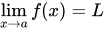


Proof: Given the limit above, there exists in particular a such that whenever , for some such that . Hence
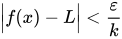


- .

Sum Rule for Limits
- Suppose that and . Then,
- }}.

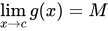
![{\displaystyle \lim _{x\to c}{\Big [}f(x)+g(x){\Big ]}=\lim _{x\to c}f(x)+\lim _{x\to c}g(x)=L+M}](https://wikimedia.org/api/rest_v1/media/math/render/svg/63558973f7dd0b0f40d8b5ec75c0069be55cbfd5)
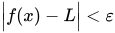
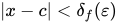
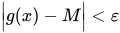
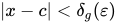
Proof: Since we are given that and , there must be functions, call them and , such that for all , whenever , and whenever .
Adding the two inequalities gives . By the triangle inequality we have , so we have whenever and . Let be the smaller of and . Then this satisfies the definition of a limit for having limit .







![{\displaystyle \lim _{x\to c}{\Big [}f(x)+g(x){\Big ]}}](https://wikimedia.org/api/rest_v1/media/math/render/svg/31c6d4f3cc8728d7e72b0f426657955d0cb1b383)

Difference Rule for Limits
- Suppose that and . Then
- }}
![{\displaystyle \lim _{x\to c}{\Big [}f(x)-g(x){\Big ]}=\lim _{x\to c}f(x)-\lim _{x\to c}g(x)=L-M}](https://wikimedia.org/api/rest_v1/media/math/render/svg/2245bcbbf23e62d18e911d97fb3374f21029d253)
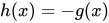
Proof: Define . By the Scalar Product Rule for Limits, . Then by the Sum Rule for Limits, .
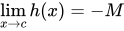
![{\displaystyle \lim _{x\to c}{\Big [}f(x)-g(x){\Big ]}=\lim _{x\to c}{\Big [}f(x)+h(x){\Big ]}=L-M}](https://wikimedia.org/api/rest_v1/media/math/render/svg/8928557687932b07789eb9ee3cb1b4b4125b8065)
Product Rule for Limits
- Suppose that and . Then
- }}
![{\displaystyle \lim _{x\to c}{\Big [}f(x)\cdot g(x){\Big ]}=\lim _{x\to c}f(x)\cdot \lim _{x\to c}g(x)=L\cdot M}](https://wikimedia.org/api/rest_v1/media/math/render/svg/8bb3a49fa4c6cf42d9198a0a3a589f0d37f801ef)
Proof: Let be any positive number. The assumptions imply the existence of the positive numbers such that

- when
- Failed to parse (MathML with SVG or PNG fallback (recommended for modern browsers and accessibility tools): Invalid response ("Math extension cannot connect to Restbase.") from server "https://wikimedia.org/api/rest_v1/":): {\displaystyle (2)\qquad\Big|g(x)-M\Big|<\frac{\varepsilon}{2(1+|L|)}} when Failed to parse (MathML with SVG or PNG fallback (recommended for modern browsers and accessibility tools): Invalid response ("Math extension cannot connect to Restbase.") from server "https://wikimedia.org/api/rest_v1/":): {\displaystyle 0<|x-c|<\delta_2}
- Failed to parse (MathML with SVG or PNG fallback (recommended for modern browsers and accessibility tools): Invalid response ("Math extension cannot connect to Restbase.") from server "https://wikimedia.org/api/rest_v1/":): {\displaystyle (3)\qquad\Big|g(x)-M\Big|<1} when Failed to parse (MathML with SVG or PNG fallback (recommended for modern browsers and accessibility tools): Invalid response ("Math extension cannot connect to Restbase.") from server "https://wikimedia.org/api/rest_v1/":): {\displaystyle 0<|x-c|<\delta_3}


According to the condition (3) we see that
- Failed to parse (MathML with SVG or PNG fallback (recommended for modern browsers and accessibility tools): Invalid response ("Math extension cannot connect to Restbase.") from server "https://wikimedia.org/api/rest_v1/":): {\displaystyle \Big|g(x)\Big|=\bigg|g(x)-M+M\bigg|\le\Big|g(x)-M\Big|+|M|<1+|M|} when Failed to parse (MathML with SVG or PNG fallback (recommended for modern browsers and accessibility tools): Invalid response ("Math extension cannot connect to Restbase.") from server "https://wikimedia.org/api/rest_v1/":): {\displaystyle 0<|x-c|<\delta_3}
Supposing then that Failed to parse (MathML with SVG or PNG fallback (recommended for modern browsers and accessibility tools): Invalid response ("Math extension cannot connect to Restbase.") from server "https://wikimedia.org/api/rest_v1/":): {\displaystyle 0<|x-c|<\min\{\delta_1,\delta_2,\delta_3\}} and using (1) and (2) we obtain
- Failed to parse (MathML with SVG or PNG fallback (recommended for modern browsers and accessibility tools): Invalid response ("Math extension cannot connect to Restbase.") from server "https://wikimedia.org/api/rest_v1/":): {\displaystyle \begin{align}\bigg|f(x)g(x)-LM\bigg| &=\bigg|f(x)g(x)-Lg(x)+Lg(x)-LM\bigg|\\ &\le\bigg|f(x)g(x)-Lg(x)\bigg|+\bigg|Lg(x)-LM\bigg|\\ &=\Big|g(x)\Big|\cdot\Big|f(x)-L\Big|+|L|\cdot\Big|g(x)-M\Big|\\ &<(1+|M|)\frac{\varepsilon}{2(1+|M|)}+(1+|L|)\frac{\varepsilon}{2(1+|L|)}\\ &=\varepsilon \end{align}}
Quotient Rule for Limits
- Suppose that Failed to parse (MathML with SVG or PNG fallback (recommended for modern browsers and accessibility tools): Invalid response ("Math extension cannot connect to Restbase.") from server "https://wikimedia.org/api/rest_v1/":): {\displaystyle \lim_{x\to c}f(x)=L}
and Failed to parse (MathML with SVG or PNG fallback (recommended for modern browsers and accessibility tools): Invalid response ("Math extension cannot connect to Restbase.") from server "https://wikimedia.org/api/rest_v1/":): {\displaystyle \lim_{x\to c}g(x)=M}
and Failed to parse (MathML with SVG or PNG fallback (recommended for modern browsers and accessibility tools): Invalid response ("Math extension cannot connect to Restbase.") from server "https://wikimedia.org/api/rest_v1/":): {\displaystyle M\ne 0}
. Then
- Failed to parse (MathML with SVG or PNG fallback (recommended for modern browsers and accessibility tools): Invalid response ("Math extension cannot connect to Restbase.") from server "https://wikimedia.org/api/rest_v1/":): {\displaystyle \lim_{x\to c}\frac{f(x)}{g(x)}=\frac{\lim\limits_{x\to c}f(x)}{\lim\limits_{x\to c}g(x)}=\frac{L}{M}}
Proof: If we can show that Failed to parse (MathML with SVG or PNG fallback (recommended for modern browsers and accessibility tools): Invalid response ("Math extension cannot connect to Restbase.") from server "https://wikimedia.org/api/rest_v1/":): {\displaystyle \lim_{x\to c}\frac{1}{g(x)}=\frac{1}{M}} , then we can define a function, Failed to parse (MathML with SVG or PNG fallback (recommended for modern browsers and accessibility tools): Invalid response ("Math extension cannot connect to Restbase.") from server "https://wikimedia.org/api/rest_v1/":): {\displaystyle h(x)} as Failed to parse (MathML with SVG or PNG fallback (recommended for modern browsers and accessibility tools): Invalid response ("Math extension cannot connect to Restbase.") from server "https://wikimedia.org/api/rest_v1/":): {\displaystyle h(x)=\frac{1}{g(x)}} and appeal to the Product Rule for Limits to prove the theorem. So we just need to prove that Failed to parse (MathML with SVG or PNG fallback (recommended for modern browsers and accessibility tools): Invalid response ("Math extension cannot connect to Restbase.") from server "https://wikimedia.org/api/rest_v1/":): {\displaystyle \lim_{x\to c}\frac{1}{g(x)}=\frac{1}{M}} .
Let Failed to parse (MathML with SVG or PNG fallback (recommended for modern browsers and accessibility tools): Invalid response ("Math extension cannot connect to Restbase.") from server "https://wikimedia.org/api/rest_v1/":): {\displaystyle \varepsilon}
be any positive number. The assumptions imply the existence of the positive numbers Failed to parse (MathML with SVG or PNG fallback (recommended for modern browsers and accessibility tools): Invalid response ("Math extension cannot connect to Restbase.") from server "https://wikimedia.org/api/rest_v1/":): {\displaystyle \delta_1,\delta_2}
such that
- Failed to parse (MathML with SVG or PNG fallback (recommended for modern browsers and accessibility tools): Invalid response ("Math extension cannot connect to Restbase.") from server "https://wikimedia.org/api/rest_v1/":): {\displaystyle (1)\qquad\Big|g(x)-M\Big|<\frac{\varepsilon|M|^2}{2}} when Failed to parse (MathML with SVG or PNG fallback (recommended for modern browsers and accessibility tools): Invalid response ("Math extension cannot connect to Restbase.") from server "https://wikimedia.org/api/rest_v1/":): {\displaystyle 0<|x-c|<\delta_1}
- Failed to parse (MathML with SVG or PNG fallback (recommended for modern browsers and accessibility tools): Invalid response ("Math extension cannot connect to Restbase.") from server "https://wikimedia.org/api/rest_v1/":): {\displaystyle (2)\qquad\Big|g(x)-M\Big|<\frac{|M|}{2}} when Failed to parse (MathML with SVG or PNG fallback (recommended for modern browsers and accessibility tools): Invalid response ("Math extension cannot connect to Restbase.") from server "https://wikimedia.org/api/rest_v1/":): {\displaystyle 0<|x-c|<\delta_{2}}
According to the condition (2) we see that
- Failed to parse (MathML with SVG or PNG fallback (recommended for modern browsers and accessibility tools): Invalid response ("Math extension cannot connect to Restbase.") from server "https://wikimedia.org/api/rest_v1/":): {\displaystyle |M|=|M-g(x)+g(x)|\le|M-g(x)|+|g(x)|<\frac{|M|}{2}+|g(x)| }
so Failed to parse (MathML with SVG or PNG fallback (recommended for modern browsers and accessibility tools): Invalid response ("Math extension cannot connect to Restbase.") from server "https://wikimedia.org/api/rest_v1/":): {\displaystyle |g(x)|>\frac{|M|}{2} }
when Failed to parse (MathML with SVG or PNG fallback (recommended for modern browsers and accessibility tools): Invalid response ("Math extension cannot connect to Restbase.") from server "https://wikimedia.org/api/rest_v1/":): {\displaystyle 0<|x-c|<\delta_2}
which implies that
- Failed to parse (MathML with SVG or PNG fallback (recommended for modern browsers and accessibility tools): Invalid response ("Math extension cannot connect to Restbase.") from server "https://wikimedia.org/api/rest_v1/":): {\displaystyle (3)\qquad\left|\frac{1}{g(x)}\right|<\frac{2}{|M|}}
when Failed to parse (MathML with SVG or PNG fallback (recommended for modern browsers and accessibility tools): Invalid response ("Math extension cannot connect to Restbase.") from server "https://wikimedia.org/api/rest_v1/":): {\displaystyle 0<|x-c|<\delta_2}
Supposing then that Failed to parse (MathML with SVG or PNG fallback (recommended for modern browsers and accessibility tools): Invalid response ("Math extension cannot connect to Restbase.") from server "https://wikimedia.org/api/rest_v1/":): {\displaystyle 0<|x-c|<\min\{\delta_1,\delta_2\}} and using (1) and (3) we obtain
- Failed to parse (MathML with SVG or PNG fallback (recommended for modern browsers and accessibility tools): Invalid response ("Math extension cannot connect to Restbase.") from server "https://wikimedia.org/api/rest_v1/":): {\displaystyle \begin{align}\left|\frac{1}{g(x)}-\frac{1}{M}\right|&=\left|\frac{M-g(x)}{Mg(x)}\right|\\ &=\left|\frac{g(x)-M}{Mg(x)}\right|\\ &=\left|\frac{1}{g(x)}\right|\cdot\left|\frac{1}{M}\right|\cdot|g(x)-M|\\ &<\frac{2}{|M|}\cdot\frac{1}{|M|}\cdot|g(x)-M|\\ &<\frac{2}{|M|}\cdot\frac{1}{|M|}\cdot\frac{\varepsilon|M|^2}{2}\\ &=\varepsilon \end{align}}
Squeeze Theorem
- Suppose that Failed to parse (MathML with SVG or PNG fallback (recommended for modern browsers and accessibility tools): Invalid response ("Math extension cannot connect to Restbase.") from server "https://wikimedia.org/api/rest_v1/":): {\displaystyle g(x)\le f(x)\le h(x)} holds for all Failed to parse (MathML with SVG or PNG fallback (recommended for modern browsers and accessibility tools): Invalid response ("Math extension cannot connect to Restbase.") from server "https://wikimedia.org/api/rest_v1/":): {\displaystyle x} in some open interval containing Failed to parse (MathML with SVG or PNG fallback (recommended for modern browsers and accessibility tools): Invalid response ("Math extension cannot connect to Restbase.") from server "https://wikimedia.org/api/rest_v1/":): {\displaystyle c} , except possibly at Failed to parse (MathML with SVG or PNG fallback (recommended for modern browsers and accessibility tools): Invalid response ("Math extension cannot connect to Restbase.") from server "https://wikimedia.org/api/rest_v1/":): {\displaystyle x=c} itself. Suppose also that Failed to parse (MathML with SVG or PNG fallback (recommended for modern browsers and accessibility tools): Invalid response ("Math extension cannot connect to Restbase.") from server "https://wikimedia.org/api/rest_v1/":): {\displaystyle \lim_{x\to c}g(x)=\lim_{x\to c}h(x)=L} . Then also.
Proof: From the assumptions, we know that there exists a Failed to parse (MathML with SVG or PNG fallback (recommended for modern browsers and accessibility tools): Invalid response ("Math extension cannot connect to Restbase.") from server "https://wikimedia.org/api/rest_v1/":): {\displaystyle \delta}
such that Failed to parse (MathML with SVG or PNG fallback (recommended for modern browsers and accessibility tools): Invalid response ("Math extension cannot connect to Restbase.") from server "https://wikimedia.org/api/rest_v1/":): {\displaystyle \Big|g(x)-L\Big|<\varepsilon}
and Failed to parse (MathML with SVG or PNG fallback (recommended for modern browsers and accessibility tools): Invalid response ("Math extension cannot connect to Restbase.") from server "https://wikimedia.org/api/rest_v1/":): {\displaystyle \Big|h(x)-L\Big|<\varepsilon}
when Failed to parse (MathML with SVG or PNG fallback (recommended for modern browsers and accessibility tools): Invalid response ("Math extension cannot connect to Restbase.") from server "https://wikimedia.org/api/rest_v1/":): {\displaystyle 0<|x-c|<\delta}
.
These inequalities are equivalent to Failed to parse (MathML with SVG or PNG fallback (recommended for modern browsers and accessibility tools): Invalid response ("Math extension cannot connect to Restbase.") from server "https://wikimedia.org/api/rest_v1/":): {\displaystyle L-\varepsilon<g(x)<L+\varepsilon}
and Failed to parse (MathML with SVG or PNG fallback (recommended for modern browsers and accessibility tools): Invalid response ("Math extension cannot connect to Restbase.") from server "https://wikimedia.org/api/rest_v1/":): {\displaystyle L-\varepsilon<h(x)<L+\varepsilon}
when Failed to parse (MathML with SVG or PNG fallback (recommended for modern browsers and accessibility tools): Invalid response ("Math extension cannot connect to Restbase.") from server "https://wikimedia.org/api/rest_v1/":): {\displaystyle 0<|x-c|<\delta}
.
Using what we know about the relative ordering of Failed to parse (MathML with SVG or PNG fallback (recommended for modern browsers and accessibility tools): Invalid response ("Math extension cannot connect to Restbase.") from server "https://wikimedia.org/api/rest_v1/":): {\displaystyle f(x),g(x)}
, and Failed to parse (MathML with SVG or PNG fallback (recommended for modern browsers and accessibility tools): Invalid response ("Math extension cannot connect to Restbase.") from server "https://wikimedia.org/api/rest_v1/":): {\displaystyle h(x)}
, we have
- Failed to parse (MathML with SVG or PNG fallback (recommended for modern browsers and accessibility tools): Invalid response ("Math extension cannot connect to Restbase.") from server "https://wikimedia.org/api/rest_v1/":): {\displaystyle L-\varepsilon<g(x)\le f(x)\le h(x)<L+\varepsilon}
when Failed to parse (MathML with SVG or PNG fallback (recommended for modern browsers and accessibility tools): Invalid response ("Math extension cannot connect to Restbase.") from server "https://wikimedia.org/api/rest_v1/":): {\displaystyle 0<|x-c|<\delta}
.
Then
- Failed to parse (MathML with SVG or PNG fallback (recommended for modern browsers and accessibility tools): Invalid response ("Math extension cannot connect to Restbase.") from server "https://wikimedia.org/api/rest_v1/":): {\displaystyle -\varepsilon<f(x)-L<\varepsilon}
when Failed to parse (MathML with SVG or PNG fallback (recommended for modern browsers and accessibility tools): Invalid response ("Math extension cannot connect to Restbase.") from server "https://wikimedia.org/api/rest_v1/":): {\displaystyle 0<|x-c|<\delta}
.
So
- Failed to parse (MathML with SVG or PNG fallback (recommended for modern browsers and accessibility tools): Invalid response ("Math extension cannot connect to Restbase.") from server "https://wikimedia.org/api/rest_v1/":): {\displaystyle \Big|f(x)-L\Big|<\varepsilon} when Failed to parse (MathML with SVG or PNG fallback (recommended for modern browsers and accessibility tools): Invalid response ("Math extension cannot connect to Restbase.") from server "https://wikimedia.org/api/rest_v1/":): {\displaystyle 0<|x-c|<\delta} .
Resources
- The Limit Laws PowerPoint file created by Dr. Sara Shirinkam, UTSA.
- Properties of Limits by The Organic Chemistry Tutor
- Limit Laws to Evaluate a Limit , Example 1 by patrickJMT
- Limit Laws to Evaluate a Limit , Example 2 by patrickJMT
- Limit Laws to Evaluate a Limit , Example 3 by patrickJMT

