Arc Length
We can deduce that the length of a curve with parametric equations Failed to parse (MathML with SVG or PNG fallback (recommended for modern browsers and accessibility tools): Invalid response ("Math extension cannot connect to Restbase.") from server "https://wikimedia.org/api/rest_v1/":): {\displaystyle \begin{cases} x=f(t) \\ y=g(t) \end{cases} } , Failed to parse (MathML with SVG or PNG fallback (recommended for modern browsers and accessibility tools): Invalid response ("Math extension cannot connect to Restbase.") from server "https://wikimedia.org/api/rest_v1/":): {\displaystyle a\le t\le b } should be:
Failed to parse (MathML with SVG or PNG fallback (recommended for modern browsers and accessibility tools): Invalid response ("Math extension cannot connect to Restbase.") from server "https://wikimedia.org/api/rest_v1/":): {\displaystyle L=\int_a^b\sqrt{\biggl(\frac{dx}{dt}\biggr)^2+\biggl(\frac{dy}{dt}\biggr)^2}dt }
Since vector functions are fundamentally parametric equations with directions, we can utilize the formula above into the length of a space curve.
Arc length of a space curve
If the curve has the vector equation Failed to parse (MathML with SVG or PNG fallback (recommended for modern browsers and accessibility tools): Invalid response ("Math extension cannot connect to Restbase.") from server "https://wikimedia.org/api/rest_v1/":): {\displaystyle \mathbf{r}(t)=\langle f(t),g(t),h(t)\rangle,a\le t\le b} , or, equivalently, the parametric equations Failed to parse (MathML with SVG or PNG fallback (recommended for modern browsers and accessibility tools): Invalid response ("Math extension cannot connect to Restbase.") from server "https://wikimedia.org/api/rest_v1/":): {\displaystyle x=f(t),y=g(t),z=h(t)} , where are continuous, then the length of the curve from to is:


- }}
![{\displaystyle L=\int _{a}^{b}{\sqrt {[f'(t)]^{2}+[g'(t)]^{2}+[h'(t)]^{2}}}dt=\int _{a}^{b}{\sqrt {{\biggl (}{\frac {dx}{dt}}{\biggr )}^{2}+{\biggl (}{\frac {dy}{dt}}{\biggr )}^{2}+{\biggl (}{\frac {dx}{dz}}{\biggr )}^{2}}}dt}](https://wikimedia.org/api/rest_v1/media/math/render/svg/80fd4bf2e740ece118f4071bddb2b13995fc56d5)
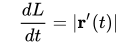
For those who prefer simplicity, the formula can be rewritten into:
or

Example Problem
Find the circumference of the circle given by the parametric equations , with Failed to parse (MathML with SVG or PNG fallback (recommended for modern browsers and accessibility tools): Invalid response ("Math extension cannot connect to Restbase.") from server "https://wikimedia.org/api/rest_v1/":): {\displaystyle t\in[0,2\pi]} .

- Failed to parse (MathML with SVG or PNG fallback (recommended for modern browsers and accessibility tools): Invalid response ("Math extension cannot connect to Restbase.") from server "https://wikimedia.org/api/rest_v1/":): {\displaystyle \begin{align}s&=\int\limits_0^{2\pi}\sqrt{\left(\tfrac{d}{dt}\big(R\cos(t)\big)\right)^2+\left(\tfrac{d}{dt}\big(R\sin(t)\big)\right)^2}dt\\ &=\int\limits_0^{2\pi}\sqrt{\big(-R\sin(t)\big)^2+\big(R\cos(t)\big)^2}dt\\ &=\int\limits_0^{2\pi}\sqrt{R^2\big(\sin^2(t)+\cos^2(t)\big)}dt\\ &=\int\limits_0^{2\pi}Rdt\\ &=R\cdot t\Big|_0^{2\pi}\\ &=\mathbf{2\pi R}\end{align}}
Resources
- Arc Length and Curvature, OpenStax

