Quadratic Functions
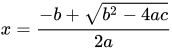
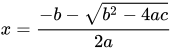
A Quadratic function is a polynomial where the highest power is two. The basic form of this function is: F(X) = ax² + bx + c. Where, ax² is the quadratic term, bx is the linear term and c is the independent term or "constant", which does not depend on the variable, x. The letters a and b are called "coefficients", a being the "leading coefficient". The standard form is F(X) = ax² + bx + c. The x-intercepts of the function are:
Failed to parse (MathML with SVG or PNG fallback (recommended for modern browsers and accessibility tools): Invalid response ("Math extension cannot connect to Restbase.") from server "https://wikimedia.org/api/rest_v1/":): {\displaystyle x = \frac{-b + \sqrt{b^2 - 4ac}}{ 2a} } OR Failed to parse (MathML with SVG or PNG fallback (recommended for modern browsers and accessibility tools): Invalid response ("Math extension cannot connect to Restbase.") from server "https://wikimedia.org/api/rest_v1/":): {\displaystyle x = \frac{-b - \sqrt{b^2 - 4ac}}{2a} }
The independent term is also the y-coordinate of the point of intersection with the y-axis (when X=0, F(X)=C).
A quadratic function has a "vertex" or "turning point", which is the point where the function has either a maximum or minimum value. If a is greater than zero, then there will be a minimum and the curve will be concave. If a is less than zero, then there will be a maximum and the curve will be convex. If a = 0, then we have a linear function rather than a quadratic function.The x-coordinate of the vertex is Failed to parse (MathML with SVG or PNG fallback (recommended for modern browsers and accessibility tools): Invalid response ("Math extension cannot connect to Restbase.") from server "https://wikimedia.org/api/rest_v1/":): {\displaystyle x = -\frac{b}{2a} } The y-coordinate of the vertex is Failed to parse (MathML with SVG or PNG fallback (recommended for modern browsers and accessibility tools): Invalid response ("Math extension cannot connect to Restbase.") from server "https://wikimedia.org/api/rest_v1/":): {\displaystyle F(-\frac{b}{2a}) }
The general form of a quadratic equation is actually F(X) = ax² + bxy + cy² + dx + ey + f = 0, which can take many shapes including circles, ellipses and parabolas, but in most Western high schools, quadratic equation refers only to those of the form F(X) = ax² + bx + c, which forms a parabola.
Deriving the Quadratic Equation
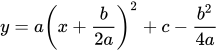
The solutions to the general-form quadratic function Failed to parse (MathML with SVG or PNG fallback (recommended for modern browsers and accessibility tools): Invalid response ("Math extension cannot connect to Restbase.") from server "https://wikimedia.org/api/rest_v1/":): {\displaystyle ax^2+bx+c=0} can be given by a simple equation called the quadratic equation. To solve this equation, recall the completed square form of the quadratic equation derived in the previous section:

- Failed to parse (MathML with SVG or PNG fallback (recommended for modern browsers and accessibility tools): Invalid response ("Math extension cannot connect to Restbase.") from server "https://wikimedia.org/api/rest_v1/":): {\displaystyle y=a\left(x+\frac{b}{2a}\right)^2+c-\frac{b^2}{4a}}
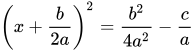
In this case, Failed to parse (MathML with SVG or PNG fallback (recommended for modern browsers and accessibility tools): Invalid response ("Math extension cannot connect to Restbase.") from server "https://wikimedia.org/api/rest_v1/":): {\displaystyle y = 0 } since we're looking for the root of this function. To solve, first subtract c and divide by a:
- Failed to parse (MathML with SVG or PNG fallback (recommended for modern browsers and accessibility tools): Invalid response ("Math extension cannot connect to Restbase.") from server "https://wikimedia.org/api/rest_v1/":): {\displaystyle \left(x+\frac{b}{2a}\right)^2=\frac{b^2}{4a^2}-\frac{c}{a}}
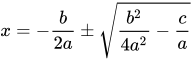
Take the (plus and minus) square root of both sides to obtain:
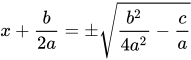
- Failed to parse (MathML with SVG or PNG fallback (recommended for modern browsers and accessibility tools): Invalid response ("Math extension cannot connect to Restbase.") from server "https://wikimedia.org/api/rest_v1/":): {\displaystyle x+\frac{b}{2a}=\pm\sqrt{\frac{b^2}{4a^2}-\frac{c}{a}}}
Subtracting Failed to parse (MathML with SVG or PNG fallback (recommended for modern browsers and accessibility tools): Invalid response ("Math extension cannot connect to Restbase.") from server "https://wikimedia.org/api/rest_v1/":): {\displaystyle \frac{b}{2a}} from both sides:
- Failed to parse (MathML with SVG or PNG fallback (recommended for modern browsers and accessibility tools): Invalid response ("Math extension cannot connect to Restbase.") from server "https://wikimedia.org/api/rest_v1/":): {\displaystyle x=-\frac{b}{2a}\pm\sqrt{\frac{b^2}{4a^2}-\frac{c}{a}}}
This is the solution but it's in an inconvenient form. Let's rationalize the denominator of the square root:

- Failed to parse (MathML with SVG or PNG fallback (recommended for modern browsers and accessibility tools): Invalid response ("Math extension cannot connect to Restbase.") from server "https://wikimedia.org/api/rest_v1/":): {\displaystyle \sqrt{\frac{b^2}{4a^2}-\frac{c}{a}}=\sqrt{\frac{b^2-4ac}{4a^2}}=\frac{\sqrt{b^2-4ac}}{2|a|}=\pm\frac{\sqrt{b^2-4ac}}{2a}}
Now, adding the fractions, the final version of the quadratic formula is:
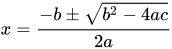
Failed to parse (MathML with SVG or PNG fallback (recommended for modern browsers and accessibility tools): Invalid response ("Math extension cannot connect to Restbase.") from server "https://wikimedia.org/api/rest_v1/":): {\displaystyle x=\frac{-b\pm\sqrt{b^2-4ac}}{2a}}
This formula is very useful, and it is suggested that the students memorize it as soon as they can.
Resources
- Quadratic Functions, Book Chapters
- Guided Notes