Logarithmic and Exponential Equations
Contents
Logarithms and Exponents
A logarithm is the inverse function of an exponent.
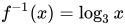
e.g. The inverse of the function Failed to parse (MathML with SVG or PNG fallback (recommended for modern browsers and accessibility tools): Invalid response ("Math extension cannot connect to Restbase.") from server "https://wikimedia.org/api/rest_v1/":): {\displaystyle f(x) = 3^x} is Failed to parse (MathML with SVG or PNG fallback (recommended for modern browsers and accessibility tools): Invalid response ("Math extension cannot connect to Restbase.") from server "https://wikimedia.org/api/rest_v1/":): {\displaystyle f^{-1}(x) = \log_3 x} .
In general, , given that Failed to parse (MathML with SVG or PNG fallback (recommended for modern browsers and accessibility tools): Invalid response ("Math extension cannot connect to Restbase.") from server "https://wikimedia.org/api/rest_v1/":): {\displaystyle b > 0} .
Laws of Logarithms
The laws of logarithms can be derived from the laws of exponentiation:
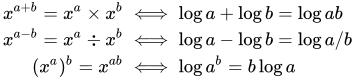
These laws apply to logarithms of any given base
Natural Logarithms
The natural logarithm is a logarithm with base , where is a constant such that the function is its own derivative.
The natural logarithm has a special symbol:
The graph exhibits exponential growth when and exponential decay when . The inverse graph is . Here is an interactive graph which shows the two functions as inverses of one another.
Solving Logarithmic and Exponential Equations
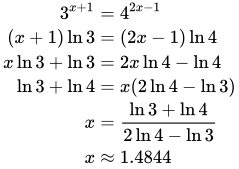
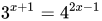
An exponential equation is an equation in which one or more of the terms is an exponential function. e.g. . Exponential equations can be solved with logarithms.
e.g. Solve
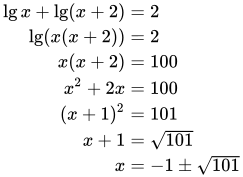
A logarithmic equation is an equation wherein one or more of the terms is a logarithm.
e.g. Solve Failed to parse (MathML with SVG or PNG fallback (recommended for modern browsers and accessibility tools): Invalid response ("Math extension cannot connect to Restbase.") from server "https://wikimedia.org/api/rest_v1/":): {\displaystyle \lg x + \lg (x+2) = 2} [note 1]

Converting Relationships to a Linear Form
In maths and science, it is easier to deal with linear relationships than non-linear relationships. Logarithms can be used to convert some non-linear relationships into linear relationships.
Exponential Relationships
An exponential relationship is of the form . If we take the natural logarithm of both sides, we get Failed to parse (MathML with SVG or PNG fallback (recommended for modern browsers and accessibility tools): Invalid response ("Math extension cannot connect to Restbase.") from server "https://wikimedia.org/api/rest_v1/":): {\displaystyle \ln y = \ln a + x \ln b} . We now have a linear relationship between Failed to parse (MathML with SVG or PNG fallback (recommended for modern browsers and accessibility tools): Invalid response ("Math extension cannot connect to Restbase.") from server "https://wikimedia.org/api/rest_v1/":): {\displaystyle \ln y} and Failed to parse (MathML with SVG or PNG fallback (recommended for modern browsers and accessibility tools): Invalid response ("Math extension cannot connect to Restbase.") from server "https://wikimedia.org/api/rest_v1/":): {\displaystyle x} .

e.g. The following data is related with an exponential relationship. Determine this exponential relationship, then convert it to linear form.
| x | y |
|---|---|
| 0 | 5 |
| 2 | 45 |
| 4 | 405 |
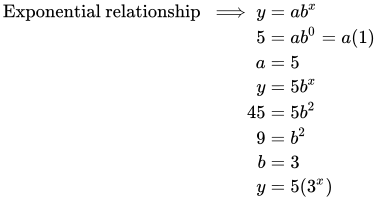
Failed to parse (MathML with SVG or PNG fallback (recommended for modern browsers and accessibility tools): Invalid response ("Math extension cannot connect to Restbase.") from server "https://wikimedia.org/api/rest_v1/":): {\displaystyle \begin{align} \text{Exponential relationship } \implies y &= ab^x \\ 5 &= ab^0 = a(1) \\ a &= 5 \\ y &= 5b^x \\ 45 &= 5b^2 \\ 9 &= b^2 \\ b &= 3 \\ y &= 5(3^x) \end{align}}
Now convert it to linear form by taking the natural logarithm of both sides:
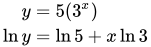
Failed to parse (MathML with SVG or PNG fallback (recommended for modern browsers and accessibility tools): Invalid response ("Math extension cannot connect to Restbase.") from server "https://wikimedia.org/api/rest_v1/":): {\displaystyle \begin{align} y &= 5(3^x) \\ \ln y &= \ln 5 + x \ln 3 \end{align}}
Power Relationships
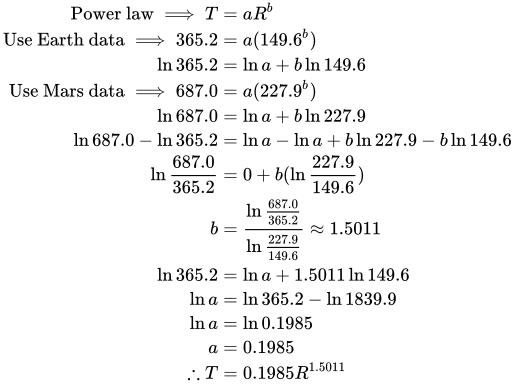
A power relationship is of the form Failed to parse (MathML with SVG or PNG fallback (recommended for modern browsers and accessibility tools): Invalid response ("Math extension cannot connect to Restbase.") from server "https://wikimedia.org/api/rest_v1/":): {\displaystyle y = ax^b} . If we take the natural logarithm of both sides, we get Failed to parse (MathML with SVG or PNG fallback (recommended for modern browsers and accessibility tools): Invalid response ("Math extension cannot connect to Restbase.") from server "https://wikimedia.org/api/rest_v1/":): {\displaystyle \ln y = \ln a + b \ln x} . This is a linear relationship between Failed to parse (MathML with SVG or PNG fallback (recommended for modern browsers and accessibility tools): Invalid response ("Math extension cannot connect to Restbase.") from server "https://wikimedia.org/api/rest_v1/":): {\displaystyle \ln y} and Failed to parse (MathML with SVG or PNG fallback (recommended for modern browsers and accessibility tools): Invalid response ("Math extension cannot connect to Restbase.") from server "https://wikimedia.org/api/rest_v1/":): {\displaystyle \ln x} .

e.g. The amount of time that a planet takes to travel around the sun (its orbital period) and its distance from the sun are related by a power law. Use the following data[1] to deduce this power law:
| Planet | Distance from Sun /106 km | Orbital Period /days |
|---|---|---|
| Earth | 149.6 | 365.2 |
| Mars | 227.9 | 687.0 |
| Jupiter | 778.6 | 4331 |
Failed to parse (MathML with SVG or PNG fallback (recommended for modern browsers and accessibility tools): Invalid response ("Math extension cannot connect to Restbase.") from server "https://wikimedia.org/api/rest_v1/":): {\displaystyle \begin{align} \text{Power law}\implies T &= aR^b \\ \text{Use Earth data}\implies 365.2 &= a(149.6^b) \\ \ln 365.2 &= \ln a + b \ln 149.6 \\ \text{Use Mars data}\implies 687.0 &= a(227.9^b) \\ \ln 687.0 &= \ln a + b \ln 227.9 \\ \ln 687.0 - \ln 365.2 &= \ln a - \ln a + b\ln 227.9 - b\ln 149.6 \\ \ln \frac{687.0}{365.2} &= 0 + b(\ln\frac{227.9}{149.6}) \\ b &= \frac{\ln \tfrac{687.0}{365.2}}{\ln\tfrac{227.9}{149.6}} \approx 1.5011 \\ \ln 365.2 &= \ln a + 1.5011 \ln 149.6 \\ \ln a &= \ln 365.2 - \ln 1839.9 \\ \ln a &= \ln 0.1985 \\ a &= 0.1985 \\ \therefore T &= 0.1985R^{1.5011} \end{align}}
Resources
- Logarithmic and Exponential Functions, Wikibooks: A-level Mathematics
- Logarithmic and Exponential Equations. Written notes created by Professor Esparza, UTSA.
Cite error: <ref> tags exist for a group named "note", but no corresponding <references group="note"/> tag was found, or a closing </ref> is missing
- ↑ Retrieved from NASA's Planetary Fact Sheet